
CIA Career Path in India & Abroad: Roles, Salary, Skills
Explore the CIA career path from fresher to CAE: job roles, CIA salary in India and abroad, skills to upgrade, and growth in Big 4 and GCCs.

Table of Contents
- 1. CIA Career Path in India and Abroad: Job Roles, Salary Growth, and Skills Required from Fresher to Senior-Level Positions
- 1.1. Before the Conversation Begins
- 2. Stage 1: Entry-Level Opportunities (0–3 Years)
- 3. Stage 2: Mid-Level Career Growth (3–7 Years)
- 4. Stage 3: Managerial and Specialized Positions (7–12 Years)
- 5. Stage 4: Senior Leadership and Top-Level Positions (12+ Years)
- 6. Six Career Paths After CIA
- 7. Skills Required to Move from One Role to the Next
- 8. Salary Progression: Certified Internal Auditor Salary by Experience
- 9. Future Scope of CIA Professionals
- 10. Additional Skills that Support CIA Career Growth
- 11. Closing the Conversation
- 11.1. Frequently Asked Questions
CIA Career Path in India and Abroad: Job Roles, Salary Growth, and Skills Required from Fresher to Senior-Level Positions
Before the Conversation Begins
It was a Saturday morning at an alumni mentoring meet, and the coffee corner was quieter than the main hall. Karthik, 23, a B.Com graduate working as an audit trainee, had just cleared CIA Part 1. He sat with a notebook open, a list of questions, and a slightly nervous look.
Across from him sat Meera Iyer, who had spent 17 years in internal audit. She began as an audit associate at a Big 4 firm, moved into a bank's internal audit team, and now heads internal audit at a Global Capability Center (GCC). She had mentored dozens of young auditors, and she liked questions better than speeches.
"Everyone tells me CIA is good," Karthik began. "Nobody tells me what happens after I pass. What does the CIA career path actually look like?"
Meera smiled and pushed his notebook closer. "Good. Let's map the entire CIA career path together, from your first desk to the chair of Chief Audit Executive. Start writing."

Stage 1: Entry-Level Opportunities (0–3 Years)

Let me start with the basics. What are the CIA job roles for a fresher, and what will I actually do all day?

Most people start as an Internal Audit Associate or Internal Auditor. You will walk through processes, test controls, collect evidence, document working papers, and help draft audit observations. It is detail work, and it builds the foundation for everything else.
And who hires at this level? Are there enough Certified Internal Auditor jobs in India for freshers, and what about CIA jobs in Big 4?
Three kinds of employers dominate:
- Big 4 and large audit or advisory firms: Internal audit and risk advisory teams. Structured training, wide exposure.
- Banks, NBFCs and insurers: Regulated sectors where internal audit is mandatory, so hiring is steady.
- GCCs and MNC shared services: Global audit methodology, good tools, and strong work-life balance.
What about the package? What is the CIA salary in India for a fresher?
Indicative base pay is roughly ₹4–10 lakh a year, and most metro offers land around ₹6–8 lakh. Big 4 analyst bands run about ₹8–10 lakh. Abroad, entry-level internal auditors in the US typically start around $50,000–$70,000. The CIA itself tends to add a premium over colleagues without a credential.
So, what moves me up from here?
Think of it as a chain. Here is yours:
- Current role: Internal Audit Associate / Internal Auditor
- Existing skills: Audit basics, Excel, documentation, accounting knowledge
- Skills to upgrade: Risk-based testing, sampling, clear report writing, basic data analytics
- Practical experience required: About 2–3 years, with 5 to 8 complete audit cycles under your belt
- Next role: Senior Internal Auditor
- Increased responsibilities: Leading fieldwork, reviewing juniors' working papers, handling auditee discussions
- Potential salary growth: Roughly ₹8–20 lakh, depending on city and employer
Stage 2: Mid-Level Career Growth (3–7 Years)
Say I become a Senior Internal Auditor. Is that when real CIA career growth begins?
It is when you stop being only a tester and start being a thinker. A senior auditor plans the scope of an audit, leads fieldwork, and writes the final report. You also begin to coach the associates who joined after you.
What should I be good at by then?
Four things matter most:
- Risk assessment: Knowing which areas deserve your time, and which do not.
- Specialized audits: SOX or internal controls over financial reporting (ICFR), procurement, treasury, or IT general controls.
- Data analytics: Excel at an advanced level, plus SQL, Power BI or an analytics tool such as ACL or Alteryx.
- Stakeholder handling: Disagreeing with a finance head politely and still keeping the relationship.
And how does the CIA salary grow at this stage?
In India, senior auditors and SOX/ICFR seniors typically earn about ₹8–20 lakh. At Big 4, a Senior Consultant sits near ₹10–14 lakh and a Manager near ₹18–24 lakh. Abroad, senior internal auditors in the US typically earn around $80,000 a year.
Give me the upgrade chain again, as I should plan it.
Here you go:
- Current role: Senior Internal Auditor
- Existing skills: Fieldwork, control testing, working-paper review
- Skills to upgrade: Audit planning, team leadership, analytics, risk-based reporting
- Practical experience required: 3–4 years in the senior role, including at least two audits you led end to end
- Next role: Internal Audit Manager or Assistant Manager
- Increased responsibilities: Owning the audit plan, managing a team, presenting to senior management
- Potential salary growth: Roughly ₹15–25 lakh in many banks, pharma and Big 4 teams
Stage 3: Managerial and Specialized Positions (7–12 Years)
People talk a lot about the internal audit manager career path. What changes when you become a manager?
Your job shifts from doing audits to running them. An Internal Audit Manager builds the annual audit plan, assigns teams, reviews every major report, manages the relationship with the audit committee, and tracks whether management closes its findings. You are judged on the quality of the whole team, not only your own work.
Is the manager role the only option at this stage?
No. This is where specialization pays off. Three common branches:
- IT Audit Manager: Cyber, cloud and application controls, often alongside CISA.
- Risk Manager: Owns the risk register and tests whether the business really manages its risks.
- Controls or Compliance Manager: Oversees internal financial controls, SOX or regulatory compliance programmes.
What do these roles pay?
For Internal Audit Managers in India, indicative ranges are ₹15–25 lakh in banks, pharma and Big 4 teams. Survey averages sit near ₹21 lakh, and BFSI AVP-level audit roles in Tier 1 banks and captives can reach about ₹46 lakh. In the US, managers commonly sit around $100,000–$140,000.
And the chain for this step?
- Current role: Internal Audit Manager
- Existing skills: Audit planning, team supervision, reporting
- Skills to upgrade: Strategic thinking, board communication, enterprise risk knowledge, change management
- Practical experience required: 4–5 years as a manager, ideally across two industries or one regulated sector plus one transformation project
- Next role: Senior Manager, Director or Head of Internal Audit
- Increased responsibilities: Overall audit strategy, budget, hiring, direct access to the audit committee
- Potential salary growth: Roughly ₹40–70 lakh and above in Tier 1 financial institutions and large GCCs

Stage 4: Senior Leadership and Top-Level Positions (12+ Years)
Now the big one. What does the Chief Audit Executive career path look like?
The CAE, or Head of Internal Audit, reports functionally to the board's audit committee and administratively to the CEO or CFO. You protect the organization's independence, decide what the board hears, and advise leadership on governance, risk, and control. Titles on the way include Senior Manager, Director, Vice President, then CAE.
Is it realistic for someone like me?
It is a long road, usually 15 years or more, and most CAEs add a second credential or an MBA. But it is realistic for people who keep building both technical depth and business judgement. The CIA is often a stated requirement because it signals that you know the profession's global standards.
What do the top roles pay?
In India, Director-level internal audit roles in Big 4 and GCC settings advertise around ₹40–50 lakh for 12–15 years of experience. In Tier 1 BFSI, VP roles average about ₹70 lakh and Directors about ₹1 crore. Heads of internal audits commonly reach ₹90 lakh to ₹1 crore and beyond. In the US, CAEs typically earn $160,000–$250,000 or more, with bonuses on top.
And the final chain?
- Current role: Director or Head of Internal Audit
- Existing skills: Audit strategy, team building, stakeholder management
- Skills to upgrade: Board governance, enterprise risk, technology and AI oversight, executive presence
- Practical experience required: 12–15+ years, with experience presenting to an audit committee
- Next role: Chief Audit Executive, or a broader Chief Risk or Governance role
- Increased responsibilities: Independent assurance for the whole organization, board reporting, quality of the entire audit function
- Potential salary growth: ₹90 lakh to ₹1 crore and beyond in India; $160,000–$250,000+ in the US
Six Career Paths After CIA
You mentioned risk and IT audit. Are there other career opportunities after CIA, or is it all internal audit?
Internal audit is the trunk of the tree, but there are six main branches. Here they are:
| Career Path | Typical Role Ladder | What It Suits |
|---|---|---|
| Internal Audit | Internal Audit Associate → Internal Auditor → Senior Internal Auditor → Internal Audit Manager → Head of Internal Audit or CAE | People who enjoy independent assurance and board exposure |
| Risk Management | Risk Analyst → Senior Risk Analyst → Risk Manager → Head of Risk Management | Analytical thinkers who like forward-looking work |
| Internal Controls and Compliance | Internal Controls Analyst → Internal Controls Specialist → Controls or Compliance Manager → Senior Risk and Compliance Leadership | Process-minded people, strong in SOX and regulation |
| IT Audit and Technology Risk | IT Audit Associate → IT Auditor → Senior IT Auditor → IT Audit Manager → Technology Risk Leadership | Those who like systems, cyber and cloud |
| Enterprise Risk Management (ERM) | Risk Analyst → Enterprise Risk Specialist → Enterprise Risk Manager → Head of Risk or related leadership | Big-picture strategists |
| Independent Consulting | Experienced Internal Auditor → Risk and Controls Consultant → Independent Consultant or Practice Leader | Seasoned professionals who want flexibility |
Can I switch between them without restarting my internal audit career path?
Absolutely, especially in the first eight years. Audit teaches you how the business works, and that knowledge transfers. I have seen internal auditors move into risk, controls, and even compliance leadership without starting over. Switching costs you very little before the manager level and more after it, so explore early.
Which one pays best?
Technology risk and BFSI-focused roles usually pay a premium, because the skills are scarce. Independent consulting can pay well too, but income is less predictable, so most people go that route only after 12 to 15 years of experience.
Skills Required to Move from One Role to the Next
If I had to put all of this on one page, what would I tell myself to build at each step?
Write this down, and keep it where you will see it:
| Move | Skills to Build | Proof You Are Ready |
|---|---|---|
| Associate → Senior Auditor | Risk-based testing, sampling, clear writing, Excel and basic analytics | You can run fieldwork without close supervision |
| Senior Auditor → Manager | Audit planning, team leadership, stakeholder negotiation, data analytics | You have led audits end to end and mentored juniors |
| Manager → Director or Head of Audit | Strategy, budgeting, board communication, enterprise risk | You have presented to an audit committee or senior leadership |
| Head of Audit → CAE | Governance, technology and AI oversight, executive presence, influence | Leadership trusts you with enterprise-wide assurance |
| Audit → Risk or Controls | Risk frameworks, control design, SOX or regulatory knowledge | You have worked on a risk or controls project |
| Audit → IT Audit | IT general controls, cyber and cloud basics, often CISA | You have supported at least one technology audit |
So, skills alone do not decide?
Never. Skills, visible experience, and a track record of results move together. Promotions go to people who can show what they did with their skills, not merely list them.
Salary Progression: Certified Internal Auditor Salary by Experience
Can you put the Certified Internal Auditor salary by experience, in India and abroad, in one table? I want to see the climb.
Of course. Remember these are indicative base salaries drawn from public salary surveys and job postings, and they move with city, employer and sector:
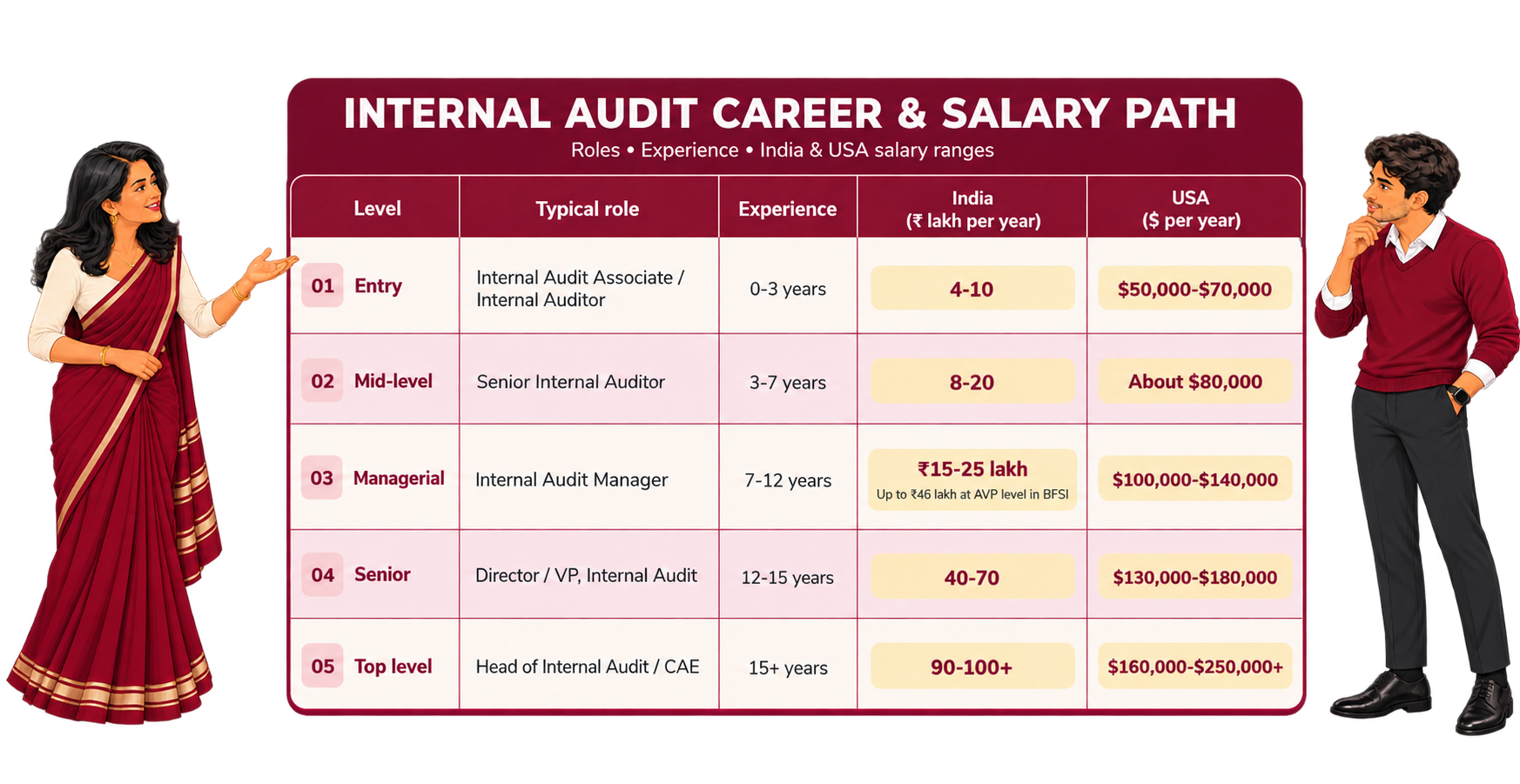
Why does the jump after manager level look so steep?
Because you start owning outcomes, not tasks. Bonuses, stock-based pay, and sector premiums also appear at that level. And the CIA matters most here, since senior hiring often treats it as a baseline for credibility with the board.
What about the city difference? I live in a metro, but will it matter?
It does. Mumbai, Bengaluru and Delhi NCR usually pay the most senior audit roles, and Hyderabad's GCC ecosystem is closing the gap fast. BFSI captives and Tier 1 MNC banks tend to pay more than manufacturing or mid-sized companies.
Future Scope of CIA Professionals
Last big question before my coffee gets cold. Is this a safe career for the next 10 to 15 years? Will AI replace auditors, and are CIA jobs abroad a realistic option?
AI will replace repetitive testing, not judgement. Boards want someone who can question assumptions, challenge management, and explain risk in plain language. That is exactly what a CIA is trained for, and the demand for that judgement is growing. Here is where I see the scope widening:
- GCCs in India: Global companies keep expanding audit, risk and compliance teams here, which is why Certified Internal Auditor jobs in India now appear regularly in job postings across Bengaluru, Hyderabad, Mumbai and Delhi NCR.
- Technology and AI assurance: Auditing algorithms, data privacy, cyber resilience and cloud controls is a new and well-paid frontier.
- Regulated sectors: Banks, insurers, NBFCs and asset managers need strong internal audit by regulation.
- ESG and sustainability assurance: Companies increasingly need independent checks on non-financial reporting.
- Fraud and forensic audit: Specialists here are consistently among the better paid.
- CIA jobs abroad: The CIA is a global credential, so it supports moves to markets such as the US, UK, Middle East and Singapore, subject to local work-permit rules.
So, the CIA is a passport, not a ticket to one single destination.
Exactly. It opens doors, and the career you build behind them is your own.
Additional Skills that Support CIA Career Growth
Beyond the CIA itself, what should I be learning on the side?
Think of these as multipliers:
- Data analytics: Advanced Excel, SQL, Power BI, or similar tools, so you can test full populations instead of small samples.
- Technology and AI awareness: Understanding how systems, automation and AI create new risks.
- Complementary credentials: CISA for IT audit, CRMA or risk certifications for risk roles, CA, CPA or an MBA for finance and senior leadership.
- Communication and report writing: Short, clear, fact-based reports that busy executives actually read.
- Business and industry knowledge: The more you understand banking, pharma or manufacturing, the better your insights.
- Leadership and influence: Persuading people who do not report to you.
- Ethics and professional skepticism: The quality your reputation will rest on.
Closing the Conversation
Karthik looked down at his notebook. Four stages, six paths, and a clear list of skills sat in his own handwriting. The nervousness was gone.
So, my plan is simple. Finish the CIA, build my first three years properly, pick a specialization by year five, and keep upgrading one skill every year.
That is a career plan. Most people never write one. Come back in a year and show me how far down this page you have travelled.
Karthik smiled, closed the notebook, and finished his coffee, ready for the long climb ahead.
Frequently Asked Questions
1. What is the CIA career path after clearing the exam?
Most CIAs start as Internal Audit Associates or Internal Auditors, then move to Senior Internal Auditor, Internal Audit Manager, Director or Head of Internal Audit, and finally Chief Audit Executive. Branches into risk, controls, IT audit and consulting are also common.
2. What is the CIA salary in India for freshers?
Entry-level roles typically pay about ₹4–10 lakh a year, with most metro offers around ₹6–8 lakh. Big 4 analyst bands run slightly higher, at roughly ₹8–10 lakh.
3. What is the Certified Internal Auditor salary by experience?
In India, indicative base pay rises from ₹4–10 lakh at entry level to ₹8–20 lakh at mid-level, ₹15–25 lakh at manager level, and ₹90 lakh to ₹1 crore and beyond at CAE level. Actual pay varies by city, employer and sector.
4. Are there CIA jobs in Big 4 firms?
Yes. Big 4 firms hire internal audit, risk advisory and controls teams, and many list CIA as a preferred qualification. Progression runs from Analyst to Senior Consultant, Manager and Senior Manager.
5. Can I find CIA jobs abroad?
The CIA is globally recognized, so it supports applications in markets such as the US, UK, Middle East and Singapore. You will still need to meet each country's work permit and hiring requirements.
6. How long does it take to become an Internal Audit Manager?
It commonly takes about 7 to 10 years of progressive experience, depending on the employer, your performance, and any additional credentials. Leading audits end to end speeds up the move.
7. What is the Chief Audit Executive career path?
The typical route is Senior Manager, Director or VP, then CAE, usually after 15 or more years. Board communication, enterprise risk knowledge, and a strong CIA-led audit background are the key requirements.
8. Can CIA holders move into risk, compliance or IT audit?
Yes. Many CIAs shift into risk management, internal controls, compliance, enterprise risk or IT audit, and technology risk. Adding a specialist credential such as CISA helps IT audit roles.
Planning to take CIA? Explore our CIA course