
CIA Exam Preparation Mistakes to Avoid
Avoid common CIA exam mistakes in your first attempt, from weak syllabus planning to poor mock practice and lack of audit application.
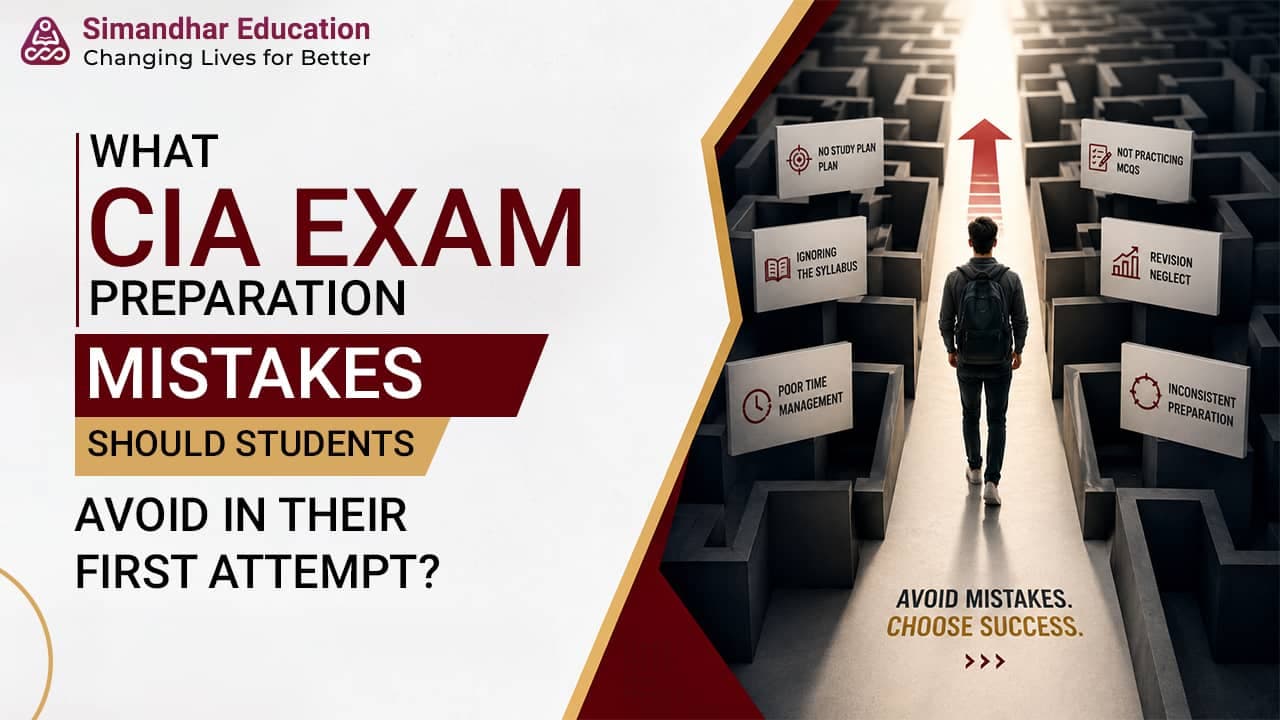
Table of Contents
- 1. CIA Exam Preparation Mistakes Students Should Avoid in Their First Attempt
- 2. What Is the CIA Exam and Why Does the First Attempt Matter?
- 3. Why Is Ignoring the Official CIA Syllabus a Big Mistake?
- 4. Why Should Students Not Treat CIA Like a Theory Exam?
- 5. Is Choosing the Wrong Exam Part First a Mistake?
- 6. Why Is Avoiding Mock Exams a Serious Preparation Mistake?
- 7. Why Should Students Avoid Studying Without Internal Audit Context?
- 8. Is Underestimating Part 3 a Common Mistake?
- 9. Why Is Exam-Day and Result Process Awareness Important?
- 10. How Does Simandhar Education Help Students Avoid These Mistakes?
- 11. What Should CIA Students Remember Before Their First Attempt?
- 12. FAQs
- 12.1. What is CIA full form?
- 12.2. How many parts are there in the CIA exam?
- 12.3. What is the biggest mistake students make in CIA preparation?
- 12.4. Can students take CIA exam parts in any order?
- 12.5. How does Simandhar Education help CIA students prepare?
CIA Exam Preparation Mistakes Students Should Avoid in Their First Attempt
Many students begin CIA preparation with one quiet hope: clear it on the first attempt.
That hope is completely natural. No student starts a professional exam thinking about failure. But CIA is not a college-style paper where last-minute revision and a few familiar topics are enough. It is a global internal audit certification, and it tests whether the candidate understands internal audit, risk, governance, controls, ethics, engagement planning, and the role of the internal audit function.
The difficult part is that many students do not fail because they are not capable.
They struggle because they prepare in the wrong way.
A student may study chapters but ignore the official syllabus. Another may watch classes but avoid mocks. Someone may memorize definitions but not understand how internal audit works in real situations. These mistakes look small in the beginning, but they become expensive on exam day.
What Is the CIA Exam and Why Does the First Attempt Matter?
CIA stands for Certified Internal Auditor. It is offered by The Institute of Internal Auditors and is recognized globally for internal audit professionals.
The CIA exam has three parts:
| Exam Part | Coverage Area |
|---|---|
| Part 1 | Internal Audit Fundamentals |
| Part 2 | Internal Audit Engagement |
| Part 3 | Internal Audit Function |
According to The IIA, Part 1 has 125 questions with a 150-minute time limit, while Part 2 and Part 3 each have 100 questions with a 120-minute time limit.
Candidates are not required to take the parts in a fixed order, but they must plan carefully because the CIA program has completion timelines and exam registration validity periods.
The first attempt matters because it teaches the student how serious the exam really is. A strong first-attempt strategy can save time, money, and confidence.
Why Is Ignoring the Official CIA Syllabus a Big Mistake?
One of the biggest mistakes students make is preparing from random material without checking the latest CIA syllabus.
The IIA publishes a detailed syllabus that defines exactly what candidates are expected to know. This syllabus is not just a formality—it is the foundation of the exam.
Students who rely on outdated notes, incomplete summaries, or random internet resources may feel productive, but they may not be covering the right topics.
This becomes especially risky because internal audit continues to evolve with changes in governance expectations, risk management practices, technology, and professional standards.
A serious CIA student should begin with the official syllabus, not shortcuts.
Why Should Students Not Treat CIA Like a Theory Exam?
CIA is not only about remembering definitions.
This is where many first-time candidates struggle. They memorize terminology and concepts but fail to understand how internal audit principles work in real situations.
For example:
- Knowing the definition of risk is not enough.
- Understanding how risk influences audit planning is essential.
- Knowing what internal control means is not enough.
- Understanding how auditors evaluate control effectiveness is critical.
CIA preparation becomes more effective when students stop asking, “What is the definition?” and start asking, “How would this apply inside an organization?”
That shift in thinking makes a significant difference.
Is Choosing the Wrong Exam Part First a Mistake?
It can be.
The IIA allows candidates to choose the order in which they take the exam parts. While this flexibility is useful, it can also create confusion.
Some students select a part because a friend recommended it. Others choose the section that appears easiest.
Neither approach is ideal.
| Approach | Potential Result |
|---|---|
| Choosing based on peer advice | May not suit individual strengths |
| Selecting the easiest-sounding part | Can create foundational gaps |
| Planning based on experience and strengths | More effective progression |
| Following a structured study plan | Higher confidence and consistency |
A candidate with little audit exposure may benefit from building fundamentals first, while someone already working in internal audit may approach the exam differently.
The right sequence depends on background, confidence, and preparation strategy.
Simandhar Education helps students understand all three parts and create a preparation plan that aligns with their profile.
Why Is Avoiding Mock Exams a Serious Preparation Mistake?
Mock exams are uncomfortable, which is exactly why many students avoid them.
Unfortunately, avoiding mocks is one of the quickest ways to enter the exam underprepared.
A student may feel confident after reading notes or attending lectures. The real question is whether they can answer exam-style questions correctly under time pressure.
Mock exams help identify:
- Conceptual weaknesses
- Time-management issues
- Question interpretation errors
- Decision-making mistakes
- Overthinking between answer choices
This is especially important because CIA questions often test judgment and application rather than simple recall.
Students who consistently practice mocks usually understand the exam far better than students who only revise notes.
Why Should Students Avoid Studying Without Internal Audit Context?
Many candidates study CIA as a collection of separate topics.
Risk management becomes one chapter. Governance becomes another. Controls become another.
But internal audit does not work that way in practice.
All these concepts are interconnected.
| Topic | Connection to Internal Audit |
|---|---|
| Risk Management | Supports audit planning and prioritization |
| Governance | Provides oversight and accountability |
| Internal Controls | Protect organizational objectives |
| Audit Engagements | Evaluate risks and controls |
| Reporting | Communicates findings and recommendations |
Internal audit exists to help organizations improve governance, risk management, and control processes.
Students who understand this broader purpose tend to perform better than those who only memorize isolated concepts.
Is Underestimating Part 3 a Common Mistake?
Yes, many students underestimate Part 3.
Part 3 focuses on the Internal Audit Function and often requires a broader perspective than the earlier sections.
Students must understand topics such as:
- Governance
- Strategy
- Quality management
- Performance measurement
- Internal audit leadership
Part 3 is not simply an extension of the previous parts. It requires candidates to think at the organizational and functional level.
It deserves the same level of preparation and seriousness as Part 1 and Part 2.
Why Is Exam-Day and Result Process Awareness Important?
Another common mistake is ignoring exam logistics.
Students often focus entirely on content and forget the administrative side of the certification process.
According to The IIA, candidates must:
- Apply through CCMS
- Register for exam parts
- Schedule examination appointments
- Follow exam security procedures
- Meet identification requirements
From April 1, 2026, candidates receive a single official exam result within three weeks of the exam date.
Understanding registration timelines, exam-day requirements, and result procedures helps reduce avoidable stress.
Preparation includes both content readiness and process readiness.
How Does Simandhar Education Help Students Avoid These Mistakes?
Simandhar Education's CIA program is designed for students who prefer structured guidance throughout the certification journey.
The program includes:
- Live and recorded lectures
- Study material
- IIA registration and fee support
- Mentor guidance
- Study groups
- Placement assistance
- Alumni access
- AI Sripal support
- Pathway to Big 4 access in selected packages
- Success coaching sessions
This support system helps students build confidence, follow a structured plan, identify weak areas, and connect CIA preparation with long-term career goals.
What Should CIA Students Remember Before Their First Attempt?
The first attempt is not only about hard work.
It is about preparing intelligently.
Students should avoid:
- Outdated study materials
- Skipping mock exams
- Random exam-part selection
- Theory-only learning
- Last-minute preparation
- Shortcuts
CIA preparation requires discipline, but it also requires direction.
The exam is designed to test whether candidates can think like internal audit professionals.
The strongest preparation combines syllabus mastery, practical understanding, consistent practice, and thoughtful review.
Students interested in structured CIA preparation can explore Simandhar Education's CIA program for coaching, mentoring, AI Sripal support, exam guidance, and career-focused development.
FAQs
1. What is CIA full form?
CIA stands for Certified Internal Auditor. It is a globally recognized internal audit certification offered by The Institute of Internal Auditors.
2. How many parts are there in the CIA exam?
The CIA exam consists of three parts: Internal Audit Fundamentals, Internal Audit Engagement, and Internal Audit Function.
3. What is the biggest mistake students make in CIA preparation?
The most common mistake is treating CIA as a memory-based theory exam rather than an application-focused professional certification.
4. Can students take CIA exam parts in any order?
Yes. The IIA does not require a fixed order, allowing candidates to choose a sequence based on their background and preparation strategy.
5. How does Simandhar Education help CIA students prepare?
Simandhar supports students through coaching, mentoring, study material, registration guidance, AI Sripal support, study groups, mock preparation, and career-focused assistance.
Planning to take CIA? Explore our CIA course