
How to Choose Between CMA, CIA, and EA After B.Com | Career Guide 2026
Confused between CMA, CIA, and EA after B.Com? Compare scope, careers, duration, ROI, and choose the right professional course for your future.

Table of Contents
How to Choose Between CMA, CIA, and EA After B.Com
Completing a B.Com degree is an important milestone, but it is rarely the final step in building a successful accounting or finance career. Most graduates soon realize that long-term growth depends on adding the right professional qualification to their profile.
Among the most popular options for B.Com graduates today are CMA, CIA, and EA. While all three are globally recognized, they lead to very different career outcomes. Understanding these differences is essential before making a decision.
This guide explains how to choose between CMA, CIA, and EA after B.Com by looking at career direction, industry relevance, time commitment, and future scope.
Why Choosing the Right Course After B.Com Is Critical
A B.Com degree provides academic grounding, but on its own it often limits opportunities to junior or support roles. Employers increasingly look for candidates who bring specialized knowledge and role readiness.
Professional certifications demonstrate focused expertise, practical skillsets, and global exposure. However, selecting a course without clarity can slow career progress rather than accelerate it.
The most important factor is alignment. Your certification should match your interests, strengths, and the type of work you want to build your career around.
An Overview of CMA, CIA, and EA
What CMA Prepares You For
The Certified Management Accountant qualification is centered on business finance and decision-making. It emphasizes cost management, financial planning, budgeting, performance analysis, and strategic thinking.
CMA is designed for those who want to work closely with business leadership and contribute to financial strategy rather than compliance alone.
What CIA Focuses On
The Certified Internal Auditor qualification is built around internal audit, enterprise risk management, internal controls, and governance frameworks.
It is well suited for individuals who prefer analytical roles that involve evaluating systems, identifying risks, and strengthening organizational processes.
What EA Specializes In
The Enrolled Agent credential is focused entirely on US taxation. It authorizes professionals to represent taxpayers before the Internal Revenue Service and work on tax filings, compliance, and advisory matters.
EA is ideal for those who want a career dedicated to taxation rather than broader finance or audit functions.
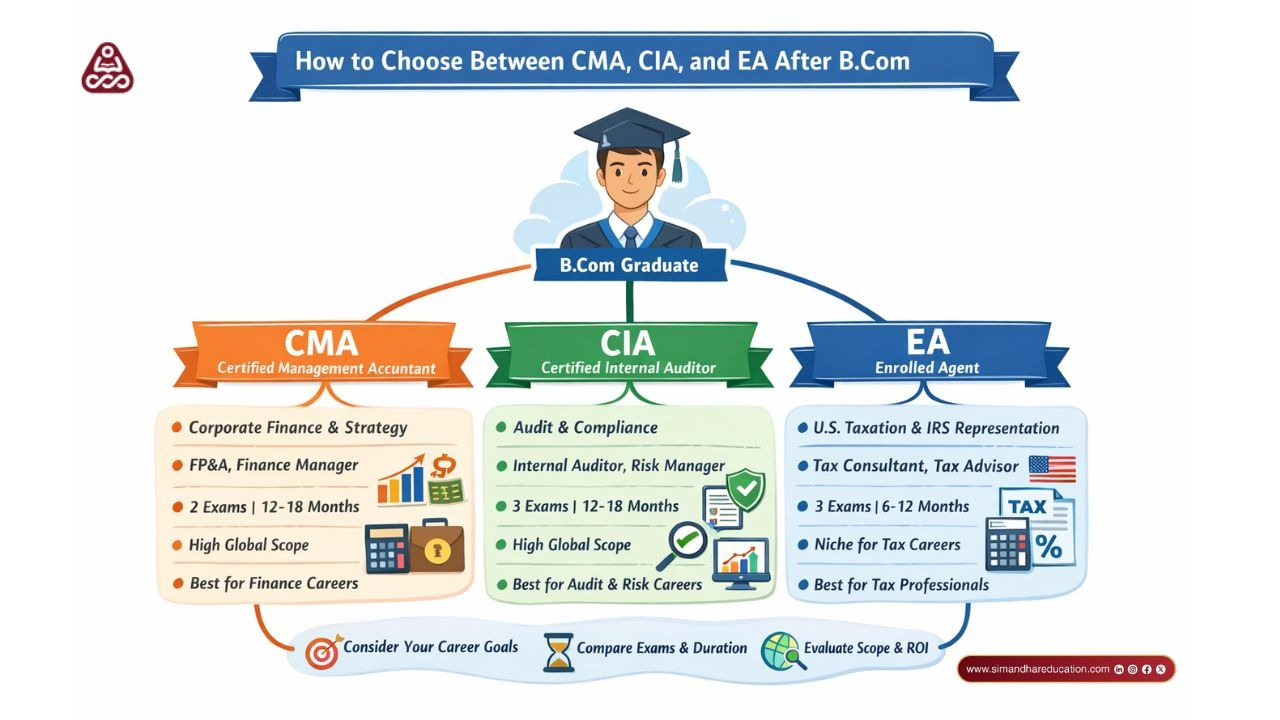
CMA vs CIA vs EA: Career Comparison
| Area of Comparison | CMA | CIA | EA |
|---|---|---|---|
| Primary Domain | Corporate finance and strategy | Internal audit and risk | US taxation |
| Suitable Career Path | Finance leadership and management | Audit, risk, and compliance | Tax consulting and compliance |
| Recognition Level | Strong global recognition | Strong global recognition | Primarily US-focused |
| Typical Roles | FP&A analyst, finance manager, controller | Internal auditor, risk analyst | Tax consultant, tax specialist |
| Exam Structure | 2 exams | 3 exams | 3 exams |
| Completion Time | Around 12–18 months | Around 12–18 months | Around 6–12 months |
| Best Suited For | Finance-driven profiles | Audit-oriented profiles | Tax-focused profiles |
How to Decide Based on Your Career Direction
If Your Goal Is Corporate Finance or Leadership Roles
If you are interested in budgeting, forecasting, financial analysis, and long-term business decision-making, CMA offers the most direct pathway. It prepares you for roles that interact closely with senior management and business strategy.
If You Prefer Audit, Risk, and Control Functions
If you are drawn to evaluating systems, ensuring compliance, and managing organizational risk, CIA aligns better with your interests. It is especially relevant for roles within large corporations and regulated industries.
If You Want to Build a Career in Taxation
If tax laws, filings, and advisory services appeal to you, EA is the most appropriate choice. It allows you to specialize deeply in US taxation and work with global tax clients.
Career Scope of CMA, CIA, and EA in India
CMA Opportunities in India
CMA-qualified professionals are widely employed in multinational corporations, consulting firms, and shared service centers. Their skills are valued in finance planning, business analysis, and strategic roles.
CIA Opportunities in India
CIA holders are in demand for internal audit, risk management, and governance roles. Large corporates, banks, and compliance-driven industries actively seek professionals with CIA credentials.
EA Opportunities in India
EA has growing relevance in US tax outsourcing and global accounting firms serving American clients. While the scope is more niche, it can be rewarding for those committed to tax careers.
Time, Cost, and Long-Term Value
Time Investment
EA is the quickest to complete, making it attractive for those who want faster entry into specialized roles. CMA and CIA require more sustained effort but offer broader career mobility.
Long-Term Career Value
CMA and CIA generally provide stronger long-term flexibility and leadership opportunities. EA offers excellent returns within taxation but has a narrower scope compared to the other two.
Common Errors Students Make When Choosing a Course
Many B.Com graduates select certifications based on popularity or peer choices rather than personal fit. Others focus only on short-term completion time and ignore long-term role satisfaction.
The better approach is to think about the kind of work you want to do daily, five or ten years from now, and choose accordingly.
Final Conclusion: Which Course Should You Choose After B.Com?
There is no universally best option after B.Com.
CMA is ideal for those targeting finance and business leadership roles.
CIA is best suited for audit, risk, and compliance careers.
EA is the right choice for professionals committed to taxation.
The most successful careers are built when certification choices are driven by clarity, not comparison. When your qualification matches your career intent, growth becomes consistent and predictable.
FREQUENTLY ASKED QUESTIONS
1. Which is better after B.Com: CMA, CIA, or EA?
There is no single best option after B.Com. CMA is best for corporate finance and management roles, CIA suits audit and risk careers, and EA is ideal for taxation-focused professionals. The right choice depends on your career goals.
2. Can I pursue CMA, CIA, or EA immediately after B.Com?
Yes, B.Com graduates are eligible to pursue CMA, CIA, and EA. Many students start these certifications either in their final year of B.Com or immediately after graduation.
3. Which course has better scope in India after B.Com?
CMA and CIA generally offer broader career scope in India across MNCs, consulting firms, and large corporates. EA has growing but more niche demand, mainly in US tax and outsourcing roles.
4. How long does it take to complete CMA, CIA, and EA?
EA can typically be completed in 6–12 months. CMA and CIA usually take 12–18 months, depending on preparation consistency and exam attempts.
5. How do I decide which course suits me best after B.Com?
You should decide based on the type of work you want to do long term. If you prefer finance and strategy, choose CMA. If you like audit and compliance, choose CIA. If taxation interests you most, EA is the right fit.