
Is CIA Still Relevant in an AI-Powered Finance Industry?
Is CIA certification worth it in 2026? Explore how AI is transforming internal audit, the future of CIA certification, emerging AI skills, career opportunities, and why Certified Internal Auditors remain relevant.
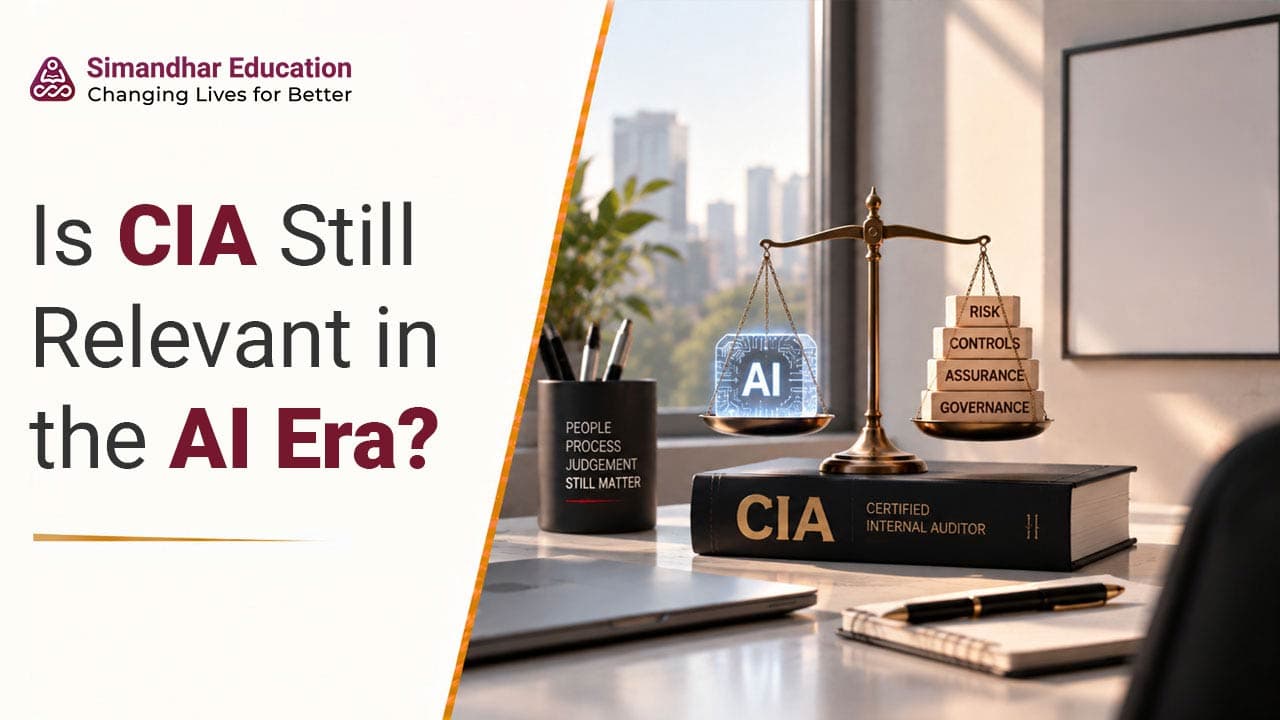
Table of Contents
- 1. Is CIA Still Relevant in an AI-Powered Finance Industry?
- 2. How Is AI Changing Internal Audit?
- 3. Will AI Replace Internal Auditors?
- 4. CIA Certification and Artificial Intelligence: Why the Combination Matters
- 5. Internal Auditor Skills for the AI Era
- 6. CIA Career Opportunities in AI-Powered Finance
- 7. CIA vs CISA for AI Audit: Which Is Better?
- 8. Is CIA Certification Worth It in 2026?
- 9. How Simandhar Education Can Help
- 10. Final Thoughts
- 11. Frequently Asked Questions
- 12. Is CIA certification worth it in 2026?
- 13. Will AI replace CIA professionals?
- 14. How is AI used in internal audit?
- 15. What AI skills should internal auditors learn?
- 16. Is CIA useful for AI governance roles?
- 17. Which is better, CIA or CISA for AI audit?
- 18. What is the future of CIA certification?
Is CIA Still Relevant in an AI-Powered Finance Industry?
Artificial intelligence is rapidly changing the finance industry. Tasks that once required hours of manual checking can now be completed using automation, advanced analytics, and generative AI. Internal audit is no exception.
This transformation naturally raises an important question for students and finance professionals: Is CIA certification worth it in 2026, or will AI eventually replace internal auditors?
The short answer is that the CIA certification remains relevant in an AI-powered finance industry, but the role of the internal auditor is evolving. AI can process data and identify unusual patterns at remarkable speed, but organizations still need professionals who can evaluate risk, understand controls, question assumptions, interpret findings, and exercise professional judgment.
For aspiring Certified Internal Auditors, the opportunity lies in combining traditional audit expertise with emerging technology and AI capabilities.
How Is AI Changing Internal Audit?
AI in internal audit is changing how audit teams approach testing, monitoring, risk assessment, and reporting. Instead of relying primarily on samples, auditors can increasingly use technology to examine much larger volumes of transactions.
An AI-powered internal audit function may use technology for activities such as:
- Analysing large financial and operational datasets
- Identifying unusual transactions and patterns
- Supporting fraud and anomaly detection
- Automating repetitive testing procedures
- Monitoring certain controls continuously
- Summarising documents and policies
- Supporting risk identification and audit planning
Generative AI in internal audit can also help professionals organise information, create preliminary summaries, analyse documents, and improve productivity.
However, identifying an anomaly is not the same as understanding why it happened.
An experienced auditor still needs to determine whether an issue represents a genuine control weakness, operational problem, compliance concern, data-quality issue, or simply an unusual but legitimate transaction.
That distinction is where human expertise remains critical.
Will AI Replace Internal Auditors?
The question “Will AI replace internal auditors?” is better reframed as: Which parts of internal auditing will AI automate?
Repetitive and highly structured audit activities are likely to become increasingly automated. However, internal auditing involves much more than checking transactions.
Auditors need to communicate with stakeholders, understand business processes, assess risks, evaluate management responses, investigate unusual situations, and make professional judgments.
These responsibilities are difficult to automate completely.
Similarly, professionals wondering “Will AI replace CIA professionals?” should understand that the CIA role itself is changing. A professional who relies entirely on traditional manual audit methods may face greater disruption than someone who understands both internal auditing and emerging technology.
In other words, AI is more likely to change the auditor's toolkit than eliminate the auditor.
CIA Certification and Artificial Intelligence: Why the Combination Matters
The growing relationship between CIA certification and artificial intelligence can create new opportunities for finance professionals.
Organizations adopting AI need assurance around questions such as:
- Is the AI system operating within appropriate governance frameworks?
- Who is accountable for AI-generated decisions?
- Is sensitive information appropriately protected?
- Are AI outputs being reviewed?
- Are models introducing unexpected risks?
- Are appropriate controls established around data and system access?
This creates growing relevance for AI governance internal audit, AI risk management for internal auditors, and AI controls and internal audit.
Internal auditors can help organizations evaluate whether AI is being adopted responsibly and whether governance structures and controls are keeping pace with technological change.
That makes the CIA certification in AI-powered finance potentially valuable for professionals who want to work at the intersection of finance, risk, governance, compliance, controls, and technology.
Internal Auditor Skills for the AI Era
Earning a certification alone may not be enough to build a future-ready career. Professionals should combine core internal audit knowledge with modern digital capabilities.
Important internal auditor skills for AI can include:
- Data analytics: Auditors increasingly need to interpret large datasets and understand what the data is actually telling them.
- AI literacy: You do not necessarily need to become an AI engineer, but understanding AI capabilities, limitations, risks, and governance principles is becoming increasingly useful.
- Cybersecurity awareness: Technology risks and financial risks are becoming increasingly interconnected.
- Risk and control assessment: Auditors must understand how new technologies change an organization's risk profile.
- Professional scepticism: AI-generated information should not automatically be treated as correct. Auditors need to challenge assumptions and validate evidence.
- Communication skills: Explaining complex findings to management and stakeholders remains fundamentally human.
Developing these internal audit AI skills alongside CIA knowledge can help professionals become more adaptable as audit functions evolve.
CIA Career Opportunities in AI-Powered Finance
The future of CIA certification is likely to involve roles extending beyond traditional financial auditing.
Potential CIA career opportunities in AI may exist across:
- Internal audit
- Risk advisory
- Governance, risk and compliance (GRC)
- Enterprise risk management
- Technology risk
- Internal controls
- Compliance
- Process assurance
- AI governance and controls
- Consulting and advisory services
For professionals exploring CIA jobs in AI finance, the strongest career positioning may come from combining audit knowledge with technology awareness rather than viewing the two as competing career paths.
In India, this combination can be particularly relevant as Big 4 firms, consulting organizations, Global Capability Centres (GCCs), banks, technology companies, and multinational organizations continue to strengthen their risk, compliance, controls, and assurance functions.
CIA vs CISA for AI Audit: Which Is Better?
The CIA vs CISA for AI audit decision depends largely on your career direction.
CIA is primarily aligned with internal audit, governance, enterprise risk, controls, and assurance. CISA has a stronger focus on information systems auditing, technology controls, cybersecurity-related assurance, and IT governance.
For finance professionals interested in broader internal audit leadership and enterprise risk, CIA can be a natural fit. Those focused heavily on technology systems and IT audit may consider CISA.
Some professionals may eventually benefit from both credentials because AI-related risks increasingly sit at the intersection of business processes, finance, technology, governance, and cybersecurity.
Is CIA Certification Worth It in 2026?
For professionals interested in internal audit, governance, controls, risk management, or assurance, CIA certification relevance in the AI era remains strong.
What is changing is the definition of a capable auditor.
The auditor of the future cannot rely only on traditional checklists. Professionals will increasingly need to understand technology-enabled business processes, evaluate AI-related risks, work with analytics, and communicate complex issues clearly.
This is one of the most important internal audit trends in 2026: technology is becoming part of the audit environment rather than something separate from it.
The CIA qualification can provide a strong foundation in internal audit concepts, but candidates should complement that foundation with practical AI, analytics, technology-risk, and communication skills.
How Simandhar Education Can Help
Simandhar Education supports aspiring CIA professionals in building structured knowledge for their certification journey while understanding how the profession is evolving.
Students can benefit from structured CIA preparation, faculty guidance, exam-focused learning support, and career-oriented insights. More importantly, professionals should look beyond simply clearing an examination and focus on developing skills relevant to modern finance and audit environments.
As AI becomes increasingly integrated into finance, aspiring auditors can strengthen their profiles by combining CIA certification for finance professionals with knowledge of analytics, AI governance, risk management, internal controls, and emerging technologies.
This combination can help candidates prepare not only for certification but also for the changing expectations of employers in India and global markets.
Final Thoughts
So, is CIA still relevant in an AI-powered finance industry?
Yes—but the profession is evolving.
AI can analyse thousands of transactions, automate repetitive procedures, and highlight anomalies faster than traditional approaches. What it cannot independently provide is the complete combination of professional scepticism, organizational understanding, ethical judgment, stakeholder communication, and accountability expected from an internal auditor.
The future is therefore unlikely to be simply AI versus internal auditors.
It is more likely to be AI-enabled internal auditors versus auditors who have not adapted.
For aspiring CIA professionals, the opportunity is clear: build a strong foundation in internal audit while developing the technology and AI skills that modern organizations increasingly value.
Frequently Asked Questions
1. Is CIA certification worth it in 2026?
Yes, CIA can be worthwhile for professionals pursuing careers in internal audit, risk management, governance, compliance, controls, and assurance. Its value can be strengthened by developing complementary AI and data analytics skills.
2. Will AI replace CIA professionals?
AI is expected to automate certain repetitive audit activities, but complete replacement is unlikely because internal auditing requires professional judgment, stakeholder interaction, risk interpretation, ethical reasoning, and accountability.
3. How is AI used in internal audit?
AI can support data analysis, anomaly detection, document review, risk identification, continuous monitoring, audit planning, and repetitive testing activities.
4. What AI skills should internal auditors learn?
Useful skills include AI literacy, data analytics, understanding AI governance, technology-risk awareness, cybersecurity fundamentals, prompt engineering, critical thinking, and evaluating AI-generated information.
5. Is CIA useful for AI governance roles?
CIA knowledge can be relevant to AI governance because organizations need professionals who understand risk, internal controls, governance, compliance, and assurance. Additional AI and technology knowledge can further strengthen this career path.
6. Which is better, CIA or CISA for AI audit?
CIA generally focuses more broadly on internal audit, governance, enterprise risk, and controls, while CISA focuses more heavily on information systems and technology auditing. The better option depends on your intended career path.
7. What is the future of CIA certification?
The future of CIA certification is increasingly connected with technology-enabled auditing, data analytics, cybersecurity awareness, AI governance, continuous monitoring, and strategic risk advisory. Professionals who combine CIA knowledge with digital capabilities may be better positioned for evolving internal audit careers.
Planning to take CIA? Explore our CIA course