
Is US CMA better than CA?
US CMA vs CA: Which is better in India? Compare course duration, syllabus, salary, career opportunities, MNC jobs and benefits to choose the right finance career.
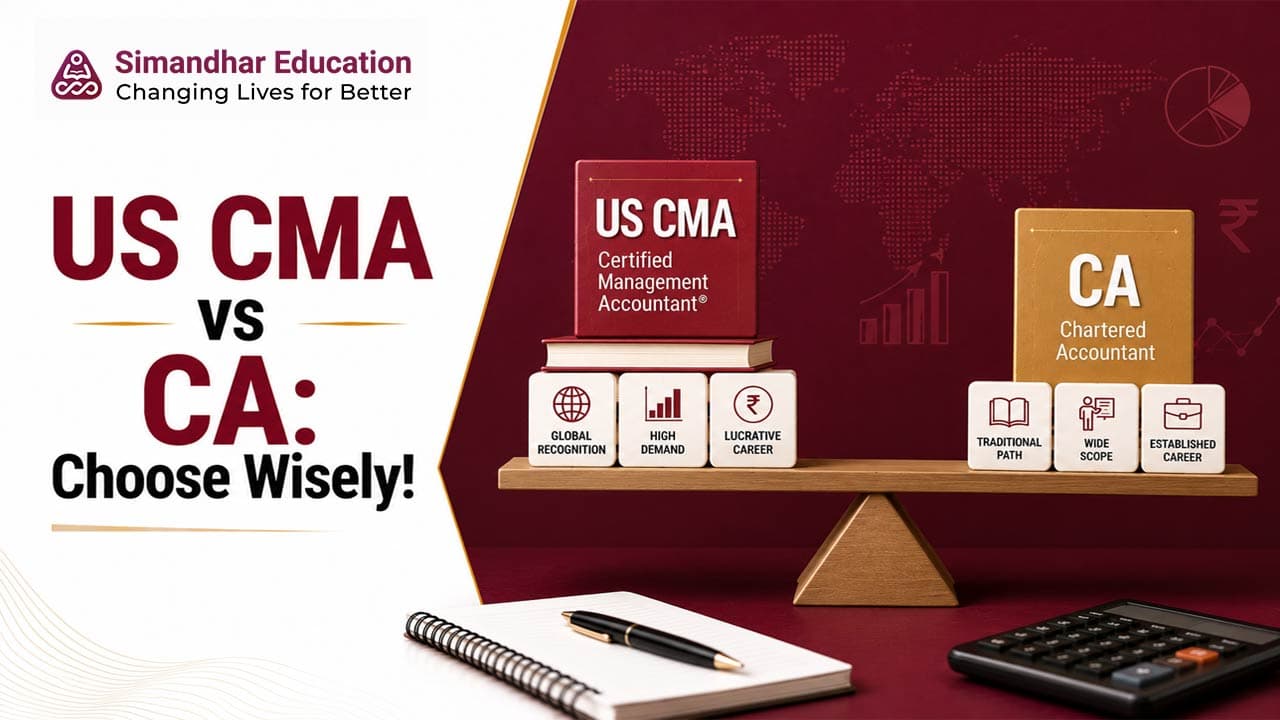
Table of Contents
- 1. Is US CMA Better Than CA? US CMA vs CA – Which Is Better in India?
- 2. What Is US CMA?
- 2.1. Part 1: Financial Planning, Performance, and Analytics
- 2.2. Part 2: Strategic Financial Management
- 3. What Is CA?
- 4. US CMA vs CA: Key Differences
- 5. US CMA vs CA Course Duration
- 6. US CMA vs CA Syllabus Comparison
- 7. US CMA vs CA Career Opportunities
- 8. US CMA Salary in India vs CA Salary
- 9. CMA USA Benefits in India
- 10. US CMA or CA: Which Is Better in India?
- 11. CA vs US CMA for Commerce Students
- 12. Can I Pursue US CMA With CA?
- 13. Is US CMA Better Than CA?
- 14. How Simandhar Education Helps With Your US CMA Journey
- 15. FAQs
- 15.1. Is US CMA better than CA?
- 15.2. Which has a shorter duration, US CMA or CA?
- 15.3. Is US CMA good for MNC jobs in India?
- 15.4. Can commerce students pursue US CMA?
- 15.5. Can I do US CMA after CA?
- 15.6. Does US CMA guarantee a higher salary than CA?
Is US CMA Better Than CA? US CMA vs CA – Which Is Better in India?
Choosing between US CMA and CA is a major career decision for commerce and finance students in India. Both qualifications can lead to strong careers, but they are designed for different professional goals. While Chartered Accountancy (CA) has deep relevance in Indian accounting, taxation, audit, and regulatory practice, the US CMA (Certified Management Accountant) focuses more on management accounting, financial analysis, strategic finance, performance management, and business decision-making.
So, is US CMA better than CA? There is no universal winner. If your goal is to build a career in corporate finance, FP&A, management accounting, or finance roles in MNCs and global organizations, US CMA can be an attractive option. If you want to build your career primarily around Indian taxation, statutory audit, compliance, or practice as a Chartered Accountant, CA may be more suitable.
This detailed US CMA vs CA comparison will help you understand which qualification fits your career goals.
What Is US CMA?
The US CMA is a globally recognized management accounting certification administered by the Institute of Management Accountants (IMA). The certification focuses on financial management, strategic decision-making, planning, performance, analytics, corporate finance, risk management, and related areas.
The CMA examination has only two parts:
Part 1: Financial Planning, Performance, and Analytics
Part 2: Strategic Financial Management
IMA requires candidates to pass both examination parts and meet education and relevant professional-experience requirements to earn the CMA certification. Candidates generally need a bachelor's degree or an accepted professional certification and two continuous years of qualifying experience.
What Is CA?
Chartered Accountancy is a professional qualification offered by the Institute of Chartered Accountants of India (ICAI). It is one of India's most established accounting qualifications and provides extensive knowledge of accounting, taxation, auditing, financial reporting, corporate laws, financial management, and related subjects.
The CA pathway includes Foundation, Intermediate, and Final levels, subject to the applicable entry route. ICAI's current curriculum covers areas including Advanced Accounting, Taxation, Auditing and Ethics, Cost and Management Accounting, Financial Management, Financial Reporting, Advanced Financial Management, and Direct and Indirect Tax Laws.
US CMA vs CA: Key Differences
| Factor | US CMA | CA |
|---|---|---|
| Primary Focus | Management Accounting & Corporate Finance | Accounting, Audit, Taxation & Finance |
| Exam Structure | 2 Exam Parts | Multiple Levels and Papers |
| Orientation | Global Corporate Finance | Strong Indian Accounting and Regulatory Orientation |
| Typical Career Direction | FP&A, Financial Analysis, Management Accounting, Corporate Finance | Audit, Taxation, Accounting, Advisory, Finance |
| Suitable for MNC-Focused Careers | Strong Option | Also Valuable |
| Independent Practice in India | Does Not Provide CA Statutory Practice Rights | Provides Relevant Practice Opportunities Subject to ICAI Requirements |
| Flexibility | Comparatively Compact Examination Structure | Longer and More Extensive Pathway |
US CMA vs CA Course Duration
One of the biggest differences in the US CMA vs CA course duration is the examination pathway.
IMA states that candidates must complete both CMA exam parts within three years of entering the certification program, while its student guidance notes that many students complete both exams in around the duration of 12–18 months. The education and professional-experience requirements for certification must also be satisfied.
CA, on the other hand, involves multiple examination stages as well as practical training requirements. Consequently, the complete journey generally requires a substantially longer commitment.
Therefore, students asking “US CMA or CA which is better?” because they want a comparatively faster professional qualification may find US CMA appealing.
US CMA vs CA Syllabus Comparison
The syllabus reflects the different objectives of the two qualifications.
The US CMA syllabus emphasizes:
- Financial Planning, Budgeting and Forecasting
- Performance Management
- Cost Management
- Internal Controls
- Technology and Analytics
- Financial Statement Analysis
- Corporate Finance
- Business Decision Analysis
- Enterprise Risk Management
- Capital Investment Decisions
- Professional Ethics
These topics make US CMA particularly relevant to corporate finance and management decision-making.
The CA syllabus goes deeper into Indian taxation, auditing, accounting standards, laws, financial reporting and regulatory subjects alongside financial and strategic management.
Therefore, CMA USA vs CA should be compared based on the type of finance professional you want to become rather than simply the number of subjects.
US CMA vs CA Career Opportunities
Career opportunities differ because the qualifications focus on different professional domains.
The US CMA career opportunities are commonly associated with:
- Financial Planning & Analysis (FP&A)
- Management Accounting
- Cost Analysis
- Corporate Finance
- Business Finance
- Financial Analysis
- Commercial Finance
- Controllership
- Strategic Finance
These roles are frequently found in multinational corporations, Global Capability Centers (GCCs), shared-service centers, consulting firms, and large corporate organizations.
CA-qualified professionals commonly work in:
- Audit
- Taxation
- Accounting
- Compliance
- Advisory Services
- Corporate Finance
- Financial Reporting
- Practice and Consultancy
Both qualifications can lead to finance leadership roles, but their starting focus is often different.
US CMA Salary in India vs CA Salary
Students frequently compare US CMA salary in India vs CA salary. However, salary comparisons should be approached carefully.
Compensation depends on multiple factors, including:
- Educational background
- Technical skills
- Communication ability
- Employer
- Industry
- Location
- Relevant experience
- Role and responsibilities
Neither qualification guarantees a specific salary level. Instead, both can strengthen employability and career progression when combined with practical skills and relevant experience.
Professionals who build expertise in analytics, technology, ERP systems, financial modelling, Power BI, AI-enabled finance tools, and business communication often improve their career prospects regardless of whether they pursue US CMA or CA.
CMA USA Benefits in India
There are several reasons why students consider the US CMA qualification.
- Globally recognized management accounting credential
- Strong alignment with corporate finance functions
- Focused two-part examination structure
- Relevance for MNCs and GCCs
- Coverage of analytics, planning, performance management, and strategic finance
- Flexibility for students and working professionals
- Applicability across multiple industries
These CMA USA benefits in India make it attractive for candidates seeking careers in business finance and management accounting rather than purely audit- or taxation-oriented roles.
US CMA or CA: Which Is Better in India?
The answer depends entirely on your long-term career goals.
US CMA may be suitable if you are interested in:
- Corporate Finance
- FP&A
- Management Accounting
- Financial Analysis
- MNC Finance Roles
- Strategic Finance
- Business Partnering Roles
CA may be suitable if you are interested in:
- Audit
- Taxation
- Compliance
- Financial Reporting
- Regulatory Advisory
- Indian Accounting Practice
- Independent Professional Practice
Therefore, the question is often not “Which qualification is better?” but rather “Which qualification is better for my career objective?”
CA vs US CMA for Commerce Students
For commerce students, both pathways can be valuable.
Students who enjoy accounting standards, taxation, auditing, and compliance may find CA more aligned with their interests. Students who prefer business analysis, management accounting, planning, budgeting, performance evaluation, and strategic finance may find US CMA more suitable.
The decision should be based on professional interests, career aspirations, learning preferences, and the type of roles you eventually want to pursue.
Can I Pursue US CMA With CA?
Yes. Many professionals choose to combine both qualifications.
CA professionals who want to strengthen their expertise in management accounting, corporate finance, business analysis, and strategic finance may pursue US CMA as an additional credential.
Similarly, candidates who already hold US CMA may later pursue qualifications that deepen their expertise in taxation, auditing, or regulatory areas if those align with their career goals.
Having multiple complementary qualifications can broaden career opportunities depending on the role and industry.
Is US CMA Better Than CA?
The most accurate answer is that US CMA is not universally better than CA, and CA is not universally better than US CMA.
Each qualification serves different purposes:
- US CMA is highly focused on management accounting, FP&A, business finance, and strategic decision-making.
- CA provides extensive expertise in accounting, taxation, auditing, compliance, and related areas.
Students should therefore evaluate their career goals before making a decision rather than choosing based solely on popularity, pass rates, or isolated salary discussions.
How Simandhar Education Helps With Your US CMA Journey
Simandhar Education is Becker's exclusive authorized provider for CPA and CMA Exam Review in India.
Through the partnership, students can access Becker's CMA learning resources along with Simandhar's mentoring, live classes, recorded sessions, exam preparation support, and career-focused guidance.
Simandhar supports CMA aspirants through:
- Becker CMA Exam Review resources
- Live and recorded learning support
- Mentoring and doubt clarification
- Exam-oriented preparation plans
- Career and placement assistance
- Practical learning aligned with modern finance functions
- Guidance for MNC, GCC, and Big 4 career opportunities
For students seeking a structured pathway toward management accounting and corporate finance careers, this support ecosystem can help make preparation more organized and goal-oriented.
FAQs
1. Is US CMA better than CA?
Neither qualification is universally better. US CMA is generally more focused on management accounting and corporate finance, while CA focuses more extensively on accounting, auditing, taxation, and compliance.
2. Which has a shorter duration, US CMA or CA?
US CMA has a comparatively compact two-part examination structure, whereas CA involves multiple levels and practical training requirements.
3. Is US CMA good for MNC jobs in India?
Yes. US CMA is widely associated with roles in FP&A, management accounting, business finance, financial analysis, and other finance functions commonly found in multinational organizations and GCCs.
4. Can commerce students pursue US CMA?
Yes. US CMA is a popular option among commerce students interested in management accounting, financial planning, business finance, and strategic finance careers.
5. Can I do US CMA after CA?
Yes. Many CA-qualified professionals pursue US CMA to strengthen their expertise in management accounting, corporate finance, FP&A, and business decision-making.
6. Does US CMA guarantee a higher salary than CA?
No. Salary depends on experience, skills, employer, industry, role, and location. Neither qualification guarantees a specific compensation level.