
US CMA Career Scope: Jobs, Industries & Growth Path in India
Explore the US CMA career scope in India and abroad: top roles, industries, fresher jobs, skills to add and your growth path after CMA USA.

Table of Contents
- 1. US CMA Career Scope: Roles, Industries & Growth Path
- 2. Why US CMA Has Strong Career Scope
- 3. Top Jobs After US CMA
- 3.1. Core finance and accounting roles
- 3.2. Strategy and business roles
- 3.3. Leadership roles
- 4. US CMA for Corporate Finance and Finance Careers
- 5. Industries for CMA USA Professionals
- 6. CMA USA Scope in India
- 6.1. US CMA jobs for freshers in India
- 7. US CMA Career Opportunities in India and Abroad
- 7.1. US CMA career opportunities in India
- 7.2. US CMA global career opportunities
- 8. Career Path for a US CMA Professional
- 9. Skills to Learn Alongside US CMA
- 10. Conclusion
- 11. Frequently Asked Questions
- 11.1. What are the top career opportunities after CMA USA?
- 11.2. What is the career path for a US CMA professional?
- 11.3. Can US CMA candidates work in Big 4 firms?
- 11.4. What skills should I learn alongside US CMA?
- 11.5. What is the career growth after US CMA?
- 11.6. Is US CMA worth it in India?
- 11.7. Can a fresher get a job after US CMA?
- 11.8. How long does it take to see career growth after CMA?
US CMA Career Scope: Roles, Industries & Growth Path
Most commerce students hear about the US CMA from a senior or a LinkedIn post and then get stuck on one question: what job will I actually get after this?
It's a fair question. A certification is only worth the time if it opens doors. The US CMA, offered by the Institute of Management Accountants (IMA), is built for people who want to work inside businesses, helping leaders make decisions with numbers. This guide covers the US CMA career scope, the jobs after US CMA, the industries that hire, and how your career can grow from your first role to the CFO's office.
Why US CMA Has Strong Career Scope
The CMA sits at the center of strategic management accounting: costing, budgeting, forecasting, performance analysis and decision support. Companies need people who can explain why the numbers moved, not just record them.
The pay data backs this up. IMA's 2023 Global Salary Survey found that CMAs earn about 21% more in total compensation than non-CMAs globally, and 24% more in the Americas. Early-career professionals saw the biggest salary premium: 32% for Gen Z respondents, compared with 12% for Baby Boomers.
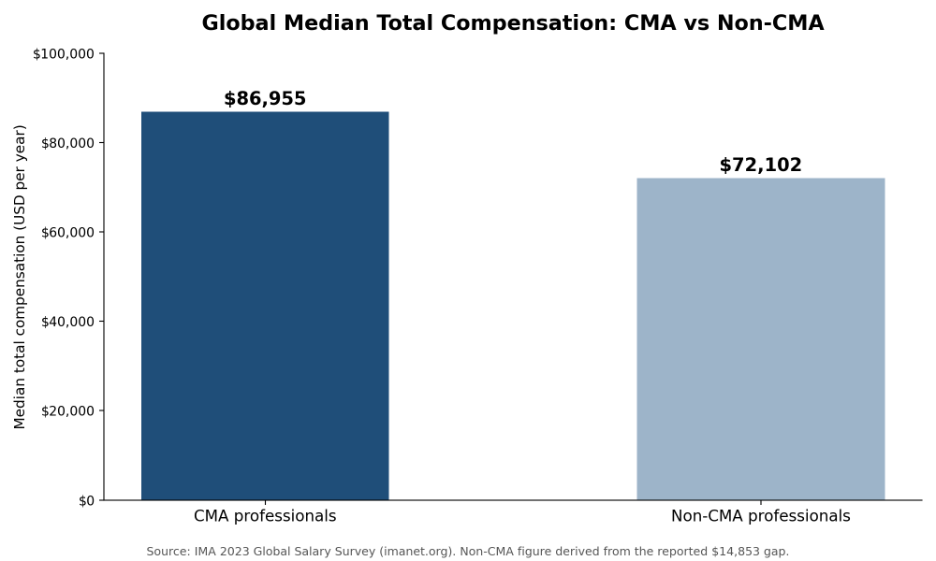
Source: IMA 2023 Global Salary Survey. Salary figures vary by country, role and experience, so treat them as a benchmark, not a promise.
Top Jobs After US CMA
If you're wondering what the top career opportunities after CMA USA are, these are the roles that come up most often.
Core finance and accounting roles
- Financial Analyst: analyses performance, builds reports, supports decisions
- Cost / Management Accountant: tracks product and process costs, improves margins
- FP&A Analyst: budgets, forecasts and variance analysis
- Financial Controller: oversees reporting, controls and compliance
Strategy and business roles
- Business Analyst / Business Finance Partner: works with sales, operations and product teams
- Corporate Finance Executive: capital budgeting, working capital and investment decisions
- Internal Auditor / Risk Analyst: reviews processes and controls
Leadership roles
- Finance Manager, Finance Director, CFO: the long-term destination for many CMAs
US CMA for Corporate Finance and Finance Careers
US CMA for corporate finance is where the credential fits best. The syllabus covers planning, budgeting, forecasting, performance management, cost management, internal controls, decision analysis, risk management, investment decisions, and professional ethics. That mix is exactly what a corporate finance or business finance team uses every day.
It also works for broader US CMA for finance careers, such as financial analysis, reporting, treasury support and shared-services finance. Unlike audit-heavy qualifications, the CMA trains you to think like someone inside the company.
Industries for CMA USA Professionals
Almost every business with a finance team needs management accountants. The industries for CMA USA professionals that hire most often include:
- Manufacturing and FMCG: product costing, plant budgeting, margin analysis
- IT, ITES and Global Capability Centres (GCCs): FP&A, reporting, finance analytics
- Banking, financial services and insurance: financial analysis, risk and controllership
- Consulting and Big 4 advisory: finance transformation and performance improvement
- Healthcare and pharma: cost control, pricing, project finance
- Retail, e-commerce and logistics: unit economics, inventory and supply-chain costing
CMA USA Scope in India
The CMA USA scope in India has grown mainly because multinational companies run large finance operations here. GCCs and shared-service centres in cities like Hyderabad, Bengaluru, Pune, Mumbai and Gurugram support global finance teams, and they value people trained in US accounting and management practices.
Some points worth knowing:
- Indian companies with global reporting needs increasingly prefer CMA-qualified analysts.
- The credential is strong for FP&A, controllership and finance business partnering roles.
- It's not the same as the Indian ICMAI "CMA" qualification. The US CMA is awarded by IMA and is recognized internationally.
US CMA jobs for freshers in India
For US CMA jobs for freshers in India, expect entry-level titles like Financial Analyst, Associate Analyst (FP&A), Junior Cost Accountant, MIS Executive, Finance Executive or Business Analyst. Freshers with a CMA plus solid Excel and basic data skills usually stand out from candidates with a degree alone. Your first role is about learning the finance cycle; the premium tends to grow as you take on analysis and decision-support work.
US CMA Career Opportunities in India and Abroad
US CMA career opportunities in India
You can build a full career in India without ever relocating, across corporates, GCCs, startups and consulting firms.
US CMA global career opportunities
Because the credential is issued by IMA and recognized across many countries, US CMA global career opportunities include the US, the UAE, Saudi Arabia, Singapore and other markets where multinational finance teams operate. Work authorization, local experience and employer preference still decide the final outcome, so plan for these rather than assuming them.
Career Path for a US CMA Professional
Here is a typical growth ladder. Timelines depend on your performance, employer, and skills.
| Stage | Typical roles | Focus |
|---|---|---|
| Entry level | Financial Analyst, Cost Accountant | Reporting, costing, Excel, ERP |
| Mid-level | Senior Analyst, FP&A Lead, Business Finance Partner | Forecasting, insights, stakeholder work |
| Senior level | Finance Manager, Controller | Team leadership, controls, planning |
| Leadership | Finance Director, VP Finance, CFO | Strategy, capital allocation, board reporting |
IMA's survey also notes that CMAs are more likely than non-CMAs to hold CFO roles, which shows the credential link to leadership paths.
Skills to Learn Alongside US CMA
The certification gets you shortlisted. These skills help you get hired:
- Advanced Excel and financial modelling
- Power BI or Tableau for dashboards
- SQL and basic Python for working with data
- ERP knowledge (SAP, Oracle)
- Business communication, because analysts who explain clearly get promoted
- AI-enabled finance tools, which are becoming part of everyday reporting and forecasting
Conclusion
The US CMA career scope is wide because it prepares you for the work companies that actually pay finance teams to do plan, control, analyses and advise. Whether you aim for a GCC role in India, a corporate finance desk or a job abroad, the path from analyst to finance leader is clear, and the right skills alongside the certification speed it up.
If you're a commerce student or early-career professional comparing options, talk to a counsellor at Simandhar Education to map the CMA route to your own background and goals.
Frequently Asked Questions
1. What are the top career opportunities after CMA USA?
Financial Analyst, FP&A Analyst, Cost Accountant, Business Finance Partner, Corporate Finance Executive, Internal Auditor, Financial Controller and, with experience, Finance Director or CFO.
2. What is the career path for a US CMA professional?
Most start as analysts or cost accountants, move into senior analyst or business partner roles, then manage teams as finance managers or controllers, and eventually reach director or CFO level.
3. Can US CMA candidates work in Big 4 firms?
Yes. Big 4 firms hire CMA-qualified professionals, mostly in advisory, consulting, risk, finance transformation and outsourcing teams. Audit teams often prefer other credentials, so check the specific role before applying.
4. What skills should I learn alongside US CMA?
Excel, financial modelling, Power BI, SQL, ERP basics and strong communication. Basic Python and AI tools for finance are a good addition.
5. What is the career growth after US CMA?
Growth usually follows your role: analyst to manager to controller to director. IMA's data shows a pay premium for CMAs globally, with the largest premium among early-career professionals.
6. Is US CMA worth it in India?
For students targeting FP&A, corporate finance, GCC, or multinational roles, yes. It's less suited if you want statutory audit or taxation work as your core career.
7. Can a fresher get a job after US CMA?
Yes. Entry-level analyst and finance executive roles are open to freshers, and skills like Excel and data tools improve your chances.
8. How long does it take to see career growth after CMA?
It depends on your role and employer. Most people see the biggest jump once they move from reporting work into analysis and decision support.
Planning to take CMA? Explore our CMA course