
US CMA Career Path in India & USA: Roles, Salary, Skills
Explore the US CMA career path in India and the USA: job roles, salary by experience, and skills needed from fresher to CFO, explained in a mentor chat.

Table of Contents
- 1. US CMA Career Path in India and the USA: Job Roles, Salary Growth, and Skills Required from Fresher to Senior-Level Positions
- 2. Stage 1: Entry-Level Roles for Freshers (0 to 2 Years)
- 3. Your First Upgrade: Stage 1 to Stage 2
- 4. Stage 2: Mid-Level Career Growth (2 to 6 Years)
- 5. The Second Upgrade: Stage 2 to Stage 3
- 6. Stage 3: Managerial and Specialized Positions (6 to 10 Years)
- 7. The Third Upgrade: Stage 3 to Stage 4
- 8. Stage 4: Senior Leadership and Top-Level Positions (10+ Years)
- 8.1. The Final Step: Toward Finance Director, CFO or Consultant
- 9. Six Career Pathways After the US CMA
- 10. Salary Progression: What to Expect in India and the USA
- 11. Future Scope: Where US CMA Professionals Work
- 12. Additional Skills That Support Career Growth
- 13. A Few Honest Closing Thoughts
- 14. Conclusion
- 14.1. Frequently Asked Questions
US CMA Career Path in India and the USA: Job Roles, Salary Growth, and Skills Required from Fresher to Senior-Level Positions
Clearing the US CMA exams feels like crossing a finish line, until the real question arrives: what happens next? Which job should you apply for, how fast can you grow, what do you need to learn in year three that you didn't need in year one, and what will the pay look like in India or the United States?
This article answers those questions through a conversation rather than a textbook. Neha Kulkarni is a 24-year-old commerce graduate from Pune who has just cleared the US CMA exams while working as an accounting associate. Suresh Menon is a Finance Director at the India finance center of a global manufacturing company. He has held the CMA for eighteen years and has hired, trained, and promoted dozens of management accountants.
They meet over coffee, and Neha arrives with a notebook full of questions.
Follow their talk and you will see the complete US CMA career path: the US CMA job roles at every stage, the skills needed to move up, how responsibilities change, and how US CMA salary by experience typically progresses in India and the USA.
All salary figures are indicative ranges, not promises, and your own outcome will depend on your employer, city, role and performance.


Suresh sir, I cleared both parts last month. Everyone congratulates me and then asks what's next. Honestly, I don't have a road map. Where does the US CMA career growth actually lead?

Congratulations, and good that you're asking now rather than five years in. Think of US CMA career growth in four stages. Stage one is learning the work. Stage two is owning the work. Stage three is managing people and decisions. Stage four is shaping the direction of the business. The titles change, but the real difference is how you spend your day. Early on you produce numbers. Later, you explain them. Eventually you decide with them.
Stage 1: Entry-Level Roles for Freshers (0 to 2 Years)
Most freshers begin in one of these roles:
- Junior Accountant
- Accounting Associate
- Cost Accounting Associate
- Management Accounting Associate
- Financial Analyst
- Junior FP&A Analyst
- Budgeting Analyst
The daily work is ledger reconciliations, month-end close support, cost sheets, variance schedules, collecting budget inputs, and preparing MIS reports. A large share of US CMA jobs in India sits inside MNCs and Global Capability Centers (GCCs) supporting a US or European parent, so the work is already global.
Which one should I aim for?
Whichever puts you closest to numbers that drive decisions. A junior FP&A or cost accounting role teaches you more about how the business earns and spends than pure data entry does. But an accounting associate role works too if you treat it as a classroom. Also remember that the IMA asks for two years of relevant professional experience before the CMA designation is awarded, so these early years count twice.
Your First Upgrade: Stage 1 to Stage 2
Show me as the example. How do I move up from where I am?
I lay it out the same way for my own team:
- Current role: Accounting Associate or Junior FP&A Analyst, preparing reports that someone else designed.
- Existing skills: Basic accounting, Excel, ERP data entry, reconciliations, and the cost-behavior concepts from your CMA Part 1 preparation.
- Skills to upgrade: Advanced Excel (lookups, pivot tables, Power Query), variance analysis, standard costing, reporting under US GAAP or IFRS, and the ability to explain a variance in two clear lines.
- How to build them: Offer to own one monthly report end to end. Rebuild a budget model from scratch. Learn the basics of Power BI or Tableau. Sit in on the month-end close and ask why each adjustment exists.
- Next role: Cost Accountant, Management Accountant, FP&A Analyst or Senior Financial Analyst.
- New responsibilities: You own a reporting cycle or a cost center, explain variances to managers, and begin reviewing a junior's work.
- Salary growth: Roughly ₹9–18 LPA in India and $80,000–$105,000 in the USA.
Stage 2: Mid-Level Career Growth (2 to 6 Years)
At this stage you stop being the person who prepares data and become the person people consult about it. Typical roles include:
- Cost Accountant
- Management Accountant
- Senior Financial Analyst
- FP&A Analyst
- Budget Analyst
- Financial Reporting Analyst
- Senior Accounting Analyst
A cost accountant in a plant tracks product margins and material usage. An FP&A analyst builds forecasts and tells the business unit head why the quarter is drifting from plan. This is where US CMA jobs in FP&A become attractive, because the CMA syllabus on planning, budgeting and decision analysis maps directly to the work.
The Second Upgrade: Stage 2 to Stage 3
Say I'm an FP&A Analyst in three years. What then?
Current role: FP&A Analyst or Management Accountant, delivering forecasts, reports and cost analysis independently.
Existing skills: Strong Excel and modelling, variance analysis, ERP and BI tools, reporting discipline.
Skills to upgrade: Driver-based forecasting, business partnering, presenting to senior stakeholders, reviewing and coaching others, project planning, and basic process automation. Add SQL or Python if you can, because data volumes are growing.
How to build them: Lead a budget cycle or a forecasting redesign. Present the monthly business review. Mentor a new joiner. Take on a cross-functional project such as a cost-reduction drive or a pricing analysis.
Next role: FP&A Manager, Cost Accounting Manager, Finance Manager, Management Accounting Manager, Budgeting and Forecasting Manager, Financial Reporting Manager or Commercial Finance Manager.
New responsibilities: A team to manage, deadlines you answer for, and recommendations that influence business decisions.
Salary growth: Roughly ₹20–35 LPA in India and $110,000–$160,000 in the USA.
Stage 3: Managerial and Specialized Positions (6 to 10 Years)
Managers are judged less on their own spreadsheets and more on the quality of their team's output and the decisions it supports. A commercial finance manager works alongside sales to price deals and protects margins. A budgeting and forecasting manager runs the annual plan. A cost accounting manager owns product costing and plant profitability. A financial reporting manager ensures the numbers that go to leadership and auditors are right.
The Third Upgrade: Stage 3 to Stage 4
And after manager, what are the senior US CMA job roles I should aim for?
Current role: FP&A Manager, Finance Manager or Cost Accounting Manager, running a team and a process.
Existing skills: Planning and forecasting, team management, stakeholder communication, and process knowledge.
Skills to upgrade: Strategic thinking, capital allocation and investment appraisal, risk and internal controls, treasury and working capital awareness, M&A basics, influencing executives, and building a leadership bench.
How to build them: Work on a business case for a new plant or product. Support an acquisition or restructuring. Present to the CFO or board. Take ownership of the full close, controls, and audit interface.
Next role: Senior Finance Manager, Financial Controller or Director of FP&A.
New responsibilities: Accountability for the integrity of the numbers, a wider team across geographies, and a seat in business leadership discussions.
Salary growth: Roughly ₹35–60 LPA in India and $150,000–$200,000 in the USA, with senior US roles going higher.
Stage 4: Senior Leadership and Top-Level Positions (10+ Years)
The senior destinations include:
- Senior Finance Manager
- Financial Controller
- Director of FP&A
- Finance Director
- Head of Finance
- Head of Strategic Finance
- Chief Financial Officer (CFO)
- Independent Finance Consultant
The Final Step: Toward Finance Director, CFO or Consultant
- Current role: Senior Finance Manager, Financial Controller or Director of FP&A.
- Existing skills: Deep finance expertise, leadership of large teams, strong governance and reporting.
- Skills to upgrade: Enterprise strategy, investor and board communication, financing and capital structure, change leadership, and a clear understanding of operations, technology and people.
- How to build them: Lead a cross-functional transformation, take a P&L ownership role, work with the board or audit committee, and build a successor team.
- Next role: Finance Director, Head of Finance, Head of Strategic Finance, CFO, or Independent Finance Consultant.
- New responsibilities: Company-level decisions, funding, risk, and long-term value creation.
- Salary growth: Often ₹50 LPA and above in India, and $160,000–$240,000+ in the USA, with bonuses and equity increasing the total at senior levels.
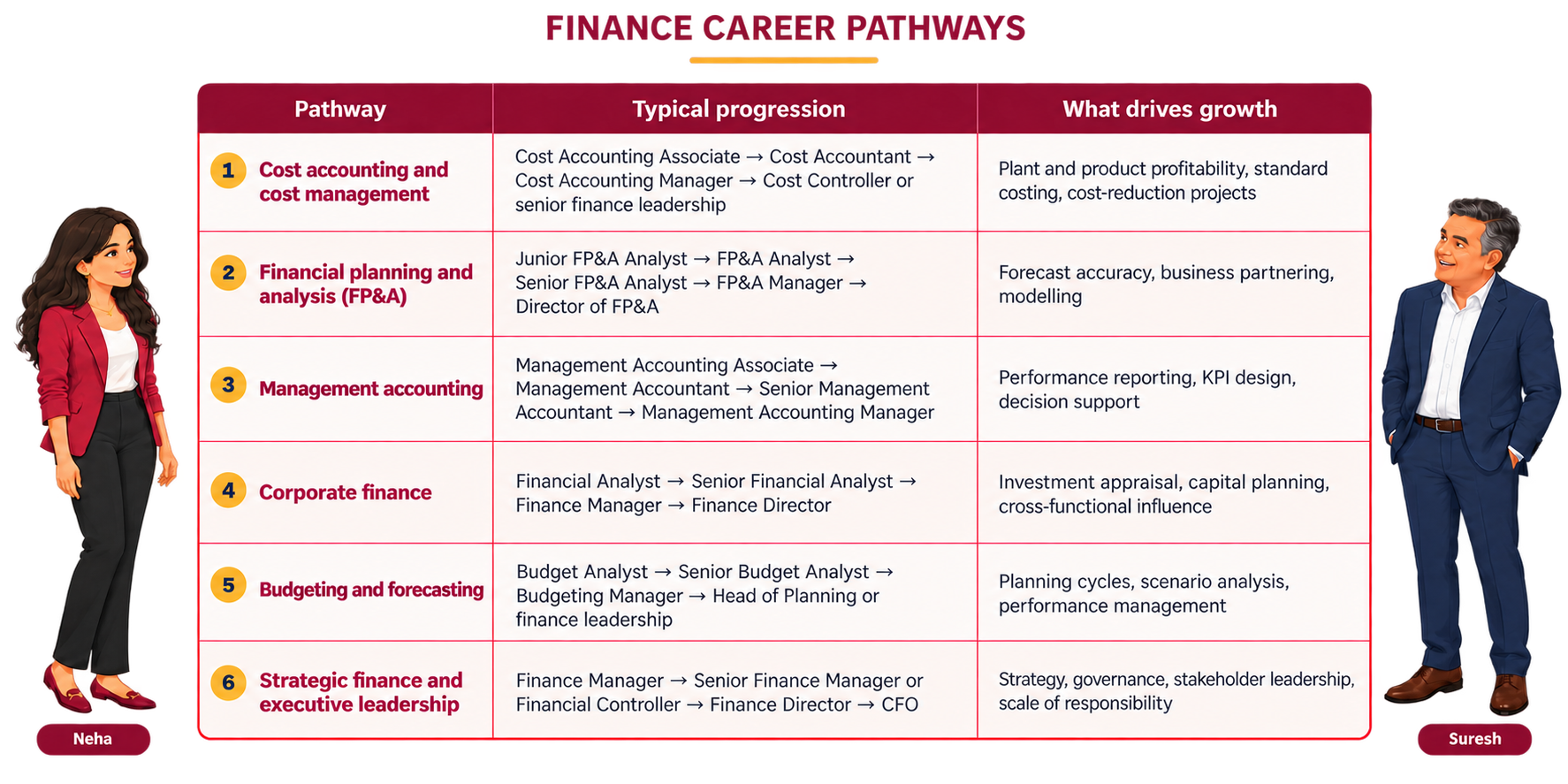
Six Career Pathways After the US CMA
You mentioned different US CMA career paths. How do they differ?
There are six main ones, and you can cross between them:
Salary Progression: What to Expect in India and the USA
Now the question everyone really wants answered. What does the salary progression look like?
Let me show you the table I give my team. Treat these as ranges, not guarantees.
| Career Stage | Typical Job Titles | Experience | India (INR per year) | USA (USD per year) | Key Responsibilities | Skills to Progress |
|---|---|---|---|---|---|---|
| 1. Entry level | Junior Accountant, Accounting Associate, Cost/Management Accounting Associate, Financial Analyst, Junior FP&A Analyst, Budgeting Analyst | 0–2 years | ₹5–8 lakh | $60,000–$80,000 | Reconciliations, MIS, cost sheets, budget inputs, reporting support | Advanced Excel, variance analysis, reporting standards, BI basics |
| 2. Mid level | Cost Accountant, Management Accountant, Senior Financial Analyst, FP&A Analyst, Budget Analyst, Financial Reporting Analyst, Senior Accounting Analyst | 2–6 years | ₹9–18 lakh | $80,000–$105,000 | Own reporting cycles, forecasts, cost analysis, business support | Forecast modelling, stakeholder communication, team review, automation |
| 3. Managerial | Cost Accounting Manager, FP&A Manager, Finance Manager, Management Accounting Manager, Budgeting and Forecasting Manager, Financial Reporting Manager, Commercial Finance Manager | 6–10 years | ₹20–35 lakh | $110,000–$160,000 | Lead teams, run planning cycles, influence decisions | Strategy, investment appraisal, controls, executive presentation |
| 4. Senior leadership | Senior Finance Manager, Financial Controller, Director of FP&A, Finance Director, Head of Finance, Head of Strategic Finance, CFO, Independent Consultant | 10+ years | ₹35–60 lakh and above | $160,000–$240,000+ | Own finance strategy, governance, funding, risk | Board communication, capital structure, change leadership |
Some context so you read it correctly. In the USA, the IMA's Global Salary Survey reports that CMAs in the Americas earn about 24 percent more in total compensation than non-CMAs, with a median near $135,000 for US-based CMAs and a rise from roughly $100,000 in the first decade to over $150,000 beyond twenty years. The US Bureau of Labor Statistics puts median pay for financial managers at $161,700 (May 2024) and projects 15 percent growth from 2024 to 2034.
And what about US CMA salary in India?
Indian ranges come mostly from job listings and salary aggregators, so they're less uniform. Freshers commonly see ₹5–8 lakh, and the upper ranges are reached by people in metros and in MNC or GCC finance teams who moved into planning, controllership and leadership. US CMA salary in India depends heavily on the role, not the credential alone. The CMA opens the door, and your skills decide how far you walk through it.
One more point on US CMA jobs in the USA: absolute pay is higher, but so are living costs, and you need the right work authorization. Compare what you would save and learn, not the headline number.
Future Scope: Where US CMA Professionals Work
Where will the career opportunities after US CMA actually be?
The career opportunities after US CMA are broader than most students expect:
- MNCs and GCCs: The biggest employer group. US CMA jobs in MNCs cover FP&A, cost and management reporting for global parents.
- Manufacturing and cost management: Plants need people who understand product costing, inventory, margins, and efficiency.
- FP&A teams: Every large company needs forecasting and business partnering talent.
- Corporate and management accounting: Close, consolidation, internal reporting, and performance analytics.
- Banking and financial services: Business finance, budgeting, cost control and financial reporting roles within banks, NBFCs, and fintechs.
- Consulting and advisory firms: Finance transformation, performance improvement, costing and budgeting engagements.
- Business finance and strategic finance: Partnering with sales, operations and leadership on pricing, investment and growth plans.
- Budgeting, forecasting and performance management: Planning cycles, scenario analysis, KPI frameworks.
- Independent financial consulting: Experienced professionals advise small and mid-sized companies on costing, budgeting and finance setup.
Additional Skills That Support Career Growth
Whatever stage you're in, these help US CMA career opportunities in finance compound:
- Technical: Advanced Excel, financial modelling, ERP systems, Power BI or Tableau, SQL, basics of Python or automation.
- Analytical: Variance and profitability analysis, scenario planning, root-cause thinking.
- Communication: Turning numbers into a story that a non-finance leader can act on, in writing and in person.
- Business understanding: Know how your company makes money, what drives its costs, and where the risks sit.
- Leadership: Coaching, delegation, handling conflict, building trust across teams.
- Learning habits: Short courses, internal projects, and an annual review of your own skill gaps.
A Few Honest Closing Thoughts
If you had to give me one piece of advice, what would it be?
Don't chase titles, chase skills. Each promotion in this career came to me after I'd already been doing part of the next job for six months. Ask for the stretch project, learn the next tool, and the title tends to follow. And be realistic: timelines vary, not everyone reaches the top, and salaries differ by company and city.

Conclusion
The US CMA career path is progression, not a single job. It begins with entry-level roles in accounting, cost and FP&A, grows through mid-level analyst and management accounting positions, moves into managerial and specialized roles, and can lead to controller, finance director, CFO or independent consulting. At every step the pattern is the same: use the skills you have, build the skills the next role demands, gain practical experience, take on bigger responsibility, and let salary growth follow. Whether you build your career in India with a global employer or aim for the USA, the credential gives you a strong foundation, and your skills and choices decide the rest.
Frequently Asked Questions
1. What is the career path after US CMA for a fresher in India?
Most freshers start as an accounting associate, cost accounting associate, financial analyst, or junior FP&A analyst. With two to six years of experience, they move into cost accountant, management accountant or FP&A analyst roles, and later into manager-level positions.
2. What is the US CMA salary in India?
Freshers commonly see about ₹5–8 lakh a year, mid-level professionals about ₹9–18 lakh, and managers and senior leaders ₹20 lakh and above. These are indicative ranges that vary by employer, city and role.
3. Can I get a US CMA job in the USA from India?
Yes, but it depends on work authorization, which you need to secure separately from the certification. Many professionals first build experience in a US-facing role in India and then explore overseas opportunities.
4. Which job roles can I get after clearing the US CMA?
Common US CMA job roles include financial analyst, cost accountant, management accountant, budget analyst, FP&A analyst, finance manager and financial controller. Senior paths lead to finance director, head of finance and CFO.
5. Is the US CMA good for FP&A jobs?
Yes. The CMA syllabus covers planning, budgeting, forecasting and decision analysis, which are the core of FP&A work. Pairing it with strong Excel, modelling and BI skills improves your chances.
6. Do MNCs and GCCs hire US CMA professionals?
Yes. Many US CMA jobs in MNCs are in Global Capability Centers that handle FP&A, cost accounting, and management reporting for a global parent. Hiring depends on the company's needs and your skills.
7. How long does it take to become a Finance Manager or CFO after US CMA?
There is no fixed timeline. Many professionals reach manager-level roles in roughly six to ten years, and senior leadership typically takes ten years or more, depending on performance, skills and opportunities.
8. Do I need work experience to become a certified US CMA?
The IMA requires two years of relevant professional experience for the designation, so your early jobs count toward certification as well as career growth. Check the IMA's current requirements before you plan your timeline.
Planning to take CMA? Explore our CMA course