
ACCA Career Path in India & Abroad: Roles, Salary, Skills
Explore the ACCA career path from fresher to CFO. See ACCA job roles, salary by experience, skills for each promotion, and jobs in India and abroad.

Table of Contents
- 1. ACCA Career Path in India and Abroad: Job Roles, Salary Growth, and Skills Required from Fresher to Senior-Level Positions
- 2. Stage 1: Entry-Level Opportunities (0 to 3 years)
- 3. Stage 2: Mid-Level Career Growth (3 to 7 years)
- 4. Stage 3: Managerial and Specialized Positions (7 to 12 years)
- 5. Stage 4: Senior Leadership and Top-Level Positions (12+ years)
- 6. Six Career Paths After ACCA
- 7. ACCA Salary Progression: India and Abroad
- 8. Future Scope of ACCA Professionals
- 9. Conclusion
- 10. Frequently Asked Questions
ACCA Career Path in India and Abroad: Job Roles, Salary Growth, and Skills Required from Fresher to Senior-Level Positions
Most students who start ACCA can name the exams. Far fewer can name the jobs. They know Financial Reporting, Audit and Assurance and Strategic Business Leader, but not what the first role looks like, when the first promotion arrives, or what separates a Senior Accountant from a Financial Controller.
That gap is what this article closes to. Instead of a dry list of designations, we follow one real-feeling conversation: a young ACCA student and a mentor who has walked the entire path. Along the way you will see the ACCA career path from fresher to CFO, the ACCA job roles at each stage, the skills that unlock each promotion, and how ACCA salary in India compares with markets abroad.
It was a Saturday morning at a café near the office park where Arvind Sharma, a Finance Director at a global manufacturing company's India center, had agreed to meet Payel Mukherjee. Payel was a final-year B.Com student who had just cleared her first few ACCA papers.
Arvind had started as an audit trainee at a Big 4 firm, moved into a multinational, spent three years abroad, and returned to lead finance for the India operations. A mutual friend had introduced them.
Payel had a notebook open and a long list of questions. Arvind smiled and let her begin.


Sir, I keep hearing that ACCA is global, but when I search for the ACCA career path, I get confused. What are the career opportunities after ACCA? Where does the journey start, and where can it end?

Good question to ask early, Payel. Most people ask it after qualifying. Think of the ACCA career path as four stages: entry-level, mid-level, managerial or specialized, and senior leadership. Each stage has its own roles, its own skill gaps, and its own salary band. And you are not locked into one lane. ACCA keeps six doors open: audit, financial reporting, management accounting, tax, internal audit and risk, and corporate finance. Let me walk you through them stage by stage.
Stage 1: Entry-Level Opportunities (0 to 3 years)
Let me start at the bottom. Say I am just qualified. Which ACCA jobs in India can a fresher realistically get?
Your first role is about learning how finance really runs. Most ACCA freshers land in one of these:
- Audit Associate / Audit Trainee in a Big 4 or mid-tier firm
- Junior Accountant / Accounts Executive in a company
- Tax Associate handling returns and compliance support
- Junior Financial Analyst in an MNC or a global capability center (GCC)
- Accounts Payable / Receivable or General Ledger Analyst in shared-service teams
And what does the work involve day to day?
Execution. You vouch transactions, reconcile accounts, prepare schedules, support month-end close, and learn the ERP. In audit, you test controls and document evidence. It looks routine, but this is where your IFRS and audit knowledge turns into muscle memory.
What do I need to bring?
Fewer things than students think, but do them well:
- Solid grounding in accounting standards and basic IFRS
- Excel beyond the basics: lookups, pivot tables, reconciliations
- Comfort with an ERP such as SAP, Oracle or Tally
- Clear written communication, because your working papers are read by seniors
- Punctuality and accuracy at month-end, when everything is on deadline
What is the ACCA salary in India at this stage?
It is decent, not spectacular. Salary guides put ACCA freshers in India at roughly ₹4-8 LPA, with Big 4 offers commonly around ₹5-7 LPA, and the exact figure depends on your city, employer and how many papers you have cleared. Part-qualified students earn less, and many see a jump once they qualify. The point of this stage is not the salary. It is that two to three years of good work here sets up everything after it.
So, what moves me to the next level?
Three things: finishing the ACCA qualification and your practical experience requirement, owning a process rather than just doing tasks inside it, and showing you can review someone else's work. That brings us to Stage 2.
Stage 2: Mid-Level Career Growth (3 to 7 years)
What do ACCA job roles look like once I have a few years behind me and I am fully qualified?
You stop being the person who does the work and become the person who owns an area of it. Typical roles at this stage:
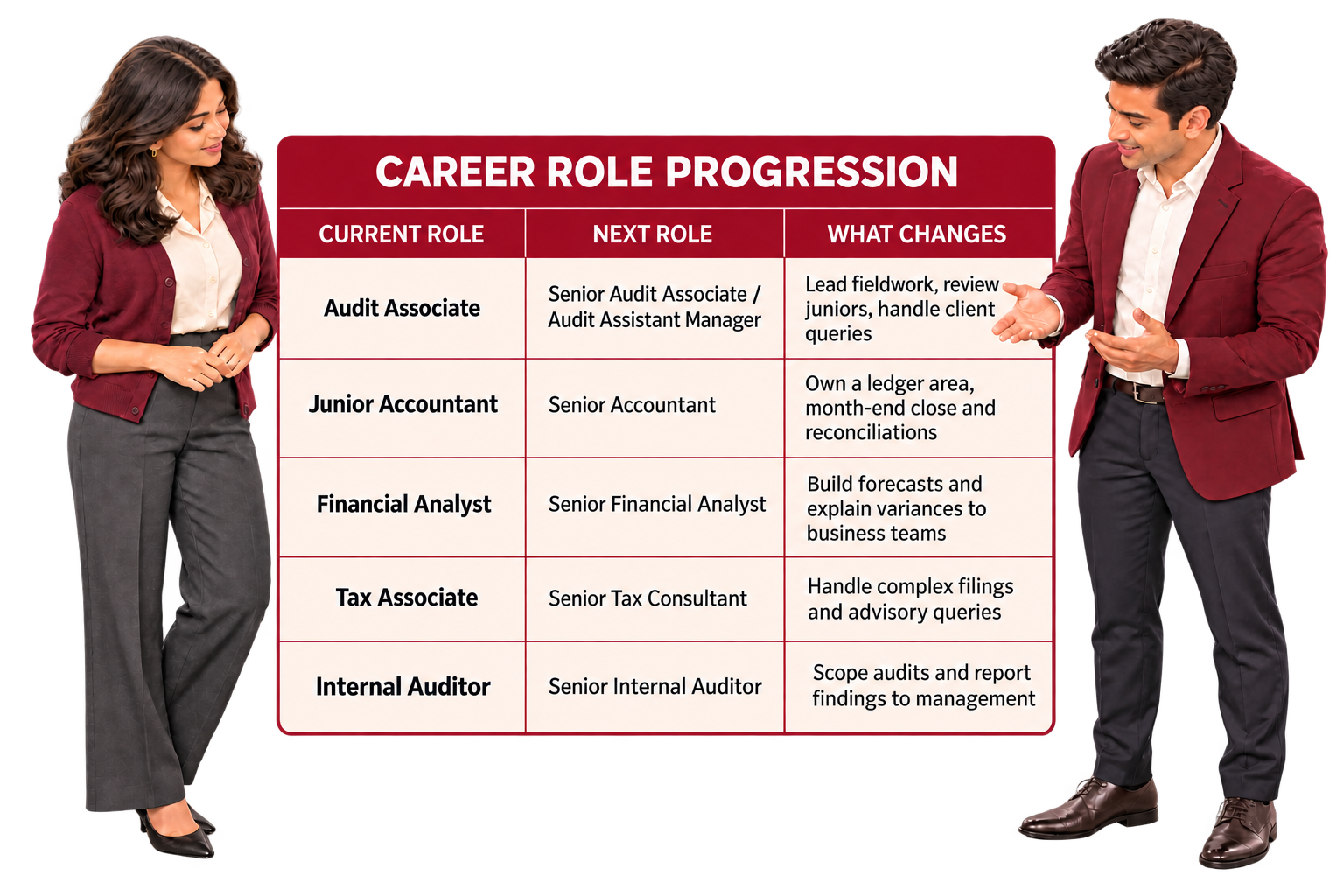
What skills do I need to upgrade here?
This is where many people stall, so listen carefully:
- Technical depth: strong IFRS application, consolidation basics and an understanding of audit risk
- Analytical tools: advanced Excel, Power BI or similar, and an eye for automating repetitive work
- Review ability: spotting errors in other people's work without demoralizing them
- Stakeholder communication: explaining numbers to non-finance managers in plain language
- Ownership: raising issues early instead of fixing them silently
How do I build these without waiting for my manager to teach me?
Volunteer for the messy tasks: a first-time IFRS adoption, system migration, and a cleanup of old balances. Learn the business behind your numbers. And keep using your ACCA study habit, because now learning comes from real problems.
And how does ACCA salary by experience change at this stage?
This is where qualified professionals start to separate from unqualified peers. Guides typically show ₹8-15LPA for roles such as Senior Accountant, Financial Analyst or Senior Auditor, and Big 4 managers with four to six years of experience reaching roughly ₹14-20 LPA. GCCs often match or beat that on total compensation. These are market ranges, not promises, and your negotiation and skills matter as much as your title.
Stage 3: Managerial and Specialized Positions (7 to 12 years)
When does ACCA career growth reach the managerial level?
Usually somewhere between year six and ten. This is the stage where your title carries the word "Manager", and the job quietly stops being about your own output.
- Audit Manager / Senior Manager in a Big 4 or mid-tier firm
- Financial Reporting Manager responsible for consolidations and statutory reporting
- Finance Manager / Senior Management Accountant in a company
- Tax Manager for a jurisdiction or business unit
- Internal Audit Manager leading risk-based audit plans
- Financial Controller in a mid-sized business or a business unit of a larger one
What is the biggest shift?
Your success is now measured by your team and your decisions. You manage budgets and deadlines, coach juniors, handle auditors and regulators, and present to senior leadership. When something goes wrong, you are accountable, not just involved.
So what skills separate a good manager from a stuck one?
- People leadership: Delegating, giving honest feedback, building successors
- Business partnering: Linking numbers to commercial decisions, not just reporting them
- Risk and controls thinking: Designing controls, not only testing them
- Systems and data: ERP transformation, automation, analytics and governance of AI-assisted tools
- Specialist depth: IFRS, group reporting, transfer pricing, internal controls or treasury, depending on your lane
Do people pick up extra qualifications here?
Many do. Some add a specialist diploma or a second credential to deepen a niche such as IFRS reporting, risk or treasury. It is not compulsory, but it can sharpen your edge when you compete for a controller or director role.
And what does an ACCA manager earn?
Indian guides show roughly ₹12-22 LPA for Audit Managers, Tax Managers and Finance Controllers at this stage, and higher at senior manager level in larger firms. Abroad, managers in the UK and Middle East typically move into the upper part of their local ranges, which I will show you in the salary table.
Stage 4: Senior Leadership and Top-Level Positions (12+ years)
Sir, you are a Finance Director now. What does the top of the ladder look like?
The senior roles are fewer, but they are very real for ACCA professionals:
- Finance Director or VP Finance
- Head of Finance / Head of Internal Audit
- Chief Financial Officer (CFO)
- Audit Director or Partner in a firm
- Tax Director
- Risk or Advisory Leader
How different is the work from being a manager?
Completely. I spend very little time on the books themselves. I sit with the CEO and the board on capital allocation, budgets, investor or parent-company reporting, M&A, audit committees and risk appetite. I am judged on whether the business makes better decisions because finance exists.
So, what skills do I need to build for that?
- Strategic thinking: connecting finance to growth, pricing, capital and risk
- Executive communication: presenting to boards and handling hard questions calmly
- Leadership and culture: building a finance function people want to join
- Governance and regulation: audit committees, compliance and ethics
- Transformation: finance technology, automation and data-led decision-making
- Commercial judgement: knowing which numbers matter and which do not
Is the CFO seat realistic for ACCA professionals?
It is possible, not automatic. It rewards people who have worked across functions, handled a crisis, and earned trust outside finance. Some ACCA professionals also move into independent consulting or board advisory roles later in their careers.
What is the ACCA salary in India at that level?
Guides place Finance Directors around ₹25-45 LPA and CFOs from ₹40 LPA to ₹80 LPA or more, with large listed companies and multinationals paying well above that in total compensation, including bonuses and stock. Remember that these are market indicators, and top-level pay is highly variable.
Six Career Paths After ACCA
You mentioned six doors earlier. Can you show me the ACCA career opportunities in finance, ladder by ladder, and what I must learn to climb each one?
Of course. Here are the career opportunities after ACCA, laid out side by side.
| Pathway | Progression ladder | Key skills to upgrade for the next step |
|---|---|---|
| Audit and Assurance | Audit Associate → Senior Audit Associate → Audit Manager → Senior Manager → Director or Partner | Risk assessment, IFRS and auditing standards depth, client handling, team leadership, business development |
| Accounting and Financial Reporting | Junior Accountant → Senior Accountant → Financial Reporting Manager → Financial Controller → Finance Director | IFRS and consolidation, close process ownership, controls, ERP, stakeholder management |
| Management Accounting and Business Finance | Management Accountant → Senior Management Accountant → Finance Manager → Head of Finance | Costing, budgeting, variance analysis, business partnering, dashboards |
| Taxation | Tax Associate → Senior Tax Consultant → Tax Manager → Tax Director (depends on jurisdiction and experience) | Local tax law, transfer pricing, tax planning, client advisory, tax technology |
| Internal Audit and Risk Advisory | Internal Auditor → Senior Internal Auditor → Internal Audit Manager → Risk or Advisory Leadership | Risk frameworks, control design, data analytics, report writing, governance |
| Corporate Finance and Financial Analysis | Financial Analyst → Senior Financial Analyst → Finance Manager → Finance Director or CFO | Financial modelling, valuation, forecasting, capital allocation, strategic thinking |
Which one should I pick?
Pick by what energizes you, not by what sounds prestigious. If you like testing and questioning, audit or internal audit suits you. If you like clean books and standards, go into reporting. If you enjoy explaining the business through numbers, choose management accounting or corporate finance. If you like rules and puzzles, tax is rewarding. The good news is that these lanes overlap, and many Finance Directors, including me, have crossed from audit into reporting and then into business finance.
Does ACCA give me an edge in any of these?
The syllabus is built around IFRS, audit, tax, financial management and strategy, so it maps well to reporting, audit and corporate finance. For tax, jurisdiction matters. A global ACCA holder often needs to add local tax knowledge or experience to progress, especially when moving between countries.
ACCA Salary Progression: India and Abroad
Could you put the salary picture together in one place? I want to compare ACCA salary by experience, in India and abroad.
Here is a consolidated view. Treat it as an indicative guide, because pay depends on city, employer type, skills and negotiation.
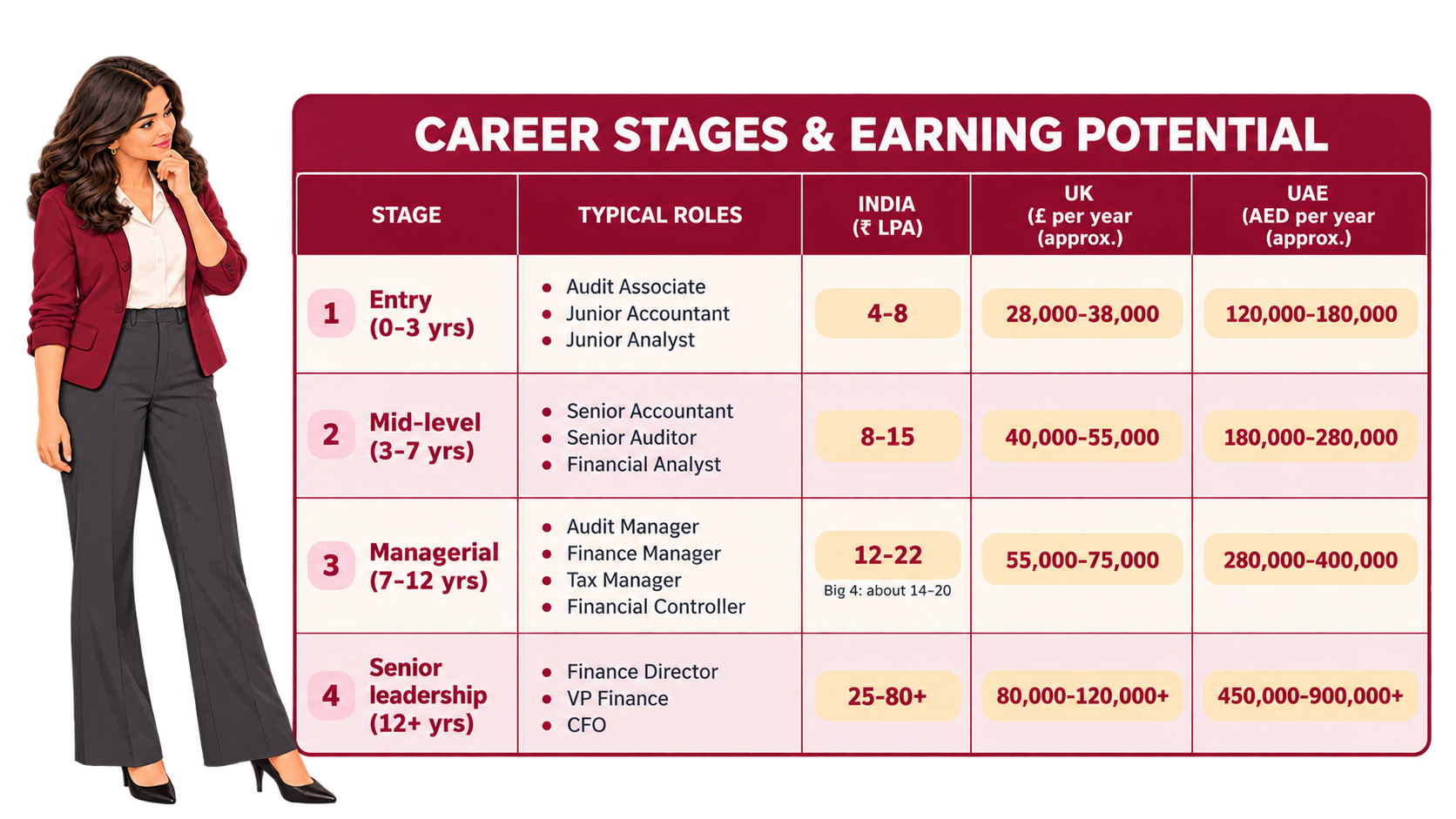
The foreign numbers look much higher. Are ACCA jobs abroad automatically better?
Not automatically. Higher gross pay abroad comes with higher living costs, and tax matters. The UAE has no personal income tax, while the UK takes a significant share through income tax and national insurance, so you should compare take-home pay, not just the headline.
Also check visa rules, local licensing, and whether employers abroad will count on your experience. Many professionals build two to four years of solid experience in India first and then move.
Anything that pushes salary up faster?
Four things: working in a Big 4 firm or a GCC early, strong IFRS and technology skills, a move from compliance work to business-facing work, and a willingness to change jobs when you have outgrown the role.
Note on the figures: India ranges are drawn from published ACCA salary guides by training providers and are indicative, not official ACCA data. UK and UAE bands are approximate illustrations built around published ranges and should be validated against current recruitment salary guides or ACCA's own research before publishing.
Future Scope of ACCA Professionals
Last big question, sir. Will ACCA jobs in Big 4, MNCs and GCCs still be a good bet in ten years?
I think so, but the winners will be people who keep upgrading. Here is where I see the demand:
- ACCA jobs in Big 4: audit, tax and advisory teams continue to hire globally skilled finance graduates, and ACCA's IFRS and audit grounding fits these roles well.
- ACCA jobs in MNCs and GCCs: global capability centers are among the fastest-growing employers of finance talent in India, handling reporting, FP&A, controllership and analytics for parent companies.
- ACCA jobs abroad: ACCA is recognized in over 180 countries, with strong communities in the UK, the UAE, Singapore and Australia, so mobility is a genuine advantage.
- Corporate finance and FP&A: businesses want finance professionals who can forecast, model and advise, not only close the books.
- Risk, ESG and sustainability reporting: new disclosure requirements are creating roles for finance people who understand assurance and reporting.
- Consulting and independent practice: experienced professionals can advise on reporting, controls and finance transformation.
What about AI? Everyone says accounting jobs will vanish.
Routine tasks like data entry, reconciliations and first-pass analysis are being automated. What stays valuable is judgement: interpreting standards, challenging assumptions, assessing risk and advising leaders. So, learn to work with AI tools, verify their output, and move up the value chain early.
So, what extra skills should I add alongside ACCA?
- Advanced Excel and a data tool such as Power BI or SQL
- ERP exposure, such as SAP or Oracle
- IFRS depth and, for some roles, a second credential
- Communication and presentation skills
- Basic understanding of AI-assisted finance workflows and their risks

Conclusion
Payel closed her notebook as the café began to fill up. She had come up with one question, "What happens after ACCA?", and left with a map: a first role to aim for, a skill to build for each promotion, and a sense of how far the ladder can go. Arvind's last advice was simple: choose a lane, learn the next skill before you need it, and treat every role as preparation for the one above it.
That is the real ACCA career path. It is not one fixed route but a set of connected ladders, and your pace depends on the skills you add and the experience you gather.
Frequently Asked Questions
1. What is the ACCA career path from fresher to senior level?
It usually runs through four stages: entry-level roles such as Audit Associate or Junior Accountant, mid-level roles such as Senior Accountant or Financial Analyst, managerial roles such as Audit Manager or Financial Controller, and senior leadership roles such as Finance Director or CFO.
2. What are the best ACCA jobs in India?
Common options include audit and assurance roles in Big 4 and mid-tier firms, accounting and reporting roles in MNCs, FP&A and corporate finance roles in GCCs, tax roles, and internal audit and risk roles.
3. What is the ACCA salary in India for freshers?
Published salary guides generally show ACCA freshers earning around ₹4-8 LPA, with Big 4 offers often around ₹5-7 LPA. The exact figure depends on your city, employer, skills, and the number of papers cleared.
4. How does ACCA salary by experience grow?
Indicative ranges show roughly ₹8-15 LPA at 3-7 years, ₹12-22 LPA at managerial level, and ₹25 LPA to ₹80 LPA or more at Finance Director and CFO level. These are market indicators, not guaranteed outcomes.
5. Can I get ACCA jobs abroad, and where?
Yes. ACCA is recognized in over 180 countries, and the UK, the UAE, Singapore and Australia are popular destinations. Check visa rules, local licensing requirements, and whether your experience will be recognized before you move.
6. Are there ACCA jobs in Big 4 firms?
Yes. Big 4 firms hire ACCA students and members into audit, tax and advisory teams. Many professionals start there to build strong technical foundations and then move into industry or senior roles.
7. Do MNCs and GCCs hire ACCA-qualified professionals?
Yes. MNCs and global capability centers hire financial reporting, FP&A, controllership, internal audit and shared-service roles, often valuing IFRS knowledge and global exposure.
8. Can an ACCA professional become a CFO?
It is possible. The route usually involves years of progressive experience, moving from reporting or auditing into business finance, leading teams, and building commercial and strategic judgement. There is no guaranteed timeline or title.
Planning to take ACCA? Explore our ACCA course