
Scared of ACCA Subjects? Cover and Clear Your Exams Easily by Following This Study Path
Scared of ACCA subjects? Follow this ACCA study plan: all 13 papers, exam pattern, 90-day plan, timetables and FAQs from ACCA’s official information.

Table of Contents
- 1. ACCA Subjects List: All Exams at a Glance
- 2. ACCA Exam Pattern and Rules you Must Know Before you Plan
- 2.1. Exam formats that ACCA publishes
- 2.2. Rules that shape your study plan
- 3. Easy vs Hard ACCA Subjects: How to Prioritize your Papers
- 3.1. How to prioritize in four steps
- 3.2. How to study difficult ACCA subjects
- 4. ACCA Study Plan: For Beginners, Working Professionals and a 90-day Sprint
- 4.1. ACCA's study-habit advice, in short
- 4.2. The 90-day ACCA study plan (one paper)
- 4.3. ACCA exam preparation while working
- 5. Bottom Line
- 6. Frequently Asked Questions
ACCA has 13 exams, three levels, and a string of paper codes that can look scary on day one. The good news is that ACCA gives you a clear order to follow: Applied Knowledge first, then Applied Skills, then Strategic Professional.
You can take papers within a level in any order, and most papers are available in four sessions a year. A study path turns "13 scary subjects" into small steps you can repeat.
This guide covers every ACCA subject, what each level tests, which papers are lighter or heavier to prepare for, how to prioritize, and how to plan if you are a beginner or a working professional.
You will also find a 90-day plan, daily and revision timetables, a mock-test strategy, and note-making techniques. Facts about the structure, exam patterns and rules come from ACCA Global's own pages, listed under Sources.
ACCA Subjects List: All Exams at a Glance
ACCA offers 15 exams, but you sit 13 of them: three Applied Knowledge, six Applied Skills, both Strategic Professional Essentials, and two of the four Options. This is the full ACCA course subjects list.
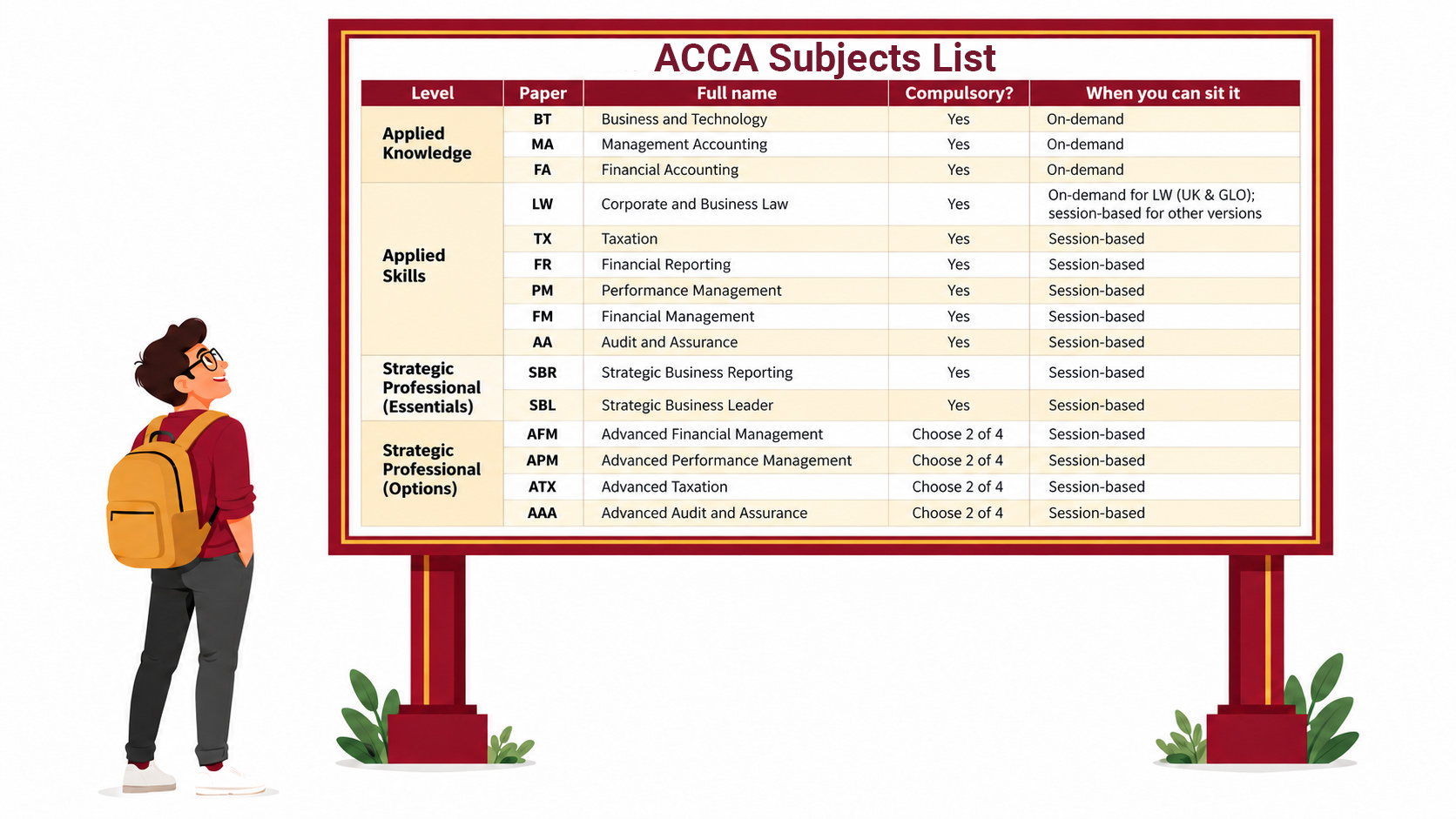
ACCA has three levels: Applied Knowledge introduces finance and accounting, Applied Skills develops practical finance skills, and Strategic Professional builds leadership, ethical, and strategic expertise with optional specializations.
Beyond exams, you must complete the Ethics and Professional Skills module and gain 36 months of relevant practical experience, including nine performance objectives approved by a supervisor.
Depending on your qualifications, exemptions may cover Foundation and up to nine Applied Knowledge and Applied Skills exams, but not Strategic Professional exams or work experience. If your qualification is older, consider refreshing your knowledge through exams or ACCA’s Get Ready Modules before claiming exemptions.
ACCA Exam Pattern and Rules you Must Know Before you Plan
All ACCA exams are computer-based. You sit at an exam center, or remotely if your country has no exam center provision. Some exams are on demand, the rest are held in four sessions a year, so the first planning decision is which type of your paper is.
| On-demand exams | Session exams | |
|---|---|---|
| Papers | BT, MA, FA, LW (UK & GLO) | LW (other versions), TX, FR, PM, FM, AA, SBR, SBL, AFM, APM, ATX, AAA |
| When | Any time of the year | March, June, September and December |
| How to book | Directly with an exam center | Through ACCA's Exam Planner, before the session booking deadline |
| Results | Shown at the end of the exam, uploaded to your account within 72 hours | About 6 weeks after the exam |
Not every exam version is offered for every session, so check out ACCA's exam availability page for your location. The pass mark for an ACCA exam is 50%.
Exam formats that ACCA publishes
| Paper | Format |
|---|---|
| BT and LW | 2-hour computer-based exam: Section A has objective questions, Section B has multi-task questions |
| FR | 3-hour computer-based exam with three sections: Section A has 15 two-mark objective questions (30%), Section B has three cases with five two-mark objective questions each (30%), and Section C holds the remaining marks as written answers. All sections are compulsory |
| SBL | 4-hour integrated case study exam. 80 marks are technical and 20 marks (20%) are professional skills |
For MA, FA, TX, PM, FM, AA, SBR and the Options, open each paper's page under ACCA's exam support resources and attempt the specimen exam on the ACCA Practice Platform, because formats are updated from time to time.
Rules that shape your study plan
- Exams must be taken in modular order: Applied Knowledge, then Applied Skills, then Strategic Professional. Within a module you can sit papers in any order.
- You can take a maximum of four exams in each exam cycle and a maximum of eight distinct exams in a calendar year.
- To enter exams in the next module, you must also enter all outstanding exams in your current module.
- You can take the Ethics and Professional Skills module at any point after Applied Knowledge. ACCA recommends completing it before you attempt the Strategic Professional exams.
- You have seven years from your first Strategic Professional pass to pass all Strategic Professional exams. Passes older than seven years have to be retaken.
Plan around the 2027 transition. ACCA's published timeline lists June 2027 as the final sitting of the current Applied Skills and Strategic Professional exams. New Knowledge exams are available on demand from July 2027, and new Expertise and Strategic Professional exams start in September 2027, including a new Option exam called Data Science Professional. If you are studying now, check ACCA's Transition Tool and the future-qualification pages before you fix your exam calendar.
Easy vs Hard ACCA Subjects: How to Prioritize your Papers
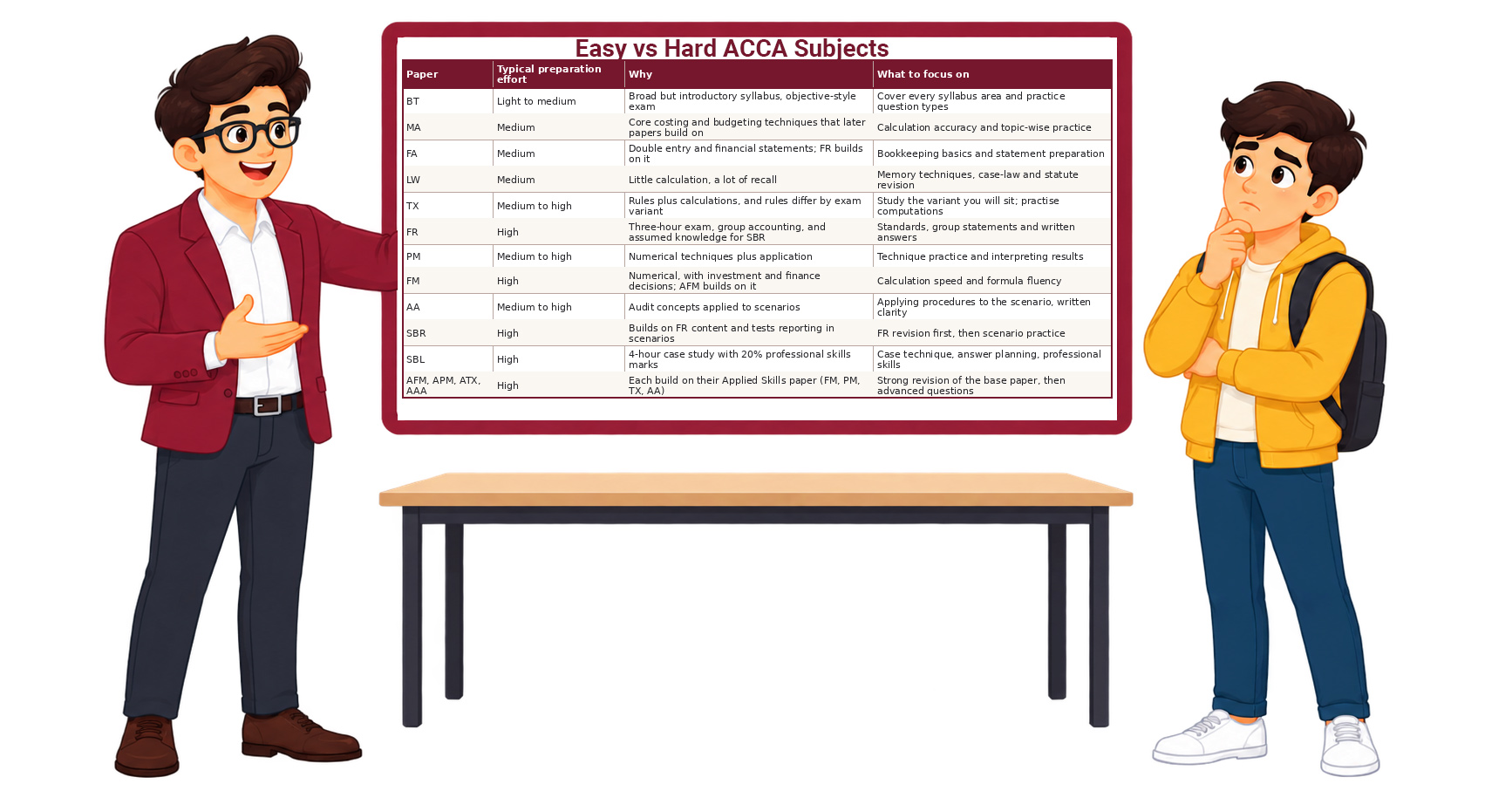
No ACCA paper is easy for everyone. How hard a paper feels depends on your degree, work experience, and how much time you can give it. ACCA publishes pass rates after each exam session, so check the latest figures before you decide.
The table below is a preparation-effort guide based on what each paper asks of you, not an ACCA statistic.
How to prioritize in four steps
- Map dependencies. FR matters for SBR, and the Applied Skills papers feed the matching Options. Do not rush through a paper that a later paper assumes you know.
- Match papers to your strengths. Use your degree, work experience and ACCA's Get Ready Modules to find gaps before you choose your first paper.
- Pair a heavy paper with a lighter one. If you sit two papers in one session, avoid pairing two high-effort papers.
- Plan backwards from the exam date. Count the weeks left, split them across syllabus coverage, question practice and revision, and book the exam first, so the date is fixed.
How to study difficult ACCA subjects
- Break the syllabus into topic clusters and finish one cluster before starting the next.
- Attempt questions early rather than after the whole syllabus is covered.
- Keep an error log and review it every week.
- Read the examiner's reports and practice past exam questions from ACCA's study resources.
- Ask your tutor for doubt-clearing on the same day, not at the end of the month.
- Practice full papers on ACCA's Practice Platform under timed conditions.
ACCA Study Plan: For Beginners, Working Professionals and a 90-day Sprint
A good ACCA study plan is built from three things: how much time you really have, how far away the exam date is, and how heavy the paper is. ACCA's own study habits guidance gives a useful base for all three.
ACCA's study-habit advice, in short
- Break revision into small chunks and make a plan, so you never start a day wondering what to study.
- Schedule free time and protect it. If you slip off schedule, start again the next day.
- Pick the time and place where you concentrate best.
- Take frequent breaks, because people can concentrate properly for only about 30 to 45 minutes at a stretch. Walk or make tea instead of staying at the screen.
- Aim for about 8 hours of sleep and stay hydrated.
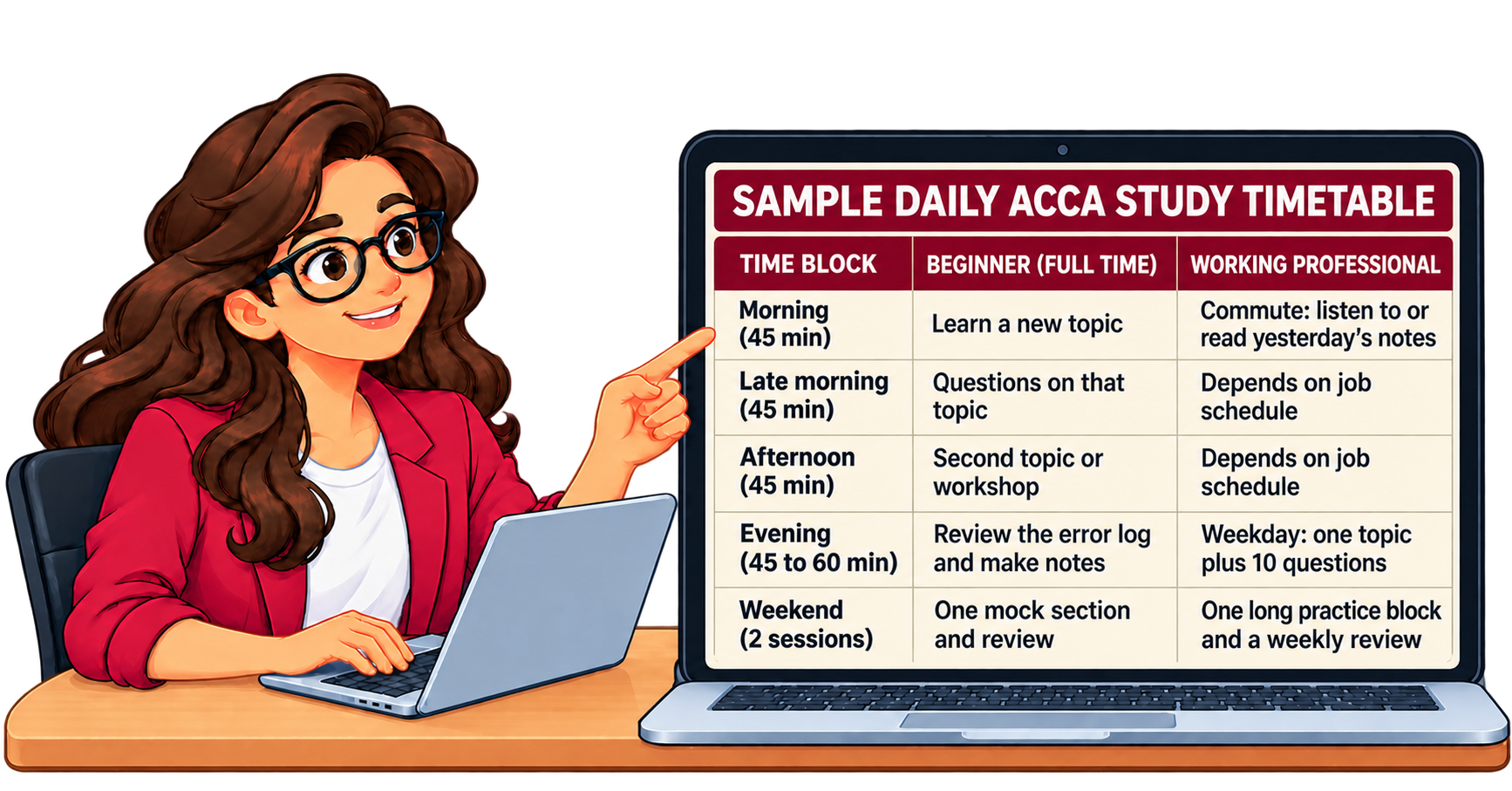
How many hours should I study daily? ACCA does not prescribe a daily number, so build your own from the exam date. The sample budgets below are planning assumptions, not ACCA requirements. Adjust them after your first two weeks.
| Student type | Sample weekly budget | Sample pattern |
|---|---|---|
| Beginner, studying full time | 20 to 25 hours | 3 to 4 hours a day, one lighter day, one revision day |
| Working professional | 10 to 14 hours | 1.5 to 2 hours on weekdays, 4 to 5 hours on the weekend |
The 90-day ACCA study plan (one paper)
| Days | Phase | What you do | Checkpoint |
|---|---|---|---|
| 1 to 30 | Learn | Read the syllabus and study guide, cover topics in clusters, do questions after each topic | Syllabus covered once, error log started |
| 31 to 60 | Practice | Question practice by topic, weak-area repair, make summary notes | Topic tests scored, weak topics listed |
| 61 to 80 | Revise | Timed past questions, formula and rule sheets, revisit the error log | Two timed papers completed |
| 81 to 90 | Mock and polish | Full mocks on the ACCA Practice Platform, light revision, exam-day checks | Final mock reviewed, exam logistics confirmed |
For session exams, book before ACCA's deadline and count your 90 days back from the exam week. For on-demand exams, book a date with your exam center as soon as you start so the plan has a finish line.
ACCA exam preparation while working
- Fix your study slots in your calendar and treat them like meetings.
- Pick one paper per session and choose on-demand papers when work is unpredictable.
- Book the exam early, so a fixed date protects your time.
- Tell your manager your exam dates in advance and plan leave for the final week.
- Use weekends for question practice and weekdays for short theory blocks.
Beginner's first 30 days: Read the ACCA qualification structure, check the exam availability and booking page for what is offered in your location, try ACCA's Get Ready Modules, pick your first paper from the section above, then follow the 90-day plan.
Bottom Line
ACCA looks heavy only when you see all 13 exams at once. Once you know the three levels, the exam pattern and the rules, the path is simple: choose a sensible first paper, fix your exam date, study in short daily blocks, practice on ACCA's own exam software, revise in cycles and sit timed mocks. Start with one paper, finish it well and let each pass build your confidence for the next.
Before you lock your calendar, check ACCA's website for the latest exam dates, rules and the 2027 transition. If you would like help turning this path into a paper-by-paper plan, talk to the Simandhar Education counselling team.
[Simandhar team to add CTA line and link.]
Frequently Asked Questions
1 How can I pass ACCA exams on the first attempt?
There is no shortcut, but ACCA's own resources give you a strong base. Start with the syllabus and study guide, attempt the specimen exam on the ACCA Practice Platform, practice past exam questions, and read the examiner's reports. Practice under timed conditions and look after your sleep and breaks in the final weeks.
2 Which ACCA subjects are the hardest?
It depends on your background and study time, so ACCA does not name one hardest paper. ACCA publishes pass rates after each session, which is the best place to compare papers. As a planning guide, papers with long exams, group accounting, heavy calculations or case studies, such as FR, FM, SBR and SBL, usually need more preparation time.
3 Can I attempt two ACCA papers together?
Yes. ACCA allows a maximum of four exams in each exam cycle and eight distinct exams in a calendar year. If you take two papers, pair a heavier paper with a lighter one, and sit one paper per session if you are working full time.
4 Which ACCA paper should I attempt first?
You must start with Applied Knowledge (BT, MA, and FA), and you can take these three in any order. Students new to finance often begin with BT, and students with an accounting background often begin with FA or MA. This is planning advice, not an ACCA rule.
5 How should I prepare for ACCA Applied Knowledge?
BT, MA and FA are on-demand computer-based exams, so you can book them when you are ready. ACCA's guidance for on-demand exams advises starting with the syllabus and study guide, using the study support guide, and not practicing objective questions alone, because these exams also include multi-task questions.
6 How should I study ACCA Applied Skills subjects?
Applied Skills papers other than LW (UK & GLO) are held in the March, June, September, and December sessions. FR, for example, is a three-hour exam in three sections, so practice full written answers as well as objective questions. ACCA's CBE Practice Platform lets you get used to the word-processing and spreadsheet tools used in session exams.
7 How many hours should I study daily?
ACCA does not set a daily number. Plan from your exam date and the weight of the paper and split your time into short blocks. ACCA notes that people can concentrate properly for only about 30 to 45 minutes at a time and recommends about 8 hours of sleep.
8 How long do ACCA results take?
On-demand exam results show at the end of the exam and are uploaded to your account within 72 hours. Session exam results arrive about 6 weeks after the exam.
9 Is there a time limit to finish ACCA?
Yes, for Strategic Professional. You have seven years from your first Strategic Professional pass to pass all the Strategic Professional exams, otherwise passing older than seven years must be retaken.
10 How many papers are left if I get exemptions?
ACCA can award exemptions across the nine Applied Knowledge and Applied Skills exams, depending on your earlier qualifications. It does not award exemptions for Strategic Professional exams or for work experience. Use ACCA's exemptions calculator to see your own position.
11 Will the 2027 changes affect my study plan?
ACCA's timeline lists June 2027 as the final sitting of the current Applied Skills and Strategic Professional exams, with new Knowledge exams from July 2027 and new Expertise and Strategic Professional exams from September 2027. Check ACCA's Transition Tool and timeline page before you fix your exam calendar.
12 How can Simandhar Education help with ACCA preparation?
Simandhar Education can help you turn this path into a paper-by-paper calendar and keep you on track through your sessions.
Planning to take ACCA? Explore our ACCA course