
ACCA Eligibility for MBA Graduates: The Complete Guide
Are MBA graduates eligible for ACCA? See exemptions after MBA Finance, papers to sit, course duration, Big 4 jobs and career options in one guide.
Table of Contents
- 1. ACCA Eligibility for MBA Graduates: The Complete Guide
- 2. Are MBA Graduates Eligible for ACCA?
- 2.1. What if my MBA wasn't in finance?
- 2.2. What you'll need to register
- 3. Why MBA Graduates Add ACCA
- 4. ACCA Exemptions after MBA Finance
- 4.1. How to check your exemptions
- 5. ACCA Papers after MBA Finance
- 6. ACCA Course Duration after MBA
- 7. ACCA Career Opportunities after MBA
- 8. Jobs after MBA Finance and ACCA
- 8.1. Can MBA + ACCA Candidates Work in Big 4 firms?
- 9. Is ACCA after MBA Worth?
- 10. Frequently Asked Questions
- 10.1. Do I need an accounting background to do ACCA after an MBA?
- 10.2. Will a marketing or HR MBA get exemptions?
- 10.3. Can I skip the Strategic Professional exams because of my MBA?
- 10.4. Can I work full time while doing ACCA after MBA?
- 10.5. Can ACCA members sign audit reports in India?
- 10.6. Is ACCA recognized outside India?
ACCA Eligibility for MBA Graduates: The Complete Guide
You already have an MBA. So why add another qualification? Because ACCA after MBA gives you something, most MBAs don't: a globally recognized accounting credential, and your degree may already cover a few of its papers. This guide covers ACCA eligibility for MBA graduates, exemptions, papers, timeline and the jobs on the other side.
Are MBA Graduates Eligible for ACCA?
Yes. ACCA's eligibility after MBA is simple: your degree meets the entry requirement, so you can register directly for the ACCA Qualification. You don't need an accounting background, and you don't need a finance specialization to apply.
The specialization matters for something else, though. It shapes how many papers you can skip.
What if my MBA wasn't in finance?
You're still eligible. You'll just find fewer exemptions, or none, because ACCA looks at what your programme actually taught. A marketing or HR MBA rarely covers financial reporting in depth.
What you'll need to register
Keep your degree certificate, semester marksheets, and a valid ID ready. If you're claiming exemptions, ACCA reviews your transcripts before confirming anything.
Why MBA Graduates Add ACCA
Think of the two different halves of the same job. The MBA gives you strategy, leadership, and network. ACCA gives you technical depth in reporting, tax, audit and financial management, the stuff a CFO expects you to know cold.
Hiring managers notice that combination. A candidate who can build a business case and also defend the numbers behind it is easier to trust with a bigger scope. It's also useful if you want to move abroad. ACCA is built for international portability, while an MBA on its own can be judged by the reputation of the school.
There's a practical benefit too. Because you're starting with a degree behind you, the early papers tend to feel familiar, and that helps you build momentum.
ACCA Exemptions after MBA Finance
Here's the rule that trips people up. ACCA can exempt you from the nine exams in Applied Knowledge and Applied Skills. It never exempts you from the four Strategic Professional exams, and it doesn't grant exemptions for work experience (ACCA exemption information).
So how many ACCA exemptions can I get after MBA? In ACCA's own exemption handbook, an MBA maps to three papers: Business and Technology (BT), Management Accounting (MA) and Financial Accounting (FA) (ACCA exemption handbook). Some programmes earn more, some earn less. You'll see training websites quoting anything from two to nine, and that spread exists for a reason: ACCA assesses each university's syllabus separately.
That's also true of ACCA exemptions for postgraduates in general. ACCA does accredit postgraduate qualifications, but there's no blanket "MBA equals X papers" rule.
How to check your exemptions
Use ACCA's own exemptions calculator. Pick India, your university and your degree. Offered exemptions then appear in your My ACCA account, where you accept and pay for them. Do this before you plan your study calendar.
ACCA Papers after MBA Finance
Assume you're exempt from BT, MA, and FA. What are the ACCA papers after MBA Finance? You'd sit these:
| Level | Papers |
|---|---|
| Applied Skills (6) | Corporate and Business Law (LW), Performance Management (PM), Taxation (TX), Financial Reporting (FR), Audit and Assurance (AA), Financial Management (FM) |
| Strategic Professional (4) | Strategic Business Leader (SBL), Strategic Business Reporting (SBR), plus two options from AFM, APM, ATX or AAA |
On top of the exams, there's the Ethics and Professional Skills module and 36 months of practical experience. The experience usually runs alongside your exams, so it isn't an extra three years.
ACCA Course Duration after MBA
Ten papers, if you get the standard three exemptions. ACCA holds exam sessions four times a year, and most working professionals take two or three papers per session at a comfortable pace.
That puts a realistic finish for the exams in about two to three years. Since the 36 months of experience runs in parallel, full membership often lands around the three-year mark. Treat that as a planning estimate, not an ACCA promise. Your pace resits and your job decides the real number.
Studying full time? You can compress it. Working sixty-hour weeks in consulting? Give yourself more room.
ACCA Career Opportunities after MBA
An MBA teaches you how a business runs. ACCA proves you can read its numbers. Together they point at roles where strategy and finance meet: finance controller, FP&A lead, financial reporting and IFRS, internal audit, risk advisory, treasury and corporate finance.
Demand is visible in the open. ACCA's own job board lists 746 live roles in India right now, with Maharashtra and Karnataka far ahead of everywhere else.
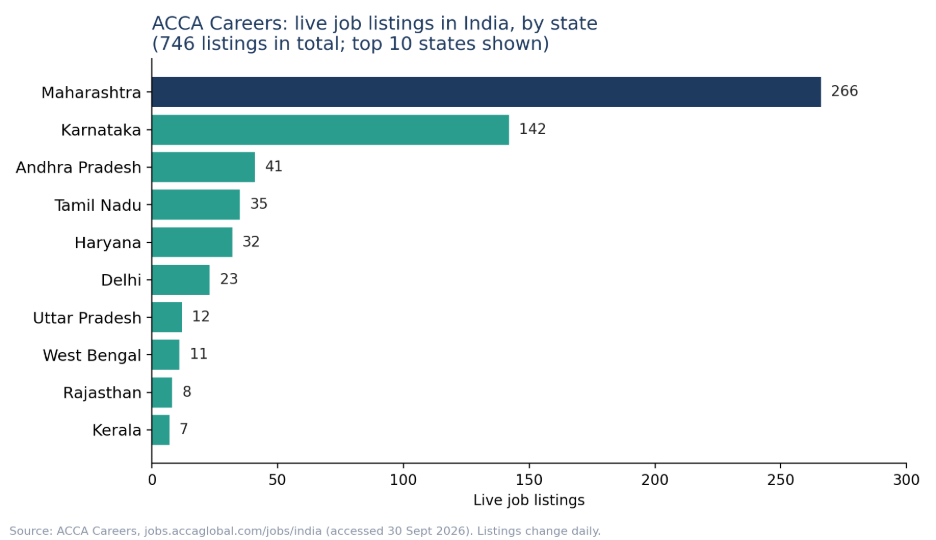
Source: Live listings on ACCA Careers, accessed 30 September 2026. Source: ACCA Careers India. Numbers change daily.
Jobs after MBA Finance and ACCA
What jobs can I pursue after MBA and ACCA? A few common routes:
- Corporate finance and FP&A: budgeting, forecasting and business partnering with leadership.
- Financial reporting and controllership: IFRS reporting, month-end close, group consolidation.
- Audit, tax and advisory: in professional services firms and in-house teams.
- Risk, treasury and M&A support: roles where the MBA's strategy lens helps.
- Global capability centers and shared services: large employers in Indian metros.
Can MBA + ACCA Candidates Work in Big 4 firms?
Yes. Deloitte, PwC, EY and KPMG all hire ACCA students and members. ACCA Careers regularly carries India openings from approved employers, including roles at EY India that ask for ACCA students or members.
One honest limit. ACCA members can't sign statutory audit reports in India. That right belongs to Chartered Accountants under ICAI. For most Big 4 audit support, tax, advisory and finance roles, though, it doesn't get in the way.
Is ACCA after MBA Worth?
If you're aiming at finance leadership, international mobility or a Big 4 or multinational career, yes, it's a strong add-on. ACCA reports 257,900 members and 530,100 future members across 180 countries (ACCA), so the credential travels well.
If your MBA was marketing or HR and you want to stay there, the payoff is smaller. Be clear on where you're headed before you register.
Start with the exemption calculator. It takes two minutes, and it tells you how long your road is.
Frequently Asked Questions
1. Do I need an accounting background to do ACCA after an MBA?
No. ACCA doesn't ask for accounting experience at registration. If your MBA had no accounting content, you'll simply sit on more papers.
2. Will a marketing or HR MBA get exemptions?
Possibly none. ACCA assesses what your programme covers, and financial reporting or management accounting content is what earns credit. Run your university through the calculator to see.
3. Can I skip the Strategic Professional exams because of my MBA?
No. ACCA doesn't grant exemptions for any Strategic Professional paper, whatever your qualification.
4. Can I work full time while doing ACCA after MBA?
Most candidates do. Exams run four times a year, so you can take one or two papers per session and let your job count toward the practical experience requirement.
5. Can ACCA members sign audit reports in India?
Not for statutory audits. That is reserved for Chartered Accountants. ACCA members still work across audit, tax, advisory and finance roles in India.
6. Is ACCA recognized outside India?
Yes. ACCA operates in 180 countries, and its qualification is widely recognized by employers in the UK, Middle East, Asia Pacific and beyond.
Planning to take ACCA? Explore our ACCA course