
Binny Patalia’s CPA Journey at 42 From CA to CPA After 17 Years
A detailed case study on how Binny Patalia transitioned from CA to CPA after a 17 year academic gap using structured preparation and disciplined execution.
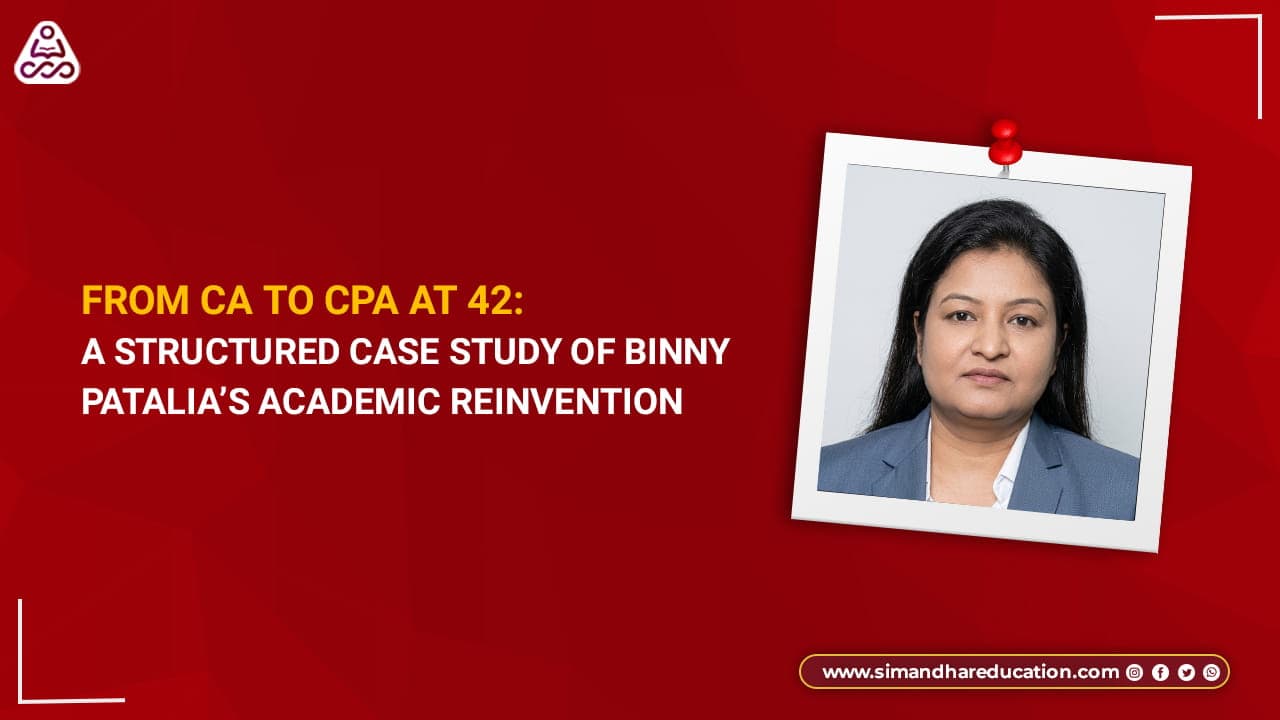
Table of Contents
- 1. From CA to CPA at 42: A Structured Case Study of Binny Patalia’s Academic Reinvention
- 2. Introduction
- 3. Academic Re-entry After a Prolonged Gap
- 4. Cognitive and Behavioral Barriers in Adult Learning
- 5. Strategic Rationale Behind Choosing CPA
- 5.1. Professional Considerations
- 5.2. Personal Motivation
- 6. Preparation Architecture and Study Design
- 7. Resource Optimization: Becker and Simandhar
- 8. Revision Depth and Practice Intensity
- 9. Comparative Evaluation: CPA versus CA
- 10. Environmental and Social Enablers
- 11. Actionable Insights for Aspirants
- 12. Conclusion
From CA to CPA at 42: A Structured Case Study of Binny Patalia’s Academic Reinvention
Introduction
Mid-career academic reinvention remains an underexplored yet increasingly relevant phenomenon in professional education. Binny Patalia’s journey presents a compelling case of cognitive re-engagement, disciplined execution, and strategic career repositioning.
At the age of 42, following a 17 year disengagement from structured academic study, she undertook the Certified Public Accountant qualification. This decision was not incidental. It was anchored in both professional foresight and personal intent.
Academic Re-entry After a Prolonged Gap
Re-entering an academic environment after nearly two decades presents non-trivial challenges. The issue is not intellectual capability but cognitive conditioning.
For Binny, the initial phase was characterized by:
- Reduced attention span for prolonged study
- Difficulty in sustaining conceptual focus
- Psychological resistance to structured learning routines
The transition required deliberate habit reconstruction. She initiated the process with limited daily study hours, gradually restoring her cognitive endurance.
Cognitive and Behavioral Barriers in Adult Learning
Adult learners often encounter friction that traditional students do not. These include competing responsibilities, mental fatigue, and diminished academic continuity.
Binny’s experience reflects three critical barriers:
- Attention Fragmentation due to external responsibilities
- Delayed Cognitive Recall after long academic inactivity
- Motivational Volatility during early preparation stages
Her response to these constraints was methodical. She prioritized consistency over intensity and allowed cognitive adaptation to occur progressively.
Strategic Rationale Behind Choosing CPA
Professional Considerations
The decision to pursue CPA was informed by observable market dynamics.
- Increasing global demand for CPA-qualified professionals
- Expansion of outsourced finance functions to India
- Emergence of flexible and remote accounting roles
- Reduced dependency on geographically constrained employment
This reflects a clear alignment between qualification choice and evolving industry structure.
Personal Motivation
Equally significant was the symbolic dimension of her decision.
She aimed to establish a behavioral precedent for her children. The underlying message was that education is not temporally bounded.
This transformed the journey from a purely professional pursuit into an intergenerational signal of lifelong learning.
Preparation Architecture and Study Design
Her preparation strategy demonstrates a structured and adaptive framework.
Phase 1: Habit Formation
She began with 2 to 3 hours of daily study to rebuild consistency.
Phase 2: Cognitive Scaling
Study duration was gradually increased to 5 to 6 hours as mental endurance improved.
Phase 3: Strategic Subject Selection
She deliberately selected FAR as the entry point. This functioned as a filtering mechanism.
The logic was binary. Clearing the most demanding subject would validate continuation.
This decision reflects risk containment and psychological commitment structuring.
Resource Optimization: Becker and Simandhar
Her preparation was not resource-heavy but resource-efficient.
- Utilized for structured conceptual clarity
- Enabled faster content consumption
- Aligned with her prior accounting foundation
- Used selectively for conceptual reinforcement
- Provided clarity in areas of confusion
- Offered pedagogical depth for foundational strengthening
Her initial perception of pacing differences evolved into an understanding of audience segmentation in teaching design.
Revision Depth and Practice Intensity
A defining feature of her preparation was repetition discipline.
- Three complete revisions per subject
- Full coverage of MCQs, SIMs, and practice modules
- Multiple iterations of practice tests
- Comprehensive mock exam participation
This indicates an emphasis on retrieval practice and applied understanding rather than passive learning.
She also observed that exam difficulty is calibrated below high-intensity mock environments, reinforcing the value of rigorous preparation systems.
Comparative Evaluation: CPA versus CA
Her dual exposure enables a grounded comparison.
CPA Advantages
- Defined completion timelines
- Outcome predictability
- Application-oriented assessment structure
- Strong global portability
CA Structural Constraints
- Indeterminate completion duration
- High variability in result patterns
- Extended time investment
Her conclusion is pragmatic. CPA demonstrates a more efficient input-to-outcome ratio in the current professional landscape.
Environmental and Social Enablers
No high-effort academic pursuit occurs in isolation.
Her success was supported by:
- A cooperative domestic environment
- Spousal understanding and emotional support
- Peer interaction through active student communities
These elements collectively reduced friction and sustained momentum.
Actionable Insights for Aspirants
Her experience yields several transferable principles.
- Maintain daily academic contact, even at minimal duration
- Avoid discontinuity, as re-entry cost is high
- Prioritize practice over passive consumption
- Accept imperfection in preparation and proceed with execution
- Use community ecosystems for doubt resolution and motivation
The emphasis is on continuity rather than intensity.
Conclusion
Binny Patalia’s journey represents a high-discipline model of late-stage academic re-engagement.
It challenges conventional assumptions about age, learning capacity, and career timing.
More importantly, it demonstrates that structured effort, when aligned with strategic intent, can produce outcomes independent of starting point.
Her case is not exceptional because of circumstances. It is instructive because of execution.
Planning to take CPA? Explore our CPA course