
CPA After B.Com: Rushant Shah’s Journey from CA Articleship to Global Career
Explore how Rushant Shah transitioned from CA articleship to CPA after B.Com, his preparation strategy, challenges, and why CPA became the right choice.
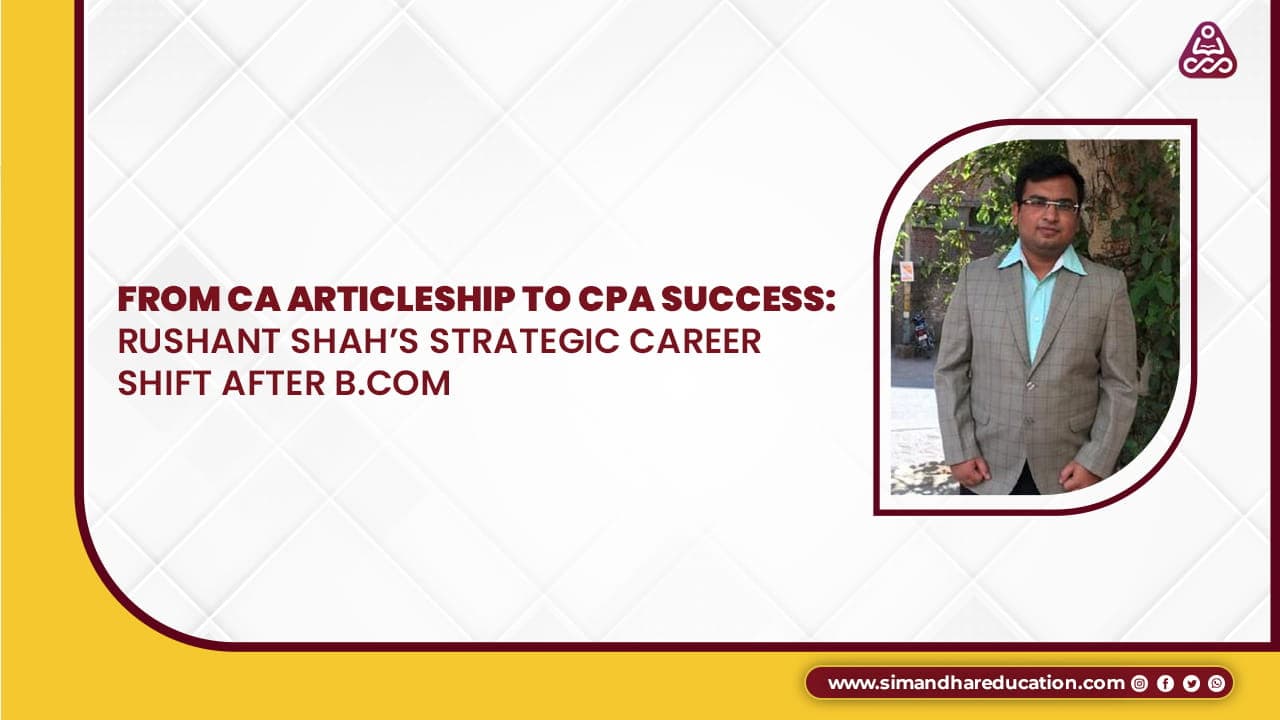
Table of Contents
- 1. Introduction
- 2. The Starting Point: B.Com and CA Direct Entry
- 2.1. Practical Exposure Through Articleship
- 3. The Turning Point: Why Rushant Shah Shifted from CA to CPA
- 3.1. Reassessing Career Alignment
- 3.2. Choosing a Globally Relevant Qualification
- 4. Understanding CPA vs CA: A Structural Difference
- 4.1. Focused Exam Framework
- 4.2. Flexibility in Preparation
- 5. Discovering CPA: The Role of Peer Influence
- 5.1. Importance of the Right Learning Environment
- 6. The CPA Learning Experience: Concept Over Memorization
- 6.1. Conceptual Depth and Application
- 6.2. Adapting to Exam Simulations
- 7. Navigating the CPA Admission Process
- 7.1. Structured Support and Clarity
- 8. Exam Strategy and Preparation Approach
- 8.1. Breaking Down the Syllabus into Manageable Parts
- 8.2. Subject-Based Time Allocation
- 9. Overcoming Challenges in CPA Preparation
- 9.1. The Delay in Attempting the First Exam
- 9.2. Learning Through Attempts
- 10. Study Routine and Time Investment
- 10.1. Daily Study Discipline
- 10.2. Adapting Based on Exam Requirements
- 11. The Role of Coaching and Study Resources
- 11.1. Concept Clarity Through Lectures
- 11.2. Practice and Question Banks
- 12. Key Advice from Rushant Shah to Aspirants
- 12.1. Focus on Daily Progress
- 12.2. Simplify Complex Topics
- 12.3. Maintain Consistency
- 13. About Simandhar Education
- 14. Conclusion
Table of Contents
Introduction
Career paths in accounting are rarely linear, and Rushant Shah’s journey reflects how clarity evolves with experience. After completing his Bachelor of Commerce, Rushant initially chose the Chartered Accountancy route through direct entry.
However, after completing articleship and facing repeated challenges in clearing CA Intermediate, he made a conscious decision to shift toward the US CPA qualification. This transition was not driven by convenience, but by alignment with his learning style, career expectations, and long-term goals.
The Starting Point: B.Com and CA Direct Entry
After completing B.Com, Rushant Shah entered the CA program through the direct entry route, which allowed him to begin directly at the Intermediate level. Alongside his studies, he undertook a three-year articleship, which served as his primary professional exposure.
Practical Exposure Through Articleship
articleship helped Rushant understand real-world accounting environments and client-facing responsibilities. It strengthened his practical foundation. However, the academic structure of CA, with its extensive syllabus and multiple papers across groups, created sustained pressure.
Despite being close to clearing one group, consistent success remained difficult due to preparation gaps and the cumulative nature of the syllabus.
The Turning Point: Why Rushant Shah Shifted from CA to CPA
The decision to move away from CA required both self-awareness and clarity.
Reassessing Career Alignment
Rushant was committed to building a career in accounting. However, he realized that continuing on a path without measurable progress would only extend uncertainty.
He evaluated whether his efforts were aligned with outcomes and began exploring alternatives.
Choosing a Globally Relevant Qualification
Through a friend, Rushant learned about CPA. The idea that a globally recognized qualification could offer similar professional value with a more structured approach made him seriously consider the shift.
This marked a turning point where he chose direction over persistence without progress.
Understanding CPA vs CA: A Structural Difference
A major factor influencing Rushant Shah’s decision was the difference in structure between the two qualifications.
Focused Exam Framework
CA involves multiple levels and a large number of papers, making it a long-duration commitment.
CPA, on the other hand, consists of four papers. This allows candidates to focus deeply on one subject at a time, improving retention and reducing mental fatigue.
Flexibility in Preparation
Rushant found that CPA offered flexibility in planning. Each subject could be prepared within a defined timeframe, often two to three months, which enabled consistent progress and better time management.
Discovering CPA: The Role of Peer Influence
Rushant Shah’s introduction to CPA came through a peer who was already enrolled in the program.
Importance of the Right Learning Environment
After attending demo sessions, he observed that the teaching methodology emphasized conceptual clarity. This was a significant shift from rote-based preparation and aligned with his preferred way of learning.
This clarity gave him confidence in making the transition.
The CPA Learning Experience: Concept Over Memorization
One of the most defining aspects of Rushant Shah’s CPA journey was the emphasis on understanding rather than memorizing.
Conceptual Depth and Application
CPA requires candidates to apply concepts in practical scenarios. This approach builds strong technical understanding and reduces dependency on memorization.
Rushant found this method more engaging and effective for long-term retention.
Adapting to Exam Simulations
Initially, the simulation-based questions were unfamiliar. However, by breaking them into smaller components and practicing consistently, he developed the ability to approach them with confidence.
Navigating the CPA Admission Process
The CPA admission process includes credit evaluation, documentation, and eligibility verification.
Structured Support and Clarity
Rushant Shah experienced a smooth admission process due to consistent guidance and quick resolution of queries. Having clarity at every step reduced uncertainty and allowed him to focus on preparation.
Exam Strategy and Preparation Approach
Rushant Shah’s preparation strategy played a crucial role in his success.
Breaking Down the Syllabus into Manageable Parts
Instead of viewing each subject as a large volume of content, he divided it into smaller sections. This approach made preparation more structured and reduced psychological pressure.
Subject-Based Time Allocation
Preparation time varied depending on the subject. While some subjects like REG were completed within a shorter duration, others like AUD required more time and multiple revisions.
Overcoming Challenges in CPA Preparation
Every professional journey includes phases of uncertainty, and Rushant’s journey was no exception.
The Delay in Attempting the First Exam
Rushant initially took several months before attempting his first CPA exam due to uncertainty about the exam pattern. This hesitation is common among students transitioning from traditional exam systems.
Learning Through Attempts
In AUD, his first attempt resulted in a score close to passing. This experience highlighted the importance of deeper preparation. With additional effort and better clarity, he cleared the subject in the next attempt.
Study Routine and Time Investment
Consistency was central to Rushant Shah’s success.
Daily Study Discipline
During the early stages, he studied for five to six hours daily. As exams approached, he increased this to seven to eight hours, and in certain cases, up to ten hours per day depending on the subject.
Adapting Based on Exam Requirements
Rushant adjusted his study intensity based on subject complexity, which allowed him to optimize both time and output.
The Role of Coaching and Study Resources
A combination of lectures and practice tools supported Rushant’s preparation.
Concept Clarity Through Lectures
Lectures helped him build a strong conceptual foundation, which is essential for CPA.
Practice and Question Banks
Advanced practice questions often exceeded the difficulty level of the actual exam. This helped him develop confidence and handle exam pressure effectively.
Key Advice from Rushant Shah to Aspirants
Rushant Shah emphasizes that success comes from approach and mindset.
Focus on Daily Progress
Instead of being overwhelmed by the entire syllabus, focus on completing daily targets.
Simplify Complex Topics
Breaking topics into smaller parts improves understanding and makes preparation more manageable.
Maintain Consistency
Discipline and regularity are more important than short bursts of effort.
About Simandhar Education
Simandhar Education has established itself as a leading institution in India for global accounting certifications such as CPA, CMA, and EA. What differentiates Simandhar is not only its academic support but the complete ecosystem it provides to students. From the initial stage of profile evaluation and credit assessment to final exam preparation and career guidance, the institution ensures that students are supported at every step.
The faculty at Simandhar focuses on building deep conceptual clarity rather than surface-level understanding. This approach becomes critical in exams like CPA, where application and analysis matter more than memorization. Students also benefit from structured study plans, regular doubt-solving sessions, and access to curated resources that align with global exam standards.
In addition to academics, Simandhar plays a significant role in shaping career outcomes. Through placement assistance, industry connections, and continuous mentorship, students are guided not only to clear exams but to build meaningful careers in global accounting roles. For students like Rushant Shah, this structured support system becomes a key enabler in transitioning from uncertainty to clarity and ultimately to professional success.
Conclusion
Rushant Shah’s journey demonstrates that career decisions should be guided by clarity, not just persistence. Moving from CA to CPA was a strategic decision that aligned better with his strengths and goals.
CPA provided him with a structured, concept-driven pathway and opened doors to global opportunities in accounting and finance.
Planning to take CPA? Explore our CPA course