
CPA Exam Passed vs Licensed CPA: Job Application Guide
Passed all four CPA exams but not licensed? Learn what to select on job applications, what CPA license means, and how Indian candidates can get licensed.
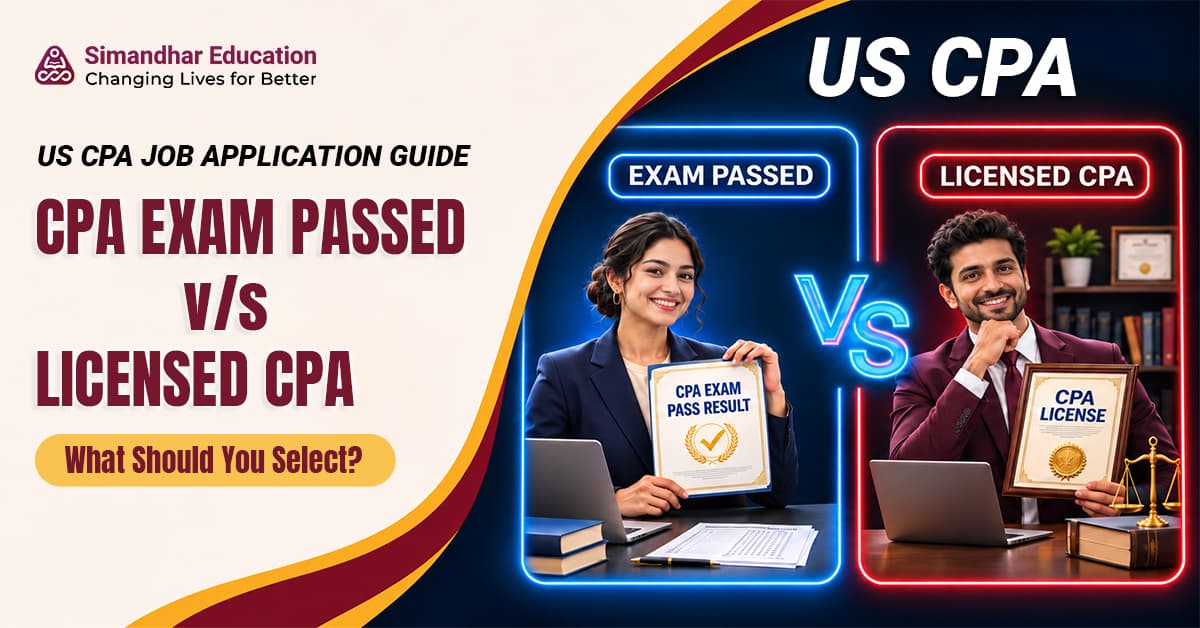
Table of Contents
- 1. CPA Exam Passed vs Licensed CPA: What Should You Select on Job Applications?
- 2. CPA Exam Completion vs. CPA Licensure
- 3. What "CPA License" Means on a Job Application
- 4. How to Answer the Common Application Questions
- 4.1. "Have you passed all parts of the US CPA exam?"
- 4.2. "Do you have or plan to pursue a CPA license?"
- 4.3. What to select if you passed all CPA exams but are not licensed
- 5. Using the CPA Title, Resumes and Job Eligibility
- 5.1. Can you call yourself a CPA after passing the exams?
- 5.2. How to mention CPA exams passed on a resume
- 5.3. Can you apply for CPA jobs after passing all four exams?
- 5.4. Do you need a license to work in accounting?
- 6. CPA License Questions in Deloitte Applications
- 7. Can Indian Candidates Become Licensed US CPAs?
- 7.1. Exam
- 7.2. Education evaluation
- 7.3. Licensure
- 8. The US CPA Licensing Process, Step by Step
- 9. Conclusion
- 10. Frequently Asked Questions
CPA Exam Passed vs Licensed CPA: What Should You Select on Job Applications?
Passing all four CPA exam sections does not make you a licensed CPA. A state board of accountancy grants the license only after you also meet its education, experience and, in most states, ethics requirements. On job applications, select an "exam passed" or "CPA eligible" status honestly, and choose "licensed" only once your board has issued your license.
This guide explains what each status means, how to read common application questions, how Deloitte-style forms phrase them, and what Indian candidates should know.
CPA Exam Completion vs. CPA Licensure
Passing the Uniform CPA Examination proves you cleared the technical test. Licensure is a separate legal step: each State Board of Accountancy sets its own education, experience and ethics rules and issues the license. Recruiters tend to call the first stage "CPA exam completion status" and the second "CPA license status."
NASBA sits between the two. Its CPA Examination Services division administers the exam in 31 jurisdictions and, according to the Tennessee State Board of Accountancy, sends the board a candidate file with your exam grades and education records. Tennessee warns that this can take 8 to 10 weeks after your last passing score.
Tennessee also shows how the license step differs from the exam. It offers two pathways: 150 education hours plus one year of experience, or 120 hours plus two years. Applicants must also pass an AICPA ethics exam with 90% or better and may apply for the license only after the board confirms it has received the candidate file. Other states differ, so always read your own board page.
Certificate vs. license. Boards use these words loosely. Tennessee's page, for instance, speaks of an initial certificate and a license application within one process. Treat a score report, an exam completion notice or a certificate-style document as proof of passing, not of being licensed. Licensed status is shown by the board's own record, and Tennessee's board, for example, lists a "Verify a License" tool.
What "CPA License" Means on a Job Application
On an application, "CPA license" means the license a state board has issued to you, not the exam you passed. Forms use it as a status declaration: a way to sort applicants by how far they are from being able to sign work as a CPA. Employers may check the answer against board records, so accuracy matters.
The four statuses below cover almost every answer a candidate needs to give.
| Status | What it means | Can you call yourself a CPA? |
|---|---|---|
| Exam candidate | You are still passing sections | No |
| Exam passed, not licensed | All sections cleared; the board has not issued a license, often because experience, ethics or education items remain | No |
| CPA eligible | You meet the education requirements for licensure in the relevant state, which can differ from the requirements to sit for the exam | Not by itself |
| Licensed CPA | A board has issued your license and it is active | Yes |
How to Answer the Common Application Questions
"Have you passed all parts of the US CPA exam?"
This is a yes-or-no question about the exam only. Answer "Yes" if you hold passing scores in every required section: the three core sections (AUD, FAR, REG) plus one discipline section (BAR, ISC or TCP), as NASBA's fee schedule lists them. Answer "No" if even one is pending. The question says nothing about licensure.
"Do you have or plan to pursue a CPA license?"
This question is about the license. "Yes" is truthful if you either hold a license or genuinely intend to obtain one. If you pass all four sections and plan to complete your state's remaining requirements, "Yes" is the right answer. If you have no intention of licensure, answer "No."
What to select if you passed all CPA exams but are not licensed
Use this pattern:
- Exam question: "Yes, passed all parts."
- License question: "Plan to pursue" (or "in process" if you have applied to a board).
- Free-text field: State the facts, for example "Passed all four sections in 2026; completing experience and ethics requirements for licensure."
- Date field: Give an honest, expected licensure date, not an optimistic one.
That pattern is accurate, complete, and easy for a recruiter to read. Rounding up your status gains nothing, because an inaccurate answer can surface when your license is verified.
Using the CPA Title, Resumes and Job Eligibility
Can you call yourself a CPA after passing the exams?
Not safe. The title is tied to the license, and state accountancy laws generally restrict it to licensed individuals, so check out your board's rules before using it. Until the license is issued, describe yourself as someone who has passed the exam.
How to mention CPA exams passed on a resume
Describe the fact, not the title:
- "US CPA Exam: passed all four sections (2026); licensure in progress"
- "CPA candidate, all exam sections passed"
- "CPA-eligible (education requirements met for [state])", only if a board or NASBA evaluation supports it
Avoid putting "CPA" after your name or in your job title and avoid the phrase "Certified Public Accountant" until a board has licensed you.
Can you apply for CPA jobs after passing all four exams?
Yes. Many postings accept candidates who are licensed or working toward it, and your exam results strengthen the application.
Do you need a license to work in accounting?
Not for every role. Whether a license is required depends on the employer and the position, so the job posting is the authority. Some postings say a license is mandatory before the start date, while others accept candidates who are eligible and in progress, as the Deloitte examples below show.
CPA License Questions in Deloitte Applications
A CPA license is not mandatory for every Deloitte job. Deloitte's own postings treat it differently by role, so the live posting for your target position is the only reliable guide. The examples below were checked on Deloitte's careers site in November 2026; some had already closed to applicants, so treat them as illustrations of wording, not current openings.
| Deloitte posting | How it handles the CPA license |
|---|---|
| Tax Consultant, Tax Technology Consulting (entry level) | CPA-eligible candidates must meet the minimal education requirements for licensure in their office state before starting. No license is needed at hire. |
| Accounting and Reporting Advisory, Senior Consultant | Meeting the education requirements for licensure is required. A US CPA license is listed only as preferred. |
| Tax Senior, National Tax Quality Assurance | A licensed CPA in the state of practice, if CPA eligible, with the accreditation obtained, in process or that the candidate is willing and able to obtain. Non-eligible candidates may hold other credentials, such as an attorney license or Enrolled Agent status. |
| Government and Public Services role, as relayed on Illinois JobLink | Requires an active CPA license. This is a state job board copy, so confirm the wording on Deloitte's site. |
What "CPA eligible" means here: The postings define it as meeting the minimal education requirements for licensure in the state of the assigned office, which may differ from the requirements to sit for the exam. Passing the exam does not by itself settle this, because licensure education rules can be stricter.
"Do you have or plan to pursue a CPA license?": A Deloitte-hosted Audit & Assurance interest form, now closed, asked this exact question beside the eligibility definition above. Answer it using the pattern in the previous section: "plan to pursue" is correct if you passed but are not yet licensed.
Can Indian Candidates Become Licensed US CPAs?
Yes, but the path runs through one specific US state board, and that choice matters.
Exam
According to NASBA, India is one of the countries where the Uniform CPA Examination is offered. You must first establish eligibility through a US jurisdiction that takes part in international testing (Alabama, Idaho, North Carolina, and the Virgin Islands currently do not). After the board issues your Notice to Schedule, you register for an international location. NASBA lists an additional fee of $460 per section for India.
Education evaluation
Candidates educated outside the US need their credentials evaluated by a service the board approves. Tennessee's board, for example, lists NASBA International Evaluation Services among them and asks applicants to finish the evaluation before applying for the exam. NIES can also suggest up to three suitable jurisdictions, according to UWorld's international candidate guide.
Licensure
Exam completion in India does not change the license step. Education, experience, and ethics rules still come from the board. Some boards also add eligibility conditions: Tennessee, for instance, limits licensure to US citizens and qualified aliens. Boards also differ on whether work experience gained outside the US counts, so ask before you commit to a state.
UWorld notes that some states, including Illinois, New York and Wisconsin, waive Social Security number or citizenship requirements for international candidates. On a job form, an Indian candidate who has passed all four sections is still "exam passed, license pending."
The US CPA Licensing Process, Step by Step
Requirements differ by state, but most boards follow this sequence:
- Meet the education rules: Many states have long required 150 semester hours for licensure. Since 2025, AICPA and NASBA model legislation has allowed a second route of 120 hours plus two years of experience, and states are adopting it at different speeds, according to UWorld's state tracker. Tennessee's version took effect on January 1, 2026.
- Pass all four exam sections: The exam is uniform nationwide, while the rules for sitting for it vary by state.
- Complete the ethics requirement: Where your board requires it.
- Meet the CPA experience requirements: Tennessee accepts work in industry, government, academia or public practice that uses accounting, tax, attest, advisory or consulting skills. NASBA also runs an experience verification service for boards that use it.
- Apply to the board: Once it has received your candidate file and pay its fee.
CPA licensure requirements by state are published on each board's website, and NASBA keeps a directory of boards of accountancy. Read the board you will apply to, not a general summary.
CPA license verification. An employer can ask for your license number and check it against the board's public records. Keep that number and the issue date ready for forms that ask for them.
Conclusion
Passing all four CPA exam sections is a real achievement, but it is a milestone on the way to licensure, not the end of it. Answer each application question with the status you hold today: exam passed, CPA eligible or licensed. Read every posting's own wording, since requirements vary by employer and role. Confirm the rules with your state board, and keep your records ready for verification.
Frequently Asked Questions
1 What does a CPA license mean on a job application?
It means a license issued to you by a state board of accountancy, not an exam result. Employers use the question to learn whether you can already use the CPA title and sign CPA work.
2 Is passing all CPA exams the same as being a licensed CPA?
No. Passing is one requirement. Education, experience and, in most states, ethics requirements must also be met, and the board must issue the license.
3 Can I call myself a CPA after passing the exams?
Not until licensed. State laws generally restrict the title, so describe your status as "passed all four CPA exam sections; licensure in progress."
4 What do "Have you passed all parts of the US CPA exam?" and "Do you have plans to pursue a CPA license?" mean?
The first asks only about exam scores in all four sections. The second asks whether you hold a license or intend to obtain one.
5 What should I select if I passed all CPA exams but am not licensed?
Select that you passed all parts, and that you plan to pursue a license (or that it is in process). Never select "licensed."
6 Can I apply for accounting jobs without a CPA license?
Yes. Requirements depend on the role. Many postings accept eligible candidates, while some require an active license, so read each posting.
7 Is a CPA license mandatory for Deloitte jobs?
No single rule applies. The postings reviewed range from CPA eligibility at hire to a preferred license to a required active license, depending on the role.
8 Can Indian candidates become licensed US CPAs?
Yes, by choosing a participating US board, completing an education evaluation, passing the exam in India or abroad, and meeting that board's licensure rules, including any citizenship or work authorization conditions.
Planning to take CPA? Explore our CPA course