
US CPA Career Path in India & USA: Roles, Salary, Skills
Follow a US CPA career path from fresher to senior roles. See job roles, salary in India and USA by experience, and skills to upgrade at each step.

Table of Contents
- 1. US CPA Career Path in India and the USA: Job Roles, Salary Growth, and Skills Required from Fresher to Senior-Level Positions
- 1.1. Meet Ananya and Vikram
- 1.2. The US CPA Career Path at a Glance
- 1.3. Stage 1: Entry-level US CPA Jobs for Freshers
- 1.4. Stage 2: Mid-level Career Growth, Years 3 to 5
- 1.5. Stage 3: Managerial and Specialized Positions
- 1.6. Stage 4: Senior Leadership, Practice Ownership and the Top of the Ladder
- 1.7. Different US CPA Career Paths: One Credential, Five Tracks
- 1.8. US CPA Salary by Experience: India and USA Compared
- 1.9. Where US CPAs Work: The Future Scope
- 1.10. Additional Skills that Support Growth
- 1.11. A Concluded Conversation: How to Use All This
- 1.12. Frequently Asked Questions
US CPA Career Path in India and the USA: Job Roles, Salary Growth, and Skills Required from Fresher to Senior-Level Positions
Meet Ananya and Vikram
Ananya Rao has just cleared the fourth section of the US CPA exam. The congratulation messages have slowed down, and she is left with the question every newly qualified CPA runs into: what do I do with this now? So, she calls Vikram Iyer, a finance leader who has spent more than twenty years in a Big 4 firm, a US multinational's India finance center and a CFO's office. He has hired and promoted more CPAs than he can count, and he has also seen which ones stall.
What follows is their conversation. Ananya asks what a candidate really asks: which roles to apply for, what they pay, what to learn before the next promotion. Vikram answers the way he would across a table, with roles, pay ranges and the skills behind each step up, and he is straight about what the credential does not guarantee.


I have cleared all four sections of the US CPA exam. Everyone tells me the credential opens doors, but nobody says which doors, in what order, or what each one pays. Where do I actually start?
Start with one ground rule, because it will save you from bad decisions later. The US CPA does not hand you a job title. It makes you a stronger candidate for roles that need US accounting knowledge, and what you actually get depends on your degree, your experience, your employer, and your city. Titles also change between firms. What one company calls a Senior Associate, another calls an Analyst II.
So, through this conversation I will do three things: show you the roles by stage, show you what you have to learn to move from each role to the next, and give you pay figures with their source next to them.


Which salary numbers can I trust?
Depends on the country, and the gap is wide.
- USA: The US government publishes wage data by occupation. The Bureau of Labor Statistics (BLS) reports medians and percentiles every year. These figures cover the wages and salaries of employees. They leave out non-production bonuses and benefits, and they do not include self-employed people, which matters when we get to practice owners. The AICPA, the CPA body itself, also surveys public accounting firms every two years.
- India: There is no government salary survey for US CPA holders. The ranges you will see are market estimates built from job postings and recruiter data. I will use the ranges Simandhar Education publishes in its salary guide (updated October 2026) and tell you clearly that they are estimates. Most Indian offers are quoted as annual cost-to-company, and GCC packages often add variable pay or stock units on top.
None of these are promises. Treat every range as a starting point for your own research.
The US CPA Career Path at a Glance
Can you give me the whole map first?
Here it is. Read it as four stages, but remember the ladder is not a timetable. Some people reach Stage 3 in six years, some take ten.
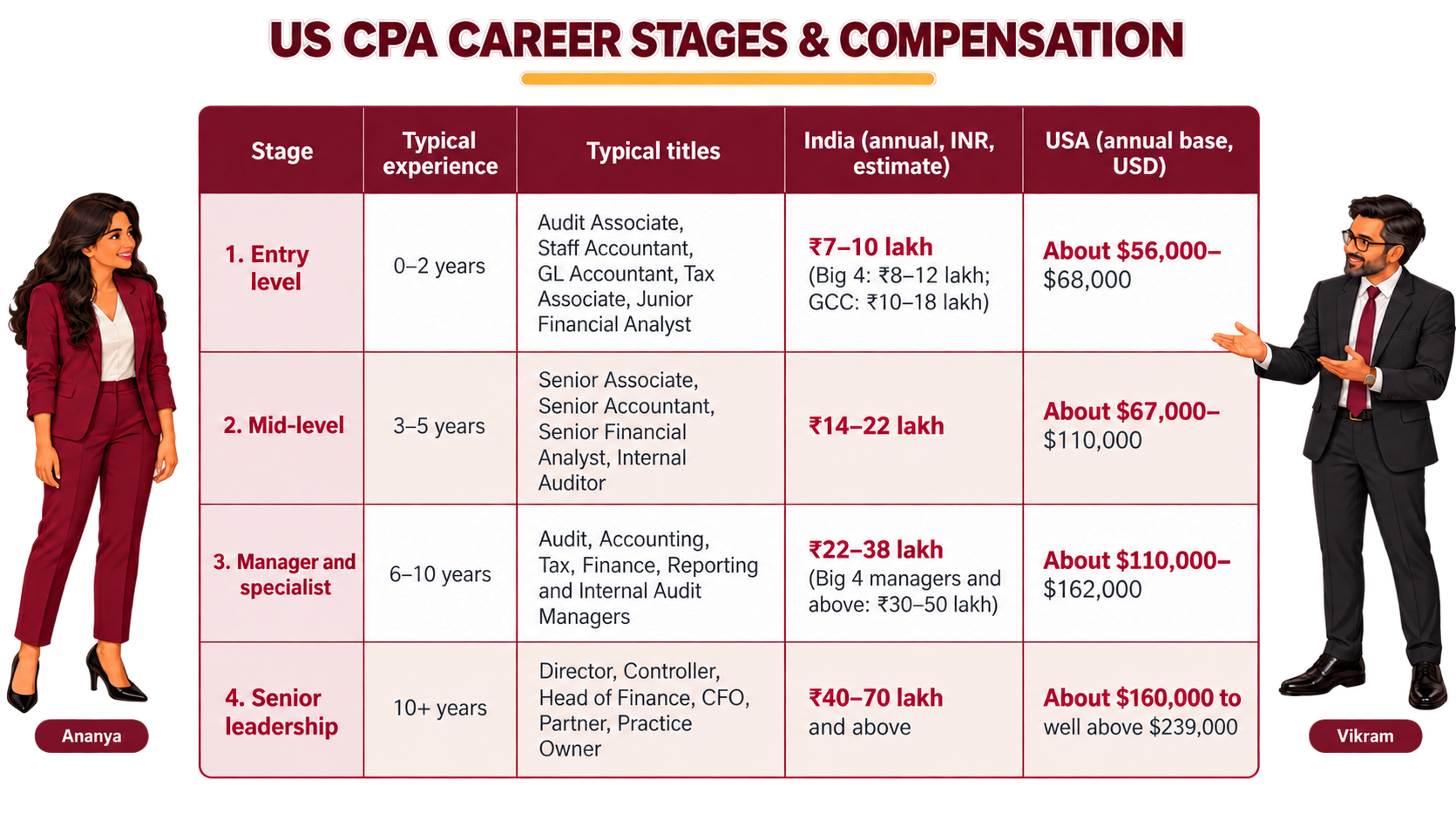
Sources: India ranges from Simandhar Education's US CPA salary guide (market estimates). USA ranges are derived from BLS wage data for accountants and auditors (May 2025), financial analysts (May 2025) and financial managers (May 2024), and from the AICPA 2025 MAP Survey. The full table with responsibilities and skills is further down.
Stage 1: Entry-level US CPA Jobs for Freshers
I have no experience yet. Which US CPA job roles should I target first?
Look at where US accounting work is actually done. Audit and assurance, accounting and reporting, tax, and finance analysis. In your first job, you are not expected to judge. You are expected to be accurate, fast at learning, and careful with documentation.
| Role | What you will do | Who hires |
|---|---|---|
| Audit Associate / Assurance Associate | Test samples, vouch transactions, prepare workpapers, send confirmations, tick and tie schedules | Big 4 and mid-size audit firms, their India delivery centres |
| Staff Accountant | Journal entries, reconciliations, month-end close support, basic reporting | MNCs, GCCs, accounting firms |
| General Ledger (GL) Accountant | Account reconciliations, accruals, intercompany entries, ledger clean-up | GCCs and shared service centres |
| Financial Reporting Associate | Support preparation of financial statements and disclosure checklists under US GAAP | MNCs, GCCs, audit firms |
| Tax Associate | Prepare US tax computations and returns, collect client data, research basic issues | Big 4 tax practices, tax and consulting firms |
| Junior Financial Analyst | Update models, prepare variance schedules, pull data for management reports | MNCs, GCCs, banks |
Are all of these open to me on the day I qualify?
No, and I want you to hear that clearly. Availability depends on your degree, any article ship or internship, the employer's requirements and the openings of that year. A candidate with Big 4 article ship experience reaches an audit role faster than one with none. A candidate who has done GL work in a shared service center reaches an accounting role faster. The CPA helps, and the rest of your profile decides the rest.
What does the pay look like?
In India, freshers with a US CPA are generally reported at ₹7–10 lakh a year. By employer type, it reports about ₹8–12 lakh at Big 4 entry level and ₹10–18 lakh at GCCs. Other published guides put fresher ranges slightly wider, around ₹6–12 lakh, which tells you the range moves with the city and the year.
In the USA, BLS reports that the bottom 10 per cent of accountants and auditors earned about $56,020 and the 25th percentile about $67,020 in May 2025. The AICPA's 2025 MAP Survey of CPA firms found median starting salaries of $60,834 for new hires with a bachelor's degree and $67,750 for those with a master's degree.
What should I focus on in these first two years?
Three things. Learn US GAAP properly by applying it, not by re-reading the exam notes. Learn the tools your team uses, usually Excel first and then the ERP or audit software. And build a reputation for work that does not come back with review comments. The people who get promoted early are rarely the fastest. They are the ones whose files the reviewer trusts.
Stage 2: Mid-level Career Growth, Years 3 to 5
After two or three years, what changes?
You stop only doing what you are assigned. You start deciding how to do it, and you start checking other people's work. Typical roles at this stage:
- Senior Audit Associate
- Senior Accountant
- Senior GL Accountant
- Financial Reporting Analyst
- Senior Financial Analyst
- Senior Tax Associate
- Internal Auditor
The shift is from tasks to sections. A Senior Associate owns a full audit area such as revenue or inventory, a Senior Accountant owns the close for an entity, a Senior Tax Associate handles a client's return from data to draft. You explain variances instead of just computing them, you resolve issues before they reach your manager, and you begin talking to clients or business stakeholders directly.
And the pay?
It estimates ₹14–22 lakh in India for roughly 3–5 years of experience. Another published guide quotes a wider ₹12–25 lakh for 3–7 years, so use the range as a guide, not a rule. In the USA, the middle half of accountants and auditors earned between about $67,020 and $109,810 in May 2025, with a median of $83,680 (BLS). Financial and investment analysts had a median of $102,740 that year (BLS).
Stage 3: Managerial and Specialized Positions
What does a manager's job look like compared with a senior?
A senior is judged on the quality of their own work. A manager is judged on the quality of a team's work and on the relationship with the client or the business. Roles at this stage:
- Audit Manager
- Accounting Manager
- Finance Manager
- Tax Manager
- Financial Reporting Manager
- Internal Audit Manager
- Risk and Advisory Manager
You review deliverables, allocate people to deadlines, handle difficult conversations with clients or the CFO's office, own compliance calendars and make professional judgments where the standards leave room. In an audit, you decide whether an issue is significant enough to escalate. In reporting, you decide how a new transaction should be accounted for and defend that position.
Pay at this level?
In India, it estimates ₹22–38 lakh for about 6–10 years of experience. For Big 4 managers and above it reports ₹30–50 lakh, and for experienced finance managers and controllers in GCCs, ₹35–60 lakh. In the USA, BLS reports a median of $161,700 for financial managers (May 2024), with the lowest-paid tenth earning under $86,490. BLS does not publish a separate audit-manager or tax-manager figure, so for those titles I give you a band running from the 75th percentile of accountants and auditors ($109,810) up to the financial manager median.
Stage 4: Senior Leadership, Practice Ownership and the Top of the Ladder
What is at the top, and can the CPA alone get me there?
It cannot, and nobody honest will tell you otherwise. Here are the destinations people usually mean:
- Senior Audit Manager
- Director of Finance, Director of Accounting, Director of Audit
- Financial Controller
- Head of Finance
- Chief Financial Officer (CFO)
- Partner in an accounting or professional services firm
- Independent accounting or consulting practice owner
BLS says financial managers usually come from another business or finance role such as accountant or financial analyst, and that experienced financial managers may advance to CFO. That is the honest version of the path. What separates the people who make it is a mix of technical depth, leadership of larger teams, understanding of the business (not just the books), a record of results, and often an additional qualification, such as an MBA, or a specialization in tax, risk or treasury.
What do these roles pay?
In India, it estimates ₹40–70 lakh for 10+ years across VP Finance, CFO and Director roles, with variable pay and stock units extending packages beyond that at larger employers. In the USA, financial managers' pay has a median of $161,700, and BLS reports that the top tenth earns more than $239,200, which is the highest figure it publishes. CFO pay at large companies runs well above that and depends on company size, performance and equity.
Partners are different again. In the AICPA's 2025 MAP Survey, median partner compensation was reported at $202,521, but that survey is dominated by small and mid-size firms. Big 4 partner pay is not published in official statistics. A practice owner's income is not in the BLS figures at all, because BLS excludes the self-employed. It depends on client base, pricing, and the number of people you run.
Different US CPA Career Paths: One Credential, Five Tracks
You keep saying "ladder", but are all CPAs on the same one?
No. After two or three years you usually pick a lane. These are illustrative pathways, and titles, speed and entry requirements change from one organization to another.
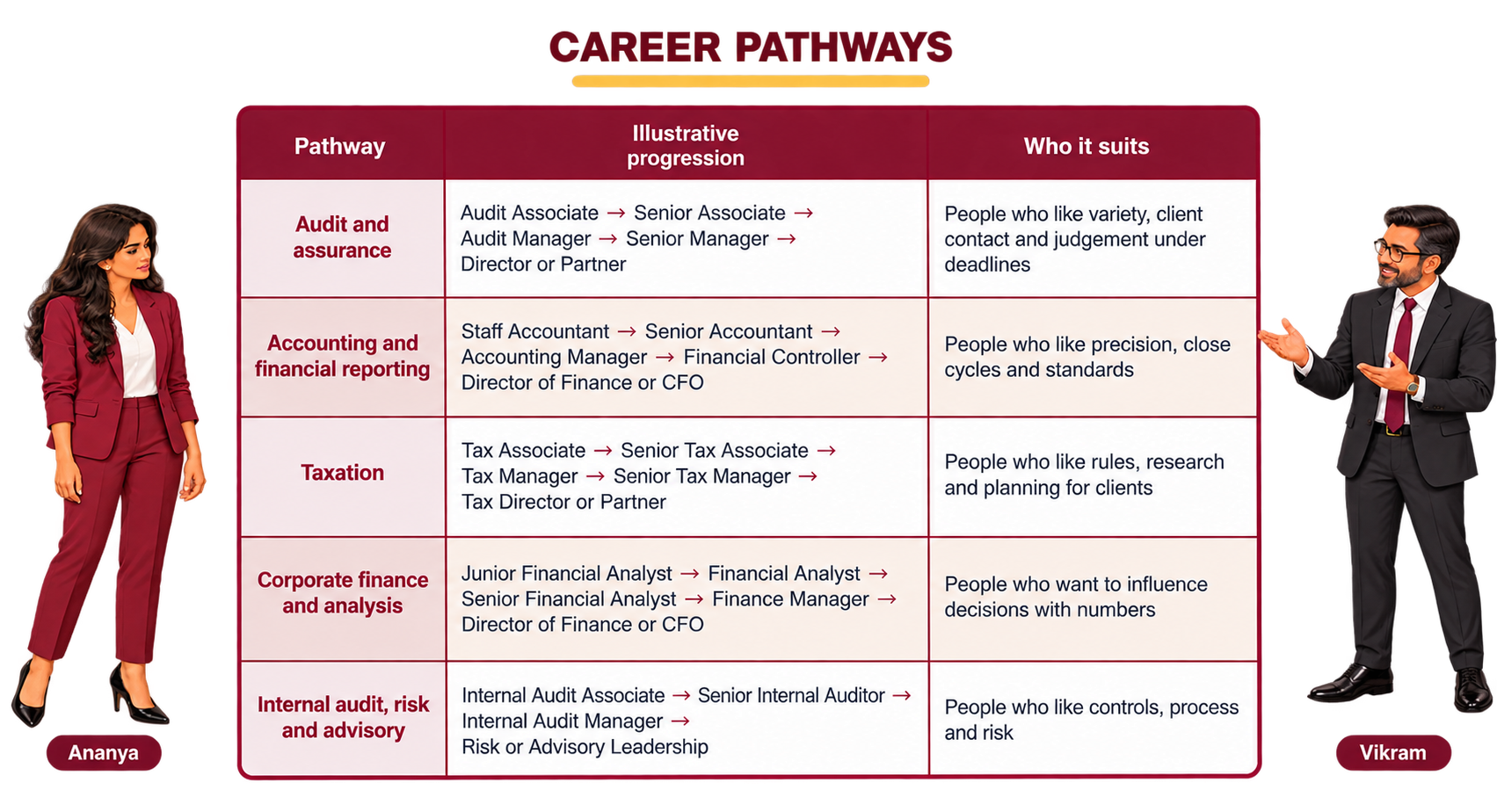
Moving between lanes is common. Auditors often move into reporting or controllership in industry after three to five years, and that move is one of the most common ways US CPA professionals in India reach MNCs and GCCs.
US CPA Salary by Experience: India and USA Compared
Can I see it all in one place?
Here it is. Read the USA column as base salary from BLS (employees only, excluding non-production bonuses and benefits) and the India column as market-estimated annual packages. Where a range is derived rather than published, I have marked it.
| Stage | Typical job titles | Experience | India (INR, annual, estimate) | USA (USD, annual base) | Key responsibilities | Skills to reach the next level |
|---|---|---|---|---|---|---|
| 1. Entry | Audit Associate, Staff Accountant, GL Accountant, Tax Associate, Junior Financial Analyst | 0–2 years | ₹7–10 lakh; Big 4 ₹8–12 lakh; GCC ₹10–18 lakh | About $56,000–$68,000 (BLS 10th–25th percentile; AICPA new-hire medians $60,834 and $67,750) | Execute assigned procedures, post and reconcile, prepare schedules | Own a full area, risk awareness, close ownership, documentation quality |
| 2. Mid | Senior Associate, Senior Accountant, Senior Analyst, Internal Auditor | 3–5 years | ₹14–22 lakh | About $67,000–$110,000 (BLS 25th–75th percentile; median $83,680) | Own sections or closes, review juniors, resolve issues, talk to clients | Review skills, technical accounting, planning, team and client handling |
| 3. Manager | Audit, Accounting, Finance, Tax, Reporting, Internal Audit Managers | 6–10 years | ₹22–38 lakh; Big 4 managers ₹30–50 lakh; experienced GCC finance managers ₹35–60 lakh | About $110,000–$162,000 (derived: BLS 75th percentile of accountants to financial manager median of $161,700) | Manage teams and deadlines, review deliverables, own relationships and compliance | Function ownership, policy and control design, strategy and business knowledge |
| 4. Leadership | Director, Controller, Head of Finance, CFO, Partner, Practice Owner | 10+ years | ₹40–70 lakh and above; variable pay and stock units extend this at large employers | About $160,000 to above $239,200 (BLS financial managers, top tenth); partner median $202,521 in the AICPA MAP survey, mostly smaller firms | Run a function, firm or company; strategy, risk, people, client base | Board and investor communication, capital allocation, business development |
Base salary versus total compensation: BLS figures are wages and salaries. Bonuses, equity and benefits come on top, and for CFOs and partners they can be a large part of the package. Salaries vary by city, employer, industry, specialization, experience and responsibilities. No figure here is a guarantee.
Where US CPAs Work: The Future Scope
Which employers should I be watching?
Eight places, and they do not all pay or promote the same way.
Big 4 and other accounting firms: US CPA jobs in Big 4 give you structured training, a brand name, and a path to audit, tax and advisory leadership. In India, CPA-qualified people usually work on international audit, US tax and US GAAP advisory engagements.
MNCs and Global Capability Centres (GCCs): US CPA jobs in MNCs and GCCs cover accounting, reporting, FP&A and controllership for the parent company. NASSCOM–Zinnov's 2026 landscape, as reported in the press, puts the ecosystem at more than 2,100 centres and over 2.3 million professionals. Hiring in the first half of 2026 was 227,991, up 11 per cent on the year before, and 56 per cent of it was for people with 4 to 10 years of experience. That tells you where mid-career CPAs are most wanted.
Audit and assurance firms: Mid-size and smaller firms, including those with offshore teams working with US clients.
Corporate accounting and financial reporting teams: Close, consolidation, technical accounting, and SEC-style reporting.
Tax and consulting firms: US tax compliance, international tax, transfer pricing support and advisory.
Banking and financial services: Product control, finance, risk reporting, and internal audit.
Corporate finance and controllership: FP&A, treasury support, controllership, and business finance.
Independent consulting and professional practice: Possible after solid experience and a client base, with income that varies a lot.
What is different in India and the USA?
In India, the CPA's value is highest where the work is US-facing: GCCs, Big 4 international teams, MNC finance centers. For domestic statutory audit and Indian tax, the CA qualification carries the legal weight and may earn the same or more in those roles. CA plus CPA is the widest combination.
In the USA, BLS projects employment of accountants and auditors to grow about 5 per cent from 2025 to 2035, and financial managers to grow 15 per cent from 2024 to 2034, much faster than average. Both numbers include replacement demand and new roles. But two cautions. First, passing the exam does not give you the right to work in the USA.
That needs work authorization, usually through an employer, a transfer within a multinational, or other immigration routes, and the CPA does not replace it. Second, the exam and the license are different things.
Most US state boards ask for 150 semester hours of education and one to two years of experience verified by a licensed CPA before issuing a license, and the rules differ by state. Some roles, especially signing audit reports, need the license itself. Check your state board's current rules.
Will AI take these jobs?
It will change them, and it is already changing the first two years most. Routine tasks such as reconciliations, data pulls, first-pass testing, and standard schedules are the easiest to automate. In the AICPA's 2025 MAP Survey coverage, 65 per cent of firms said they were open to these technologies, but only 13 per cent said they had implemented them successfully, so the shift is early, not finished. In India, press reports on 2026 GCC hiring say nearly two in three new GCC roles ask for AI, data science or intelligent automation skills.
What stays valuable is the part a tool cannot sign: professional judgment, understanding why a number moved, explaining it to someone who does not read ledgers, and taking responsibility for it. So, learn the tools and keep growing the judgment and communication that sits above them.
Additional Skills that Support Growth
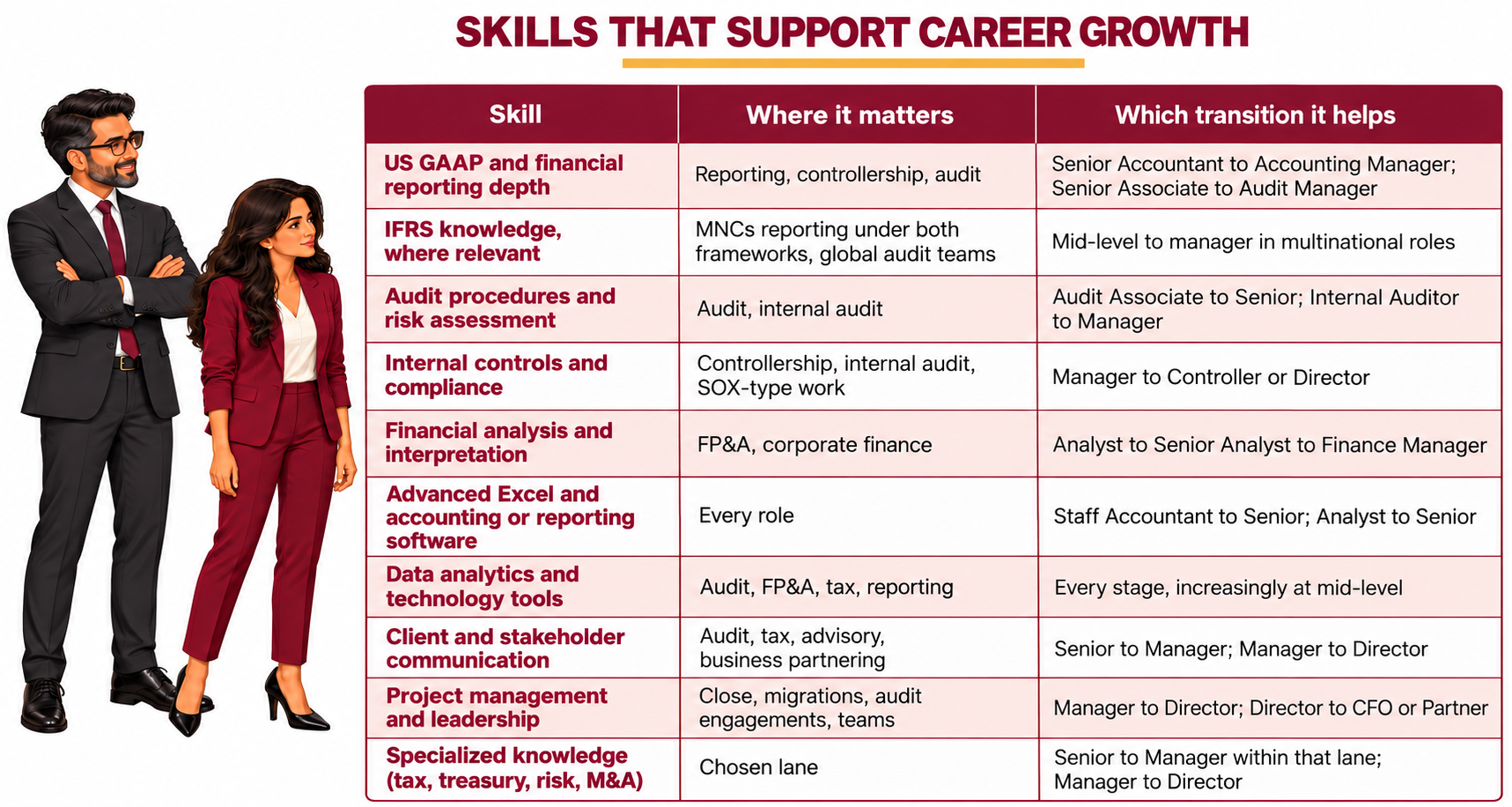
Besides the CPA itself, what should I add?
Pick skills by the promotion you want, not by what sounds fashionable.
A Concluded Conversation: How to Use All This
Summing up, what should I do in the next twelve months?
Choose a first employer type by what you need. A Big 4 gives breadth and discipline, a GCC often gives higher early pay, and a closer view of how a business is run. Pick a lane within two or three years, based on what you actually enjoyed doing. For each promotion, write down the skills in the checklist above and ask for the assignment that builds them. Keep your numbers realistic, check your state board's license rules, and look at salary data from the government and professional bodies before negotiating.
The CPA gets you started. The skills you keep adding decide how far you go.
Frequently Asked Questions
1. What is the US CPA career path in India?
Most candidates start in audit, accounting, tax or financial analysis at a Big 4 firm, GCC or MNC, move to senior roles in 3–5 years, and to manager roles in 6–10 years. Titles and speed vary by employer.
2. What is the US CPA salary in India for freshers?
Simandhar Education's 2026 guide estimates ₹7–10 lakh a year for freshers, with about ₹8–12 lakh at Big 4 firms and ₹10–18 lakh at GCCs. There is no official government survey, so treat these as market estimates.
3. How does US CPA salary by experience change in India?
The same guide estimates ₹14–22 lakh at 3–5 years, ₹22–38 lakh at 6–10 years, and ₹40–70 lakh at 10+ years. Employer type and city can move any of these.
4. What is a US CPA's salary in the USA?
BLS reports a median of $83,680 for accountants and auditors (May 2025), with the middle half earning roughly $67,020–$109,810. Financial managers had a median of $161,700 (May 2024). These are base wages, not total compensation.
5. Are there US CPA jobs in the USA for Indian candidates?
There are, but the exam alone does not give you the right to work in the USA. You need work authorization, often through an employer or an internal transfer. Many US licenses also need 150 credit hours and verified experience, which vary by state.
6. Are US CPA jobs in Big 4 and in MNCs and GCCs different?
Big 4 roles give training across clients and a path to audit, tax or advisory leadership. MNC and GCC roles focus on one company's accounting, reporting, and finance, often with higher early pay. Both value US GAAP knowledge.
7. Can a US CPA become a CFO?
It can be part of the route, but it does not guarantee the role. BLS notes that financial managers usually come from another business or finance role and may advance to CFO with experience. Leadership, business knowledge, and results matter as much as the credentials.
8. Will AI reduce US CPA jobs?
It is changing entry-level tasks the most. Judgment, communication, and the ability to use technology matter more as routine work gets automated. Professionals who build those skills keep a path to senior roles.
Planning to take CPA? Explore our CPA course