
CPA Journey After 40: How Rishi Built Global Credibility While Leading a Finance Career
Discover how Rishi, a 43-year-old finance leader, completed CPA while managing a demanding career and family. A powerful story of clarity, discipline, and global career growth.
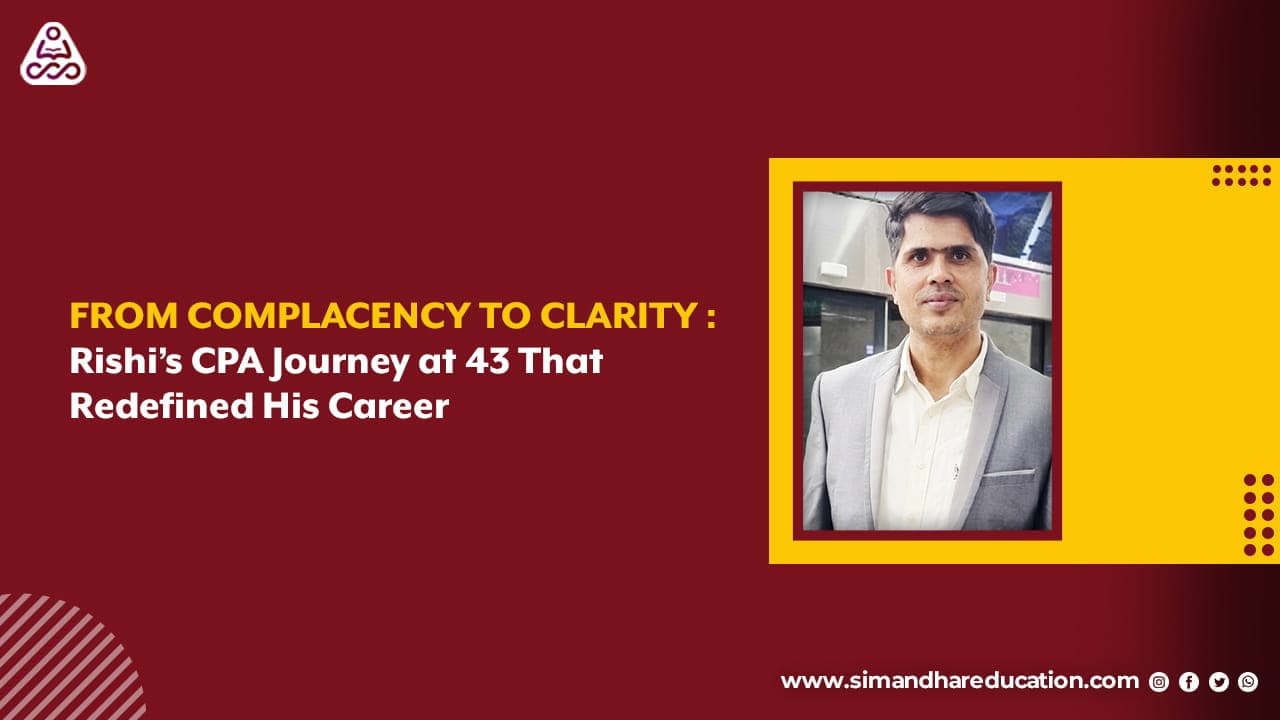
Table of Contents
- 1. Introduction
- 2. When Experience Alone Stops Being Enough
- 3. Why Credentials Matter in the Indian Job Market
- 4. Why Rishi Chose CPA Over Other Options
- 4.1. Global Relevance and Career Alignment
- 4.2. Influence of Professional Exposure
- 5. The Reality of Studying After 40
- 6. Balancing Career, Family, and Preparation
- 7. Study Strategy That Led to First-Attempt Success
- 7.1. Practice Over Passive Learning
- 7.2. Learning Through Mistakes
- 8. The Role of Technology in Modern CPA Preparation
- 8.1. AI-Driven Concept Clarity
- 9. The Bigger Outcome
- 10. A Message to CPA Aspirants
- 10.1. Clarity Before Commitment
- 10.2. Age Is Not the Limitation
- 11. Conclusion
- 12. FREQUENTLY ASKED QUESTIONS
- 13. Related Blogs
Table of Contents
Introduction
Career growth is often assumed to be a function of experience. However, there comes a point where experience alone stops creating differentiation. Rishi’s journey reflects this reality with remarkable clarity.
At 43, while already working in a senior finance role and managing family responsibilities, he made a decision that many hesitate to even consider. He chose to pursue CPA. Not because he lacked success, but because he understood that the next level of growth required something more.
This is not a story about starting early. This is a story about starting with purpose.
When Experience Alone Stops Being Enough
Rishi began his career after completing his MBA and spent more than a decade working with a leading multinational organization. Within that system, he performed well and built a strong professional identity.
However, the moment he stepped outside that ecosystem, a shift became visible.
Despite having deep knowledge and practical exposure, he realized that the market evaluates professionals differently. There was an unspoken expectation of strong, recognizable credentials.
This gap was not about skill. It was about signaling credibility in a competitive environment.
Why Credentials Matter in the Indian Job Market
In India, professional differentiation often begins with how one is introduced. Strong academic backgrounds and globally recognized qualifications immediately influence perception.
Rishi observed that while internal growth depends on performance, external opportunities often depend on how quickly your profile communicates value.
This realization became the trigger for change.
Why Rishi Chose CPA Over Other Options
Global Relevance and Career Alignment
CPA was directly aligned with his work in finance and offered immediate practical relevance. More importantly, it was globally recognized, which added long-term strategic value.
Influence of Professional Exposure
During international assignments and cross-border interactions, Rishi consistently noticed that senior finance professionals in global organizations held CPA credentials. This pattern reinforced his belief that CPA was not just a qualification, but a positioning tool.
Another subtle but important influence came from consistently engaging with insights shared by mentors and industry educators, particularly from Simandhar Education, whose thought leadership around global careers helped him connect the dots between experience and credentials.
The Reality of Studying After 40
Returning to academics after more than a decade brings a different kind of challenge. It is not about intelligence, but about rebuilding discipline and consistency.
Rishi was managing a high-pressure leadership role while raising two young children in a dual-income household. There was no extra time available in his schedule.
Time had to be created through sacrifice and structure.
Balancing Career, Family, and Preparation
His routine was intense and demanding.
After completing his workday and family responsibilities, he would begin studying late at night, typically between 10 PM and 1 or 2 AM. This pattern was not sustainable every single day, but it became the backbone of his preparation.
Weekends played a critical role in compensating for weekday fatigue. At the same time, his family had to make silent sacrifices, especially when it came to spending quality time together.
This journey was not individual. It was collective.
Study Strategy That Led to First-Attempt Success
Practice Over Passive Learning
Instead of consuming excessive content, he focused on completing his study material quickly and shifted his attention to practice.
Daily multiple-choice question practice became the core of his preparation, often solving 60 to 80 questions consistently.
Learning Through Mistakes
What differentiated his approach was how he treated mistakes. He did not just check the correct answer. He analyzed why he selected the wrong one.
By identifying the assumptions behind each error, he gradually eliminated conceptual gaps.
The Role of Technology in Modern CPA Preparation
AI-Driven Concept Clarity
Rishi used AI tools to deeply analyze his mistakes. Instead of passively reviewing explanations, he questioned his own logic.
He would validate why he thought a certain answer was correct and understand precisely where his reasoning failed. This interactive learning approach strengthened his conceptual clarity significantly.
This kind of structured, outcome-focused preparation approach is increasingly being emphasized by institutes like Simandhar Education, where the focus goes beyond content delivery to building exam readiness and long-term career clarity.
The Bigger Outcome
For Rishi, CPA was never just about passing exams.
He is already operating at a senior level in finance, but his aspiration is to move into top leadership roles such as CFO.
CPA strengthens his profile in a global context and aligns him with the expectations of senior leadership in multinational environments.
More importantly, it builds internal confidence backed by global credibility.
A Message to CPA Aspirants
Clarity Before Commitment
CPA is demanding in terms of time, effort, and financial investment. Without a clear purpose, it becomes difficult to sustain motivation.
Age Is Not the Limitation
According to him, age is never the constraint. The real limitation is hesitation. If there is a desire to grow, the right time to act is now.
Conclusion
Rishi’s journey is a reminder that growth does not stop with experience. It evolves with intention.
At 43, while managing a demanding career and family responsibilities, he chose to invest in himself. That decision did not just add a qualification. It redefined his direction.
The difference was not age. The difference was clarity.
FREQUENTLY ASKED QUESTIONS
Is CPA worth it after 40?
Yes, CPA is highly valuable for experienced professionals aiming for leadership roles and global opportunities.
Can working professionals manage CPA with a full-time job?
Yes, with disciplined time management and a structured approach, it is achievable.
How long does it take to complete CPA?
Most candidates complete CPA within 12 to 18 months.
Is CPA difficult after a long study gap?
It is challenging initially, but becomes manageable with consistent practice.
What is the key to clearing CPA in the first attempt?
Clarity of purpose, consistent practice, and learning from mistakes are critical factors.
Related Blogs
Planning to take CPA? Explore our CPA course