
CPA Journey After CA Articleship: Real Student Story & Strategy (2026)
Discover how a CA student transitioned to CPA during articleship, cleared exams with a structured strategy, and built a global career path. Read this real CPA journey.
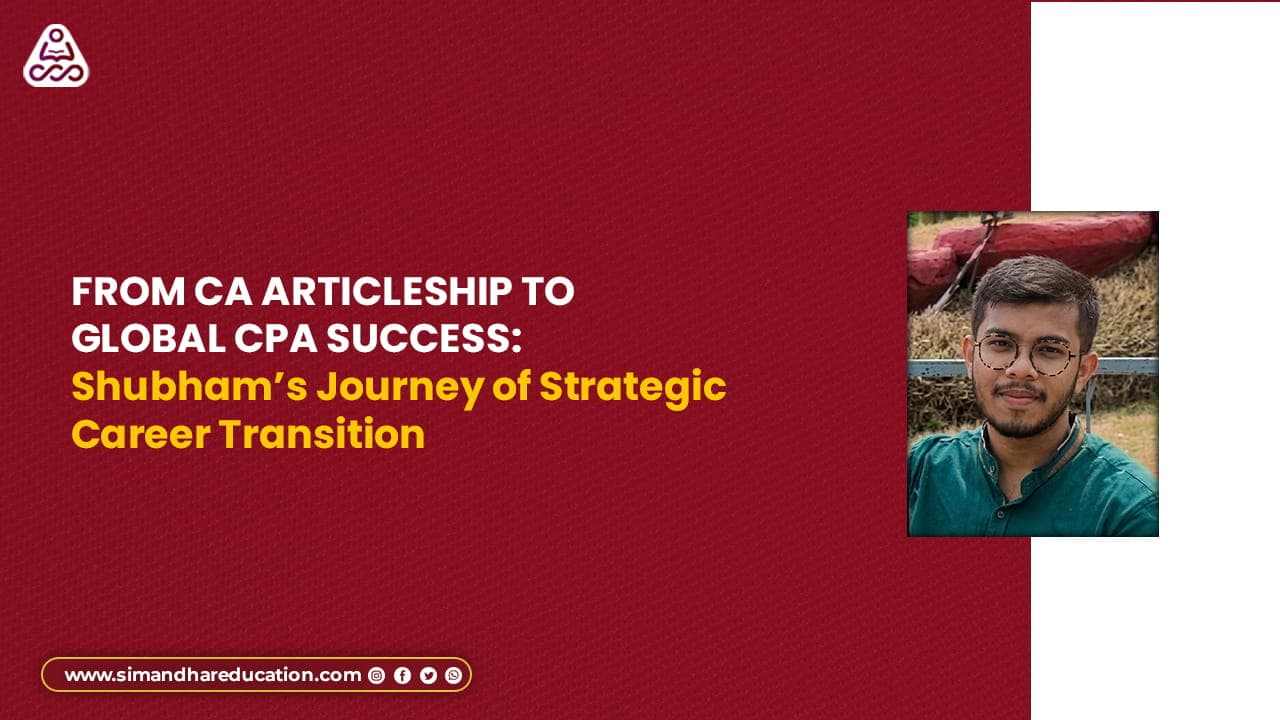
Table of Contents
- 1. Introduction
- 2. Educational Background and Early Direction
- 3. Why Shift from CA to CPA?
- 3.1. Limited Exposure During Articleship
- 3.2. Aspiration for Global Career Opportunities
- 4. Discovering Simandhar and Beginning the CPA Journey
- 5. Learning Experience with Becker and Simandhar
- 5.1. Structured Learning Ecosystem
- 5.2. Role of Becker in Preparation
- 6. CPA Exam Strategy and Study Approach
- 6.1. Lecture-First Approach
- 6.2. Reinforcement Through Books
- 6.3. Practice Through MCQs and Simulations
- 7. Paper Difficulty and Subject Insights
- 7.1. Most Challenging Subject
- 7.2. Overall Difficulty Level
- 8. Time Taken to Complete CPA
- 9. Consistency, Discipline, and Study Routine
- 9.1. Daily Study Structure
- 9.2. Balancing CA and CPA
- 10. ROI of CPA vs CA: A Practical Perspective
- 10.1. Cost Consideration
- 10.2. Return on Investment
- 11. Advice for Students Considering CPA
- 11.1. It Is Not as Difficult as It Seems
- 11.2. Focus on Consistency and Discipline
- 12. Conclusion
- 13. Related Blogs
Table of Contents
Introduction
Career decisions in accounting are often shaped not just by academic background but by long-term vision. For many Indian students pursuing Chartered Accountancy , exposure during articleship becomes a defining phase. This blog captures the journey of Shubham, who transitioned from CA articleship to CPA, driven by a clear goal to build a global career in accounting and taxation.
Educational Background and Early Direction
Shubham began his professional journey with a strong foundation. He completed his Bachelor of Commerce alongside pursuing Chartered Accountancy . Like many CA aspirants, he entered articleship to gain practical exposure and develop technical expertise.
However, during this phase, a critical realization emerged. While CA provides depth in Indian accounting and compliance, the exposure to international opportunities remained limited within his immediate environment. This insight became the turning point.
Why Shift from CA to CPA?
Limited Exposure During Articleship
During his articleship, Shubham observed that the scope of work and opportunities did not align with his aspiration to work in international taxation and global finance roles. The experience, while valuable, lacked the global dimension he was seeking.
Aspiration for Global Career Opportunities
The desire to move beyond domestic accounting frameworks and enter global markets led him to explore alternatives. The CPA qualification emerged as a natural fit due to its recognition in international accounting, taxation, and multinational firms.
Rather than abandoning his CA background, he leveraged it as a foundation and strategically added CPA to reposition his career globally.
Discovering Simandhar and Beginning the CPA Journey
Shubham discovered Simandhar Education through YouTube. What began as casual exploration quickly turned into a decisive step toward enrolling in the CPA program.
The accessibility of information and clarity in guidance played a crucial role in helping him understand the pathway, eligibility, and preparation strategy required for CPA.
Learning Experience with Becker and Simandhar
Structured Learning Ecosystem
According to Shubham, the experience was seamless from enrollment to evaluation and ultimately licensing. The structured support system ensured that administrative complexities did not interfere with academic preparation.
Role of Becker in Preparation
Becker, as the learning partner, played a critical role in shaping his preparation. The study materials, particularly the software interface, simulations, and MCQ bank, significantly enhanced conceptual clarity.
The simulations, in particular, helped bridge the gap between theoretical understanding and practical application, which is essential for CPA exams.
CPA Exam Strategy and Study Approach
Lecture-First Approach
Shubham followed a disciplined and structured study strategy. He began with video lectures to build conceptual clarity, ensuring that foundational understanding was strong before moving ahead.
Reinforcement Through Books
After completing lectures, he transitioned to textbook revision. This stage involved highlighting key concepts and identifying high-yield areas for repeated revision.
Practice Through MCQs and Simulations
The final stage of preparation focused on solving MCQs and simulations. This iterative practice allowed him to test his understanding, improve accuracy, and build exam confidence.
This three-layered approach formed the backbone of his success.
Paper Difficulty and Subject Insights
Most Challenging Subject
Audit emerged as the most challenging paper for Shubham. This difficulty was consistent with his earlier experience during CA Intermediate, where audit had already been a demanding subject.
Overall Difficulty Level
None of the CPA papers were perceived as easy. However, apart from audit, the remaining subjects were moderate in difficulty. This highlights an important insight. CPA is not about finding easy papers but about consistent preparation across all sections.
Time Taken to Complete CPA
Shubham cleared his first CPA exam on August 24 and completed his final exam by January 30, 2026. This reflects a focused preparation cycle of approximately five to six months of active exam-taking, though the overall journey extended longer due to overlapping commitments.
His journey demonstrates that with clarity and consistency, CPA can be completed efficiently even alongside professional commitments.
Consistency, Discipline, and Study Routine
Daily Study Structure
Shubham maintained a realistic and sustainable study schedule. On weekdays, he studied for approximately three to four hours. On weekends, particularly Saturdays and Sundays, he extended his study time to around six hours.
Balancing CA and CPA
Since he was simultaneously managing CA-related commitments, studying every single day was not always possible. However, he emphasized consistency over perfection. Even with interruptions, he ensured continuity in preparation.
This reflects a critical principle. Success in CPA is not driven by extreme study hours but by disciplined consistency over time.
ROI of CPA vs CA: A Practical Perspective
Cost Consideration
CPA does involve a higher upfront investment compared to CA. This can often be a concern for students evaluating the course.
Return on Investment
However, the return on investment is significantly higher in terms of faster earning potential and access to global opportunities. CPA enables professionals to enter international roles earlier, thereby accelerating career growth.
Shubham’s perspective reinforces that while cost matters, long-term career outcomes should be the primary decision factor.
Advice for Students Considering CPA
It Is Not as Difficult as It Seems
One of the most important takeaways from Shubham’s journey is that CPA is manageable with the right approach. The perception of difficulty often stems from lack of clarity rather than actual complexity.
Focus on Consistency and Discipline
His core advice is simple yet powerful. Remain consistent and disciplined. Instead of overcomplicating preparation, focus on structured study and regular revision.
Conclusion
Shubham’s journey is a strong example of how strategic career decisions can redefine professional trajectories. Moving from CA articleship to CPA was not a rejection of one path but an expansion toward global opportunities.
His experience highlights three essential truths. First, clarity of long-term goals is crucial. Second, the right guidance and resources can simplify even complex journeys. Third, consistency remains the most underrated yet powerful factor in professional success.
For students at a similar crossroads, this journey offers both reassurance and direction.
Related Blogs
Planning to take CPA? Explore our CPA course