
CPA Journey – Garima G
Discover how a B.Com graduate transitioned into CPA while working at Deloitte. Learn preparation strategy, challenges, and career impact.
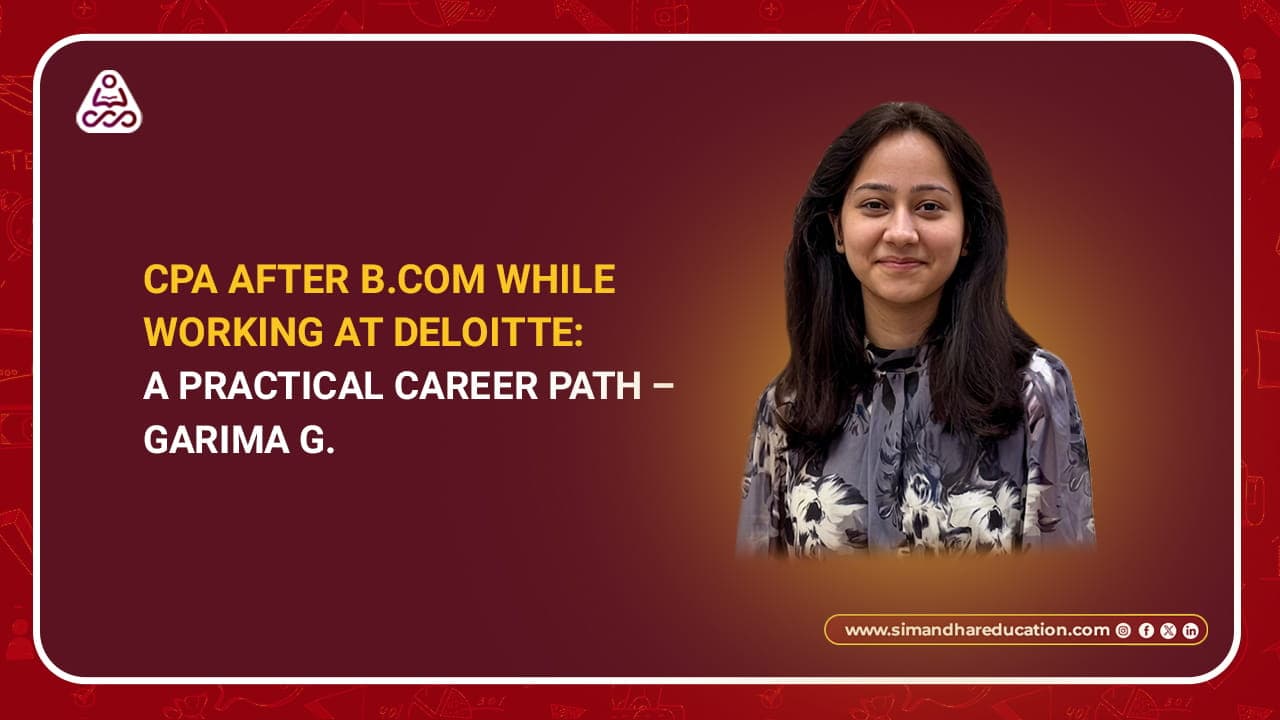
Table of Contents
- 1. CPA After B.Com While Working at Deloitte: A Practical Career Path – Garima G.
- 2. Introduction
- 3. Academic Background and Early Career Direction
- 4. What Influenced the Decision to Pursue CPA
- 5. Preparation Strategy While Managing a Full-Time Job
- 5.1. Study Routine
- 5.2. Key Preparation Principles
- 6. Challenges Faced During the CPA Journey
- 6.1. Conceptual Difficulty in Audit
- 6.2. Managing Time Alongside Work
- 7. Navigating the Credit Evaluation and Process
- 8. Experience with Simandhar Education
- 9. Career Impact After Completing CPA
- 10. Evolving Career Perspective
- 11. Conclusion
CPA After B.Com While Working at Deloitte: A Practical Career Path – Garima G.
Introduction
For many commerce graduates, the biggest challenge is not choosing a career, but understanding which path creates long-term value. While traditional routes like M.Com or MBA remain popular, global certifications are increasingly becoming relevant for those aiming to build strong professional positioning early in their careers.
This blog presents a real and practical perspective of a candidate who transitioned from a B.Com background into CPA while working at Deloitte, highlighting how experience, timing, and structured effort shape better career outcomes.
Academic Background and Early Career Direction
After completing B.Com from Calcutta University, the initial inclination was towards higher education. The long-term plan included pursuing advanced academic qualifications and potentially building a career in teaching.
However, instead of directly continuing academics, an opportunity at Deloitte introduced a new direction. The role in audit provided exposure to real business environments, client handling, and financial reporting practices.
This phase played a critical role in shifting career thinking from theoretical learning to practical relevance.
What Influenced the Decision to Pursue CPA
The decision to pursue CPA did not come immediately after graduation. It developed after gaining work experience and understanding industry expectations.
Key factors that influenced this decision:
● Alignment with audit and accounting roles
● Need for a globally recognized qualification
● Advice from seniors to build long-term value alongside work
● Realization that work experience alone may not be sufficient
CPA emerged as a practical extension of the existing career path rather than a separate academic choice.
Preparation Strategy While Managing a Full-Time Job
Balancing a demanding job with CPA preparation requires a structured approach. Instead of relying on last-minute preparation, a consistent schedule was followed.
Study Routine
● Weekdays: 1 to 1.5 hours of focused study
● Weekends: 5 to 6 hours for deeper practice and revision
● Leaves: Used only for final revision, not for first-time learning
Key Preparation Principles
● Completing the syllabus before taking leave
● Revising multiple times instead of rushing content
● Practicing questions regularly to improve accuracy
● Avoiding long study gaps
Consistency was the most important factor in maintaining momentum.
Challenges Faced During the CPA Journey
Even with an audit background, certain challenges were evident during preparation.
Conceptual Difficulty in Audit
● Questions required analytical thinking, not just familiarity
● Multiple options often appeared correct
● Required repeated practice to identify patterns
Managing Time Alongside Work
● Maintaining daily discipline after work hours
● Avoiding burnout while balancing professional and academic commitments
These challenges were addressed through consistent practice and structured planning.
Navigating the Credit Evaluation and Process
One of the less discussed yet important aspects of CPA is the evaluation and documentation process.
Key areas that required attention:
● Transcript collection from university
● Understanding eligibility requirements
● Completing evaluation steps accurately
Having proper guidance simplified this process and ensured there were no delays in exam planning.
Experience with Simandhar Education
Garima shared that she was already aware of Simandhar Education during her college days while exploring US CMA, and when she decided to pursue CPA, she naturally chose Simandhar due to its strong association with Becker. She mentioned that Becker’s content, along with the additional practice questions, live lectures, and support available on the Simandhar portal, was more than sufficient for her preparation.
She also highlighted that Simandhar played a crucial role in simplifying the entire process, especially during credit evaluation and documentation. She frequently reached out to the support team for guidance on transcripts and next steps, and consistently received clear direction. Additionally, she referred to the provided PPTs and PDFs regularly throughout her journey, which helped her stay on track and made the overall experience smooth and hassle-free.
Career Impact After Completing CPA
Completing CPA within 15 months while working full-time had a direct impact on career progression.
Key outcomes:
● Promotion to a senior role at Deloitte
● Increased confidence in handling audit responsibilities
● Stronger professional credibility
● Better alignment with long-term career growth
The qualification added measurable value rather than being just an additional credential.
Evolving Career Perspective
Initially, the career path was inclined towards academics. However, real-world exposure changed the direction.
Important realizations from this journey:
● Career clarity develops over time
● Exposure helps in making better decisions
● Practical experience can redefine long-term goals
● Professional qualifications should align with work, not replace it
This shift highlights the importance of staying open to change and adapting based on experience.
Conclusion
Pursuing CPA after B.Com while working full-time is a practical and achievable path when approached with discipline and clarity.
This journey demonstrates that:
● Early career decisions do not have to be final
● Work experience can guide better educational choices
● Consistency is more effective than short-term intensity
● The right qualification can accelerate career growth significantly
For students and professionals evaluating their next step, the focus should be on relevance, sustainability, and long-term value rather than following conventional paths blindly.
Planning to take CPA? Explore our CPA course