
CPA Student Journey: How Shubham Bansal Cracked CPA with a Simple Strategy
Discover how Shubham Bansal successfully prepared for the CPA exam using a simple, consistent strategy. Learn his preparation approach, Becker usage, and revision plan.
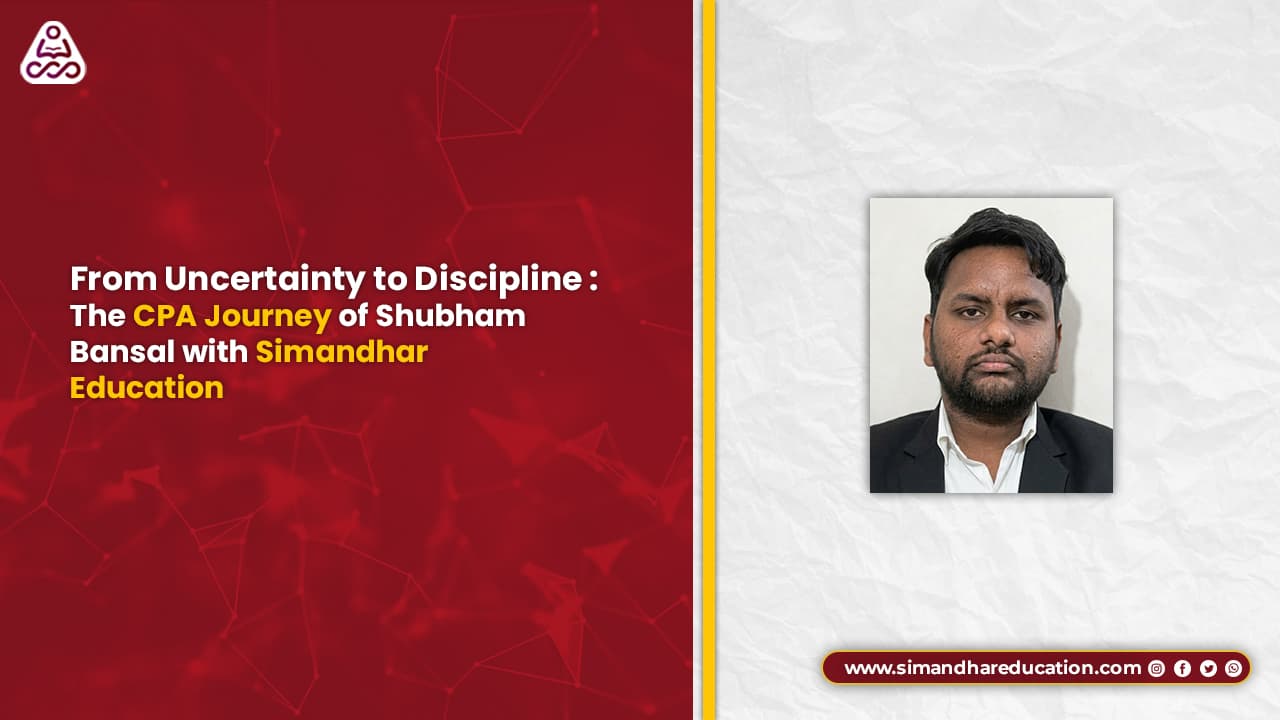
Table of Contents
- 1. Introduction
- 2. The Decision Behind Choosing CPA
- 3. Adapting to a New Academic Framework
- 4. A Preparation Strategy Built on Simplicity
- 5. Strategic Use of Becker
- 6. The Role of Consistency in Daily Study
- 7. Revision as a Decisive Phase
- 8. Key Takeaways from His Journey
- 9. The Role of the Right Learning Ecosystem
- 10. Conclusion
Table of Contents
Introduction
Career decisions in professional accounting are rarely instant. For many students, they evolve through exposure, guidance, and a gradual understanding of long-term opportunities. The journey of Shubham Bansal reflects this reality. What began as a distant consideration, something he believed he might pursue years later eventually transformed into a focused and disciplined pursuit of the Certified Public Accountant (CPA) qualification.
His story is not built on extraordinary shortcuts or aggressive strategies. Instead, it is a clear example of how structured preparation, consistency, and the right guidance can convert uncertainty into measurable progress.
The Decision Behind Choosing CPA
Shubham’s decision to pursue CPA was shaped by both awareness and influence. He recognized early that accounting was no longer limited to domestic opportunities and that global finance roles required qualifications with international recognition. The CPA designation stood out as a pathway that aligned with this vision.
At the same time, his decision was reinforced by guidance from his sister, who had prior exposure to the field. This combination of personal insight and external validation gave him the clarity to move forward. Even during his graduation, he understood that CPA would demand a transition into subjects that were unfamiliar and academically rigorous.
Adapting to a New Academic Framework
The initial phase of preparation was not without difficulty. Moving into the CPA curriculum required a shift from traditional academic learning to a more application-oriented approach. Concepts were new, expectations were higher, and the learning process demanded deeper engagement.
However, rather than being discouraged by this transition, Shubham approached it with acceptance. He acknowledged that the challenge was part of the process and focused on gradually building conceptual clarity. This mindset played a critical role in ensuring that the initial difficulty did not become a long-term obstacle.
A Preparation Strategy Built on Simplicity
One of the defining aspects of Shubham’s journey is the simplicity of his preparation strategy. Instead of overcomplicating the process with multiple resources or constantly changing methods, he relied on a structured and repeatable approach.
He consistently attended live lectures, ensuring that his conceptual foundation was built correctly from the beginning. This was followed by self-study, where he revised and internalized what was taught. Assignments were treated as an essential part of learning rather than an additional burden, allowing him to reinforce concepts through application.
What distinguished his preparation was not the complexity of his plan but the consistency with which he executed it. Each day was aligned with the same objective—progress through clarity and practice.
Strategic Use of Becker
In his preparation, Shubham used Becker in a highly focused manner. Rather than attempting to cover every aspect of the material exhaustively, he identified where it added the most value.
Becker became a critical tool for practice, particularly for multiple-choice questions, which he considered indispensable to his preparation. He selectively referred to its content for reinforcement but did not rely on it uniformly across all subjects. For instance, in areas like Audit, he preferred alternative learning methods and focused more on conceptual understanding through primary lectures.
This selective usage ensured efficiency. It allowed him to avoid information overload while still benefiting from one of the most recognized CPA preparation resources.
The Role of Consistency in Daily Study
Shubham’s preparation was not driven by extreme study hours or unsustainable routines. Instead, it was defined by discipline and consistency. His daily schedule revolved around attending lectures, revising concepts, practicing questions, and identifying areas of improvement.
This steady approach ensured that learning was continuous rather than fragmented. By maintaining this rhythm, he avoided the need for last-minute pressure and built confidence gradually over time. His journey reinforces an important principle: in professional exams like CPA, consistency holds greater value than intensity.
Revision as a Decisive Phase
As the examination approached, Shubham shifted his focus entirely to revision. He dedicated approximately one month to revisiting the entire syllabus, strengthening weak areas, and consolidating his understanding.
This phase was not merely about rereading content. It was a deliberate effort to refine concepts, improve accuracy, and enhance exam readiness. The time invested in revision played a crucial role in ensuring that his preparation translated effectively into performance.
Key Takeaways from His Journey
Shubham’s experience highlights that success in CPA is not dependent on complex strategies or excessive resources. It is built on clarity of purpose, disciplined execution, and the ability to remain consistent over time. His journey demonstrates that even when the starting point is uncertain, a structured approach can lead to strong outcomes.
An important insight from his approach is the way he utilized time during the evaluation phase. Instead of waiting for the process to complete, he smartly began his first reading of the subjects in parallel. This ensured that once everything was finalized, he was already ahead in his preparation, ultimately saving valuable time and reducing pressure in later stages.
The Role of the Right Learning Ecosystem
A critical factor in Shubham’s journey was the guidance he received from Simandhar Education. The structured learning environment, expert-led sessions, and access to globally recognized resources provided him with both direction and confidence.
Such an ecosystem reduces uncertainty and ensures that students are not navigating the CPA journey alone. Instead, they are supported at every stage with clarity, mentorship, and a well-defined preparation path.
Conclusion
The journey of Shubham Bansal is a reminder that professional success does not require perfect timing or extraordinary methods. It requires a clear decision, a structured plan, and the discipline to follow it consistently.
For students who feel they need several years to begin or are unsure about when to start, his story offers a practical perspective. The right time is not determined by how far the goal seems, but by how early one chooses to approach it with clarity and commitment.
Planning to take CPA? Explore our CPA course