
From Chartered Accountant to US CPA: Real Story of Scoring 90+ While Working
A Chartered Accountant shares his journey to US CPA, scoring 90+ in all papers while working full time and building global career exposure in finance
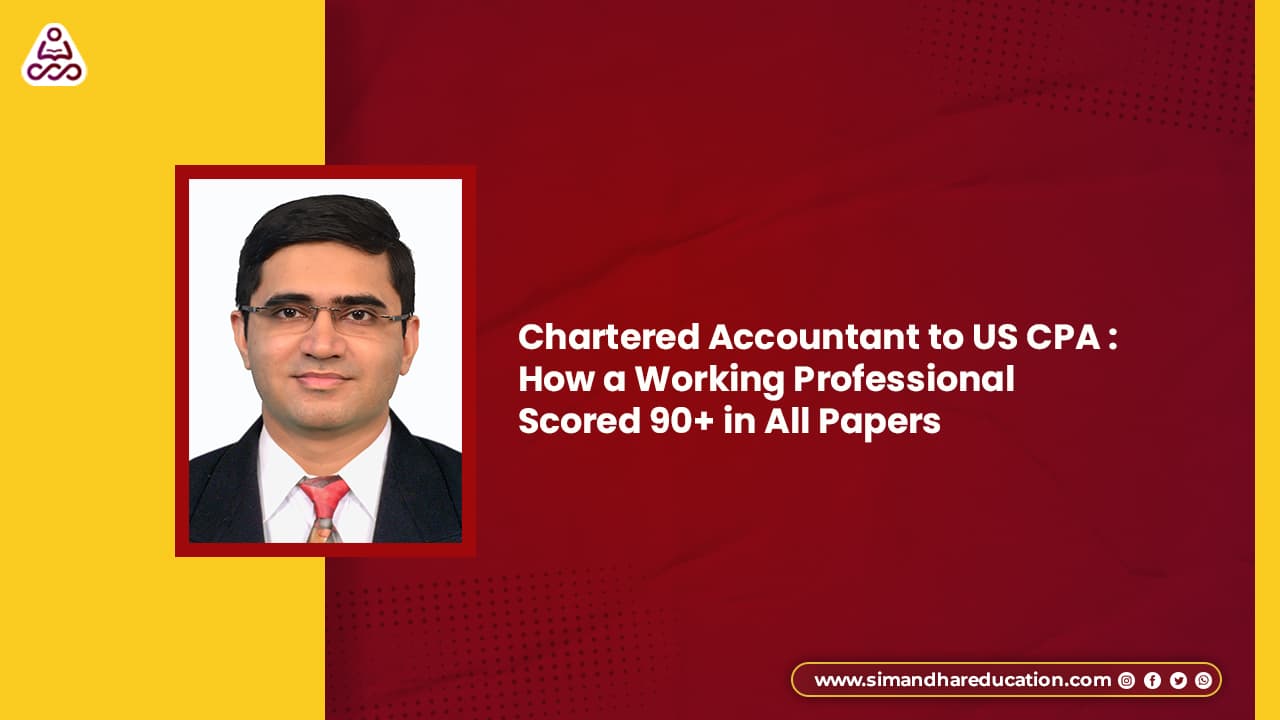
Table of Contents
- 1. Introduction
- 2. Career After Chartered Accountancy
- 3. Transition from Practice to Corporate
- 4. Why US CPA Became the Next Step
- 5. Understanding the CPA Exam Structure
- 6. Preparation Strategy While Working Full Time
- 7. CPA Scores and Performance Insight
- 8. Timeline to Complete CPA
- 9. The Role of Learning Ecosystem
- 10. Common Mistakes Students Make
- 11. Importance of Practical Knowledge
- 12. Personal Sacrifices and Support System
- 13. Career Perspective and Continuous Growth
- 14. About Simandhar Education
- 15. Conclusion
Table of Contents
Introduction
In the evolving landscape of global finance, professional qualifications alone are no longer sufficient to sustain long term growth. What differentiates high performing professionals is their ability to reassess their trajectory and take deliberate steps toward upskilling.
This is the journey of a Chartered Accountant who chose to pursue the US CPA not out of necessity, but out of a clear understanding that global exposure demands global competence.
Career After Chartered Accountancy
After qualifying as a Chartered Accountant in 2014, the initial phase of the career was rooted in traditional practice. Over a span of seven years, significant experience was gained through work in a CA firm, including exposure to client handling and professional assignments.
However, over time, a limitation became evident. The nature of work, although stable, did not fully align with long term career ambitions. The scope for growth and exposure appeared restricted, creating a gap between qualification and actual professional utilization.
Transition from Practice to Corporate
To bridge this gap, a transition into the corporate sector was undertaken. This phase involved multiple role changes, each aimed at achieving better exposure and a more structured career path.
Eventually, a stable position was secured in a reputed organization in Pune, where the role involved working with US based companies. This exposure played a critical role in shaping the next career decision.
Why US CPA Became the Next Step
Working with international organizations highlighted a key gap. While the Chartered Accountant qualification provided a strong foundation, it did not fully address the requirements of US accounting and taxation frameworks.
The decision to pursue CPA was therefore strategic. It was driven by the need to build expertise in US accounting, enhance global relevance, and align with the expectations of multinational organizations.
Understanding the CPA Exam Structure
A significant realization during preparation was the true nature of the CPA examination.
The exam is not theoretical. It does not reward memorization or textbook knowledge. Instead, it is designed to evaluate practical understanding, professional judgment, and the ability to apply concepts in real world scenarios.
The questions are simulation based and require candidates to think analytically rather than recall information.
Preparation Strategy While Working Full Time
Preparing for CPA alongside a full time job required a disciplined and structured approach.
The preparation was focused on consistency rather than intensity. Concepts were prioritized over memorization, and flexibility in learning played a key role in maintaining continuity.
The ability to study at one’s own pace ensured that professional responsibilities and preparation could be balanced effectively.
CPA Scores and Performance Insight
The outcome of this approach is reflected in the scores achieved across all four papers.
A score of 97 in Regulation, 94 in FAR, 93 in ISC, and 92 in Audit resulted in an overall average of 94. This level of performance demonstrates not only subject mastery but also a clear understanding of exam expectations.
Timeline to Complete CPA
The CPA journey was completed in a structured manner while continuing full time employment.
The first two papers were completed within six to seven months. The third paper required a shorter duration due to prior exposure, and the final paper was completed over the following months.
This highlights that with the right approach, CPA can be completed efficiently without career disruption.
The Role of Learning Ecosystem
An active and responsive learning environment played a crucial role in the preparation process.
Access to peer discussions, previously solved queries, and real exam experiences helped in gaining practical insights. This type of ecosystem significantly enhances understanding and reduces preparation challenges.
Common Mistakes Students Make
A key observation from this journey is the approach taken by many students.
A large number of candidates rely heavily on memorization. This approach is ineffective for CPA because the exam is application driven. Without conceptual clarity and practical understanding, it becomes difficult to perform well.
Importance of Practical Knowledge
Success in CPA is closely linked to practical understanding.
Candidates who can relate concepts to real world scenarios are better equipped to handle simulation based questions. Work experience and application oriented learning provide a significant advantage in this regard.
Personal Sacrifices and Support System
Preparing for CPA requires commitment and discipline. This often involves reducing social activities, dedicating weekends to study, and maintaining focus over an extended period.
During this phase, support from family becomes essential. A strong support system enables consistency and helps sustain motivation throughout the journey.
Career Perspective and Continuous Growth
The decision to pursue CPA reflects a broader mindset. Professional growth does not end with one qualification. It requires continuous effort, learning, and the willingness to evolve.
In a global finance environment, staying relevant is a continuous process. Upskilling is not optional but necessary.
About Simandhar Education
Simandhar Education played a significant role in enabling this journey. The decision to choose Simandhar was influenced by its strong track record, including multiple global rank holders and its association with Becker content.
What differentiates Simandhar is its structured yet flexible approach to learning. The program is designed specifically for working professionals, allowing them to prepare at their own pace without compromising their careers.
The availability of recorded lectures, a well organized curriculum, and an active student support system ensures that candidates receive both academic guidance and practical insights. This alignment between content, structure, and student needs makes Simandhar a reliable platform for professionals aiming to transition into global accounting roles.
Conclusion
The journey from Chartered Accountant to US CPA is not about replacing an existing qualification. It is about expanding professional capability and aligning with global opportunities.
This story demonstrates that growth is a conscious decision. It requires clarity, discipline, and the willingness to move beyond comfort.
In today’s finance landscape, those who continue to learn are the ones who lead.
Planning to take CPA? Explore our CPA course