
From Commerce Graduate to US CPA: How Pritibha Cracked All Four CPA Exams in Eight Months While Working Full-Time
Learn how Pritibha, a Delhi University commerce graduate, cleared all four US CPA exams in just eight months while working full-time in audit. A disciplined, structured, and globally aligned CPA journey.
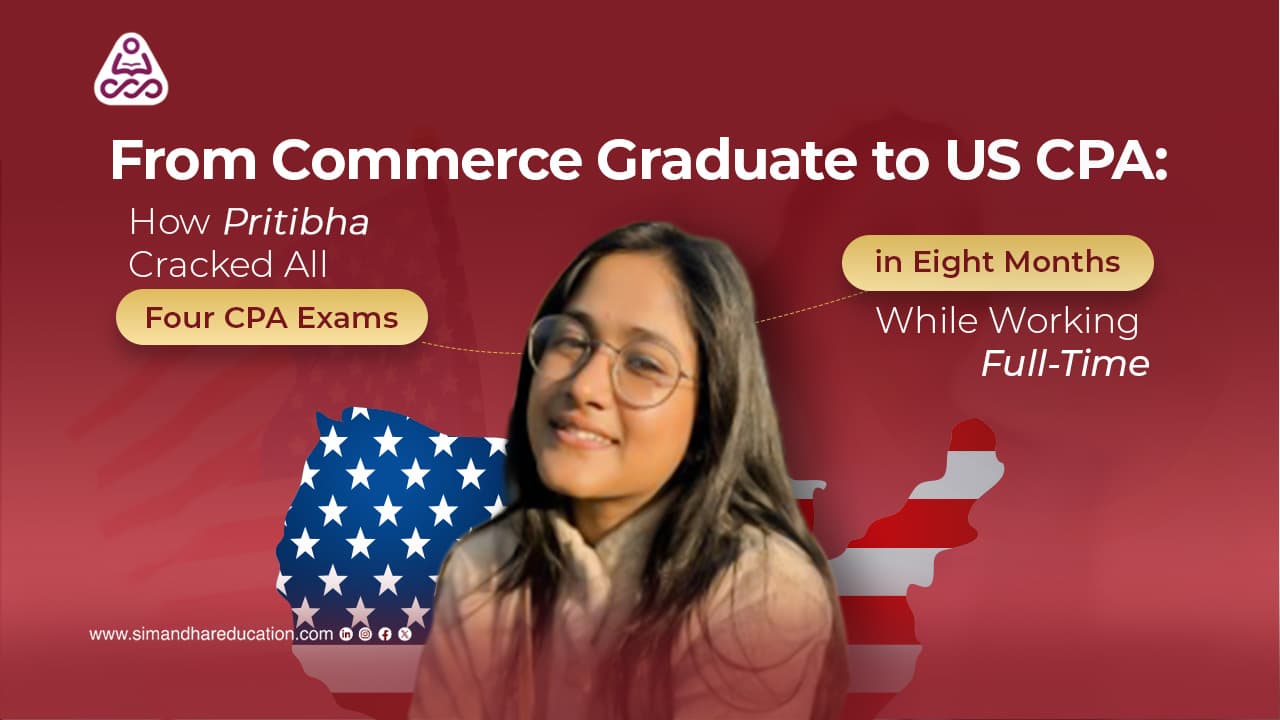
The progression from an undergraduate commerce degree in India to a globally recognized professional credential requires more than determination. It demands alignment between academic choices, professional exposure, and long-term career intent. Pritibha’s journey from graduating in commerce at Delhi University to successfully completing all four US CPA examinations within eight months while working full-time in audit demonstrates how structured planning and academic discipline can translate into accelerated global career outcomes.
Her experience reflects a broader principle relevant to accounting professionals: professional qualifications yield the greatest value when they reinforce existing work environments rather than operate independently of them.
Academic Foundation and Professional Context
Pritibha
completed her commerce degree from Delhi University, developing a strong
conceptual base in accounting, finance, and assurance. Early in her career, she
secured a campus placement at RSM US LLP, where her role was firmly embedded in
the audit function and involved working directly on US-based client
engagements.
This professional exposure proved pivotal. Daily interaction with US audit methodologies, documentation standards, and compliance frameworks created a natural convergence between her professional responsibilities and the competencies tested under the CPA examination framework. In this context, pursuing CPA was not an additional academic obligation but a structured formalization of knowledge already being applied in practice.
The Strategic Rationale for Choosing CPA
The decision
to pursue the US CPA qualification was driven by professional relevance rather
than general aspiration. For professionals operating within US accounting and
audit environments, CPA remains the most directly applicable and globally
respected credential. It strengthens technical judgment, reinforces regulatory
understanding, and enhances professional credibility within international audit
settings.
For Pritibha, CPA represented continuity rather than divergence, an academic pathway that complemented her audit role and supported long-term professional scalability.
Examination Preparation and Academic Approach
Pritibha
prepared for the CPA examinations exclusively using Becker, selecting it for
its academic rigor and close alignment with the CPA examination blueprint. The
structured progression of concepts, combined with examination-oriented practice
questions and simulations, enabled efficient preparation rooted in conceptual
clarity.
This alignment between preparation material and examination expectations reduced redundancy in learning and allowed focused engagement with areas of high assessment relevance. As a result, preparation efforts translated directly into examination readiness.
Balancing Full-Time Audit Work with CPA Studies
Managing CPA
preparation alongside full-time audit responsibilities required methodological
discipline rather than extended study hours. Pritibha adopted a
consistency-driven approach, ensuring daily engagement with study material
regardless of professional workload. Even brief, uninterrupted study sessions
preserved conceptual continuity and minimized the effort required to re-enter
academic mode.
This approach reflects established academic principles: sustained incremental learning produces stronger retention and application than intermittent intensive study. By prioritizing continuity, she maintained steady progress without compromising professional performance.
Completion of All Four CPA Exams in Eight Months
All four CPA
examinations were completed within a span of eight months while continuing
full-time employment. This achievement was not the result of acceleration
alone, but of alignment between professional exposure, academic preparation,
and examination structure.
The completion timeline illustrates that CPA, when pursued within a compatible professional ecosystem, becomes an integrated career milestone rather than an external academic burden.
Role of Structured Academic and Procedural Guidance
Alongside
individual discipline, structured academic and procedural guidance supported
the journey from initiation to completion. Assistance included credential
evaluation, examination planning, academic mentoring, and clarity across
regulatory processes. Institutions such as Simandhar Education focus on
providing this integrated ecosystem, enabling candidates to navigate the CPA
pathway with confidence, clarity, and continuity.
Concluding Perspective
Pritibha’s
journey from commerce graduate to US CPA underscores a fundamental insight into
professional advancement: global qualifications deliver the greatest impact
when they reinforce professional realities rather than compete with them. In
this context, CPA functioned not merely as a certification, but as formal
recognition of expertise within the US accounting and audit framework.
For commerce graduates and audit professionals
working with international clients, CPA offers intellectual coherence,
professional legitimacy, and sustained career scalability. When pursued with
disciplined methodology and structured guidance, it becomes a natural extension
of one’s professional trajectory rather than a parallel pursuit.
Planning to take CPA? Explore our CPA course