
How to Clear CPA as a Fresher | CPA Success Story & Study Strategy
Learn how to clear CPA as a fresher without work experience. Discover the CPA study plan, preparation strategy, MCQ practice method, and success tips from Manish Dharmani’s journey.
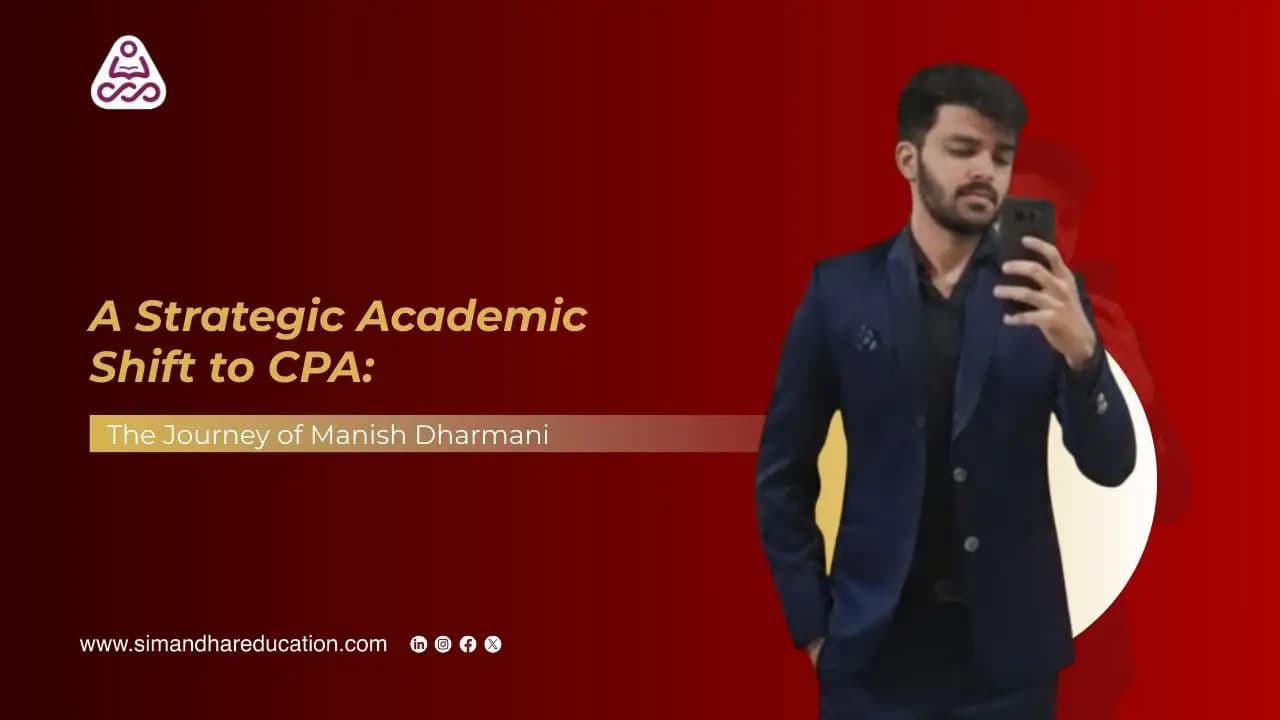
Table of Contents
A Strategic Academic Shift to CPA: The Journey of Manish Dharmani
Professional growth is often shaped not by uninterrupted continuity, but by informed recalibration. The journey of Manish Dharmani reflects how deliberate academic decisions, structured preparation, and disciplined execution can redefine professional direction.
His progression toward the CPA qualification was not the result of circumstance, but of strategic clarity. By reassessing his academic alignment during a period of uncertainty, he positioned himself toward a globally recognized certification pathway with renewed focus.
Academic Background – From Early Professional Exploration to M.Com
● Choosing to Realign Academic Direction During the COVID Period
During his undergraduate studies, Manish explored professional certification pathways alongside completing his B.Com. However, during the COVID period, he made a conscious decision to discontinue that pursuit and concentrate fully on strengthening his academic foundation.
This was not a reactive decision but a strategic one. Rather than continuing without full alignment, he chose clarity over continuity, prioritizing structured academic progression.
● Strengthening Foundations Through M.Com
Following graduation, Manish pursued M.Com to deepen his conceptual understanding of commerce, accounting principles, and analytical reasoning.
The postgraduate program reinforced theoretical rigor and enhanced his academic maturity. It also served as a strong bridge toward pursuing the CPA qualification, aligning his academic credentials with professional eligibility requirements.
Why Manish Chose CPA as His Professional Path
● Evaluating Career Scope and Global Relevance
The decision to pursue CPA was driven by a structured evaluation of long-term career opportunities. Manish identified CPA as a globally respected certification that aligns with international accounting standards and evolving professional demands.
In a dynamic financial ecosystem, globally recognized credentials provide mobility, adaptability, and structured career progression.
● Pursuing CPA as a Fresher Without Work Experience
Manish entered the CPA journey without prior full-time professional experience. A common concern among fresh graduates is whether subjects with practical orientation such as Audit, become challenging without workplace exposure.
However, his preparation experience demonstrated that structured academic guidance and disciplined study can effectively compensate for experiential gaps.
Conceptual clarity, reinforced through systematic learning, enabled him to navigate the curriculum confidently.
Can a Fresher Successfully Clear CPA?
The perception that professional certifications require industry experience is widespread. However, Manish’s experience provides a counterpoint.
While professional exposure may enhance contextual understanding, examination performance primarily depends on:
● Conceptual comprehension
● Analytical reasoning
● Structured problem-solving
● Consistent application practice
His journey confirms that fresh graduates can successfully clear CPA when preparation is methodical and disciplined.
CPA Preparation Strategy – Study Plan and Time Management
● Studying 8–10 Hours Daily with Structured Discipline
Manish maintained a study schedule of approximately 8 to 10 hours per day. More importantly, this commitment was consistent rather than sporadic.
Regular engagement allowed for progressive assimilation of content and minimized cognitive overload.
● Emphasis on MCQs and Simulation-Based Learning
His preparation followed a structured progression:
○ Attending lectures for conceptual clarity
○ Reading the textbook once for reinforcement
○ Transitioning directly to MCQs and simulations
Simulation practice enhanced familiarity with exam structure and strengthened analytical speed. Active recall through MCQs ensured deeper retention compared to repetitive passive revision.
This approach reflects established learning principles that prioritize application over memorization.
Overcoming Challenges in the CPA Journey
● Restarting After a Gap Year
Following a one-year pause, resuming preparation required renewed discipline. The primary challenge was reestablishing routine and maintaining uninterrupted consistency.
Through focused execution, Manish completed three CPA papers within five months after restarting, demonstrating the impact of structured concentration.
● The Role of Consistency
The most demanding aspect of the journey was not syllabus complexity but maintaining daily momentum. Professional certifications reward steady discipline more than intermittent intensity.
The Role of Structured Study Resources in Exam Readiness
Standardized preparatory materials played a significant role in his performance.
Simulation modules and structured question banks:
● Reinforced conceptual application
● Improved time management
● Reduced exam-day uncertainty
Alignment between practice formats and examination patterns enhanced both confidence and performance stability.
Recommended Study Commitment for CPA Aspirants
Based on his experience, Manish recommends:
● 8–10 focused study hours daily
● Dedicated weekend reinforcement
● A preparation timeline of approximately 8 to 12 months
However, he emphasizes that success depends on three interrelated factors:
● Focus
● Regularity
● Volume of practice
The quality of engagement determines outcome effectiveness.
Key Takeaways from Manish Dharmani’s CPA Journey
His journey offers several instructive insights:
● Strategic academic realignment strengthens long-term clarity.
● Fresh graduates can pursue CPA without prior work experience.
● Application-driven preparation is central to success.
● Discipline and structured routine outweigh perceived difficulty.
● Resilience during transition phases shapes professional maturity.
Manish’s Learning Experience and Academic Support
Manish emphasized that the structured academic support and evaluation framework from Simandhar Education played a significant role in maintaining clarity and confidence throughout his preparation. He noted that the learning environment was organized and systematic, which reduced ambiguity during complex subject areas. In particular, he found the evaluation process and academic guidance to be consistent and responsive, enabling him to track his conceptual progress effectively. He also highlighted the usefulness of the structured study material and simulation-based practice, observing similarities between practice questions and the actual examination pattern. According to him, this alignment strengthened exam readiness and minimized uncertainty during the assessment phase.
Conclusion: Strategic Clarity and Structured Execution
The journey of Manish Dharmani illustrates that professional advancement is often the product of thoughtful recalibration rather than uninterrupted continuation.
By consciously realigning his academic direction and committing to disciplined CPA preparation, he demonstrated that clarity, consistency, and structured effort remain the foundational drivers of success.
In an evolving professional landscape, adaptability supported by rigorous preparation is the true differentiator.
Planning to take CPA? Explore our CPA course