
How Triple-AI Training Strengthens Your US CMA Journey
Discover how Triple-AI training can strengthen your US CMA journey by improving exam preparation, practical finance capabilities, AI readiness, and career opportunities in a technology-driven workplace.
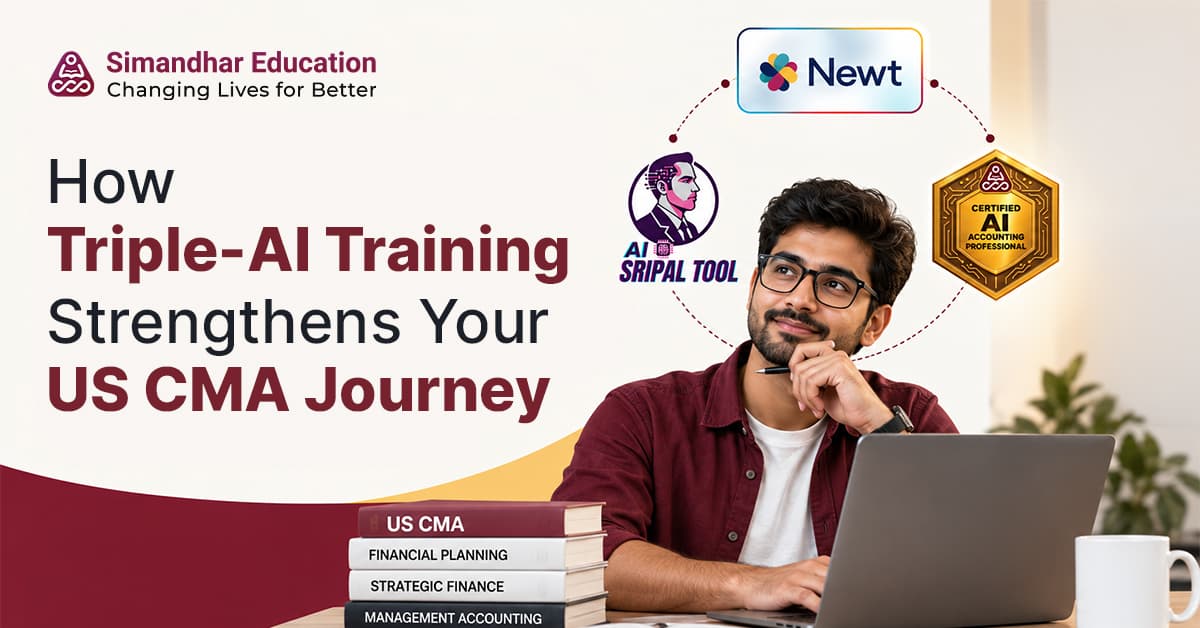
Table of Contents
- 1. How Triple-AI Training Strengthens Your US CMA Journey
- 2. Why Finance Professionals Need to Understand AI
- 3. Combining Professional Knowledge with Technology
- 4. Understanding the Triple-AI Approach
- 5. Making Exam Preparation More Effective
- 6. Building Skills Beyond the Examination
- 7. The AI Capabilities CMA Students Should Develop
- 8. Preparing for Modern Finance Roles
- 9. Creating Career Value in MNCs and Global Organisations
- 10. Why Human Judgement Still Matters
- 11. How the Learning Model Supports Students
- 12. Simandhar's Role in Building AI-Ready Finance Professionals
- 13. Building a Future-Ready Finance Career
- 14. Frequently Asked Questions
- 15. What does the Triple-AI approach include?
- 16. How can artificial intelligence support CMA preparation?
- 17. What technology capabilities are useful for CMA students?
- 18. Will artificial intelligence replace management accountants?
- 19. Can combining CMA knowledge and AI capabilities improve career readiness?
- 20. Is learning AI useful for students without a technical background?
- 21. How is artificial intelligence changing management accounting careers?
- 22. Should students learn artificial intelligence before completing the CMA?
- 23. How does Simandhar support students beyond exam preparation?
- 24. Why combine professional accounting knowledge with AI?
How Triple-AI Training Strengthens Your US CMA Journey
The role of a management accountant is evolving. Finance professionals today are expected to do more than prepare reports, analyse costs, or work with budgets. Organisations increasingly want professionals who can interpret data, support strategic decisions, improve processes, and understand how emerging technologies can be applied responsibly in finance.
For students pursuing the US Certified Management Accountant (US CMA) qualification, this shift creates an important opportunity. The US CMA develops strong foundations in management accounting, financial planning, performance management, analytics, and strategic decision-making. Adding relevant artificial intelligence capabilities can make this knowledge even more practical for a changing workplace.
This is where AI training for US CMA students becomes valuable. Instead of viewing professional education and technology as separate areas, students can learn how the two complement each other.
A Triple-AI learning ecosystem can support students at different stages—from understanding concepts and preparing for examinations to developing workplace-oriented AI capabilities. The objective is not to replace core accounting knowledge with technology but to help future finance professionals use technology more effectively.
Why Finance Professionals Need to Understand AI
Artificial intelligence is becoming increasingly relevant across finance functions. Companies are exploring automation, advanced analytics, forecasting tools, intelligent reporting, and AI-assisted decision support to improve the speed and quality of financial processes.
This development is particularly relevant to management accountants.
US CMA professionals may work in areas such as financial planning and analysis (FP&A), budgeting, performance management, cost management, corporate finance, internal controls, and strategic decision support. Many of these responsibilities involve large volumes of financial and operational information.
Understanding AI in corporate finance can therefore help professionals recognise where technology can improve efficiency and where human judgement remains essential.
For example, AI-enabled tools can assist with identifying patterns in financial data, summarising information, supporting variance investigations, automating repetitive activities, and developing initial forecasts. However, finance professionals are still responsible for validating information, interpreting results, considering business context, and making appropriate recommendations.
That combination of financial expertise and technological awareness is becoming increasingly important.
Combining Professional Knowledge with Technology
The value of US CMA with AI training lies in bringing together two complementary skill sets.
The US CMA curriculum builds knowledge in financial planning, performance, analytics, strategic financial management, corporate finance, risk management, investment decisions, and professional ethics. AI training can then help students explore how modern technology may be applied to these areas.
Consider budgeting as an example.
A management accountant traditionally collects historical information, studies business assumptions, communicates with departments, and develops forecasts. Technology can make portions of this process faster by assisting with data analysis or identifying unusual patterns.
But technology cannot independently understand every strategic priority, market condition, operational challenge, or management objective.
A skilled finance professional needs to interpret what the information actually means.
This is why AI skills for CMA professionals should complement rather than replace accounting knowledge.
Understanding the Triple-AI Approach
Triple-AI US CMA learning can be understood as an ecosystem where students receive support through three complementary AI-oriented learning components.
At Simandhar Education, this approach brings together Becker’s technology-enabled learning ecosystem, AI Sripal, and the Certified AI Accounting Professional (CAAP) program.
Each component can serve a different purpose in the student's development.
The learning technology supporting professional exam preparation can help students work through their study journey more efficiently. AI Sripal can provide additional learning support when students need assistance with concepts or questions. CAAP focuses on developing a broader understanding of AI applications relevant to accounting and finance.
Together, these elements aim to connect examination preparation, continuous learning support, and workplace-oriented technology skills.
For students asking, What is Triple-AI training for US CMA?, the simplest answer is that it is an approach that combines professional CMA preparation with AI-supported learning and practical exposure to AI concepts relevant to accounting and finance.
Making Exam Preparation More Effective
Students often ask, how AI can help with US CMA preparation, particularly when professional examinations already involve extensive study materials and practice.
The biggest advantage is not simply receiving faster answers. It is using technology to make learning more structured and responsive.
An AI-powered CMA course environment can help students identify areas that require more attention, access explanations, reinforce concepts, and practise more strategically.
Suppose a student understands the formula behind a variance but struggles to interpret what the result means from a managerial perspective. An AI learning assistant may help the student break the problem into smaller steps, revisit the underlying concept, and understand how the calculation connects to business decisions.
Similarly, AI learning for CMA students can support revision by helping learners explore concepts through questions and explanations rather than relying entirely on passive reading.
However, students should not treat AI-generated responses as unquestionable answers. Professional education requires conceptual understanding, critical thinking, and verification. AI should support the learning process—not replace it.
Building Skills Beyond the Examination
Passing the US CMA examination is an important milestone, but professional development continues after the exam.
Employers evaluate candidates on their ability to apply financial knowledge in practical business situations. Professionals may need to work with financial models, management reports, business data, dashboards, forecasts, and cross-functional teams.
This is where US CMA AI training can add another dimension to professional preparation.
Students can learn how AI tools may assist with activities such as analysing structured information, summarising financial insights, generating initial scenarios, supporting research, and improving routine workflows.
The goal is not necessarily to become an AI engineer or programmer.
Instead, management accountants need enough technological understanding to recognise appropriate use cases, communicate effectively with technology teams, evaluate AI-generated information, and use tools responsibly.
The AI Capabilities CMA Students Should Develop
Students frequently ask, Which AI skills should CMA students learn?
A good starting point is learning how to communicate effectively with generative AI tools. Clear prompting involves providing context, defining the objective, specifying relevant constraints, and critically evaluating the response.
Data literacy is equally important. Finance professionals need to understand the information they are working with, recognise inconsistencies, question unusual results, and distinguish between correlation and meaningful business insights.
Students should also develop an understanding of automation and workflow improvement. Many finance activities involve repetitive processes that may be streamlined with technology.
Another important capability is AI output validation. A finance professional should never assume that an AI-generated calculation, explanation, forecast, or recommendation is automatically correct.
These are among the best AI skills for US CMA students because they reinforce rather than compete with core management accounting capabilities.
Preparing for Modern Finance Roles
The future of US CMA with AI is closely connected to how finance departments themselves are changing.
Routine processing is becoming increasingly automated, while professionals are expected to spend more time analysing results, communicating insights, supporting decisions, and contributing to strategy.
This does not mean accounting expertise becomes less valuable. In many situations, it becomes more important because professionals need sufficient knowledge to assess technology-generated outputs.
This is also central to understanding how AI is changing US CMA careers.
A management accountant may receive an automatically generated variance report, for example, but someone still needs to investigate why the variance occurred, determine whether it represents a temporary issue or structural problem, and recommend an appropriate response.
Technology can accelerate analysis. Professional judgement gives that analysis meaning.
Creating Career Value in MNCs and Global Organisations
Large organisations and multinational companies increasingly operate through technology-enabled finance functions. Employees may interact with enterprise systems, analytics platforms, automation tools, and AI-enabled applications as part of everyday work.
Therefore, US CMA with AI skills for MNC jobs can represent a useful combination.
The US CMA provides globally relevant management accounting and financial decision-making knowledge, while AI capabilities can demonstrate that a candidate is prepared to work in technology-enabled finance environments.
This combination can be relevant across roles such as FP&A, management accounting, financial analysis, business finance, costing, budgeting, performance management, and related corporate finance functions.
AI capabilities alone do not guarantee employment, just as earning a qualification does not automatically guarantee a particular role or salary. Career outcomes depend on multiple factors, including experience, communication abilities, technical knowledge, location, employer requirements, and interview performance.
The advantage comes from developing a broader professional profile.
Why Human Judgement Still Matters
One of the biggest misconceptions surrounding artificial intelligence is that better technology eliminates the need for human expertise.
Finance demonstrates why that assumption is problematic.
An AI system may analyse thousands of transactions quickly, but it may not fully understand why a particular business decision was taken. It may identify an unusual number but not know whether that variation is commercially reasonable.
Management accountants contribute context.
They understand organisational objectives, financial implications, controls, risks, ethical responsibilities, and stakeholder expectations.
This is one reason is AI important for CMA professionals has become such a relevant question. Yes, understanding AI is increasingly useful, but the objective should be augmentation rather than dependence.
The strongest professionals are likely to be those who know when to use technology, when to question it, and when professional judgement should take priority.
How the Learning Model Supports Students
For anyone wondering how AI training helps US CMA students, its value can be viewed across three stages.
During preparation, AI-supported tools can complement classes, study materials, practice questions, and faculty guidance.
During skill development, students can explore how artificial intelligence is being applied to accounting and finance activities.
During career preparation, students can begin developing the technology awareness increasingly relevant to modern finance teams.
This integrated approach helps connect the qualification to the environment in which students may eventually work.
The purpose of AI training for US CMA is therefore broader than making study easier. It is about helping students become more adaptable professionals.
Simandhar's Role in Building AI-Ready Finance Professionals
Simandhar Education's role extends beyond helping learners prepare for professional qualifications. Its learning ecosystem is designed to help students connect qualification knowledge with skills relevant to modern accounting and finance careers.
For US CMA learners, Simandhar combines structured learning support with the Triple-AI ecosystem involving Becker's learning technology, AI Sripal, and CAAP.
AI Sripal is designed to provide additional learning assistance, allowing students to seek concept support and explore questions as part of their learning journey.
CAAP—the Certified AI Accounting Professional program—focuses specifically on helping accounting and finance professionals understand practical AI applications. This creates an opportunity for learners to develop technology awareness alongside their professional qualification journey.
Through this approach, US CMA with AI training becomes more than an exam-focused proposition. Students can work towards professional knowledge while developing an understanding of how technology is influencing accounting roles.
Simandhar also provides learning guidance and career-oriented support that can help students understand how their qualification and skills connect with opportunities in the finance industry.
Building a Future-Ready Finance Career
The relationship between accounting and technology will continue to evolve.
Some tasks that finance professionals perform today may become increasingly automated. At the same time, organisations will continue to need professionals who can interpret financial information, understand business priorities, communicate recommendations, maintain professional standards, and exercise sound judgement.
For US CMA students, the goal should therefore not be to compete with AI.
It should be to learn how to work effectively with it.
The combination of US CMA knowledge and practical AI awareness can help students prepare for finance functions where technology and human expertise increasingly operate together.
Ultimately, how AI training helps US CMA students depends on how thoughtfully the technology is used. AI can provide support, improve efficiency, and expand learning possibilities, but the student still needs to build conceptual understanding, practise consistently, question results, and develop professional judgement.
A Triple-AI approach brings these elements together by connecting qualification preparation, AI-supported learning, and practical technology education.
For aspiring management accountants, that combination can help turn the US CMA journey into preparation not only for an examination, but also for the changing realities of a modern finance career.
Frequently Asked Questions
1. What does the Triple-AI approach include?
The approach combines Becker's technology-enabled learning ecosystem, AI Sripal, and Simandhar's CAAP program. Together, these components support professional exam learning, concept assistance, and exposure to practical AI applications relevant to accounting and finance.
2. How can artificial intelligence support CMA preparation?
Artificial intelligence can support concept clarification, personalised explanations, revision, question-based learning, and identification of areas that require additional practice. It should complement structured classes, approved study resources, practice, and faculty guidance rather than replace them.
3. What technology capabilities are useful for CMA students?
Useful capabilities include effective prompting, data literacy, AI-assisted research, workflow automation awareness, financial analysis, output verification, critical thinking, and responsible use of AI. Students do not necessarily need advanced programming expertise to begin developing these capabilities.
4. Will artificial intelligence replace management accountants?
AI is more likely to automate or assist with specific tasks than replace the complete role of a skilled management accountant. Business context, strategic interpretation, ethical judgement, stakeholder communication, and decision-making continue to require significant human involvement.
5. Can combining CMA knowledge and AI capabilities improve career readiness?
The combination can strengthen a candidate's professional profile because modern finance teams increasingly use digital and AI-enabled tools. However, employment outcomes depend on several factors, including knowledge, experience, communication skills, employer requirements, location, and interview performance.
6. Is learning AI useful for students without a technical background?
Yes. Finance students can begin with practical capabilities such as prompting, understanding AI limitations, working with financial information, validating outputs, and identifying automation opportunities. Advanced coding is not required for every finance-related AI use case.
7. How is artificial intelligence changing management accounting careers?
AI can automate repetitive activities, accelerate data analysis, assist with reporting, and support forecasting. As a result, management accountants can increasingly focus on interpreting information, solving business problems, communicating insights, and supporting strategic decisions.
8. Should students learn artificial intelligence before completing the CMA?
Students do not necessarily need to wait until completing the qualification. Learning relevant technology capabilities alongside CMA preparation can help them understand how accounting concepts may be applied in modern finance environments.
9. How does Simandhar support students beyond exam preparation?
Simandhar supports learners through structured professional education, learning assistance, career-oriented guidance, and its Triple-AI ecosystem. Through Becker's learning technology, AI Sripal, and CAAP, students can complement qualification preparation with exposure to AI-enabled learning and practical technology concepts.
10. Why combine professional accounting knowledge with AI?
Accounting knowledge helps professionals understand what financial information means, while AI can help them process and analyse information more efficiently. Combining the two allows professionals to use technology while applying the financial judgement, business context, and ethical understanding required in management accounting.
Planning to take CMA? Explore our CMA course