
Is ACCA Relevant With AI? Careers, Skills & Future Scope
Is ACCA relevant with AI? Learn how AI is changing accounting jobs, what ACCA prepares you for, the skills to add, and future ACCA career opportunities.
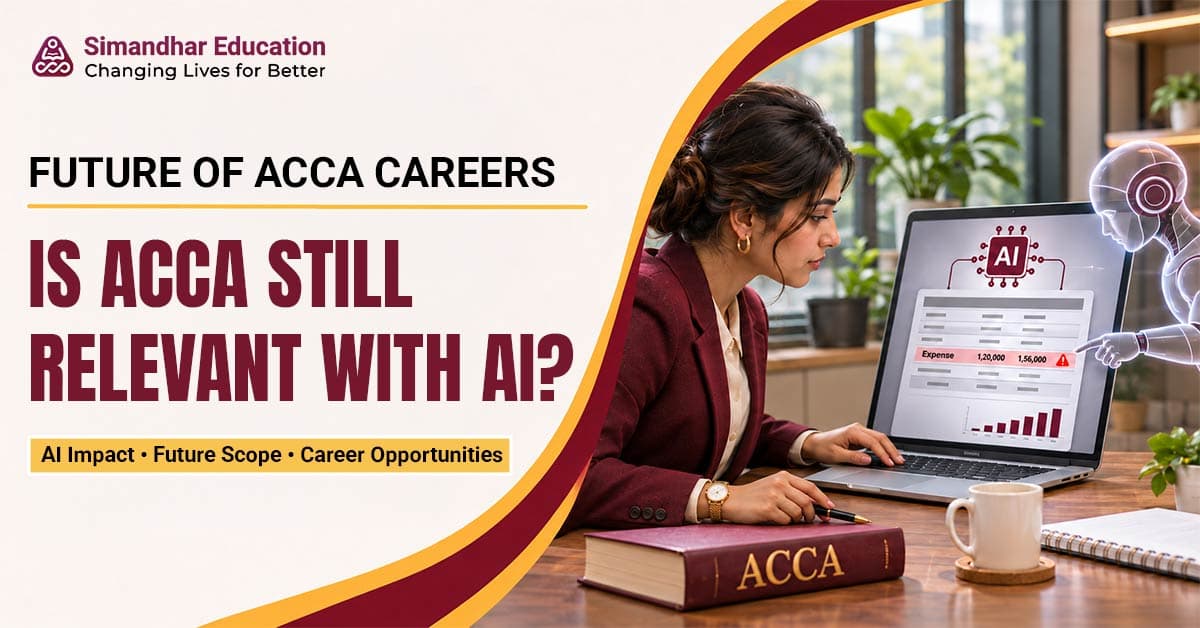
Table of Contents
- 1. Is ACCA Still Relevant in an AI-Powered Finance Industry? Career Opportunities, Future Skills & the Impact of AI
- 2. Meet Ananya and Rohit
- 3. What Is AI Actually Changing in Accounting and Finance?
- 4. Will AI Replace ACCA-Qualified Professionals?
- 5. How Does ACCA Prepare Students for the AI Era?
- 6. Traditional Accountant vs AI-Era Finance Professional
- 7. What Skills Should ACCA Students Learn Alongside Their Qualification?
- 8. What Will Future ACCA Career Opportunities Look Like?
- 9. Practical Scenario – How an ACCA Professional Works With AI
- 10. How Can ACCA Students Prepare for an AI-Driven Finance Industry?
- 11. Final Advice from the Mentor
- 12. Frequently Asked Questions
Is ACCA Still Relevant in an AI-Powered Finance Industry? Career Opportunities, Future Skills & the Impact of AI
It is 11 p.m., and Ananya is supposed to be revising her ACCA Financial Accounting paper. Instead, she is scrolling. A reel shows an AI tool reconciling a bank statement in under a minute. The comments are brutal: "Accountants are finished." "Why spend years on a qualification a chatbot can do?"
She closes the app, then opens it again. Her parents have already paid the first-year fees. Her friends keep forwarding headlines about AI wiping out finance jobs. A quiet question starts to grow: is ACCA relevant with AI, or is she preparing for a profession that may not exist by the time she qualifies?
If you are an ACCA student, an aspirant, or a parent funding one, you have probably asked the same thing. The fear is real, and it deserves a straight answer, not panic and not false comfort.
So, Ananya does what many students do when doubt hits: she reaches out to someone who has been through it. A family friend introduces her to Rohit Menon, a finance leader who has watched the profession change over fifteen years. They meet for coffee on Saturday. What follows is the conversation she wished she had found online.
Meet Ananya and Rohit
Ananya is a first-year ACCA student who finished Class 12 commerce last year. She is bright, hardworking, and worried that AI may shrink the value of her qualification.
Rohit Menon is an ACCA member with over fifteen years in audit, reporting and finance transformation at a multinational. He has trained many juniors and has seen automation arrive in his own team.
What Is AI Actually Changing in Accounting and Finance?

Rohit sir, everyone online says AI will take over accounting. Is that true?

Let's separate the noise from what happens inside finance teams. AI is changing tasks first, not the need for professionals. Take a month-end close. Not long ago, juniors spent days matching invoices, coding expenses and chasing missing entries. Today, software reads invoices, suggests ledger codes, flags duplicates and drafts first-cut reconciliations.
That sounds exactly like entry-level work.
It is, and I won't sugarcoat it. Repetitive, rule-based work is shrinking: data entry, basic reconciliations, first-pass reports, and even sample selection in audits. But look at what remains. Is this unusual transaction an error or a genuine business event? Why did margins fall, and what should the CFO do? Does this revenue treatment comply with IFRS?
So, the work moves up?
Mostly, yes. The job shifts from producing numbers to questioning and explaining them. Spreadsheets did not end accounting; they ended up adding columns by hand. AI in accounting and finance is the next step in the same story.
Will AI Replace ACCA-Qualified Professionals?

Be honest, sir. Will AI replace ACCA accountants?

It will replace some tasks, but replacing a qualified professional is a different matter. Three things stand in the way.
First, accountability. When financial statements are signed or an audit opinion is issued, a person answers for it legally and professionally. A tool cannot be held responsible.
Second, judgement. Accounting standards are full of grey areas: is this arrangement a lease, is this receivable recoverable? AI can suggest an answer, but someone must decide whether it fits the facts.
Third, trust. Boards, regulators and investors rely on professionals bound by ethics and a code of conduct.
Then will accounting jobs disappear because of AI?
Some roles built only on repetitive processing will shrink. Roles built on judgement, advice and ethics are far less likely to be automated:
- Audit and assurance
- Financial reporting
- Tax advisory
- Risk and controls
- Finance business partnering
The risk is highest for people who only process, and lowest for those who supervise, interpret and advise.
How Does ACCA Prepare Students for the AI Era?

My syllabus has no paper called "AI". Am I learning the wrong things?
You're learning the right foundation. Think about what an AI tool needs from a human: someone who knows whether a lease entry follows IFRS 16, whether audit evidence is sufficient, whether a forecast assumption is sensible.
That is exactly what Financial Reporting, Audit and Assurance, Financial Management and Strategic Business Reporting train you to do.
What else does ACCA add?
Two things people underestimate. The Ethics and Professional Skills module builds integrity, communication, and teamwork, which machines don't have. And the qualification is built around business context, so you learn to ask why numbers moved.
ACCA also keeps updating its learning technology and data skills, so check out the official ACCA website for the latest changes.
So, the ACCA qualification value lies in knowing enough to judge AI's output?
Exactly. A tool can draft. Only someone who understands the standards can tell whether the draft is right.
Traditional Accountant vs AI-Era Finance Professional

Can you show me how the job is actually different?
Here is the shift I see on my own team.
| Area | Traditional Accountant | AI-Era Finance Professional |
|---|---|---|
| Main work | Preparing entries, reconciliations and reports | Reviewing AI-prepared work, analysing results, advising |
| Tools | Spreadsheets and accounting software | Spreadsheets, BI dashboards, ERP, AI assistants |
| Time spent | Mostly processing and data gathering | Mostly analysis, checking and decisions |
| Value to employer | Accuracy and speed of output | Insight, judgement and risk control |
| Key skills | Technical accounting | Technical accounting plus data, technology and communication |
| Mindset | "Did I get the numbers right?" | "What do these numbers mean, and can I trust them?" |
So, I should aim to be in the second column.
And ACCA already gets you most of the way there. The rest is a handful of skills you add on top.
What Skills Should ACCA Students Learn Alongside Their Qualification?

Which AI skills should I learn? I don't want to waste time on the wrong things.

Start with the practical ones, in this order:
- Advanced Excel and data analysis: Pivot tables, Power Query and clean data handling. It is still the daily language of finance.
- Data visualisation: Power BI or Tableau, so you can turn numbers into a story a manager understands.
- AI tool literacy: Writing clear prompts and, above all, verifying the output. Treat AI as a fast but sometimes wrong junior.
- ERP and automation awareness: Know how systems like SAP or Oracle and workflow automation handle transactions.
- Data privacy basics: Never paste confidential client data into a public AI tool.
- Communication and critical thinking: Explaining findings clearly sets you apart from everyone who can run the same tool.
Do I need to learn coding?
Not at the start. Basic SQL or Python helps later, especially for analytics roles, but Excel, Power BI and good judgement come first.
What Will Future ACCA Career Opportunities Look Like?
I'm calm now. But what jobs will actually exist when I qualify?

Plenty, and some are newer than the ones we grew up with. ACCA career opportunities in the AI era include:
- Audit and assurance: Including technology-enabled audits and assurance over AI-driven systems.
- Financial reporting and IFRS: Where judgement on complex standards stays human.
- FP&A and business partnering: Turning forecasts and variance analysis into decisions.
- Tax and compliance advisory: Where interpretation matters more than data entry.
- Risk, controls and AI governance: Checking that automated processes are reliable and ethical.
- Finance transformation: Helping companies choose and implement automation.
- ESG and sustainability reporting: An expanding area that needs trusted assurance.
- Leadership roles: From finance controller to CFO.
So, ACCA jobs in the future look different, not fewer?
Different, and for the prepared, better. Titles vary by company, but the common thread is judgement plus technology.
Practical Scenario – How an ACCA Professional Works With AI
Can you give me a real picture of a day like that?
Imagine Meera, an ACCA-qualified FP&A manager at a manufacturing company, closing the quarter. Her AI tool consolidates data from several entities overnight and drafts the variance commentary. By 9 a.m., what once took two days of copy-paste is on her screen.
Then Meera does what the tool cannot. The commentary says costs fell because of "procurement efficiency." Something feels off. She checks and finds that a large supplier invoice was never accrued, because the tool misread its date. She corrects it, and the "efficiency" turns into a margin problem.
So, the AI nearly gave the CFO the wrong story.
Yes, and her training gave her the instinct to question it. She then spends the afternoon on what matters: why margins are under pressure in one product line, what pricing options exist, and what to recommend. She walks the CFO through it with clear reasoning.
So, AI did the heavy lifting, but Meera protected the quality.
And made the decision. That is what working alongside AI looks like.
How Can ACCA Students Prepare for an AI-Driven Finance Industry?

What should I start doing tomorrow?

Five habits:
- Master the fundamentals: Don't let AI do your learning. If you can't explain an answer, you can't judge the tool's answer.
- Add one tool at a time: Excel first, then Power BI, then an AI assistant. Depth beats a long list of half-learned tools.
- Practice checking AI: Ask an AI tool to solve an exam-style question, then mark it like an examiner. You will learn where it goes wrong.
- Build real exposure: Use internships and ACCA's practical experience requirements to see how businesses actually run.
- Practice explaining: Summarise a financial result in three sentences for a friend outside finance.
That feels doable.
Because it is. The students who stay competitive are consistent, not superhuman.
Final Advice from the Mentor
Rohit finishes his coffee and smiles.

You asked whether ACCA is relevant with AI. Here is my honest answer. AI will keep changing how finance work gets done. But the future of ACCA in the finance industry belongs to professionals who combine knowledge, critical thinking, ethical judgement, business understanding and technology skills.
ACCA gives you the first four. You build the fifth, steadily. So don't ask whether AI will replace you. Ask how you will become the person who uses it best.
Ananya walks home lighter. That night, she doesn't scroll. She opens her textbook, then a free Power BI tutorial, and gets to work.
Frequently Asked Questions
1. Is ACCA still relevant with AI?
Yes. AI automates repetitive tasks, but accounting standards, judgement, ethics and accountability still need qualified people. ACCA trains exactly those strengths, and students who add technology skills are best placed.
2. Will AI replace ACCA accountants?
Unlikely. AI will take over routine processing, but professionals who interpret standards, advise leadership and take responsibility for decisions remain essential. Roles will change, so upskilling matters.
3. Is ACCA worth pursuing in 2026 and beyond?
Yes, for students who want finance careers built on judgement and global recognition. Its value grows when paired with data, analytics, and AI skills.
4. What is the future of ACCA in the finance industry?
Expect ACCA professionals to spend less time on processing and more on analysis, assurance, advisory and oversight of automated systems, with technology fluency as a standard expectation.
5. Which AI skills should ACCA students learn?
Advanced Excel, data visualisation (Power BI or Tableau), AI tool literacy and output checking, ERP and automation awareness, data privacy basics, and clear communication.
6. Can AI perform accounting and auditing tasks?
It can assist with invoice processing, reconciliations, anomaly detection, and report drafting. It cannot take accountability or exercise professional judgement, so qualified humans must review and sign off.
7. What jobs can ACCA professionals pursue in the AI era?
Audit and assurance, financial reporting, FP&A, tax advisory, risk and controls, AI governance, finance transformation, ESG reporting and finance leadership.
8. How can ACCA students stay competitive in an AI-driven industry?
Master the fundamentals, add one tool at a time, practice verifying AI output, gain real business exposure, and build communication skills. Basic coding is optional at first; Excel and Power BI come first.
Planning to take ACCA? Explore our ACCA course