
Siddharth Phadke CPA Journey: Whole-Time Director Restarting Studies After 20 Years
Read Siddharth Phadke’s real CPA journey as a Whole-Time Director balancing work and studies after a 20-year gap. Insights, challenges, and strategy.
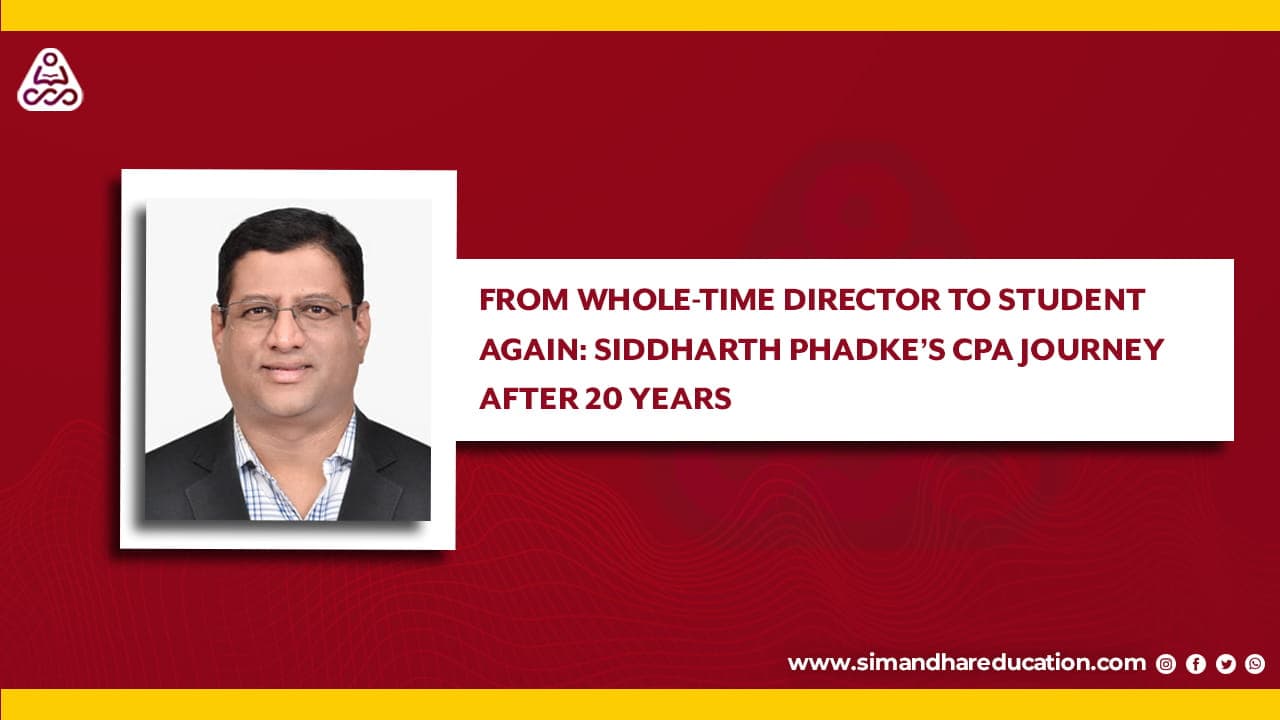
Table of Contents
- 1. Restarting After 20 Years: Siddharth Phadke’s CPA Journey
- 2. Introduction
- 3. The Thought Behind Starting CPA
- 4. Choosing CPA After Careful Evaluation
- 5. Seeing How CPA Has Evolved
- 6. Managing CPA Alongside a Whole-Time Director-Level Role
- 7. The Real Challenge: Restarting After 20 Years
- 8. What Preparation Actually Felt Like
- 9. The Most Challenging Subject
- 10. His Perspective on CPA Today
- 11. What Siddharth Would Tell Future Aspirants
- 12. Conclusion
- 13. FAQs
- 13.1. Can someone restart studies after 20 years?
- 13.2. How did Siddharth manage studies with a senior role?
- 13.3. What was his biggest challenge?
- 13.4. Which subject was the most difficult?
- 13.5. What is the key lesson from his journey?
Restarting After 20 Years: Siddharth Phadke’s CPA Journey
Introduction
There comes a point in every long career when experience begins to feel incomplete without structured knowledge.
For Siddharth Phadke, that realization came after years of working in a multinational environment. Having qualified in 2006 and built a stable career over nearly two decades, he was already operating at a senior level. Yet, something was missing.
The exposure to global accounting systems was there, but the formal depth of understanding was not.
That is when he made a decision that many professionals delay. He chose to become a student again.
The Thought Behind Starting CPA
Siddharth’s decision to pursue CPA was not impulsive. It developed gradually through his work experience.
Working in an MNC meant regular interaction with global accounting frameworks. Over time, he began to notice the importance of understanding how US GAAP connects with Indian accounting practices.
This was not just about technical knowledge. It was about clarity.
Alongside this, he also recognized the value that CPA adds as a qualification. It carries strong global credibility and aligns well with professionals working in international environments.
For him, it was a combination of relevance and recognition that led to the decision.
Choosing CPA After Careful Evaluation
Before finalizing CPA, Siddharth took time to evaluate different options. This was a considered decision, not a rushed one.
He spoke to friends and colleagues who had experience with CPA and other certifications. Their recommendations helped, but what influenced him more was his own interaction with the study material.
The structure of the content, the way concepts were explained, and the ability to relate learning to practical scenarios made a clear difference. It felt aligned with his work and easier to connect with.
That clarity made the choice straightforward.
Seeing How CPA Has Evolved
During his journey, Siddharth also realized how much CPA has changed over time.
He had colleagues who attempted CPA nearly twenty years ago, and their experience was very different. The exam structure was more manual and less aligned with modern learning.
What he experienced was a system that had evolved.
The CPA today is computer-based, structured, and designed to test understanding in a practical way. This shift reflects how the qualification has adapted to the needs of today’s professionals.
Managing CPA Alongside a Whole-Time Director-Level Role
Balancing studies with a demanding role was one of the most important aspects of Siddharth’s journey.
Initially, he believed that studying for long hours during weekends would be enough. However, this approach did not work for him.
He realized that sitting for extended hours was not effective. Instead, he shifted his approach. He began studying for around forty five minutes to one hour every day. On weekends, he studied for longer durations but divided the time into smaller sessions, usually two hours at a stretch rather than pushing beyond that.
This change made his preparation more sustainable and consistent.
The Real Challenge: Restarting After 20 Years
The biggest challenge Siddharth faced was not the syllabus.
It was starting again.
After nearly twenty years away from academics, getting back into the habit of studying was difficult. In the beginning, even focusing for fifteen to twenty minutes was a challenge.
The first couple of months required effort and patience. But once he adjusted to the routine, his focus improved and the process became smoother.
This phase became the foundation for everything that followed.
What Preparation Actually Felt Like
One of the most interesting parts of Siddharth’s journey was his experience during preparation. He noticed that his scores in practice exams were often lower than expected. Initially, this felt discouraging.
But over time, he understood that this was intentional. The preparation system was designed to challenge students more during practice so that they perform better in the actual exam. When he finally appeared for the exam, his scores were higher than what he had been getting during preparation.
This built confidence and validated the process.
The Most Challenging Subject
For Siddharth, Audit turned out to be the most difficult subject.
The challenge came from the fact that he did not have prior experience in audit. His background was in finance, which required a different approach to understanding concepts.
Adapting to this new perspective took time. It required him to think differently and step outside his comfort zone.
This experience highlighted an important point. Difficulty is not about the subject itself, but about how familiar you are with it.
His Perspective on CPA Today
Looking at the journey as a whole, Siddharth sees CPA as a qualification that is well-suited for working professionals.
The structure, flexibility, and format make it possible to manage alongside a full-time role. At the same time, the way the content is delivered plays a key role. Learning becomes easier when concepts are explained in a way that connects with the student’s context and background.
What Siddharth Would Tell Future Aspirants
When asked about advice, Siddharth does not give a one-size-fits-all answer.
He believes that every individual must evaluate their own situation before making a decision. However, one thing stands out clearly from his experience. Many professionals delay taking the next step, not because they lack ability, but because they hesitate.
Over time, that hesitation becomes a bigger challenge than the effort required to move forward.
Conclusion
Siddharth Phadke’s journey is not just about completing CPA.
It is about restarting after twenty years. It is about balancing responsibility with ambition. It is about recognizing that growth does not stop at a certain stage.
Becoming a student again was not easy. But it was necessary.
And in making that decision, he demonstrated that professional evolution is always possible, regardless of where you stand in your career.
FAQs
Can someone restart studies after 20 years?
Yes. The initial phase may be difficult, but consistency makes it achievable.
How did Siddharth manage studies with a senior role?
He focused on short, consistent study sessions instead of long hours.
What was his biggest challenge?
Rebuilding concentration and study discipline after a long gap.
Which subject was the most difficult?
Audit, due to lack of prior exposure.
What is the key lesson from his journey?
Delaying decisions creates bigger barriers than taking action.
Planning to take CPA? Explore our CPA course