
Simandhar Education | US-Based Non-Accounting Graduate Dharuvi Jain Clears CPA in 5 Months
Dharuvi Jain, a United States-based non-accounting graduate, completed CPA in 5 months through Simandhar Education’s structured mentorship and concept-driven preparation.
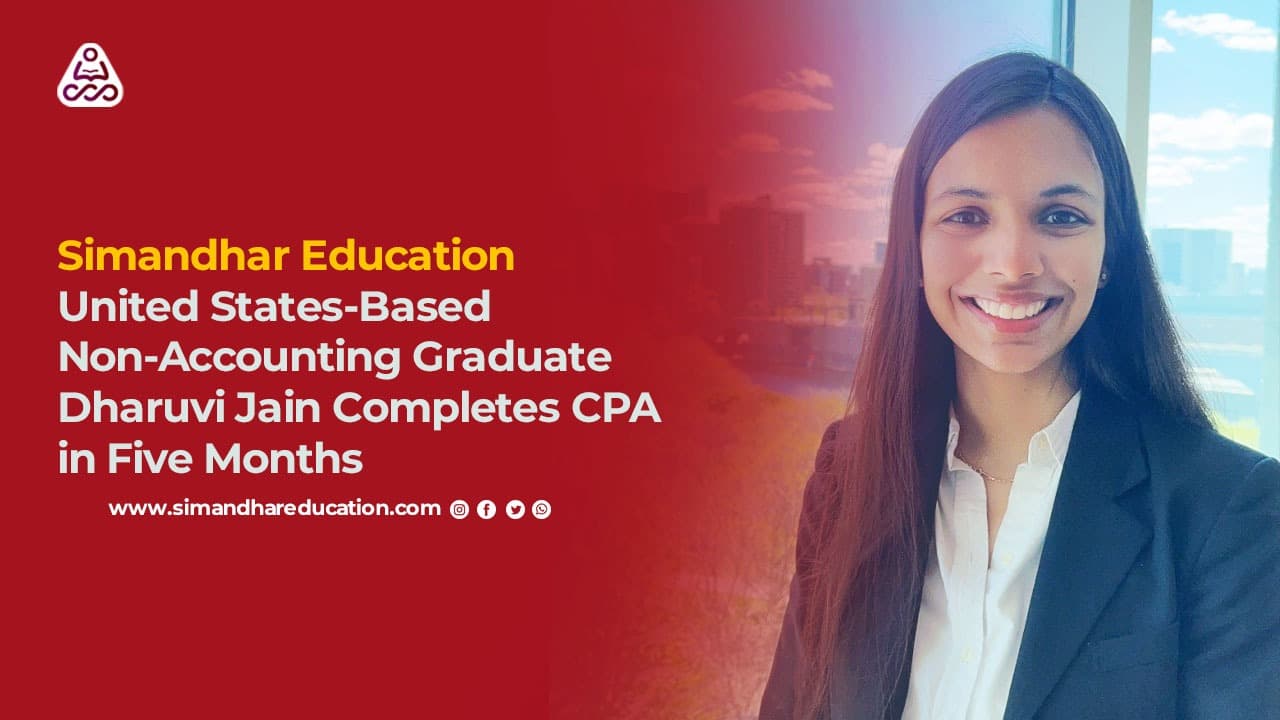
Table of Contents
Simandhar Education | United States-Based Non-Accounting Graduate Dharuvi Jain Completes CPA in Five Months
The pursuit of the Certified Public Accountant CPA designation is often associated with individuals who possess a formal academic background in accounting. Yet, as global professional education evolves, this assumption is increasingly being challenged.
The journey of Dharuvi Jain, a United States-based professional with no formal accounting background, offers a compelling academic case study. Residing in the United States and academically trained in Economics and Finance, Dharuvi completed her CPA examinations within five focused months under the structured mentorship of Simandhar Education.
Her achievement reflects more than examination success. It demonstrates how institutional structure, disciplined preparation, and conceptual clarity can redefine professional trajectories across geographical and academic boundaries.
Why Dharuvi Jain Chose Simandhar Education While Living in the United States
For candidates residing in the United States, local CPA preparation options are readily accessible. However, Dharuvi Jain made a deliberate and strategic decision to pursue her CPA preparation through Simandhar Education.
Her choice was guided by academic architecture rather than convenience. She sought a structured curriculum, concept-driven teaching methodology, and a mentorship ecosystem capable of supporting candidates from diverse educational backgrounds.
Seamless Time Zone Coordination Across Continents
Operating from the United States while enrolling in an India-based academic institution requires logistical alignment. In Dharuvi Jain’s case, time zone differences were handled with notable efficiency.
Administrative coordination and academic sessions were structured during Indian evening hours, which corresponded to her early mornings in the United States. This thoughtful scheduling ensured continuity, responsiveness, and uninterrupted academic momentum.
Her experience illustrates that in a digitally connected educational environment, geography does not limit opportunity when institutional systems are robust.
A Non-Accounting Background and Learning from First Principles
Dharuvi Jain’s academic credentials include an undergraduate degree in Economics and Business and a Master’s degree in Finance. Despite her strong analytical training, she had no exposure to accounting fundamentals prior to beginning her CPA journey.
Concepts such as debit and credit entries, audit frameworks, and regulatory reporting structures were entirely unfamiliar.
Building Accounting Competence from Scratch
Rather than treating this absence of background as a limitation, Dharuvi approached the subject as a new intellectual discipline. Simandhar Education’s pedagogy did not presume prior accounting literacy.
Foundational lectures, particularly within Financial Accounting and Reporting (FAR), systematically introduced accounting principles from first principles.
This structured progression enabled her to build conceptual clarity without correcting prior misconceptions. From an academic standpoint, learning without cognitive interference often enhances absorption and retention. Dharuvi Jain’s journey exemplifies this principle.
Completing CPA in Five Months Through Structured Discipline
Excluding a temporary health-related interruption, Dharuvi Jain’s active preparation period spanned approximately five months.
Her performance in the Audit section reflects her disciplined approach. After five weeks of preparation, she secured a score of 72. Following recovery, she reattempted the section and achieved an 88. Other sections were completed within concentrated preparation windows ranging between two and five weeks.
This timeline is particularly significant given the context. She was residing in the United States. She had no accounting background. She was balancing professional responsibilities. Yet structured preparation enabled accelerated progress.
A Reverse Engineered Preparation Strategy
A defining characteristic of Dharuvi Jain’s CPA preparation was her reverse engineered strategy. Instead of studying extensively before scheduling exams, she first fixed her examination dates.
The commitment to a defined deadline created psychological accountability and urgency. With a scheduled date in place, her preparation intensity aligned naturally with the timeline.
Her study process was methodical. She began with a thorough conceptual reading of the material, followed by extensive question practice. Repetition became central to her learning model, allowing theoretical understanding to transition into applied problem-solving competence.
She relied exclusively on Becker study material, consciously avoiding multiple sources to prevent cognitive overload. Simandhar Education’s mentorship ensured clarity in prioritization and exam alignment.
The Institutional Role of Simandhar Education in Dharuvi Jain’s Success
Professional achievements of this magnitude rarely occur in isolation. Institutional frameworks significantly influence learning velocity and execution discipline.
Simandhar Education provided Dharuvi Jain with a structured section-wise roadmap aligned with CPA examination standards. The institution offered foundational clarity tailored for non-accounting students, administrative coordination across international time zones, and consistent mentorship during health-related interruptions.
The academic ecosystem did not operate under the assumption that all candidates begin with accounting fluency. Instead, it created a structured transition pathway from foundational unfamiliarity to professional competence.
For a United States-based candidate selecting an overseas academic partner, such reliability and academic rigor become decisive.
Work Experience and CPA Preparation
At the time of preparation, Dharuvi Jain was working as a Tax Analyst in a corporate environment. However, she emphasizes an important insight. Work experience, while beneficial for contextual familiarity, is not a prerequisite for CPA success.
The CPA examination evaluates analytical reasoning, regulatory comprehension, and applied technical understanding. Structured preparation remains the primary determinant of performance.
Her journey demonstrates that professional certification is earned through disciplined study rather than inherited through prior exposure.
What Dharuvi Jain’s Journey Means for Non-Accounting Graduates in the United States
For non-accounting graduates residing in the United States, the CPA designation can appear academically demanding. Dharuvi Jain’s experience offers measurable reassurance.
Geographical distance did not create operational barriers. Lack of accounting background did not restrict conceptual mastery. Time zone differences did not disrupt academic continuity.
What remained constant was structured mentorship, disciplined execution, and clarity of preparation.
In a global professional environment, the selection of the right academic ecosystem becomes as critical as individual effort. When both converge, accelerated outcomes become attainable.
Conclusion
Dharuvi Jain’s journey reflects a broader truth about modern professional education.
She was a United States-based candidate with a non-accounting academic foundation. She had no familiarity with debit and credit principles before beginning her preparation. Within five focused months, she completed her CPA sections under the guidance of Simandhar Education.
Her achievement reinforces that professional advancement is shaped not by where one begins, but by the structure one chooses and the discipline with which one executes.
For aspiring CPAs, particularly non-accounting graduates in the United States, her story stands as a measured and evidence-based reminder that structured mentorship and strategic preparation can transform unconventional beginnings into professional distinction.
Planning to take CPA? Explore our CPA course