
US CMA accounting to finance India
Can US CMA help Indian students move from accounting roles to finance decision-making roles? Learn how CMA builds skills in FP&A, budgeting, cost management, analytics, and business finance.
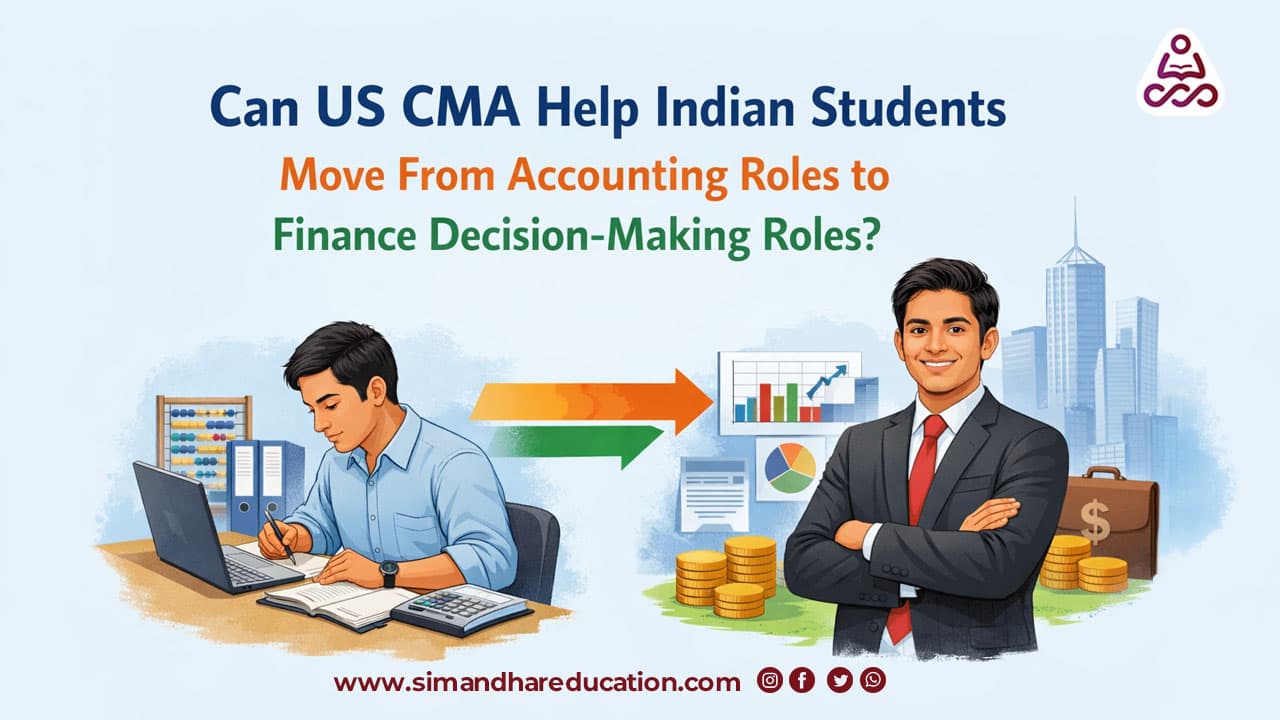
Table of Contents
- 1. Can US CMA Help Indian Students Move From Accounting Roles to Finance Decision-Making Roles?
- 2. Why Do Many Indian Students Want to Move Beyond Accounting Roles?
- 3. What Is US CMA?
- 4. How Does US CMA Help Students Think Differently?
- 5. Which Finance Decision-Making Roles Can US CMA Support?
- 6. Is US CMA Better Than Staying in a Pure Accounting Role?
- 7. Can B.Com Students Use US CMA to Build a Finance Career?
- 8. Does US CMA Guarantee a Finance Decision-Making Job?
- 9. How Can Simandhar Education Help Students Move From Accounting to Finance Roles?
- 10. Should Indian Students Choose US CMA for Finance Decision-Making Roles?
- 11. FAQs
- 11.1. What is the full form of CMA?
- 11.2. What is US CMA?
- 11.3. Can US CMA help students move from accounting to finance roles?
- 11.4. Is US CMA good for B.Com students in India?
- 11.5. What jobs can students get after US CMA?
Can US CMA Help Indian Students Move From Accounting Roles to Finance Decision-Making Roles?
Yes, US CMA can help Indian students and professionals move from accounting-focused roles to finance decision-making roles, especially if they want to build careers in FP&A, budgeting, cost management, performance analysis, corporate finance, and business finance.
This is one of the biggest reasons many commerce students look at US CMA in the first place. They do not always want to stay limited to routine accounting work. They may start with journal entries, reconciliations, reports, invoices, or month-end closing, but somewhere in the middle of that work, a bigger question begins to appear: how does this information help the business make better decisions?
That is where US CMA becomes relevant. It does not remove the value of accounting. In fact, accounting remains the base. But US CMA helps students move beyond recording numbers and start understanding what those numbers are saying about performance, cost, risk, planning, and future decisions.
Why Do Many Indian Students Want to Move Beyond Accounting Roles?
Many Indian students begin their careers with accounting because it feels like the natural path after B.Com, M.Com, or commerce graduation. Accounting roles are easier to understand at the beginning because the work looks familiar. There are entries, ledgers, statements, reconciliations, invoices, and reporting tasks.
But after some time, many students realize that they do not want to only prepare or process information. They want to understand how that information is used.They want to know why a company is spending more than planned, why a product is not profitable, why a department is missing its targets, or why management is choosing one project over another. This is the shift from accounting work to finance decision-making work.
The problem is that most students are not taught this shift clearly in college. They study accounting and finance as subjects, but they do not always learn how finance teams support real business decisions. That is why a qualification like US CMA can help. It gives structure to this transition.
What Is US CMA?
US CMA stands for Certified Management Accountant. It is a global management accounting certification awarded by the Institute of Management Accountants, USA.
The US CMA exam has two parts. Part 1 is Financial Planning, Performance, and Analytics, and Part 2 is Strategic Financial Management. Together, these two parts focus on planning, budgeting, forecasting, cost management, performance management, internal controls, financial statement analysis, corporate finance, decision analysis, risk management, investment decisions, and ethics.
In simple words, US CMA is built for people who want to understand finance from a business decision-making angle. It is not only about knowing whether numbers are correct. It is also about understanding what the numbers mean, what action they suggest, and how they affect the future of the business.
How Does US CMA Help Students Think Differently?
US CMA helps students think differently because it trains them to connect accounting with decisions. A student may already know how to prepare financial statements. But US CMA pushes the student to ask what those statements reveal about liquidity, profitability, efficiency, and risk. A student may know cost accounting, but US CMA connects that knowledge with pricing, budgeting, variance analysis, and performance improvement.
This is the real value of management accounting. It sits between accounting and management. An accountant may say, “This is what happened.” A management accounting professional is expected to go further and ask, “Why did it happen, what does it mean, and what should the business do next?”
That change in thinking is important for students who want to move into finance decision-making roles. Employers do not only need people who can prepare data. They need people who can explain data.
Which Finance Decision-Making Roles Can US CMA Support?
US CMA can support roles where accounting knowledge is used for planning, analysis, and business decisions.
This includes roles in FP&A, budgeting, cost analysis, management accounting, performance analysis, business finance, financial planning, corporate finance support, decision analysis, and finance business partnering. It can also help candidates working in accounting or reporting move toward roles where they support management with insights rather than only completing routine processes.
For Indian students, this can be useful because many companies, MNCs, Big 4 firms, global capability centers, and shared service teams are looking for finance professionals who understand both accounting and analysis.
A student who only says “I know accounting” may sound generic. A student who can say “I understand budgeting, performance analysis, cost control, and business decision support” has a clearer career direction. That difference matters.
Is US CMA Better Than Staying in a Pure Accounting Role?
US CMA is not about saying accounting roles are small or unimportant. Accounting is still the base of finance. Without accurate accounting, decision-making becomes weak.
But for students who want to grow into more analytical and business-facing roles, pure accounting work may start feeling limited after a point. They may want to move closer to planning, forecasting, budgeting, cost decisions, and performance discussions.
US CMA can help with that move because it builds skills that are closer to management accounting and strategic finance. It helps students understand not only how financial data is prepared, but how it is used.
So the better way to look at it is this: accounting gives the foundation, and US CMA can help build the bridge toward decision-making.
Can B.Com Students Use US CMA to Build a Finance Career?
Yes, B.Com students can use US CMA to build a more focused finance career, especially if they are interested in management accounting, FP&A, cost management, budgeting, and corporate finance roles.
B.Com gives students a basic understanding of accounting, taxation, economics, business law, and finance. That foundation helps, but it does not automatically make a student job-ready for decision-making roles.
US CMA adds a more professional layer. It helps students understand how companies plan budgets, measure performance, control costs, manage risk, and make financial decisions.
This is why US CMA can be a strong option for students who do not want to remain stuck with the label of “just a commerce graduate.” It gives the profile a clearer direction.
Does US CMA Guarantee a Finance Decision-Making Job?
No certification can honestly guarantee a job by itself.
US CMA can improve a student’s profile, but the candidate still needs practical skills, communication ability, Excel comfort, interview readiness, and clarity about target roles. Employers want candidates who can apply what they have learned.
This is where students need to be realistic. Passing exams is important, but it is not the whole journey. A student who completes US CMA should also build practical exposure through internships, projects, financial analysis practice, Excel-based reporting, case studies, and role-specific preparation. The certification gives direction. The student still has to build capability around it. That is usually what separates candidates who only collect qualifications from candidates who actually become job-ready.
How Can Simandhar Education Help Students Move From Accounting to Finance Roles?
Simandhar Education supports US CMA candidates with structured preparation for both exam parts: Financial Planning, Performance, and Analytics, and Strategic Financial Management.
For Indian students, this structure can be useful because the move from accounting to finance decision-making is not always easy to make alone. Simandhar’s US CMA offering includes Becker-backed resources, live and recorded classes, mock exams, practice support, expert guidance, doubt-solving support, and placement assistance.
Simandhar is also the official and exclusive Becker partner in India for US CPA and US CMA. That matters because students preparing for a global certification need both strong study material and local guidance that understands Indian candidates, eligibility questions, study challenges, and career expectations.
A student may know they want to move beyond accounting, but not know how to plan the transition. A guided US CMA preparation path can make that journey more structured.
Explore Simandhar Education's US CMA course to prepare with Becker-backed resources, structured classes, and career-focused guidance.
Should Indian Students Choose US CMA for Finance Decision-Making Roles?
Indian students should consider US CMA if they want to move toward finance roles that involve planning, analysis, budgeting, performance management, cost control, and business decisions. They should not choose it only because it sounds global. They should choose it because the subject direction matches the career they want.
If a student enjoys only compliance or routine accounting, US CMA may not be the only path. But if the student wants to understand how finance supports business strategy and management decisions, US CMA can be a strong fit.
The shift is simple. Students stop seeing finance as only numbers and start seeing it as decisions. That is where US CMA can make a difference.
FAQs
1. What is the full form of CMA?
CMA stands for Certified Management Accountant.
2. What is US CMA?
US CMA is a global management accounting certification awarded by the Institute of Management Accountants, USA. It focuses on financial planning, performance management, analytics, strategic finance, decision-making, risk, and ethics.
3. Can US CMA help students move from accounting to finance roles?
Yes, US CMA can help students move from accounting roles to finance decision-making roles by building skills in budgeting, FP&A, cost management, performance analysis, and strategic financial management.
4. Is US CMA good for B.Com students in India?
Yes, US CMA can be a good option for B.Com students who want careers in management accounting, FP&A, corporate finance, cost management, business finance, and decision-support roles.
5. What jobs can students get after US CMA?
US CMA can support roles such as FP&A Analyst, Cost Analyst, Management Accountant, Budget Analyst, Financial Analyst, Business Finance Associate, and Performance Analyst, depending on the candidate’s skills, experience, and job market readiness.
Planning to take CMA? Explore our CMA course