
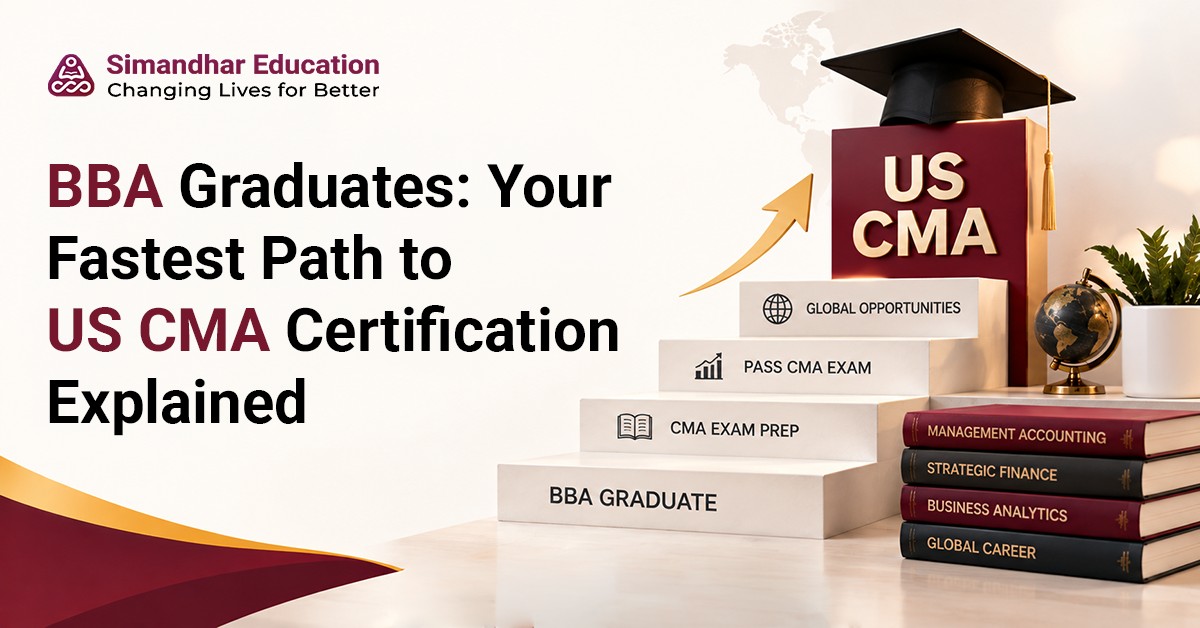
BBA Graduates: Your Fastest Path to US CMA Certification
A BBA gives you a foundation in business, finance, accounting, economics, and management. But if your goal is to build a career in management accounting, financial planning, FP&A, corporate finance or business decision-making, you may want to add a globally recognized professional credential to that degree.
That is where US CMA after BBA can fit into your career plan.
The CMA (Certified Management Accountant), offered by the Institute of Management Accountants (IMA), has two exam parts covering areas such as financial planning, performance management, analytics, corporate finance, business decision analysis and strategic financial management.
For a BBA graduate, this creates a relatively focused route to strengthen the accounting and finance skills gained during graduation.
What Is the Eligibility for US CMA After BBA?
One of the most common questions is: What is the eligibility for US CMA after BBA?
According to IMA, candidates pursuing CMA certification need:
- A bachelor's degree from an accredited college or university, or a qualifying professional certification
- Active IMA membership
- Passing both parts of the CMA examination
- Two continuous years of professional experience in management accounting or financial management
The required experience can be completed before passing the exams or within seven years after passing the examination.
Therefore, a BBA graduate from an accredited institution can meet the education requirement for US CMA certification. However, completing the exams and receiving the CMA certification are not exactly the same milestone-the professional experience requirement must also be fulfilled.
Can BBA Students Take the US CMA Exam?
Yes, students can begin their CMA journey before completing all certification requirements. IMA states that candidates may complete the exams before they have finished the education and work-experience requirements, provided those requirements are ultimately satisfied with certification.
This means a BBA student can plan CMA preparation alongside graduation, while a BBA graduate can move directly into the exam pathway after completing the degree.
For students, this can be useful because their BBA coursework may already provide exposure to accounting, finance, economics, and business concepts relevant to CMA preparation. IMA also notes that accounting and finance coursework can give students head starts in CMA preparation.
Why Consider US CMA After BBA Finance?
If you have completed a BBA in Finance, the connection becomes even more relevant.
The two CMA parts cover:
Part 1 - Financial Planning, Performance, and Analytics
- Planning, budgeting and forecasting
- Performance management
- Cost management
- Internal controls
- Technology and analytics
- External financial reporting decisions
Part 2 - Strategic Financial Management
- Financial statement analysis
- Corporate finance
- Business decision analysis
- Enterprise risk management
- Capital investment decisions
- Professional ethics
These areas can complement a BBA curriculum by moving beyond foundational business knowledge toward finance-focused decision-making and management accounting.
US CMA Course Duration After BBA
How long does US CMA take after BBA?
There is no single mandatory course duration because preparation time depends on your study schedule, prior knowledge, and exam planning.
The US CMA has only two exam parts, and candidates can take Part 1 and Part 2 in either order. IMA offers three testing windows each year: January/February, May/June, and September/October.
Simandhar Education currently presents its US CMA program as a 6–8 month course, with two books/exam parts and Becker-powered preparation.
That makes a structured US CMA roadmap for BBA graduates possible within a relatively compact preparation cycle. However, completing the course or passing both exams within that period does not by itself mean the CMA certification has been awarded-the experience requirement still applies.
US CMA Roadmap for BBA Graduates
A practical US CMA after BBA roadmap can look like this:
Step 1: Complete your BBA
Ensure your bachelor's degree meets IMA's education requirements.
Step 2: Join IMA and enter the CMA program
IMA requires candidates to become members and enroll in the CMA program.
Step 3: Choose your exam order
You can take Part 1 or Part 2 first.
Step 4: Prepare with a structured study plan
Use classes, study materials, practice questions, and mock examinations to build exam readiness.
Step 5: Pass both CMA parts
The CMA examination currently consists of Part 1 and Part 2. From the September/October 2026 testing window onward, case-based questions are the standard format for English CMA exams in India and other listed regions.
Step 6: Complete the experience requirement
Gain two continuous years of relevant professional experience in management accounting or financial management.
Step 7: Complete the certification process
Once the education, experience, examination, and other IMA requirements are satisfied, you can complete the certification process.
How Simandhar Supports the US CMA Journey
For BBA graduates looking for a US CMA course for BBA graduates, Simandhar Education combines exam preparation with structured academic support.
Its current US CMA program highlights Becker-powered preparation, live learning, recorded classes and a 6–8 month course structure.
The objective is not simply to prepare for two examinations but to create a structured learning journey around the CMA syllabus and finance career skills.
For students who want additional guidance after BBA, this can provide a defined pathway from degree - CMA preparation - exams - relevant work experience - certification.
What Jobs Can I Get After BBA and US CMA?
A BBA combined with CMA can be relevant to roles across accounting, financial analysis, and corporate finance. Depending on your skills, experience and employer requirements, potential roles can include:
- Financial Analyst
- FP&A Analyst
- Management Accountant
- Cost Analyst
- Business Finance Analyst
- Corporate Finance Analyst
- Financial Planning Analyst
- Internal Audit or Controls roles
The CMA curriculum covers areas such as financial planning, analytics, cost management, corporate finance, risk management, and business decision analysis, which are relevant to several finance functions.
Your actual job opportunities will also depend on factors such as experience, technical skills, communication, internships, location, and the requirements of individual employers.
Can US CMA Candidates Work in GCCs and MNCs?
Yes. A US CMA can be relevant when applying for finance and management-accounting roles in GCCs, MNCs and other organizations, provided your profile matches the role requirements.
For BBA graduates, the combination can be particularly useful when you build additional practical skills alongside the certification-such as financial analysis, Excel, ERP exposure, data analytics, communication, and business understanding.
The key is to view CMA as one part of your professional profile rather than as a substitute for relevant work experience.
Is US CMA a Good Finance Certification After BBA?
For students specifically interested in management accounting, FP&A, corporate finance and strategic financial decision-making, US CMA provides a focused professional pathway after BBA.
The important distinction is that passing two CMA exam parts is not the same as completing CMA certification. Education, examination, experience, IMA membership and other certification requirements all form part of the journey.
For a BBA graduate, the pathway can therefore be mapped clearly:
BBA - US CMA preparation - Part 1 & Part 2 - Relevant work experience - CMA certification - Finance career growth
Final Takeaway
For BBA graduates, US CMA after BBA offers a structured route into management accounting and corporate finance. With only two exam parts, flexible exam order and multiple annual testing windows, the exam pathway can be planned alongside the early stages of your finance career.
The bigger goal, however, is not simply to finish the exams. It is to combine your BBA + CMA knowledge + relevant work experience + practical finance skills into a profile that is ready for modern finance roles in India, GCCs and MNCs.
Frequently Asked Questions
1. Is BBA enough to meet the US CMA education requirement?
A bachelor's degree from an accredited college or university meets IMA's stated education requirement. Candidates must also satisfy the examination, experience, membership, and other certification requirements.
2. Can I complete the US CMA experience requirement after passing both exams?
Yes. IMA allows the required two years of professional experience to be completed before or within seven years of passing the examination.
3. Can I take US CMA Part 2 before Part 1?
Yes. IMA allows candidates to register for and take Part 1 or Part 2 in either order.
4. What is the passing score for each US CMA exam?
The CMA exam uses a scaled score from 0 to 500, with 360 as the passing score for each part.
5. Can relevant part-time work count toward the CMA experience requirement?
IMA's experience rules allow qualifying continuous part-time employment of at least 20 hours per week to count at a rate of one year of experience for every two years of part-time employment. Internships, trainee roles, and clerical positions do not qualify under the stated experience rules.