
US CPA Exam Syllabus 2024: A Valuable Guide to Success
Certified Public Accountant (CPA) is the highest credential in the field of accounting, administered by the American Institute of Certified Public Accountant (AICPA). CPAs are highly sought after in the US firms as well as acclaimed worldwide. But preparation for becoming a qualified CPA can be tough. The first step towards preparing for an examination is always knowing about the syllabus in detail and have clear mindset about its core concepts. In this blog, we’ll be discussing on the essential subjects and exam format of the Uniform CPA exam and its changes done in the 2024 cycle.
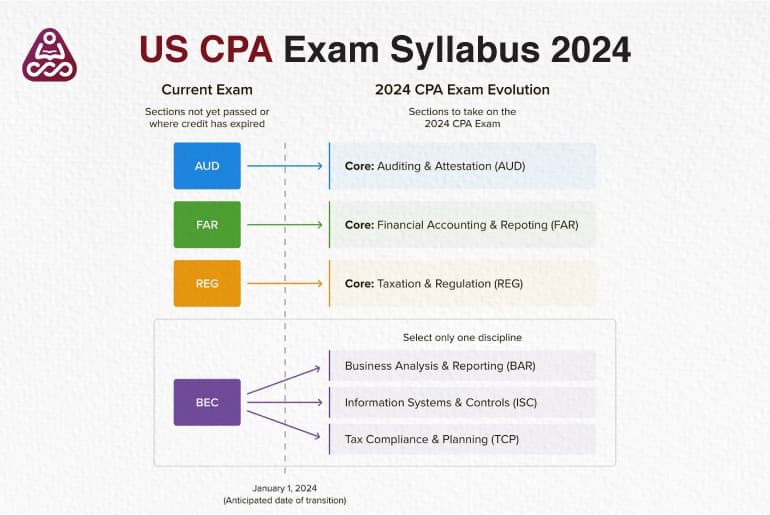
Table of Contents
Introduction:
Certified Public Accountant (CPA) is the highest credential in the field of accounting, administered by the American Institute of Certified Public Accountant (AICPA). CPAs are highly sought after in the US firms as well as acclaimed worldwide. But preparation for becoming a qualified CPA can be tough. The first step towards preparing for an examination is always knowing about the syllabus in detail and have clear mindset about its core concepts. In this blog, we’ll be discussing on the essential subjects and exam format of the Uniform CPA exam and its changes done in the 2024 cycle.
Table of Contents:
US CPA Evolution, 2024:
In the 2024 cycle of the US CPA examination, the AICPA and NASBA have restructured the exam syllabus and named it CPA Evolution. According to the new model, there will be 3 Core Sections + 1 Discipline Section. Each candidate must pass all 4 sections to become a qualified CPA. The BEC (Business Environment and Concepts) part has been removed from the Core Sections in the new module. The candidates who have already cleared BEC before 2024, will not have to sit for the Discipline section.
|
Old CPA Exam Sections (Before 2024) |
CPA Evolution (2024) |
| Core: Financial Accounting and Reporting (FAR) | Core: Financial Accounting and Reporting (FAR) |
|
Core: Auditing and Attestation (AUD) |
Core: Auditing and Attestation (AUD) |
|
Core: Regulation (REG) |
Core: Regulation (REG) |
|
Core: Business Environment and Concepts (BEC) |
Discipline: Business Analysis and Reporting (BAR) |
|
|
Discipline: Information Systems and Controls (ISC) |
|
|
Discipline: Tax Compliance and Planning (TCP) |
- BAR is the continuation of FAR section,
- ISCis the continuation of AUD section, and
- TCP is the continuation of the REG section.
Core Sections:
- Financial Accounting and Reporting (FAR):
- Financial Reporting – 30-40%
- Select Balance Sheet Accounts – 30-40%
- Select Transactions – 25-35%
- Auditing and Attestation (AUD):
- Ethics, Professional Responsibilities and General Principles – 15-25%
- Assessing Risk and Developing a Planned Response – 25-35%
- Performing Further Procedures and Obtaining Evidence – 30-40%
- Forming Conclusions and Reporting – 10-20%
- Taxation and Regulation (REG):
- Ethics, Professional Responsibilities and Federal Tax Procedures – 10-20%
- Business Law – 15-25%
- Federal Taxation of Property Transactions – 5-15%
- Federal Taxation of Individuals – 22-32%
- Federal Taxation of Entities (including tax preparation) – 23-33%
The FAR Core section tests the knowledge and skills needed with respect to financial accounting and reporting frameworks, including those issued by the Financial Accounting Standards Board (FASB), U.S. Securities and Exchange Commission (U.S. SEC) and the AICPA for use by both for-profit and nonprofit entities. Mentioning the weightage, this section focuses on
The AUD Core section tests knowledge and skills you will need to show when performing audit engagements, attestation engagements, and accounting and review service engagements. Mentioning the weightage, this section focuses on
The REG Core section tests the knowledge and skills concerning U.S. ethics and professional responsibilities related to tax practice, U.S. business law, and U.S. federal tax compliance for individuals and entities with a focus on recurring and routine transactions. Mentioning the weightage, the section focuses on
Discipline Sections:
- Business Analytics and Reporting (BAR):
- Business Analysis – 40-50%
- Technical Accounting and Reporting – 35-45%
- State and Local Governments – 10-20%
- Information Systems and Controls (ISC):
- Information Systems and Data Management – 35-45%
- Security, Confidentiality and Privacy – 35-45%
- Considerations for System and Organisation Controls (SOC) Engagements – 15-25%
- Tax Compliance and Planning (TCP):
- Tax Compliance and Planning for individuals and Personal Financial Planning – 30-40%
- Entity Tax Compliance – 30-40%
- Entity Tax Planning – 10-20%
- Property Transactions (disposition of assets) – 10-20%
This section assesses knowledge and skills related to analysing financial statements and information, selecting technical accounting and reporting requirements under the FASB and SEC, financial accounting and reporting under GASB, and data & technology concepts to transform data into a valuable tool used in decision-making. Mentioning the weightage, it focuses on
This section tests the knowledge and skills concerning information systems, including processing integrity, availability, security, confidentiality, and processing. It also covers topics related to data management, including data collection, storage, and usage throughout the data life cycle. It assesses the knowledge and skills related to information technology (IT) audit and advisory services, including SOC engagements. Mentioning the weightage, it focuses on
Federal tax compliance emphasizes nonroutine and complex transactions and focuses on preparing and reviewing tax returns. Federal tax planning focuses on tax implications of proposed transactions, available tax options, or business structures. Personal finance planning focuses on the strategies and opportunities typically identified by CPAs in connection with individual tax return preparation and review. Mentioning the weightage, this section focuses on
Significance of Discipline Sections in CPA:
The CPA Evolution initiative is transforming the CPA licensure model to recognize the rapidly changing skills and competencies the practice of accounting requires today and, in the future, as well. Technology concepts will also be incorporated into all the sections as the impact of advances in technology on our profession continues to grow. The ISC discipline will demonstrate knowledge and skills required to advise a client on business processes. It will also focus on the SOC (System and Organization Controls) Engagement. The BAR discipline could assess how to analyse GAAP-compliant financial statements to explain the entity’s performance against budget, prior periods, or compared to a competitor.
Conclusion:
Preparing for CPA Evolution can be daunting and overwhelming, but with the right guidance and effective study resources, you can ace the exam with confidence. Start preparing for your US CPA career today. Enroll in Simandhar Education’s US CPA review course and get access to our renowned study materials and online lectures, live classes, and exclusive webinars. For more information, contact us at 7780273388 or visit our official page at www.simandhareducation.com/.
Planning to take CPA? Explore our CPA course