
What Is a Fractional CFO? US CPA & CMA Career Guide
Learn what a Fractional CFO does, the skills and experience required, and how US CPA and US CMA can help you build a global finance career.

Table of Contents
- 1. What Is a Fractional CFO? How US CPA and CMA Can Help You Build a Career in Global Finance
- 2. What Is a Fractional CFO? A Simple Explanation
- 2.1. Difference between a CFO and a Fractional CFO
- 3. Why Are Startups and Small Businesses Hiring Fractional CFOs?
- 4. What Does a Fractional CFO Do on a Typical Workday?
- 5. Can Freshers Become Fractional CFOs? What Should Beginners Know?
- 5.1. What Should Freshers Focus on First?
- 6. How Can US CPA and US CMA Help You Build a Career Towards Fractional CFO Consulting?
- 6.1. How Can US CPA Help?
- 6.2. How Can US CMA Help?
- 7. Can You Work with International Clients from India?
- 7.1. What Should Indian Finance Professionals Consider?
- 8. How to Build Your Career Towards Fractional CFO Consulting?
- 8.1. Stage 1: Build your foundation after graduation
- 8.2. Stage 2: Gain experience in finance roles
- 8.3. Stage 3: Move towards financial planning and management
- 8.4. Stage 4: Develop client-facing skills
- 8.5. Stage 5: Explore consulting opportunities
- 9. Is Fractional CFO a Good Long-Term Career Option?
- 10. Frequently Asked Questions
What Is a Fractional CFO? How US CPA and CMA Can Help You Build a Career in Global Finance
A business does not always need a full-time Chief Financial Officer (CFO) to manage its finances. Startups, small businesses, and growing companies may need experienced financial guidance without hiring a senior finance executive permanently. This is where a Fractional CFO comes in.
A Fractional CFO provides financial leadership on a part-time, contractual, or consulting basis. Instead of working exclusively for one organization, the professional may support multiple businesses with financial planning, cash flow management, budgeting, and strategic decisions.
For finance professionals, this creates an opportunity to move beyond routine accounting and financial reporting into business advisory and financial management.
However, becoming a Fractional CFO is not an entry-level career option. It requires practical experience, business understanding, and the ability to advise clients on financial decisions. Qualifications such as US CPA and US CMA can help professionals build the technical foundation needed to progress towards this role.
Let's understand what a Fractional CFO does, the experience required, and how you can build a career towards financial consulting.
1. What Is a Fractional CFO? A Simple Explanation
A Fractional CFO is an experienced finance professional who provides CFO-level financial guidance to a business without working as its full-time employee.
Consider a growing startup that is generating revenue but struggling to manage cash flow, forecast expenses and plan its expansion. Hiring a full-time CFO may not be practical at this stage.
The company can engage a Fractional CFO to review its financial position, prepare forecasts, identify risks and guide business decisions.
The professional may work for a fixed number of hours each week or provide support for specific financial projects.
In simple terms, a Fractional CFO gives businesses access to experienced financial leadership without the commitment of hiring a full-time CFO.
Difference between a CFO and a Fractional CFO
Both professionals handle financial leadership and strategic responsibilities. The primary difference is their working arrangement and the level of involvement with the business.
| Basis | Full-Time CFO | Fractional CFO |
|---|---|---|
| Working arrangement | Permanent employee | Part-time or contractual consultant |
| Business involvement | Dedicated to one organization | May work with multiple businesses |
| Responsibilities | Oversees the overall finance function | Handles agreed financial leadership responsibilities |
| Availability | Regular, ongoing involvement | Based on agreed hours and requirements |
| Business requirements | Often suited to established organizations | Often suited to startups and growing businesses |
Both roles involve financial leadership. The primary difference is the working arrangement and level of involvement.

2. Why Are Startups and Small Businesses Hiring Fractional CFOs?
Growing businesses face several financial challenges. They need to monitor cash flow, control expenses, prepare budgets, and evaluate expansion opportunities. However, maintaining a full-time senior finance team may not always be practical.
A Fractional CFO can help address these requirements through:
- Cash flow management: Monitoring incoming and outgoing cash, planning payments, and identifying potential cash shortages.
- Financial planning and forecasting: Preparing financial projections to estimate future revenue, expenses and funding requirements.
- Business expansion: Evaluating the financial impact of entering new markets, launching products, or increasing operational capacity.
- Financial performance analysis: Reviewing expenses, profit margins and business performance to identify areas that need improvement.
- Funding and investment preparation: Helping businesses organize financial statements, projections and supporting information for discussions with investors or lenders.
For growing businesses, this arrangement provides access to experienced financial guidance while offering flexibility in senior-level hiring.
3. What Does a Fractional CFO Do on a Typical Workday?
The daily responsibilities of a Fractional CFO depend on the business and its financial requirements. Unlike an accountant who primarily focuses on recording transactions and preparing reports, a Fractional CFO uses financial information to guide business decisions.
Typical responsibilities include:
- Reviewing financial performance: Analyzing income statements, balance sheets, and cash flow statements to understand the company's financial position.
- Preparing budgets and forecasts: Estimating future revenue, expenses, and cash requirements to support business planning.
- Monitoring cash flow: Tracking receivables, payables, and available funds to identify potential financial challenges.
- Analyzing business performance: Evaluating revenue growth, profitability, operating expenses, and other financial indicators.
- Advising business owners: Explaining financial findings and recommending practical improvements.
- Coordinating with finance teams: Working with accountants, bookkeepers, tax professionals and department heads.
The US Bureau of Labor Statistics (BLS) also identifies financial reporting, forecasting, cost analysis and advising management as important responsibilities of financial managers.
4. Can Freshers Become Fractional CFOs? What Should Beginners Know?
Can you become a Fractional CFO immediately after B.Com, BBA or completing US CPA or US CMA? Generally, no.
Businesses expect Fractional CFOs to understand financial operations, interpret financial information and recommend practical solutions. This level of expertise develops through professional experience.
For example, knowing how to prepare a cash flow statement is different from identifying why a company is repeatedly facing cash shortages and recommending ways to address the problem.
The BLS states that financial managers typically need a bachelor's degree and five or more years of experience in a related business or financial occupation. This highlights the importance of practical experience in senior financial management careers.
What Should Freshers Focus on First?
If you are pursuing B.Com, BBA or a global finance qualification, focus on building your foundation before considering independent consulting.
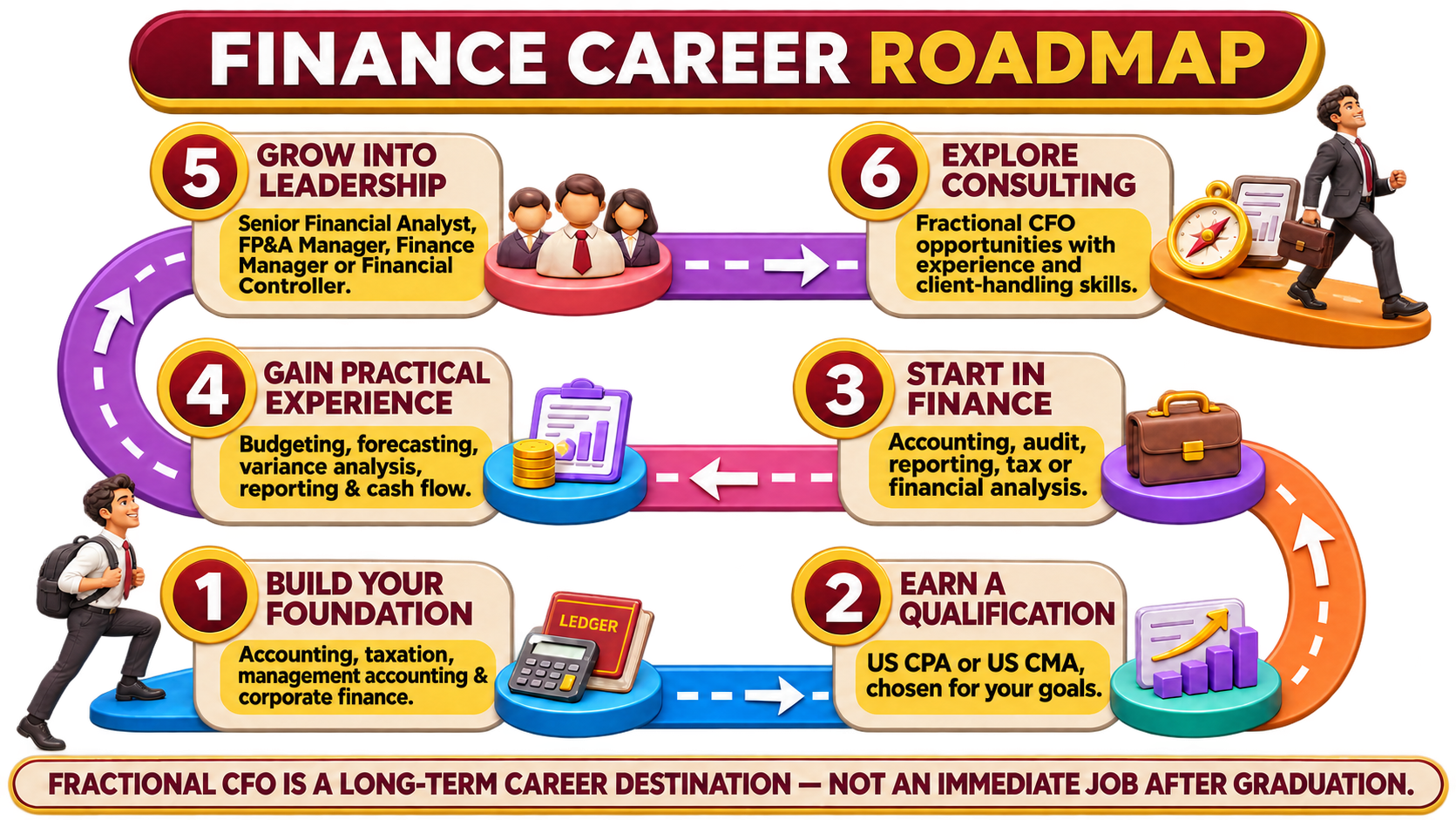
A practical career progression could look like this:
- Build your academic foundation: Understand accounting, taxation, management accounting and corporate finance.
- Pursue a professional qualification: Consider US CPA or US CMA based on your interests and career goals.
- Start with an entry-level role: Explore accounting, audit, financial reporting, taxation or financial analysis.
- Gain practical experience: Work on budgeting, forecasting, variance analysis, financial reporting, and cash flow management.
- Move into leadership roles: Progress towards Senior Financial Analyst, FP&A Manager, Finance Manager or Financial Controller positions.
- Explore consulting: With sufficient experience and client-handling capabilities, consider Fractional CFO opportunities.
Treat Fractional CFO as a potential long-term career destination rather than an immediate job opportunity after graduation.
5. How Can US CPA and US CMA Help You Build a Career Towards Fractional CFO Consulting?
Professional qualifications can strengthen your understanding of financial reporting, analysis, management, and business decision-making. However, neither certification automatically qualifies someone to become a Fractional CFO.
US CPA and US CMA develop different areas of expertise that can support different stages of this career journey.
How Can US CPA Help?
The US CPA qualification develops knowledge across financial accounting and reporting, auditing and attestation, taxation and regulation, along with a chosen discipline.
This knowledge can support careers in financial reporting, accounting advisory, audit, compliance, and financial management.
Its relevance to future CFO responsibilities includes:
- Financial reporting: Understanding financial statements and reporting requirements.
- Accounting knowledge: Evaluating financial transactions and identifying reporting issues.
- Tax knowledge: Understanding taxation and recognizing relevant compliance requirements.
- Financial analysis: Using accounting information to assess business performance.
- Professional judgement: Understanding ethics, controls, and reporting responsibilities.
The CPA examination is part of the US CPA licensure system. Licensing requirements are determined by individual state boards of accountancy. Passing the examination alone does not make someone a licensed CPA.
How Can US CMA Help?
US CMA is particularly relevant to professionals interested in management accounting, corporate finance, financial planning and analysis (FP&A), and business decision-making.
Its two-examination parts cover Financial Planning, Performance and Analytics, and Strategic Financial Management.
These subjects connect with several responsibilities of a Fractional CFO:
- Budgeting and forecasting: Preparing financial plans and estimating future business requirements.
- Performance management: Evaluating financial results against business objectives.
- Financial statement analysis: Interpreting financial performance and identifying areas for improvement.
- Corporate finance: Understanding financing decisions and capital requirements.
- Business decision analysis: Evaluating alternatives and supporting management decisions.
- Risk management: Understanding financial and business risks.
The Institute of Management Accountants (IMA) outlines these competencies in its official CMA certification structure.

6. Can You Work with International Clients from India?
Yes. Experienced finance professionals based in India can explore remote finance consulting opportunities with international clients, including US-based businesses.
Depending on the engagement, a Fractional CFO may review financial reports, prepare forecasts, attend virtual meetings, and advise business owners remotely.
Potential opportunities include:
- Supporting US-based startups with financial planning.
- Helping small businesses manage budgets and cash flow.
- Providing remote FP&A support.
- Reviewing financial performance and reporting.
- Assisting business owners with financial planning.
What Should Indian Finance Professionals Consider?
- International accounting practices: Understand relevant US GAAP requirements and financial reporting expectations.
- Client communication: Be prepared to explain financial results and discuss business challenges across different time zones.
- Financial technology: Develop proficiency in Excel, financial modelling, Power BI and relevant accounting or ERP software.
- Data confidentiality: Understand data privacy, access controls, and the importance of protecting sensitive financial information.
- Cross-border compliance: Consider applicable contractual, tax and regulatory requirements when providing services to overseas clients.
India's GST framework also specifies conditions for a service to qualify as an export of services. The exact treatment depends on the nature of the engagement and applicable regulations.
One important distinction: Holding a US CPA qualification does not automatically authorize an Indian professional to perform every regulated public accounting or attestation service in the United States. Applicable licensing and practice requirements must be checked.
7. How to Build Your Career Towards Fractional CFO Consulting?
Building a career in Fractional CFO consulting requires more than technical knowledge. You need financial management experience, business understanding, and the ability to communicate recommendations to decision-makers.
Consider these stages:
Stage 1: Build your foundation after graduation
Develop your knowledge of accounting, finance, taxation, and business operations. Consider US CPA or US CMA based on your interests and eligibility.
Stage 2: Gain experience in finance roles
Explore opportunities such as Financial Reporting Analyst, Audit Associate, Accountant, Tax Associate, or Financial Analyst. These roles can help you understand financial operations and reporting.
Stage 3: Move towards financial planning and management
Progress towards roles such as Senior Financial Analyst, FP&A Manager, Finance Manager, or Financial Controller. Gain experience in budgeting, forecasting, profitability analysis, cash flow, and financial risk assessment.
Stage 4: Develop client-facing skills
Learn to present financial insights, explain risks, and recommend practical solutions. Experience working with business owners, senior management, and different teams can be valuable.
Stage 5: Explore consulting opportunities
Once you have sufficient experience, consider supporting businesses with financial forecasting, budgeting, cash flow management, or broader financial advisory requirements.
There is no universal number of years that guarantees readiness for Fractional CFO consulting. The responsibilities you have managed and your ability to advise clients independently matter more than simply counting years of experience.
8. Is Fractional CFO a Good Long-Term Career Option?
Fractional CFO consulting can be a worthwhile long-term career direction for finance professionals who enjoy working with businesses and contributing to financial decisions.
Some potential opportunities include:
- Industry exposure: Work with businesses across different industries and understand their financial requirements.
- Independent consulting: Build your own finance consulting practice with sufficient experience and a professional network.
- Strategic involvement: Move beyond routine financial reporting and contribute to business planning.
- International exposure: Explore remote consulting arrangements with overseas businesses, subject to applicable requirements.
- Professional growth: Develop specialized expertise in FP&A, financial strategy, cash flow management, or business advisory.
However, consulting also involves managing multiple clients, meeting deadlines, handling incomplete financial information, and communicating financial challenges.
The best approach is to build your expertise first and explore Fractional CFO consulting when you are ready to take responsibility for a business's financial decisions.
9. Frequently Asked Questions
1. What is a Fractional CFO in simple terms?
A Fractional CFO is an experienced finance professional who provides financial leadership to a business on a part-time or contractual basis. They may support multiple businesses with budgeting, forecasting, cash flow management, and financial decisions.
2. Can a fresher become a Fractional CFO?
Generally, no. Fractional CFO roles require practical experience in financial management, business analysis, and decision-making. Freshers should first gain experience through accounting, audit, financial reporting, or FP&A roles.
3. Is US CPA useful for a career in financial consulting?
Yes. US CPA develops knowledge of financial reporting, auditing, taxation and regulation. These areas can support careers in accounting advisory and financial management. Practical experience in business analysis and financial planning is also important for consulting.
4. How can US CMA help in corporate finance and FP&A?
US CMA covers budgeting, forecasting, performance management, financial statement analysis, and strategic financial management. These competencies are relevant to FP&A and corporate finance roles.
5. Can Indian finance professionals work with US clients remotely?
Yes. Indian finance professionals can explore remote finance and consulting engagements with US businesses. They should consider applicable professional licensing, contractual, data privacy, tax, and GST requirements.
6. What skills are required to become a Fractional CFO?
Important skills include financial reporting, budgeting, forecasting, cash flow management, financial modelling, business analysis, risk assessment, and client communication. Practical experience in applying these skills is essential.
7. Do you need prior CFO experience to start a finance consulting practice?
Not necessarily the exact CFO job title. However, you need substantial relevant experience in financial management, client handling, and business advisory, along with the ability to independently manage the responsibilities you accept.
8. What is the difference between a full-time CFO and a Fractional CFO?
A full-time CFO is a permanent executive responsible for an organization's overall financial function. A Fractional CFO provides financial leadership on a part-time or contractual basis and may support multiple businesses.