
What Topics Are Covered in the US CMA Part 2 Syllabus?
Fri Jun 26 2026
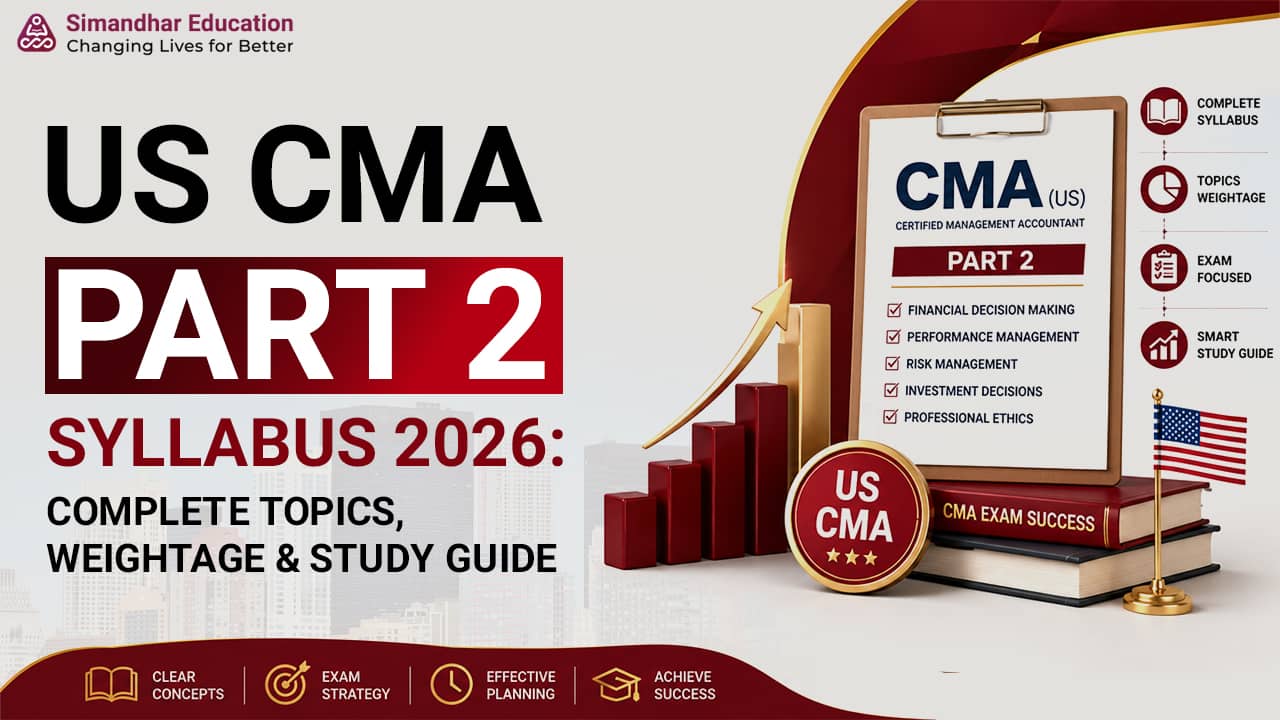
Table of Contents
The US CMA Part 2 syllabus focuses on Strategic Financial Management and is designed to test a candidate's ability to make financial decisions, manage risks, evaluate investments, analyse financial statements, and support business strategy.
CMA Part 2 is the second and last exam needed to obtain the US CMA certification for individuals who wish to work in management, finance, or FP&A.
Unlike Part 1, which focuses on financial planning and performance, Part 2 emphasizes decision-making and strategic financial management. Candidates who understand the syllabus thoroughly can create a focused study plan and improve their chances of passing the exam.
What Is US CMA Part 2?
US CMA Part 2 is called Strategic Financial Management.
The exam evaluates whether candidates can apply financial concepts in real business situations and contribute to strategic decision-making within organizations.
CMA Part 2 Exam Overview
| Particulars | Details |
|---|---|
| Exam Name | US CMA Part 2 |
| Section Name | Strategic Financial Management |
| Number of Parts | 2 (Part 2 is the final exam) |
| Duration | 4 Hours |
| MCQs | 100 Questions |
| Essay Questions | 2 Scenarios |
| Passing Score | 360 out of 500 |
| Conducted By | Institute of Management Accountants (IMA) |
US CMA Part 2 Syllabus 2026
The CMA Part 2 syllabus consists of six major topics.
| Topic | Weightage |
|---|---|
| Financial Statement Analysis | 20% |
| Corporate Finance | 20% |
| Decision Analysis | 25% |
| Risk Management | 10% |
| Investment Decisions | 10% |
| Professional Ethics | 15% |
Understanding these weightages helps candidates allocate their study time effectively.
Financial Statement Analysis (20%)
Financial Statement Analysis is one of the most important areas in the CMA Part 2 topics.
This section focuses on evaluating a company's financial health using accounting information and financial reports.
Topics Covered
- Financial statement analysis
- Income statement evaluation
- Balance sheet analysis
- Cash flow statement analysis
- Profitability ratios
- Liquidity ratios
- Solvency ratios
- Activity ratios
- Market value ratios
- Performance measurement
Why It Matters
Finance professionals often need to analyse company performance before making business decisions. This section develops those analytical skills.
Example
A Financial Analyst may compare profitability ratios of two companies before recommending an investment decision.
Corporate Finance (20%)
Corporate Finance focuses on how businesses raise, manage, and utilize funds effectively.
Careers in FP&A, treasury, finance management, and corporate strategy are all extremely relevant to this field.
Topics Covered
- Financial risk and return
- Capital structure
- Working capital management
- Cost of capital
- Dividend policy
- Capital acquisition
- Corporate restructuring
- International finance
Skills Developed
- Evaluating financing options
- Managing business cash flows
- Understanding capital budgeting
- Optimizing shareholder value
Practical Application
A Finance Manager may decide whether a company should use debt or equity financing to fund expansion.
Decision Analysis (25%)
Decision Analysis carries the highest weightage in the US CMA Part 2 syllabus.
This section focuses on using financial data to make strategic business decisions.
Topics Covered
- Cost-volume-profit analysis
- Marginal analysis
- Pricing decisions
- Product profitability
- Customer profitability
- Special order decisions
- Make-or-buy decisions
- Capacity management
- Business process improvement
Why It Is Important
Organizations make hundreds of financial decisions every year. Management accountants play a key role in evaluating alternatives and recommending the best course of action.
Example
A company deciding whether to manufacture a product internally or outsource production would rely on decision analysis techniques.
Risk Management (10%)
Every business faces risks. This section helps candidates understand how organizations identify and manage those risks.
Topics Covered
- Enterprise risk management
- Internal controls
- Cybersecurity risks
- Operational risks
- Financial risks
- Compliance risks
- Fraud prevention
- Risk monitoring
Key Learning Outcome
Candidates learn how organizations build systems to reduce uncertainty and protect business assets.
Real-World Example
A multinational company may implement internal controls to prevent fraud and financial misstatements.
Investment Decisions (10%)
Investment Decisions focuses on evaluating projects and investment opportunities.
Finance professionals regularly assess whether investments will create value for a business.
Topics Covered
- Capital budgeting
- Net Present Value (NPV)
- Internal Rate of Return (IRR)
- Payback Period
- Discounted cash flow analysis
- Investment risk assessment
Why It Matters
Businesses need to allocate resources efficiently. Understanding investment evaluation methods helps professionals make better decisions.
Example
A company evaluating whether to build a new manufacturing plant would use capital budgeting techniques from this section.
Professional Ethics (15%)
Professional Ethics is a crucial component of the CMA strategic financial management syllabus.
Finance professionals are expected by organizations to uphold professionalism, ethics, and confidentiality.
Topics Covered
- IMA Statement of Ethical Professional Practice
- Ethical standards
- Integrity
- Confidentiality
- Credibility
- Competence
- Ethical decision-making framework
Importance
Strong ethical judgment helps finance professionals maintain trust and comply with professional standards.
Real-Life Relevance
Finance leaders frequently face situations involving confidential information and ethical dilemmas. This section prepares candidates to handle such situations responsibly.
How Is the US CMA Part 2 Exam Structured?
The exam consists of two sections.
Section 1: Multiple Choice Questions
- 100 MCQs
- Three hours allotted
- Covers all syllabus areas
- Tests conceptual understanding and application
Section 2: Essay Questions
- Two essay scenarios
- One hour allotted
- Tests practical application
- Requires analytical thinking and written explanations
To pass, candidates need to do well in both areas.
CMA Part 1 and Part 2 Differences
| CMA Part 1 | CMA Part 2 |
|---|---|
| Financial Planning, Performance & Analytics | Strategic Financial Management |
| Internal reporting focus | Decision-making focus |
| Budgeting and costing | Corporate finance and investments |
| Performance management | Strategic analysis |
| Operational finance | Leadership-level finance |
Part 1 builds a strong accounting foundation, while Part 2 develops strategic finance and business decision-making skills.
Best Study Plan for US CMA Part 2
Exam performance can be greatly enhanced by a methodical preparation approach.
Step 1: Understand the Weightage
Focus more on:
- Decision Analysis (25%)
- Financial Statement Analysis (20%)
- Corporate Finance (20%)
These three sections account for 65% of the exam.
Step 2: Build Conceptual Clarity
Avoid memorization.
Understand:
- Why formulas are used
- How business decisions are made
- How financial data influences strategy
Step 3: Practice Questions Regularly
Consistent practice improves:
- Accuracy
- Time management
- Confidence
Step 4: Take Mock Exams
Simulated exams help identify weak areas before the actual test.
Step 5: Revise Ethics Thoroughly
Many candidates underestimate ethics despite its significant weightage.
Common Challenges Students Face in CMA Part 2
Many candidates find the following topics challenging:
- Corporate finance calculations
- Capital budgeting techniques
- Investment analysis
- Decision analysis scenarios
- Financial ratio interpretation
The best approach is to focus on understanding business applications rather than simply learning formulas.
Why US CMA Part 2 Is Important for Career Growth
The skills covered in the US CMA Part 2 syllabus are directly aligned with modern finance roles.
Professionals with CMA knowledge often work in:
- Financial Planning & Analysis (FP&A)
- Corporate Finance
- Business Strategy
- Risk Management
- Treasury
- Financial Consulting
- Management Accounting
These skills are highly valued by multinational companies, Global Capability Centres (GCCs) , consulting firms, and large enterprises.
Why Choose Simandhar Education for US CMA Preparation?
Simandhar Education is one of India's leading providers of global accounting and finance certifications, helping students build successful careers in management accounting and corporate finance.
What Students Benefit From
- Becker study material for US CMA preparation
- 365 days of live online classes
- 8,100+ MCQs and 300+ essay questions
- 1,400 digital flashcards for revision
- Adapt2U learning technology
- AI-powered Digital AI Sripal for 24/7 support
Simandhar Education Highlights
- 30,000+ students trained
- 5,000+ successful placements
- 250+ corporate hiring partners
- 1,000+ students placed at ₹10+ LPA
- 90% pass rate across professional programs
Students also gain industry exposure through sessions with leaders from organizations such as EY, SAP, Infosys, Invesco, and D.E. Shaw, along with career guidance, mentorship, and placement support to help them succeed in the global finance industry.
Visit: US CMA Course | Global Finance Careers | Earn up to ₹50 LPA
FAQs
What is covered in the US CMA Part 2 syllabus?
US CMA Part 2 covers Financial Statement Analysis, Corporate Finance, Decision Analysis, Risk Management, Investment Decisions, and Professional Ethics.
What is the name of CMA Part 2?
CMA Part 2 is called Strategic Financial Management.
Which topic has the highest weightage in CMA Part 2?
Decision Analysis carries the highest weightage at 25%.
How many questions are there in CMA Part 2?
The exam includes 100 multiple-choice questions and two essay scenarios.
What is the passing score for CMA Part 2?
Candidates need a scaled score of 360 out of 500 to pass.
Conclusion
The US CMA Part 2 syllabus focuses on Strategic Financial Management and prepares candidates for leadership roles in finance and business. The exam covers Financial Statement Analysis, Corporate Finance, Decision Analysis, Risk Management, Investment Decisions, and Professional Ethics.
A clear understanding of the syllabus, combined with consistent practice and structured preparation, can help candidates pass the exam and build successful careers in management accounting and corporate finance.
If you are planning to complete your US CMA journey, mastering Part 2 is the final step toward earning a globally respected certification.

Renuka is an MBA (Finance) graduate and content writer specializing in professional courses and career-focused content. She creates clear, easy-to-understand, and SEO-friendly blogs that simplify complex topics and help students and professionals make informed career decisions.