
Why Bcom students prefer US CPA over MBA 2026
Why are B.Com students choosing US CPA before MBA in 2026? Understand CPA eligibility, career scope, exam structure, job relevance, and how it compares with an MBA.
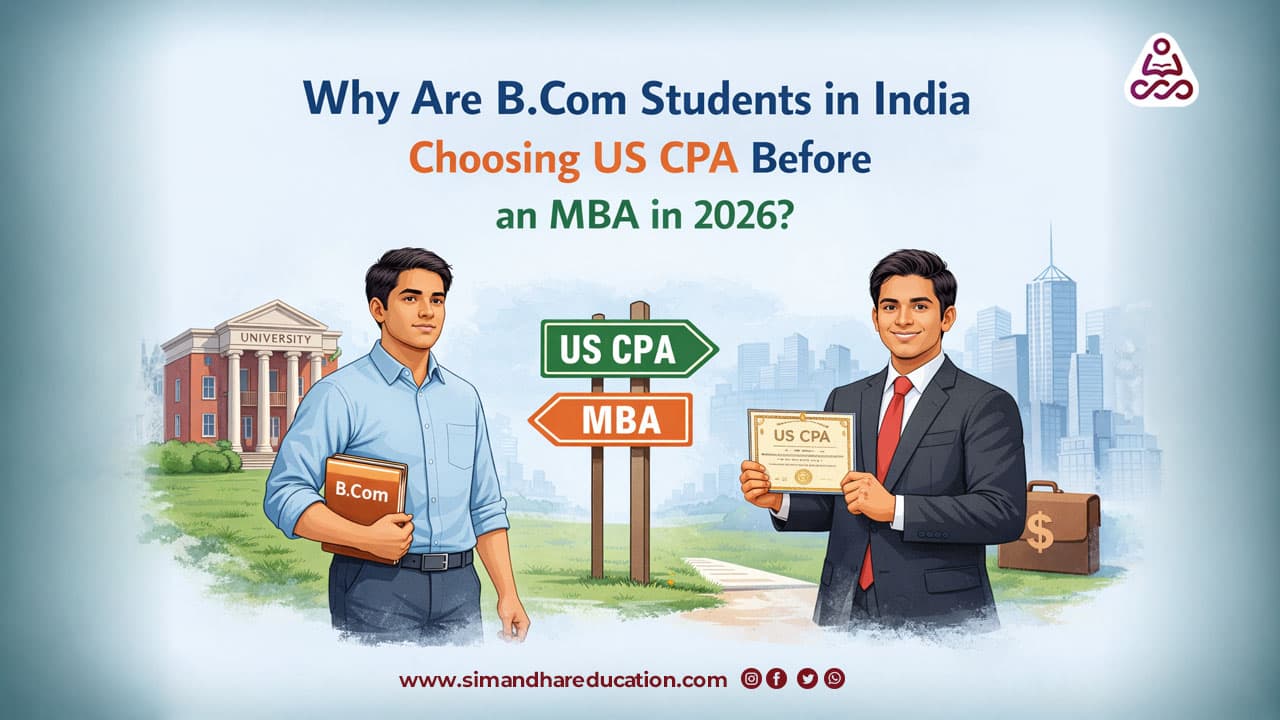
Table of Contents
- 1. Why Are B.Com Students in India Choosing US CPA Before an MBA in 2026?
- 2. Introduction
- 3. What Is US CPA?
- 4. Why Are B.Com Students Thinking Beyond MBA First?
- 5. Is US CPA Better Than MBA After B.Com?
- 6. Why Does CPA Feel More Practical for Accounting Careers?
- 7. What About CPA Eligibility for B.Com Students in India?
- 8. Why Are Students Choosing CPA Before MBA in 2026?
- 9. Can CPA Help Before Doing an MBA Later?
- 10. How Can Simandhar Education Help B.Com Students Plan the CPA Journey?
- 11. Should B.Com Students Choose CPA Before MBA?
- 12. FAQs
- 12.1. What is the full form of CPA?
- 12.2. Can B.Com students do US CPA in India?
- 12.3. Is CPA better than MBA after B.Com?
- 12.4. How many exams are there in US CPA in 2026?
- 12.5. Should students do CPA before MBA?
Why Are B.Com Students in India Choosing US CPA Before an MBA in 2026?
Introduction
For many B.Com students in India, MBA used to feel like the obvious next step after graduation. Finish B.Com, prepare for entrance exams, join a business school, and hope the degree leads to a better job. That was the standard plan for years.
But in 2026, many commerce graduates are pausing before following that route. They are asking a more practical question, will an MBA really solve the career problem right now?
That question matters because a lot of B.Com students are not struggling only because they lack a postgraduate degree. They are struggling because their career direction is unclear. They know commerce, but they do not always know whether they want audit, accounting, tax, reporting, advisory, finance operations, or management roles.
This is where US CPA starts becoming attractive. For students who want a serious career in accounting, audit, taxation, reporting, and global finance, US CPA can feel more direct than doing an MBA immediately after B.Com.
What Is US CPA?
US CPA stands for Certified Public Accountant. It is a globally respected accounting credential for candidates who want careers in accounting, audit, taxation, financial reporting, advisory, and global finance roles.
In 2026, the CPA exam follows the CPA Evolution structure. Candidates need to clear three Core sections: AUD, FAR, and REG. They also choose one Discipline section from BAR, ISC, and TCP.
That means CPA is not just a basic accounting exam. It tests audit, financial accounting and reporting, taxation and regulation, business analysis, information systems and controls, or tax planning depending on the chosen Discipline section. For a B.Com student who wants a specialized accounting career, this structure feels more connected to the actual work than a general management degree.
Why Are B.Com Students Thinking Beyond MBA First?
B.Com students are thinking beyond MBA first because the job market has become more skill-specific. A general degree is not always enough anymore. Employers want candidates who can show direction.
A student saying “I want a finance job” may not stand out. But a student building a profile around accounting, audit, reporting, or tax has a clearer story.
MBA is broad. It can lead to marketing, HR, operations, consulting, finance, analytics, or general management. That flexibility can be useful, but it can also create confusion when a student has no work experience or clear career goal.
CPA is narrower, but that is exactly why it helps some students. It gives a B.Com graduate a more focused path. Instead of trying to become “management ready” too early, the student first becomes technically stronger in accounting and finance.
That can be a smarter sequence for many commerce students.
Is US CPA Better Than MBA After B.Com?
US CPA is not automatically better than MBA. The better choice depends on the student’s goal.
If the student wants accounting, audit, taxation, financial reporting, advisory, controllership, or global accounting roles, US CPA can be more relevant than a general MBA. If the student wants marketing, entrepreneurship, people management, operations, product roles, or a broad leadership path, MBA may make more sense.
The mistake is comparing CPA and MBA as if they solve the same problem. They do not. CPA builds technical accounting credibility. MBA builds broader business and management exposure.
For a B.Com student who is still early in the career and wants to enter global accounting or Big 4-style roles, CPA can sometimes be the more practical first move. MBA can always come later if the student wants leadership, strategy, or management growth.
Why Does CPA Feel More Practical for Accounting Careers?
CPA feels practical because it is directly connected to accounting work. A B.Com student who chooses CPA is not studying random management subjects first. The preparation connects with audit, taxation, financial reporting, regulation, business controls, and accounting decisions.
These are areas that employers already care about in accounting and finance roles. For Indian candidates, CPA can be relevant for Big 4 firms, MNCs, global capability centers, shared service teams, U.S. accounting firms, audit support teams, tax teams, and financial reporting roles.
This does not mean CPA guarantees a job. No certification does that. But it gives the candidate a sharper profile than a generic commerce degree. And in a crowded job market, that clarity is important.
What About CPA Eligibility for B.Com Students in India?
CPA eligibility should be checked carefully because requirements depend on the U.S. state board or jurisdiction. Many candidates need academic credit evaluation before applying.
Simandhar’s CPA guidance explains that candidates generally need 120 credits to appear, which can come through graduation plus post-graduation, relevant professional degrees, or a CPA Bridge route.
Licensure requirements may also vary by jurisdiction. Traditionally, many states required 150 semester hours for licensure, but NASBA and AICPA have also supported newer model pathways, including a 120-hour pathway with additional professional experience. State adoption can vary, so candidates should not assume one rule applies everywhere.
This is why B.Com students should not guess their eligibility. A candidate may be eligible under one state board and not under another. The right state board, credit evaluation, and licensing plan should be understood before beginning the journey.
Why Are Students Choosing CPA Before MBA in 2026?
Many students are choosing CPA before MBA because they want career clarity before spending time and money on a broader degree.
For some B.Com graduates, the worry is simple. If they do an MBA without work experience or direction, they may still come out confused. They may have another degree, but not necessarily a specialized identity.
CPA gives a different kind of identity. It tells employers that the candidate is serious about accounting, audit, tax, and reporting. It gives the student a technical foundation that can be useful before moving into management later.
This is why CPA before MBA can make sense for students who want to build depth first and leadership later.
Can CPA Help Before Doing an MBA Later?
Yes, CPA can help before MBA later if the student wants to build a strong accounting and finance base first.
A candidate who completes CPA and gains work experience may enter an MBA later with more clarity. Instead of choosing MBA because there is no other plan, the candidate can choose MBA for a specific reason: leadership, consulting, strategy, global mobility, or senior finance roles.
That is a healthier way to use MBA. MBA works better when the student knows what they are trying to build. CPA can help create that professional base before the candidate moves toward broader management education.
So CPA and MBA do not have to be enemies. For many students, CPA can come first and MBA can come later, if the career needs it.
How Can Simandhar Education Help B.Com Students Plan the CPA Journey?
Simandhar Education supports Indian CPA aspirants with structured CPA preparation, eligibility guidance, state board support, licensing direction, and exam-focused training.
Simandhar is the official and exclusive Becker partner in India for US CPA and US CMA. Its CPA offering includes Becker-backed study material, live classes, recorded sessions, LMS access, doubt support, mentorship, exam strategy, adaptive learning tools, mock exams, and placement assistance.
For B.Com students, this support matters because CPA is not only about studying. Candidates also need clarity on credits, eligibility, state board selection, documentation, exam sections, and licensing direction.
A student who starts with proper guidance can avoid common mistakes and build the CPA journey with more confidence.
Explore Simandhar Education’s US CPA course to check eligibility, understand state board options, and prepare with Becker-backed CPA resources.
Should B.Com Students Choose CPA Before MBA?
B.Com students should choose CPA before MBA if their goal is accounting, audit, taxation, financial reporting, advisory, or global finance roles. They should not choose CPA only because it sounds international. They should also not choose MBA only because everyone else is doing it.
The better question is simple: what career problem is the student trying to solve?
If the problem is lack of accounting specialization, CPA may be the better first step. If the problem is lack of management exposure after work experience, MBA may be useful later.
In 2026, smart students are not blindly following the old order of B.Com, then MBA, then job. They are choosing the path that gives them the clearest career direction.
For many commerce graduates, that direction may begin with US CPA.
FAQs
1. What is the full form of CPA?
CPA stands for Certified Public Accountant.
2. Can B.Com students do US CPA in India?
Yes, many B.Com students can plan for US CPA, but eligibility depends on academic credits, state board rules, and evaluation requirements. Candidates should check their profile before applying.
3. Is CPA better than MBA after B.Com?
CPA can be better for students who want accounting, audit, tax, reporting, and global finance roles. MBA may be better for students who want broader management, marketing, operations, consulting, or leadership roles.
4. How many exams are there in US CPA in 2026?
The US CPA exam has four sections: three Core sections, AUD, FAR, and REG, plus one Discipline section chosen from BAR, ISC, and TCP.
5. Should students do CPA before MBA?
Students can consider CPA before MBA if they want to build technical accounting and finance depth first. MBA can still be useful later for leadership or broader management growth.
Planning to take CPA? Explore our CPA course