
ACCA Applied Knowledge Level: Papers, Topics & Tips
Learn everything about the ACCA Applied Knowledge level, including BT, MA and FA papers, syllabus, eligibility, exemptions, exam fees, online classes, coaching in India, and practical study tips for ACCA students.
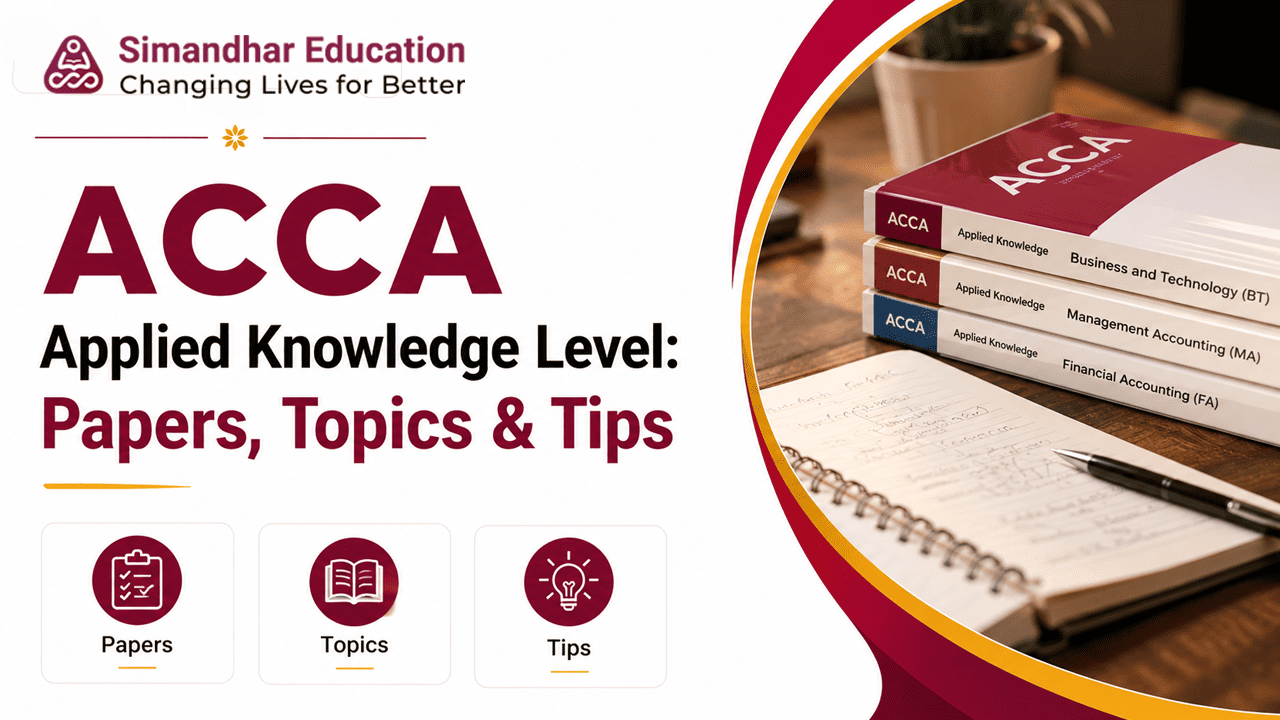
Table of Contents
- 1. ACCA Applied Knowledge Level: Eligibility, Papers, Topics, Fees & Study Tips
- 2. What Is the ACCA Applied Knowledge Level?
- 3. What Are the ACCA Applied Knowledge Papers?
- 4. Business and Technology (BT)
- 5. Management Accounting (MA)
- 6. Financial Accounting (FA)
- 7. ACCA Applied Knowledge Subjects and Syllabus at a Glance
- 8. What Is ACCA Applied Knowledge Eligibility?
- 9. Can B. Com Students Get Applied Knowledge Exemptions?
- 10. What Happens After ACCA Applied Knowledge?
- 11. How Difficult Is the ACCA Applied Knowledge Level?
- 12. ACCA Applied Knowledge Study Tips
- 13. Understand Concepts Before Memorizing
- 14. Create a Study Plan for Each Paper
- 15. Practice Questions Regularly
- 16. Don't Ignore BT Because It Is Theory-Based
- 17. Maintain an Error Log
- 18. Take Mock Exams
- 19. Revise Weak Areas Strategically
- 20. Do You Need ACCA Applied Knowledge Coaching?
- 21. ACCA Applied Knowledge Coaching in India
- 22. Are ACCA Applied Knowledge Online Classes Effective?
- 23. What Are the ACCA Applied Knowledge Exam Fees?
- 24. How Should You Prepare for Your First ACCA Applied Knowledge Exam?
- 25. How Simandhar Helps with ACCA Applied Knowledge Preparation
- 26. Conclusion
- 27. Frequently Asked Questions
- 27.1. What is the ACCA Applied Knowledge level?
- 27.2. How many ACCA Applied Knowledge papers are there?
- 27.3. What is the ACCA Applied Knowledge eligibility?
- 27.4. What subjects are covered in ACCA Applied Knowledge?
- 27.5. Can I take ACCA Applied Knowledge online classes?
- 27.6. What are the ACCA Applied Knowledge exam fees?
- 27.7. Is ACCA Applied Knowledge difficult?
- 27.8. What comes after ACCA Applied Knowledge?
Table of Contents
ACCA Applied Knowledge Level: Eligibility, Papers, Topics, Fees & Study Tips
Starting ACCA can feel overwhelming when you first look at the qualification structure, papers, examinations, and requirements. For many students, however, the journey begins with the ACCA Applied Knowledge level—the foundation stage designed to develop essential knowledge of business, management accounting, and financial accounting.
The Applied Knowledge level helps students understand how businesses operate, how financial transactions are recorded, and how accounting information supports organizational decisions. It also prepares candidates for the more advanced stages of the ACCA qualification.
If you are researching ACCA Applied Knowledge papers, syllabus, eligibility, coaching, online classes, fees, or preparation strategies, this guide answers the most important questions.
What Is the ACCA Applied Knowledge Level?
Quick answer: The ACCA Applied Knowledge level is the introductory stage of the ACCA Qualification. It consists of three exams:
- Business and Technology (BT)
- Management Accounting (MA)
- Financial Accounting (FA)
These subjects are designed to build fundamental knowledge before students’ progress to the Applied Skills level.
The Applied Knowledge stage focuses on three major areas:
- Understanding businesses and their environment
- Using management accounting information for planning and decision-making
- Understanding financial accounting and preparing basic financial statements
Rather than treating these papers as exams to simply clear, students should use this level to establish strong accounting and business fundamentals.
What Are the ACCA Applied Knowledge Papers?
There are three ACCA Applied Knowledge papers.
1. Business and Technology (BT)
Business and Technology introduces students to how organizations operate and how different factors influence business performance.
Key areas generally include:
- Business organizations and structures
- Stakeholders
- Business environment
- Organizational culture
- Corporate governance
- Leadership
- Management
- Professional ethics
- Accounting and reporting systems
- Technology in business
- Internal controls
BT is especially useful for students beginning their professional accounting education because it provides the broader business context within which accountants and finance professionals work.
2. Management Accounting (MA)
Management Accounting develops an understanding of how financial and non-financial information is used internally by organizations.
Important topics include:
- Nature and purpose of management accounting
- Cost classification
- Cost accounting techniques
- Budgeting
- Standard costing
- Performance measurement
- Variance analysis
- Decision-making information
MA requires both conceptual understanding and numerical practice. Students should therefore avoid relying entirely on reading and spend sufficient time solving questions.
3. Financial Accounting (FA)
Financial Accounting introduces the principles and techniques used to record transactions and prepare financial information.
The ACCA Applied Knowledge syllabus for FA generally covers areas such as:
- Financial accounting principles
- Double-entry bookkeeping
- Recording transactions
- Trial balances
- Accounting adjustments
- Preparation of financial statements
- Basic consolidation concepts
- Interpretation of financial statements
A strong understanding of FA becomes particularly important when students’ progress towards Financial Reporting and more advanced accounting subjects.
ACCA Applied Knowledge Subjects and Syllabus at a Glance
The three papers complement one another.
-
BT – Business and Technology
Focus: Organizations, people, governance, ethics, business systems, and technology. -
MA – Management Accounting
Focus: Costs, budgeting, performance measurement, decision-making, and management information. -
FA – Financial Accounting
Focus: Accounting records, transactions, financial statements, and interpretation.
Together, these ACCA Applied Knowledge subjects and syllabus areas establish the foundation needed for subsequent ACCA papers.
Students should always refer to ACCA's latest official syllabus and study guide for their examination session, as examinable content can be updated.
What Is ACCA Applied Knowledge Eligibility?
ACCA Applied Knowledge eligibility depends on the entry route through which a candidate begins the ACCA Qualification.
Students meeting ACCA's minimum entry requirements can begin their qualification journey at the appropriate level. Candidates with relevant previous academic qualifications may also be eligible for exemptions from one or more Applied Knowledge exams.
For Indian students, qualifications such as B.Com or other relevant degrees may result in exemptions depending on the institution, course, subjects studied, and ACCA's current exemption rules.
Can B. Com Students Get Applied Knowledge Exemptions?
Potentially, yes.
Commerce graduates may qualify for exemptions from certain papers if their previous studies satisfy ACCA's exemption requirements.
However, students should not assume that every B.Com graduate receives the same exemptions.
Your eligibility can depend on:
- University
- Degree
- Subjects studied
- Year of graduation
- Course structure
- ACCA's current exemption framework
Use ACCA's official exemption resources to determine your individual position before planning your examinations.
What Happens After ACCA Applied Knowledge?
After completing the Applied Knowledge exams—or receiving applicable exemptions—students can progress to the Applied Skills stage.
The Applied Skills level develops more advanced capabilities across areas such as law, taxation, financial reporting, performance management, financial management, and audit and assurance.
After meeting the relevant requirements, candidates continue towards the Strategic Professional stage.
This is why Applied Knowledge should be viewed as a foundation rather than an isolated set of three exams. Concepts learned in BT, MA, and FA can appear again in more complex forms during later stages.
How Difficult Is the ACCA Applied Knowledge Level?
- Applied Knowledge is the introductory ACCA stage, but that does not mean students should underestimate it.
- Difficulty varies according to a student's academic background.
- Commerce and accounting students may already recognize several concepts from MA and FA. Students from non-commerce backgrounds might require more time to understand bookkeeping, accounting terminology, and numerical concepts.
- The key is consistency.
- Students who understand concepts and regularly practice exam-style questions are generally better positioned than candidates who depend on last-minute preparation.
ACCA Applied Knowledge Study Tips
A clear preparation strategy can make the Applied Knowledge level much more manageable.
1. Understand Concepts Before Memorizing
Accounting requires application.
For example, memorizing the rules of double-entry bookkeeping without understanding why an account is debited or credited can make advanced questions difficult.
Focus first on the logic behind each concept.
2. Create a Study Plan for Each Paper
Break the ACCA Applied Knowledge syllabus into manageable sections.
Your weekly schedule can include:
Concept learning → Practice questions → Revision → Mock exam → Error analysis
This creates a continuous learning cycle rather than leaving revision until the end.
3. Practice Questions Regularly
This is particularly important for MA and FA. Reading a chapter can create the impression that you understand it, but questions reveal whether you can actually apply the concept. Practice questions after completing each topic.
4. Don't Ignore BT Because It Is Theory-Based
Students sometimes devote most of their attention to numerical papers and underestimate Business and Technology.
BT requires understanding of organizational structures, governance, ethics, management, technology, and business processes.
Use short revision notes and regular question practice to reinforce important concepts.
5. Maintain an Error Log
One of the most effective ACCA Applied Knowledge study tips is to track your mistakes.
Create a simple document containing:
- Topic
- Question attempted
- Mistake made
- Correct concept
- Why you made the error
Reviewing repeated mistakes can be more valuable than continuously solving new questions without analyzing previous errors.
6. Take Mock Exams
Mocks help you evaluate:
- Conceptual understanding
- Accuracy
- Speed
- Exam technique
- Weak topics
Treat mocks as diagnostic tools rather than just scores.
7. Revise Weak Areas Strategically
Don't spend equal time on everything during final revision.
Identify weak topics through practice tests and allocate additional revision time to those areas.
Do You Need ACCA Applied Knowledge Coaching?
Coaching is not mandatory for every student, but structured ACCA Applied Knowledge coaching can help candidates who need faculty guidance, study planning, doubt-solving, accountability, and exam-oriented preparation.
Coaching can be particularly useful if:
- You are new to accounting
- You struggle with self-study
- You need a structured timetable
- You want live faculty support
- You have limited preparation time
- You need help understanding numerical concepts
- You want mock tests and performance feedback
Before selecting an institute, evaluate faculty expertise, study resources, live support, question practice, mock exams, and student support rather than choosing solely based on fees.
ACCA Applied Knowledge Coaching in India
Students searching for ACCA Applied Knowledge coaching in India now have multiple options, including classroom, online, and hybrid learning.
The right format depends on your schedule and learning style.
College students may prefer structured classes that fit around their academic timetable. Working professionals may benefit more from online or flexible learning.
Regardless of the format, good coaching should help students understand concepts rather than merely complete the syllabus.
Are ACCA Applied Knowledge Online Classes Effective?
Yes, ACCA Applied Knowledge online classes can be effective when they provide structured learning and sufficient interaction.
Look for online classes offering:
- Live faculty sessions
- Doubt-solving support
- Recorded learning support where available
- Topic-wise question practice
- Revision sessions
- Mock examinations
- Performance tracking
- Updated study resources
Online learning can also help students who do not live near an ACCA coaching centre.
However, flexibility can become a disadvantage if it leads to procrastination. Students should maintain a fixed weekly study schedule even when attending online classes.
What Are the ACCA Applied Knowledge Exam Fees?
ACCA Applied Knowledge exam fees can vary depending on factors such as the exam, location, examination centre, and applicable ACCA or computer-based exam centre charges.
Students should also understand that the overall cost of pursuing ACCA may involve more than examination fees.
Potential costs can include:
- Initial registration
- Annual subscription
- Examination fees
- Exemption fees, where applicable
- Study materials
- Coaching or tuition fees
Because ACCA periodically updates its fees and certain computer-based exam charges can vary by centre, candidates should verify the latest amounts through ACCA's official channels or their approved examination centre before making financial plans.
How Should You Prepare for Your First ACCA Applied Knowledge Exam?
If you are beginning from scratch, use a simple five-step approach.
Step 1: Understand the syllabus.
Review the complete syllabus and identify major topics.
Step 2: Build conceptual knowledge.
Complete each topic through classes or structured self-study.
Step 3: Practice immediately.
Solve questions after every major concept instead of waiting until syllabus completion.
Step 4: Revise systematically.
Create concise revision notes and revisit difficult areas regularly.
Step 5: Attempt mock exams.
Use mocks to identify gaps and improve exam technique.
This approach helps turn ACCA preparation from passive learning into active application.
How Simandhar Helps with ACCA Applied Knowledge Preparation
Simandhar Education supports ACCA students with structured learning, experienced faculty guidance, exam-focused preparation, doubt-solving support, and flexible learning options. Students preparing for Applied Knowledge papers can strengthen fundamentals in Business and Technology, Management Accounting, and Financial Accounting through concept-based learning and question practice. Simandhar also focuses on developing practical accounting and finance capabilities alongside exam preparation. With career guidance, skill development, and placement assistance, students can work towards progressing from ACCA preparation to becoming more confident and industry-ready finance professionals.
Conclusion
The ACCA Applied Knowledge level provides the foundation for your ACCA journey. Its three papers—Business and Technology, Management Accounting, and Financial Accounting—introduce the essential business and accounting concepts needed for more advanced ACCA studies.
Success at this stage does not depend only on how many hours you study. Understanding concepts, practising questions, reviewing mistakes, attempting mocks, and following a consistent plan are more important.
Whether you choose self-study, ACCA Applied Knowledge coaching in India, or **ACCA Applied Knowledge online classes**, focus on building strong fundamentals. The knowledge developed at this level can support your performance in later ACCA papers and contribute to the accounting and finance skills required throughout your professional career.
Frequently Asked Questions
1. What is the ACCA Applied Knowledge level?
ACCA Applied Knowledge is the introductory stage of the ACCA Qualification and includes Business and Technology (BT), Management Accounting (MA), and Financial Accounting (FA).
2. How many ACCA Applied Knowledge papers are there?
There are three papers: BT, MA, and FA. Eligible students may receive exemptions depending on their previous qualifications.
3. What is the ACCA Applied Knowledge eligibility?
Eligibility depends on your academic background and ACCA's entry requirements. Candidates with recognized relevant qualifications may also be eligible for exemptions.
4. What subjects are covered in ACCA Applied Knowledge?
The level covers business and technology, management accounting, and financial accounting, providing a foundation for later ACCA stages.
5. Can I take ACCA Applied Knowledge online classes?
Yes. Students can prepare through online classes, depending on the tuition provider. Look for live teaching, doubt support, practice questions, revision sessions, and mock examinations.
6. What are the ACCA Applied Knowledge exam fees?
Fees can depend on the exam delivery method, location, and exam centre. Candidates should verify current registration, subscription, exam, and exemption fees through official ACCA resources before enrolling.
7. Is ACCA Applied Knowledge difficult?
The difficulty depends on your academic background and preparation. Students with accounting knowledge may find some topics familiar, while beginners may need additional time to understand accounting fundamentals.
8. What comes after ACCA Applied Knowledge?
After completing Applied Knowledge or receiving applicable exemptions, eligible candidates can progress to ACCA Applied Skills, followed later by Strategic Professional and the other requirements needed to achieve ACCA membership.
Planning to take ACCA? Explore our ACCA course