
CAAP Level 1 vs Level 2: Syllabus, Tools & Key Differences
Explore CAAP Level 1 vs Level 2, including syllabus, AI tools, practical applications, difficulty and skills for accounting and finance careers.
Table of Contents
- 1. CAAP Level 1 vs Level 2: Tools, Syllabus, Skills and Practical Applications Explained
- 2. What Is CAAP? Understanding the Programme
- 3. CAAP Level 1 Explained: Build Your Foundation in AI for Finance
- 3.1. A. Skills and learning areas covered in Level 1
- 3.2. Prompt Engineering
- 3.3. AI Guided Analysis
- 3.4. Data Analytics and Visualization
- 3.5. Finance Subject Applications
- 4. CAAP Level 2 Explained: Explore Advanced AI Applications in Finance
- 4.1. B. Advanced skills and learning areas covered in Level 2
- 4.2. Exploratory Data Analysis (EDA)
- 4.3. Vibe Coding
- 4.4. Automated Dashboarding
- 4.5. Machine Learning for Finance
- 4.6. AI Agents for Finance
- 4.7. C. Finance applications covered in Level 2
- 5. CAAP Level 1 vs Level 2: Tools and Learning Areas Compared
- 6. CAAP Level 1 vs Level 2 Difficulty: Which Should You Choose?
- 7. What Practical Skills Can Students Develop Through CAAP?
- 8. Who Should Pursue CAAP Level 1 and Level 2?
- 9. Explore the CAAP Course at Simandhar Education
- 9.1. Frequently Asked Questions
CAAP Level 1 vs Level 2: Tools, Syllabus, Skills and Practical Applications Explained
Finance roles are evolving as businesses increasingly integrate artificial intelligence into data analysis, financial reporting, forecasting, and process automation. For commerce students, this shift raises an important question: Are traditional accounting and finance skills enough to meet the changing expectations of employers?
Rohan, a second-year commerce student, is curious about how AI is influencing the finance job market and why professionals are increasingly expected to understand these technologies. To get a clearer picture, he approaches his professor to understand how AI is becoming an integral part of finance workflows and what skills he should start developing.


Rohan, imagine two finance graduates applying for the same financial analyst position. Both understand accounting principles, financial statements, and basic Excel. However, one candidate can also use AI tools to analyze financial data, create dashboards, identify unusual transactions, and support financial forecasting. Which candidate do you think has an additional advantage?

The second candidate, Professor. But isn't accounting knowledge still the most important requirement for finance jobs?
Absolutely. Accounting and finance fundamentals remain essential. However, the expectations from finance professionals are changing. Employers increasingly look for people who can work with financial data, understand technology-driven processes, and use AI to improve the quality and efficiency of their work.
Consider what happened in the finance department today. Professionals review large spreadsheets, prepare management reports, analyze financial ratios, monitor expenses, support audits, and assist with business forecasts. Several of these activities involve repetitive work and extensive data analysis.
AI can support these responsibilities through tools such as ChatGPT, Microsoft Copilot, Claude, Gemini, Excel, and Power BI. More advanced applications can introduce automated dashboarding, machine learning, and AI agents into finance workflows.
So, does that mean I need to learn programming or become a technology professional to work in finance?
Not necessarily. You need to understand how AI works, where it can be applied, and how to use the right tools for finance-related problems. That's why learning AI alongside your commerce or finance education can be valuable.
Is there a professional programme that combines AI learning with accounting and finance applications?
Yes. You can explore the Certified AI Accounting Professional (CAAP) programme offered by Simandhar Education. It is a NASBA-approved programme designed to help learners develop practical AI skills for accounting and finance.
It is structured into two levels. Let's understand what each level teaches, which tools you will explore and how the learning progresses.
1. What Is CAAP? Understanding the Programme
Professor, what is the full form of CAAP, and who should consider pursuing it?
CAAP stands for Certified AI Accounting Professional. It focuses on bringing AI applications into accounting, financial analysis, auditing, taxation, and other finance-related functions.
It can be relevant to:
- B.Com and BBA students who want to develop AI skills alongside their academic education.
- Recent commerce graduates exploring finance and accounting careers.
- CA, US CPA, US CMA, CIA and ACCA aspirants looking to complement their professional knowledge.
- Working accounting and finance professionals interested in applying AI to their existing responsibilities.
Does the programme teach only AI concepts, or will I actually work with tools?
The learning combines AI concepts, technology tools and finance-related subject applications. Let's explore the two levels separately.
2. CAAP Level 1 Explained: Build Your Foundation in AI for Finance
What should I expect from Level 1? Is it suitable if I have never worked with AI tools?
Yes. Level 1 introduces you to AI-assisted finance activities. You begin by understanding how to communicate with AI tools and gradually apply them to familiar accounting and financial tasks.
Let's look at its key learning areas.
A. Skills and learning areas covered in Level 1
1. Prompt Engineering
I use ChatGPT occasionally. Is that the same as prompt engineering?
Using ChatGPT is only the starting point. Prompt engineering means giving AI clear, structured instructions to obtain relevant outputs.
For example, suppose you need to analyse a company's expenses. Instead of asking AI to "analyze this spreadsheet", you can provide the business context, specify the reporting period and request a structured expense comparison.
You will explore AI assistants such as ChatGPT, Microsoft Copilot, Claude, Perplexity, Gemini, Google AI Studio, Grok, and Kimi.
2. AI Guided Analysis
You learn how AI can assist with examining information, interpreting results, and supporting analytical tasks.
For example, when reviewing a company's financial performance, AI can help organize findings and explain possible reasons behind changes in revenue or expenses. The finance professional must verify the figures and conclusions.
3. Data Analytics and Visualization
This area introduces the use of data analytics and visualization tools to understand financial information.
You work with Excel and Power BI to organize data, analyze business performance, and present information in a meaningful format.
4. Finance Subject Applications
Level 1 connects AI learning with four important finance areas:
- Financial Ratio Analysis: Understanding profitability, liquidity, solvency, and efficiency ratios to evaluate business performance.
- AI for FP&A: Exploring how AI can support financial planning and analysis activities.
- AI in Taxation: Understanding AI applications in tax-related information review and processes.
- AI in Audit: Exploring how AI can support audit analysis and the review of financial information.
I understand the tools now, but why do we need to learn financial ratio analysis and FP&A alongside AI?
Because knowing how to operate an AI tool is not enough. You must understand the finance problem you are trying to solve. For instance, AI may help explain a decline in a company's current ratio, but you need financial knowledge to assess whether the explanation makes business sense.
3. CAAP Level 2 Explained: Explore Advanced AI Applications in Finance
So, once I understand the fundamentals, what changes in Level 2?
Level 2 takes you towards more advanced AI applications. You explore how AI can support complex analysis, financial workflows, automation, and decision-making.
Let's understand the additional learning areas.
B. Advanced skills and learning areas covered in Level 2
1. Exploratory Data Analysis (EDA)
What is EDA, and how is it different from regular data analysis?
Exploratory Data Analysis involves examining a dataset to understand its structure, identify patterns, discover missing information, and spot unusual observations.
Imagine receiving a company's transaction records. Before preparing a financial report, you need to understand the data and identify inconsistencies. EDA helps you examine the dataset before drawing conclusions.
2. Vibe Coding
Vibe coding involves using natural-language instructions to generate and modify code with AI assistance.
For example, a finance professional may use AI to generate Python code for organising financial data or performing repetitive calculations without manually writing every line.
3. Automated Dashboarding
I already know Power BI. Why should I learn automated dashboarding?
Building a dashboard is one thing; improving how it is generated and updated is another. Automated dashboarding explores ways to streamline dashboard creation and reporting workflows.
4. Machine Learning for Finance
Machine learning helps systems identify patterns in data and make predictions based on historical information.
For example, businesses can explore machine learning applications to understand financial trends, support forecasting, and identify patterns that may require further investigation.
5. AI Agents for Finance
I have heard about AI agents. Are they different from ChatGPT?
Yes. A conversational AI assistant generally responds to instructions, while an AI agent can be designed to perform a sequence of tasks towards a defined objective, subject to its permissions and oversight.
For example, a finance-related AI agent could be designed to organize incoming financial information, perform preliminary checks, and prepare a summary for human review.
C. Finance applications covered in Level 2
Level 2 also extends the subject-specific learning into more advanced applications:
- Anomaly Detection – Invoice and Ledgers: Identifying unusual transaction patterns or inconsistencies in invoice and ledger data for further investigation.
- Financial Forecasting: Using historical financial information and analytical techniques to support future projections.
- AI in Compliance: Exploring AI applications that support compliance-related reviews and processes.
- AI in Risk Management: Understanding how AI can help identify patterns and potential financial or operational risks.
So, Level 2 is not just about learning more AI tools. It teaches me how to apply them to actual finance-related problems?
Exactly. The focus moves from understanding individual tools to exploring how different AI capabilities can support finance workflows.
4. CAAP Level 1 vs Level 2: Tools and Learning Areas Compared
Professor, can you put the tools and applications from both levels together? It will help me understand where I should focus.
Certainly. Let's divide them into skills, tools, and finance subject areas.
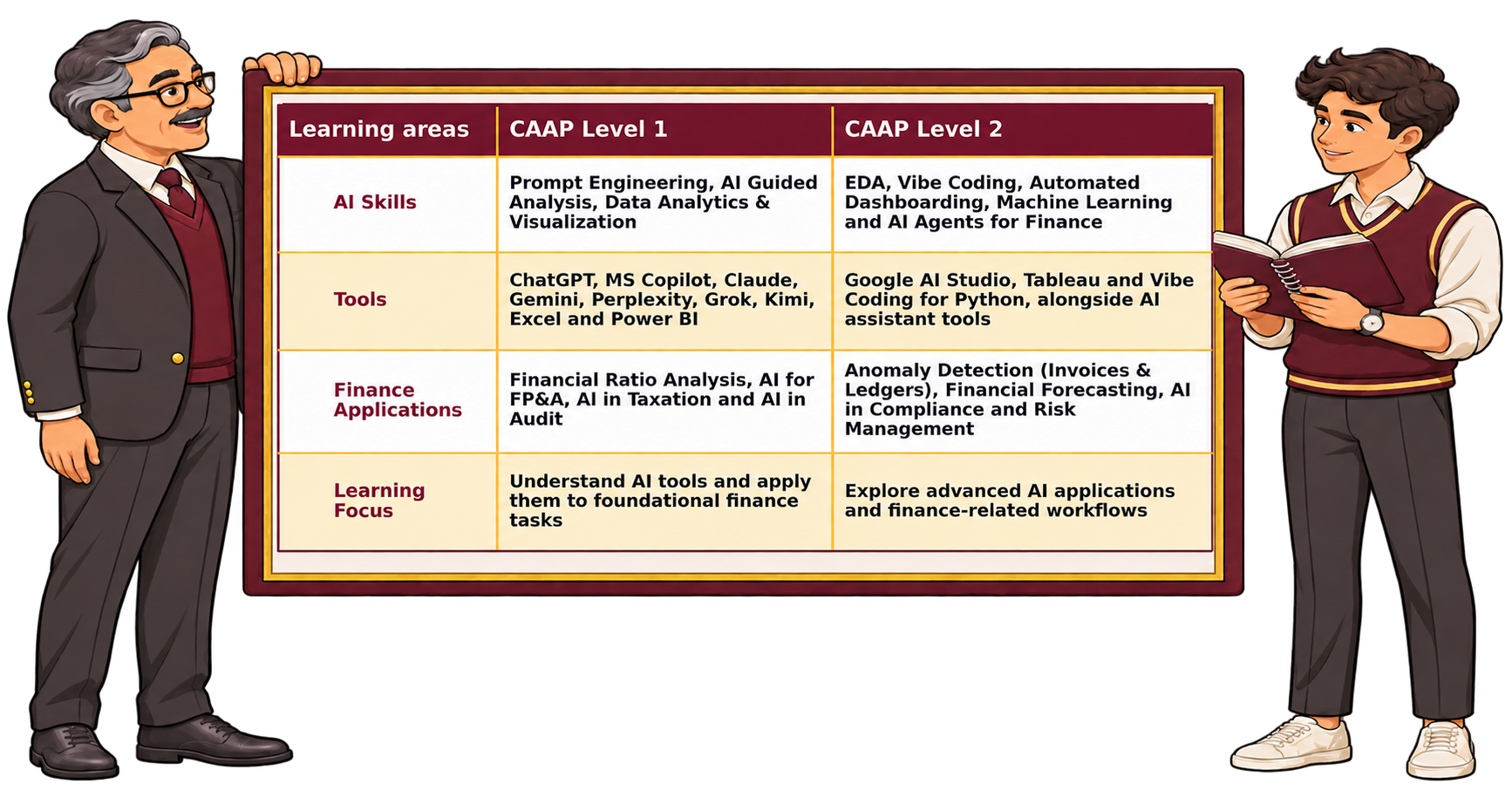
Now I can see the progression. Level 1 introduces the tools and finance applications, while Level 2 takes the learning further with Python, Tableau, machine learning, and AI agents.
Correct. You should view these levels as a learning progression rather than two unrelated courses.
5. CAAP Level 1 vs Level 2 Difficulty: Which Should You Choose?
I have a basic commerce background. Will I find Level 2 difficult?
The learning commitment is different at each stage.
- Level 1: Focuses on foundational AI skills and their applications in familiar finance activities. It is a suitable starting point for beginners.
- Level 2: Covers more advanced analytical and technical applications, including EDA, Python-based vibe coding, machine learning and AI agents.
Level 2 involves a broader range of concepts, so it requires more engagement with practical applications.
However, don't assume that you must become a programmer before learning AI. Your accounting and finance knowledge will help you understand the problems these tools are designed to address.
6. What Practical Skills Can Students Develop Through CAAP?
Professor, how will I use these skills when I start working?
Let's connect the learning to typical finance responsibilities.
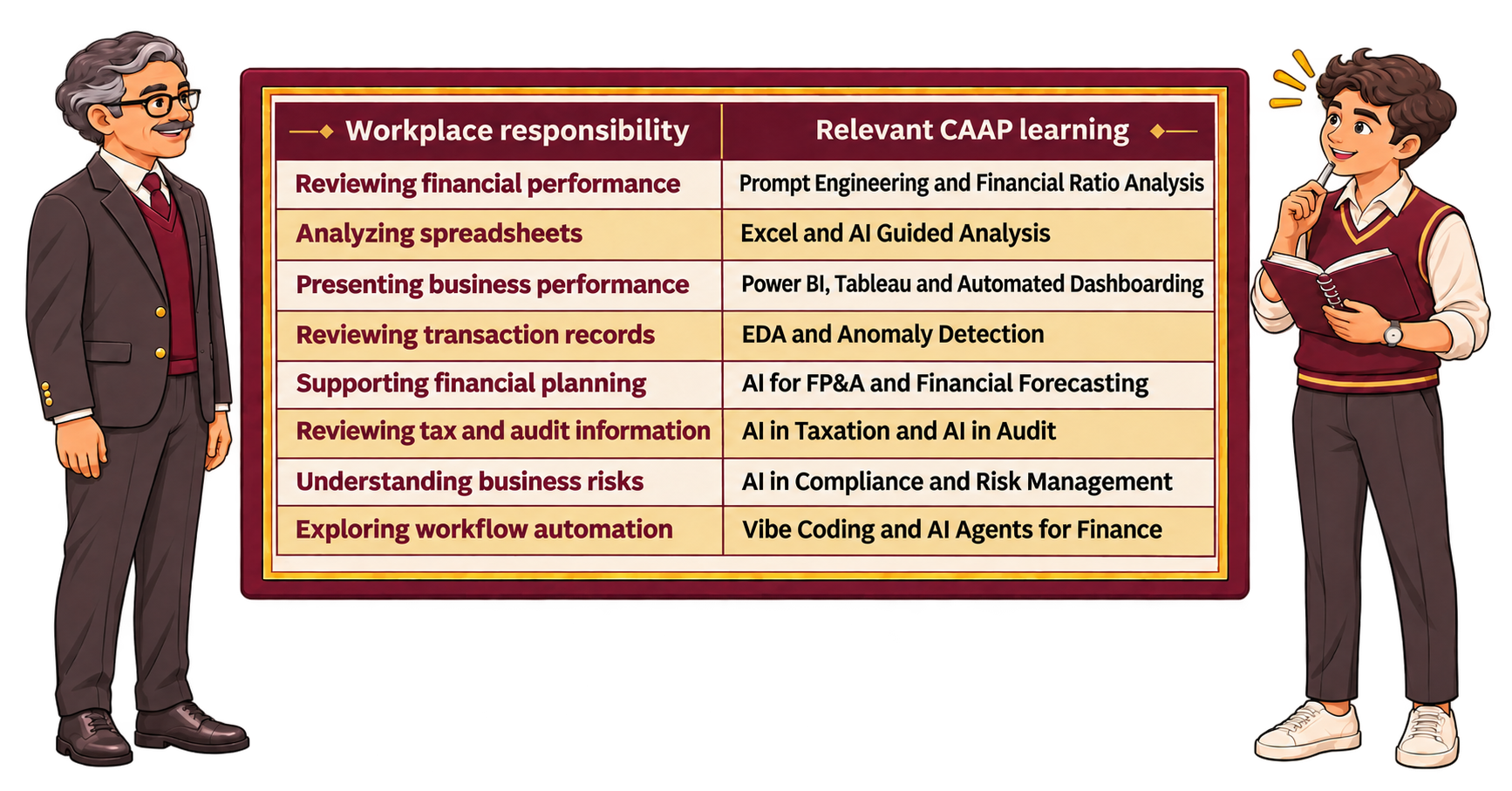
Does this mean AI will independently handle these responsibilities?
No. AI supports finance professionals; it does not remove their responsibility. You must validate financial calculations, review AI-generated outputs, protect confidential information, and apply professional judgement before making decisions.
7. Who Should Pursue CAAP Level 1 and Level 2?
Would you recommend CAAP to someone who has just completed B.Com, or is it more useful after gaining work experience?
Both can explore the programme, depending on their learning goals.
- B.Com and BBA students: Can start building AI skills alongside accounting, business and finance fundamentals.
- Recent graduates: Can explore AI-enabled analytics and finance applications while preparing for professional opportunities.
- CA and US CPA aspirants: Can complement their accounting knowledge with AI applications in audit, taxation and financial analysis.
- US CMA and ACCA aspirants: Can explore applications in FP&A, financial reporting, forecasting and business analysis.
- Working professionals: Can learn how AI tools may support their existing accounting, audit and finance responsibilities.
If you are considering a CAAP course after graduation or alongside a professional qualification, consider your existing AI knowledge and the practical skills you want to develop.
8. Explore the CAAP Course at Simandhar Education
Professor, where can I explore this programme and understand how it fits into my career plans?
You can explore the CAAP course at Simandhar Education. The programme brings together AI tools, practical learning and finance-related applications to help students and professionals understand how technology can support their work.
The two-level structure provides a progression from prompt engineering, Excel and Power BI to more advanced areas such as machine learning, AI agents, EDA and automated dashboarding.
Remember, the objective is not simply to learn how to use ChatGPT or generate a dashboard. It is to understand how AI can be applied to accounting and finance problems.
I understand now. Level 1 helps me establish the foundation, and Level 2 allows me to explore more advanced applications. I can see why learning AI alongside finance knowledge matters.
Exactly, Rohan. Your finance knowledge tells you what needs to be analysed. Your AI skills help you explore how to analyse it more efficiently. Developing both can prepare you to engage with the changing expectations of finance roles.
Frequently Asked Questions
1. What is the difference between CAAP Level 1 and Level 2?
CAAP Level 1 focuses on foundational AI skills, including prompt engineering, AI Guided Analysis, Excel, Power BI, financial ratio analysis, FP&A, taxation and audit. Level 2 introduces more advanced applications such as EDA, vibe coding, automated dashboarding, machine learning, AI agents, financial forecasting, compliance and risk management.
2. What is the CAAP Level 1 and Level 2 syllabus?
Level 1 covers prompt engineering, AI Guided Analysis, data analytics and visualization, along with finance applications such as financial ratio analysis, FP&A, taxation and audit. Level 2 covers EDA, vibe coding, automated dashboarding, machine learning for finance, AI agents, anomaly detection, forecasting, compliance and risk management.
3. Which AI tools are covered in the CAAP course?
The programme includes AI tools such as ChatGPT, Microsoft Copilot, Claude, Perplexity, Gemini, Google AI Studio, Grok and Kimi. It also covers Excel and Power BI in Level 1, and Tableau and Vibe Coding for Python in Level 2.
4. Is CAAP Level 2 more difficult than Level 1?
Level 2 covers more advanced applications, including exploratory data analysis, Python-based vibe coding, machine learning and AI agents for finance. It requires learners to engage with a broader range of analytical and practical concepts.
5. Can B.Com graduates pursue the CAAP course?
Yes. B.Com graduates can explore CAAP to develop practical AI skills alongside their commerce knowledge. The programme introduces applications in financial analysis, Excel, Power BI, taxation, audit, and other finance-related areas.
6. Do I need programming knowledge to enrol in CAAP?
The programme is designed around AI applications in accounting and finance, including natural-language prompting and AI-assisted coding. You should review the latest admission guidance from Simandhar Education to confirm the current entry requirements.
7. What practical skills can students learn through CAAP?
Students can explore prompt engineering, AI Guided Analysis, Excel analytics, Power BI, Tableau, EDA, Python-based vibe coding, automated dashboarding, machine learning, and AI agents. They also learn about AI applications in FP&A, taxation, audit, forecasting, compliance, and risk management.
8. Is the CAAP course useful for working finance professionals?
Yes. Working professionals can explore how AI tools support financial analysis, reporting, forecasting, audit reviews, taxation, and finance workflows. The learning can complement existing accounting and finance expertise.
Planning to take CAAP? Explore our CAAP course