
Will AI Replace Accountants? Skills to Stay Relevant in 2027
Will AI replace accountants? Explore AI tools, changing accounting tasks, practical applications, and essential skills to stay relevant in 2027 and beyond.
Table of Contents
- 1. Will AI Replace Accountants? Tasks That Are Changing and Skills That Still Matter
- 2. Your Accounting Workflow Is Changing. Have You Noticed?
- 3. Let Me Show You What I Can Actually Do
- 3.1. Example 1: Bank Reconciliation
- 3.2. Example 2: Analyzing a Company's Expenses
- 3.3. Example 3: Preparing a Financial Report
- 4. What I Cannot Reliably Decide on Your Behalf
- 5. The Six Skills You Need to Develop
- 5.1. AI Tool Proficiency
- 5.2. Advanced Excel and Data Analysis
- 5.3. Critical Thinking
- 5.4. Financial Interpretation
- 5.5. Problem-Solving and Risk Assessment
- 5.6. Communication and Professional Judgment
- 6. What Happens If You Do Not Adapt?
- 7. Your Practical Roadmap to Staying Relevant
- 8. One Last Question: Will AI Replace Accountants?
- 9. Frequently Asked Questions
Will AI Replace Accountants? Tasks That Are Changing and Skills That Still Matter
Artificial Intelligence is no longer limited to answering questions or generating text. It is entering everyday accounting workflows, helping professionals analyze spreadsheets, identify unusual transactions, automate bookkeeping activities, and preparing financial reports.
But how much of an accountant's work can AI actually handle? Can it analyze a company's financial performance, identify accounting errors, or make decisions that affect business outcomes?
To understand how the accounting profession is evolving, let's follow a conversation between Riya, a junior accounting associate, and an AI assistant as they explore how AI is changing her daily responsibilities, the skills she needs to develop, and what it takes to stay relevant in the profession.
Through practical examples, real AI tools, and everyday accounting situations, discover what technology can do, where professional expertise still matters, and which skills accountants need to develop to remain relevant in 2027 and beyond.
1. Your Accounting Workflow Is Changing. Have You Noticed?

I have been hearing about AI in accounting for months. But honestly, I still spend most of my day working on spreadsheets, checking invoices, reconciling transactions, and preparing reports. What exactly is changing?

Look at how you complete these activities today. You may be spending considerable time collecting information, entering data, matching records, and preparing preliminary reports.
Now, consider how AI-powered tools can assist with those activities.
For example:
- Bookkeeping: QuickBooks' Accounting AI can assist with transaction categorization, bank transaction processing, and identifying accounting issues.
- Spreadsheet analysis: Microsoft Copilot in Excel can generate formulas, analyze financial datasets, identify unusual patterns, and create charts and PivotTables.
- Financial reporting: AI assistants can help organize financial information, summarize movements, and draft preliminary explanations for reports.
- Document processing: AI-powered systems can extract information from invoices and other financial documents, reducing manual data entry.
These are not just theoretical possibilities. Accounting software providers are already introducing AI capabilities into their products.
So, instead of spending hours preparing information, can I spend more time understanding it?
Exactly. Your work is gradually moving from repetitive processing towards reviewing, interpreting, investigating, and advising.
But remember, automating a task does not mean eliminating the responsibility attached to it.
2. Let Me Show You What I Can Actually Do
Give me a practical example. I want to understand how you would help me during a normal working day.
Let's take three situations.
Example 1: Bank Reconciliation
You receive a bank statement containing 500 transactions. Your accounting records contain the corresponding entries.
Traditionally, you would compare the records, identify unmatched transactions, and investigate differences.
With QuickBooks' AI-powered bank transaction and reconciliation features, you can receive assistance with matching transactions and identifying potential discrepancies.
Here is how we can work together:
- I handle: Initial transaction matching, suggested categorization, and highlighting possible discrepancies.
- You handle: Reviewing unmatched entries, checking supporting documents, investigating differences, and approving the reconciliation.
Example 2: Analyzing a Company's Expenses
Suppose a company reports a 15% increase in operating expenses compared with the previous quarter.
You can use Microsoft Copilot in Excel to analyze the expense dataset and ask:
"Compare operating expenses across the last two quarters. Identify the categories with the highest percentage increase and highlight unusual variations."
I can help generate a summary, identify trends, and present the results through charts or PivotTables.
But consider this:
The travel expense category increased by 40%.
Does that mean the company is overspending?
Not necessarily.
You must investigate whether the increase resulted from additional business travel, a new project, a change in travel policy, or an incorrect expense classification.
I identify the variations. You investigate its business significance.
Example 3: Preparing a Financial Report
Suppose you need to prepare a monthly management report.
You can use an AI assistant to organize financial information, draft explanations for significant movements, and summarize key performance indicators.
However, you must verify the underlying figures, check accounting treatments, review assumptions, and ensure the final report accurately represents the company's financial position.
I see the difference now. You can speed up the process, but I still need to understand the numbers.
Correct. And that brings us to something important: knowing my limitations.
3. What I Cannot Reliably Decide on Your Behalf
If you can analyze financial information, why can't I simply depend on your recommendations?
Because an analytical result is not automatically a correct business decision.
Consider these situations:
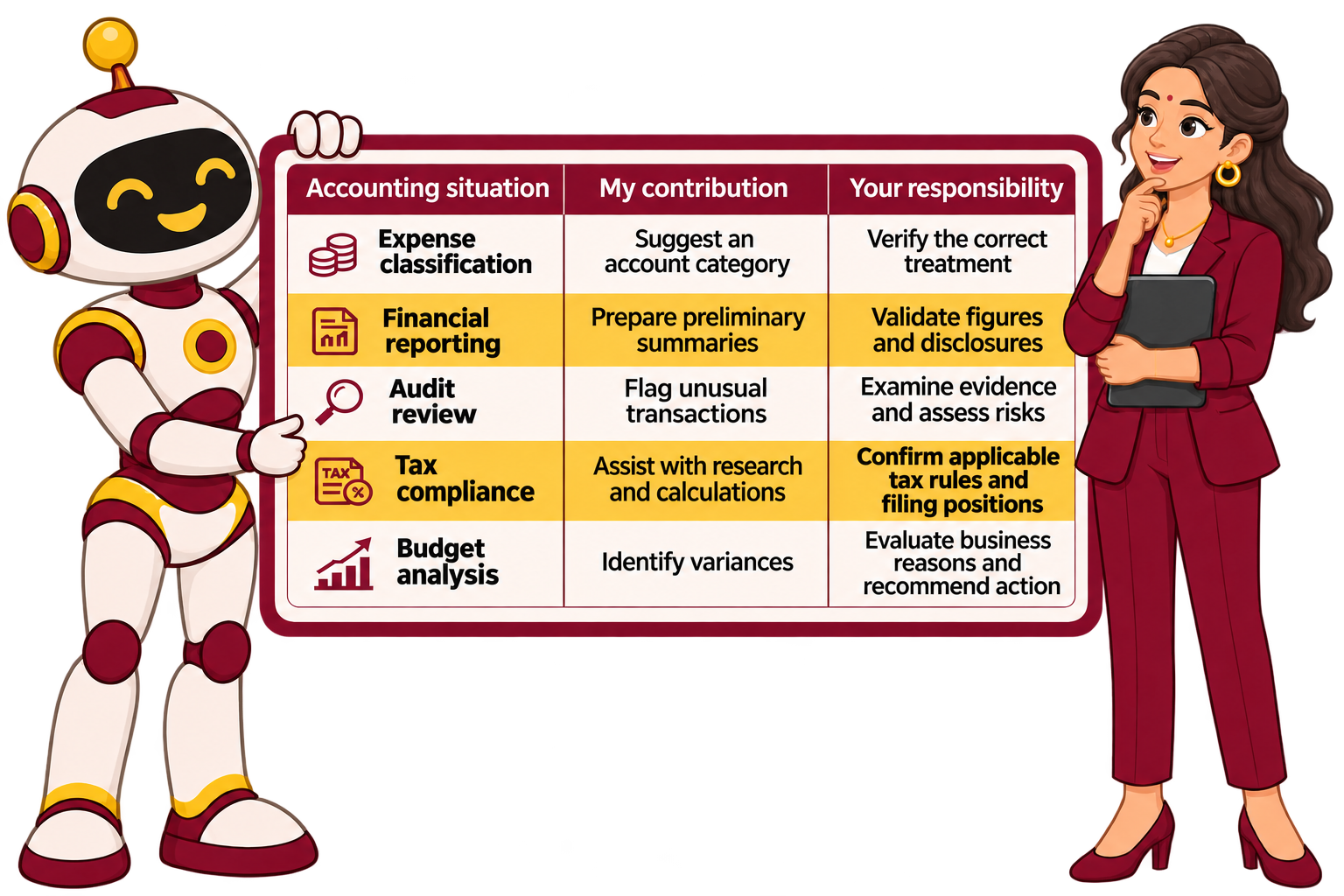
For instance, I might flag a transaction as unusual because it differs significantly from historical spending. But that does not establish fraud.
You need to examine the supporting documents, assess the circumstances, follow the audit process, and document your findings.
Similarly, I can assist with tax research, but you must verify the applicable law, jurisdiction, reporting period, and facts before relying on the conclusion.
There is also another responsibility you should never overlook: data confidentiality.
Do not upload client financial statements, payroll records, bank details, or other sensitive information into an unapproved public AI tool. Follow your organization's data policies and use appropriately authorized systems.
So, I need to understand not just how to use AI, but also when not to trust its output.
Precisely. Responsible AI usage is becoming an important professional skill.
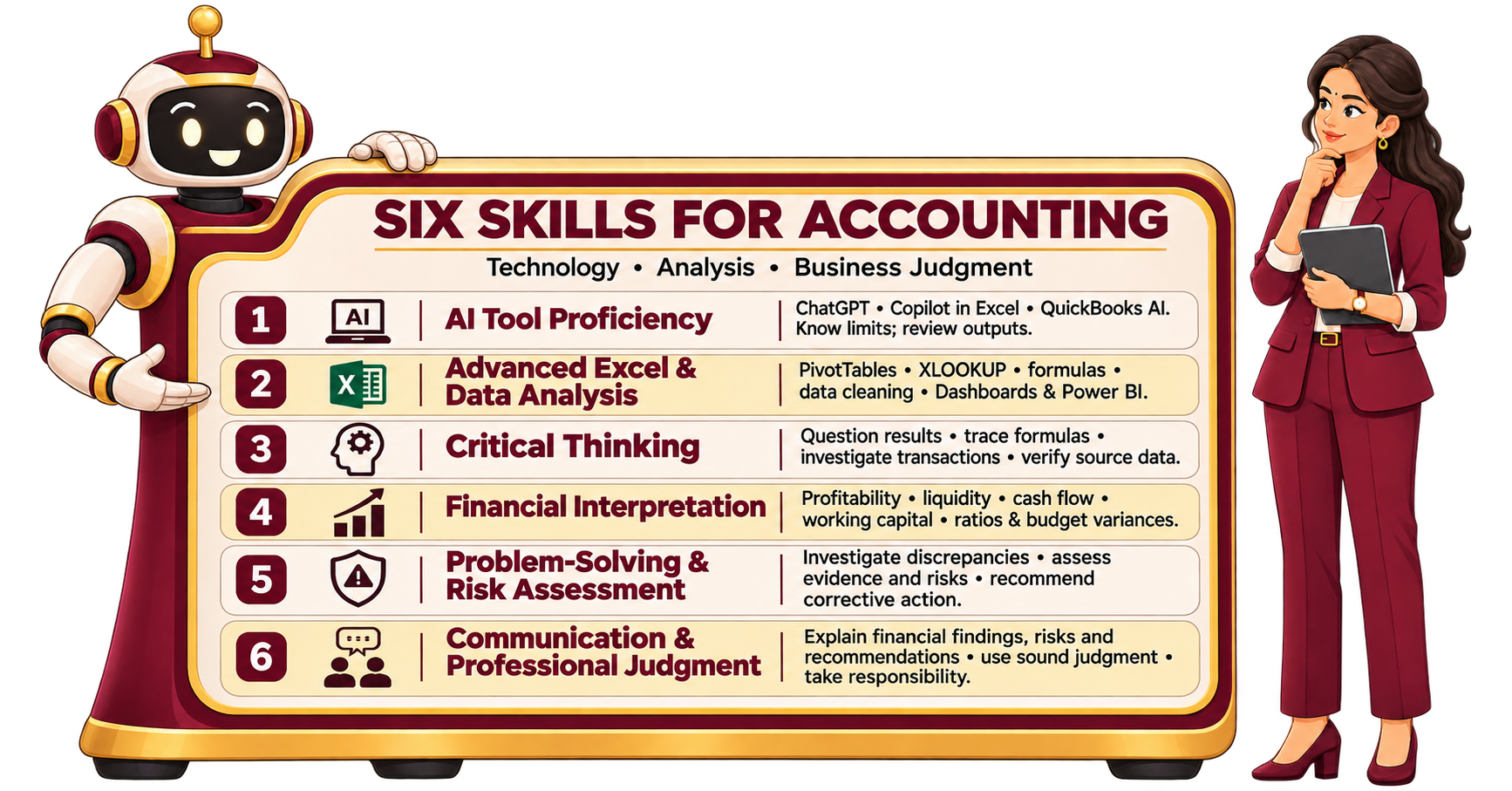
4. The Six Skills You Need to Develop
Now I understand what you can do. But what should I learn to work effectively with you?
Start with these six skills. They will help you move beyond routine accounting responsibilities.
1. AI Tool Proficiency
Learn how to use AI assistants and accounting software effectively.
Explore tools such as:
- ChatGPT: Drafting explanations, summarizing documents, and assisting with financial research.
- Microsoft Copilot in Excel: Formula generation, spreadsheet analysis, and identifying data trends.
- QuickBooks Accounting AI: Transaction processing, reconciliation assistance, and accounting insights.
Do not just learn where the buttons are. Understand what each tool can do, its limitations, and how to review its output.
2. Advanced Excel and Data Analysis
Excel remains an important tool for accounting professionals. Strengthen your knowledge of PivotTables, XLOOKUP, financial formulas, data cleaning, and dashboards.
You can also learn Power BI to present financial information through interactive reports and visualizations.
3. Critical Thinking
Learn to question results rather than accept them.
If I report a 20% increase in expenses, investigate the underlying transactions. If a calculation looks incorrect, trace the formula and verify the source data.
4. Financial Interpretation
Develop the ability to explain what financial information means.
Understand profitability, liquidity, cash flow, working capital, financial ratios, and budget variances. Businesses need professionals who can connect financial results with business performance.
5. Problem-Solving and Risk Assessment
Learn how to investigate discrepancies, identify potential risks, evaluate supporting evidence, and recommend appropriate corrective action.
6. Communication and Professional Judgment
You must be able to explain financial findings to management, clients, and other stakeholders. This includes communicating risks, supporting recommendations, and taking responsibility for professional decisions.
That's quite a shift. I need to understand accounting, technology, data, and business decisions.
Yes. The strongest combination is accounting knowledge supported by technology and analytical capabilities.
5. What Happens If You Do Not Adapt?
What if I continue using traditional accounting methods? Is that really going to affect my career?
Let me share something worth considering.
A 2026 study by the Institute of Chartered Accountants of Scotland (ICAS) found that 74% of surveyed accounting professionals said generative AI speeds up their work. At the same time, 72% expressed concerns about AI producing errors or incorrect decisions.
What does this tell you?
Accountants are already experiencing the benefits of AI, but they also recognize the need for human oversight.
Now, imagine two professionals with similar accounting qualifications.
- Professional A relies primarily on manual processes, traditional spreadsheets, and existing workflows.
- Professional B understands accounting, uses AI tools, analyses financial information, and verifies technology-generated outputs.
Professional B is better prepared to handle technology-enabled responsibilities.
This does not mean Professional A will automatically lose their job. However, refusing to develop relevant skills could limit their ability to compete for evolving roles.
As businesses continue adopting automation and AI towards 2027 and beyond, the expectations from accounting professionals will also change.
Your competition may not be AI. It may be another accountant who knows how to use AI better than you.
6. Your Practical Roadmap to Staying Relevant
All right. I don't want to wait until my responsibilities change completely. Where should I begin?
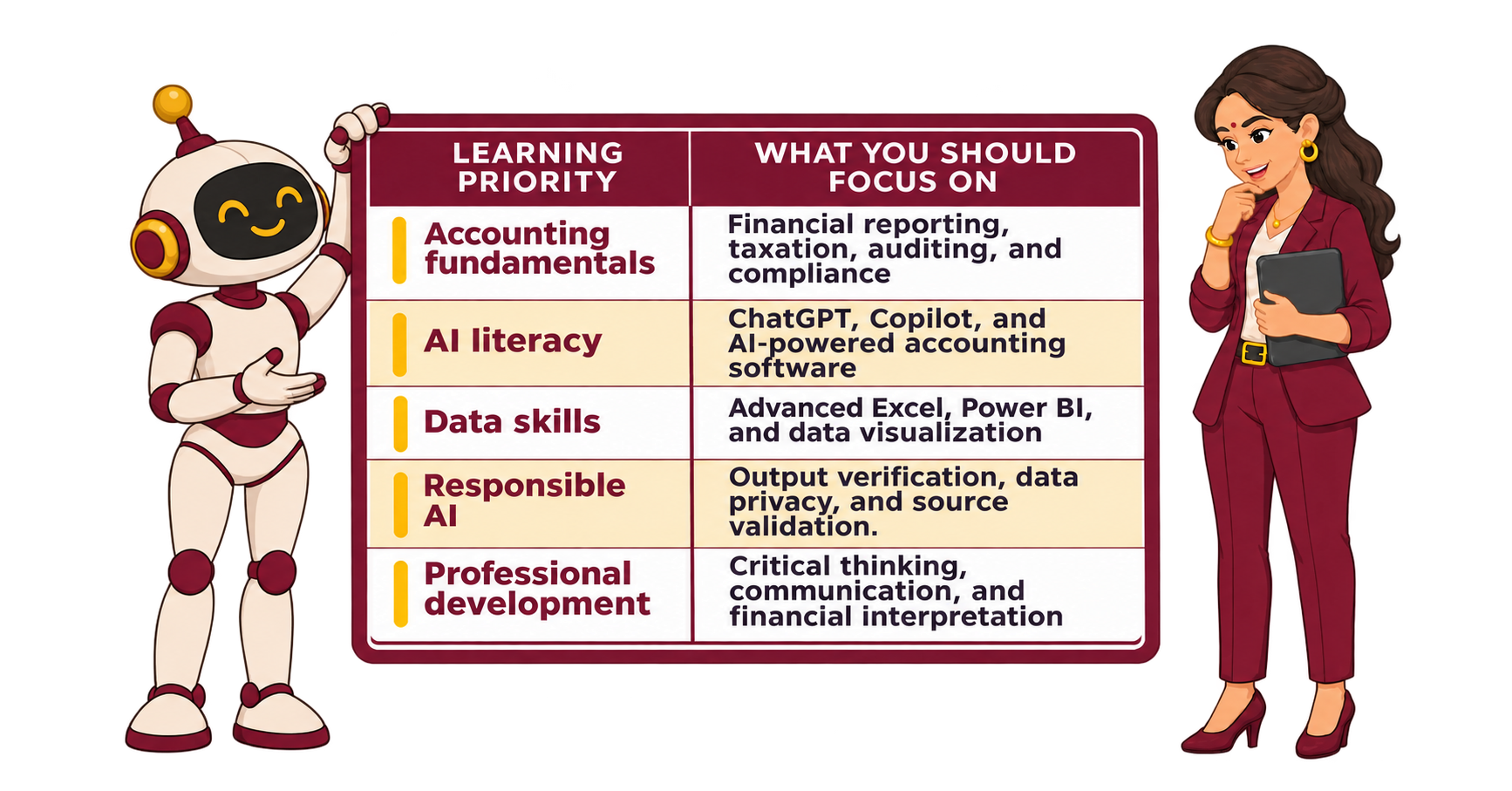
Start building your skills alongside your existing accounting knowledge.
Here is a practical roadmap.
You can also make your learning more practical.
Try these exercises:
- Take a sample expense dataset and use Copilot in Excel to identify significant variations.
- Use a dummy bank statement to practice reconciliation and investigate unmatched transactions.
- Ask an AI assistant to explain a financial ratio, then verify the calculation and interpretation yourself.
- Prepare a preliminary management report using sample financial statements and review every AI-generated figure and explanation.
These exercises will help you understand where AI saves time and where your expertise makes the difference.
Also, do not treat professional qualifications and technology skills as competing priorities. A recognized accounting or finance qualification can strengthen your technical foundation, while AI and data skills help you apply that knowledge in evolving work environments.
7. One Last Question: Will AI Replace Accountants?
We have discussed tools, tasks, skills, and career risks. But I still want a straightforward answer. Will AI replace accountants?
AI will automate more accounting activities, change existing workflows, and influence the skills employers expect from finance professionals. However, it does not eliminate the need for accounting knowledge, professional judgment, regulatory understanding, or accountability.
Think about it this way:
- I can help you process 500 transactions, but you must ensure they are correctly recorded.
- I can identify a financial variance, but you must understand why it occurred.
- I can prepare a preliminary report, but you must verify its accuracy before it reaches management.
- I can assist with research, but you must evaluate the evidence and take responsibility for your professional conclusions.
So, I shouldn't spend my career competing with technology. I should learn how to use it.
Exactly.
And remember, you do not need to become an AI engineer to remain relevant in accounting. You need to understand how technology applies to your work, develop the skills to use it responsibly, and continue strengthening your professional expertise.
The future accountant will not simply know how to work with numbers. They will know how to use technology to understand those numbers, question them, and turn them into better business decisions.
The question is no longer whether AI will enter your accounting career. It is whether you are preparing yourself to work effectively alongside it.
Frequently Asked Questions
1. Will AI replace accountants by 2027?
AI is expected to automate more repetitive accounting activities, including transaction processing, data entry, reconciliation support, and preliminary reporting. However, accounting judgment, compliance, financial interpretation, and business advisory responsibilities will continue to require human expertise. The extent of change will depend on technology adoption and the nature of each role.
2. Which accounting tasks can AI automate?
AI can assist with transaction categorization, invoice data extraction, bookkeeping workflows, bank transaction matching, expense analysis, and preliminary financial reporting. The level of automation depends on the software, data quality, configuration, and human approval requirements.
3. Which AI tools should accountants learn?
Accountants can explore ChatGPT for research and drafting assistance, Microsoft Copilot in Excel for spreadsheet analysis, and QuickBooks Accounting AI for accounting workflow automation. They should also develop skills in Excel and Power BI to strengthen their financial data analysis capabilities.
4. Can AI prepare financial statements without an accountant?
AI can assist with organizing financial data, preparing preliminary statements, generating supporting schedules, and identifying unusual balances. However, a qualified professional must verify the underlying records, accounting treatments, disclosures, and applicable reporting requirements before the statements are approved.
5. What skills will accountants need in the future?
Important skills include AI tool proficiency, advanced Excel, data analysis, Power BI, critical thinking, financial interpretation, problem-solving, communication, and professional judgment. Accountants will benefit from combining these capabilities with strong accounting fundamentals.
6. Is AI knowledge necessary for accounting students?
Yes. Accounting students should develop AI literacy alongside their academic and professional accounting knowledge. Learning how AI supports bookkeeping, financial analysis, reporting, and automation can help them prepare for changing workplace expectations.
7. Can AI make accounting and auditing decisions?
AI can assist with identifying anomalies, analysing financial information, reviewing documents, and highlighting potential risks. However, conclusions involving accounting treatment, audit evidence, compliance, and professional responsibility require appropriate human evaluation and oversight.
8. How can professional accounting certifications help in an AI-driven industry?
Professional accounting certifications help individuals develop specialised knowledge in areas such as financial reporting, auditing, taxation, management accounting, and business finance. Combining this knowledge with AI literacy, data analysis, and practical technology skills can help professionals prepare for evolving finance responsibilities.