
CPA Exam Passing Score: Understanding the CPA Scoring System
Understand the CPA exam passing score, how the CPA scoring system works, why 75 is a scaled score, and when exam scores are released. Complete guide for Indian CPA aspirants.
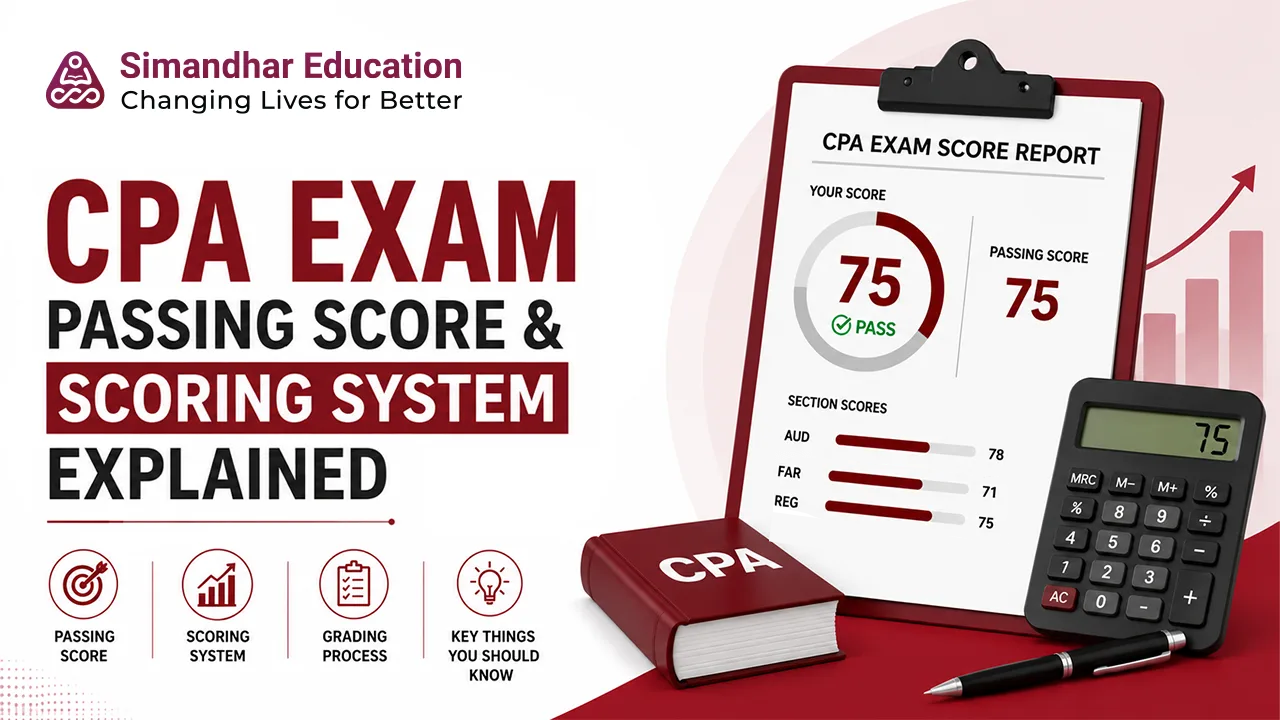
Table of Contents
- 1. What Is the CPA Exam Passing Score?
- 2. Does CPA Score 75 Mean 75 Percent?
- 3. How Does CPA Scoring Work?
- 3.1. Step 1: You Complete the Exam
- 3.2. Step 2: Your Responses Are Evaluated
- 3.3. Step 3: Raw Performance Is Converted into a Scaled Score
- 3.4. Step 4: Final Score Is Released
- 4. What Is a Scaled Score?
- 5. How Are Different Question Types Weighted?
- 6. Is the CPA Exam Curved?
- 7. Why Does the CPA Exam Use a Scaled Scoring System?
- 8. What Is the CPA Exam Score Release Process?
- 9. When Are CPA Exam Scores Released?
- 10. What Happens If You Score Below 75?
- 11. How Can You Improve Your CPA Score?
- 11.1. Follow a Study Schedule
- 11.2. Focus on Concepts Instead of Memorisation
- 11.3. Practice Task-Based Simulations
- 11.4. Analyse Your Practice Test Results
- 11.5. Revise Weak Areas
- 12. Common Myths About CPA Scoring
- 13. Why Understanding CPA Scoring Matters
- 14. How Simandhar Education Helps Students Prepare for the CPA Exam
- 15. Conclusion
- 16. Frequently Asked Questions
- 16.1. What is the CPA exam passing score?
- 16.2. Does a CPA score of 75 mean 75%?
- 16.3. How does CPA scoring work?
- 16.4. When are CPA exam scores released?
- 16.5. Can I retake a CPA exam section if I score below 75?
- 16.6. Is the CPA Exam graded on a curve?
If you're preparing for the US CPA Exam, one of the first questions you'll likely ask is, "What is the CPA exam passing score?"
The answer is simple.
The CPA exam passing score for every section of the US CPA Exam is 75. However, many candidates mistakenly assume that a score of 75 means they answered 75% of the questions correctly.
In reality, a score of 75 is a scaled score that reflects your overall performance after accounting for the difficulty of the exam questions rather than the percentage of correct answers.
Understanding the CPA scoring system helps you set realistic expectations, interpret your results correctly, and prepare more effectively for each exam section.
In this guide, you'll learn how CPA scoring works, why the passing score is 75, what a CPA score of 75 actually means, and when you can expect your CPA exam score release.
What Is the CPA Exam Passing Score?
The CPA exam passing score is 75 for every section of the Uniform CPA Examination.
Whether you're taking:
- Auditing and Attestation (AUD)
- Financial Accounting and Reporting (FAR)
- Regulation (REG)
- One Discipline section (BAR, ISC, or TCP)
you must earn a scaled score of at least 75 to pass that section.
Every section is scored independently. Passing one section does not affect the scoring of another.
| CPA Exam Section | Passing Score |
|---|---|
| AUD | 75 |
| FAR | 75 |
| REG | 75 |
| Discipline (BAR/ISC/TCP) | 75 |
Once you pass all four required sections within the allowed time frame, you become eligible for CPA licensure after meeting your state board's remaining requirements.
Does CPA Score 75 Mean 75 Percent?
No.
This is one of the biggest misconceptions among CPA candidates.
A CPA score 75 is not the same as scoring 75% marks.
Instead, the CPA Exam uses a scaled scoring system.
That means your score is adjusted based on the overall difficulty of the questions you receive. Different versions of the exam may contain questions of varying difficulty, but the scoring process ensures fairness for every candidate.
For example:
- Candidate A may answer fewer difficult questions correctly.
- Candidate B may answer more easier questions correctly.
Even though their raw performances differ, both candidates could receive similar scaled scores because the scoring system accounts for question difficulty.
The purpose of scaled scoring is to maintain consistency across every exam version.
How Does CPA Scoring Work?
The CPA scoring process is designed to measure whether a candidate has demonstrated the knowledge and skills expected of a newly licensed Certified Public Accountant.
Instead of counting only the number of correct answers, the exam evaluates overall performance using a standardized scoring methodology.
The scoring process generally follows these steps:
Step 1: You Complete the Exam
Candidates answer a combination of:
- Multiple-Choice Questions (MCQs)
- Task-Based Simulations (TBSs)
Some sections may also include discipline-specific content depending on the exam chosen.
Step 2: Your Responses Are Evaluated
Each response is reviewed through the CPA Exam scoring system.
Operational questions contribute to your final score, while pretest questions are used for future exam development and do not affect your score.
Candidates are not informed which questions are pretest items.
Step 3: Raw Performance Is Converted into a Scaled Score
Your raw performance is converted into a standardized scaled score ranging from 0 to 99.
This ensures that all candidates are evaluated consistently, regardless of which exam version they receive.
Step 4: Final Score Is Released
After quality checks and score verification, your official result becomes available during the scheduled CPA exam score release.
What Is a Scaled Score?
A scaled score is a standardized score rather than a direct percentage.
Instead of measuring only how many questions you answered correctly, it reflects your overall level of performance after statistical adjustments.
A scaled score helps ensure fairness because:
- Different candidates receive different exam versions.
- Some exam versions may be slightly more difficult.
- Every candidate is evaluated using the same performance standard.
This means two candidates who answer different numbers of questions correctly could still receive similar scaled scores.
The important takeaway is simple:
Your goal is not to achieve 75%—your goal is to achieve a scaled score of 75 or higher.
How Are Different Question Types Weighted?
The CPA Exam includes multiple assessment formats to evaluate both technical knowledge and practical application.
Generally, the exam consists of:
| Question Type | Purpose |
|---|---|
| Multiple-Choice Questions (MCQs) | Test accounting concepts and theoretical understanding |
| Task-Based Simulations (TBSs) | Evaluate real-world accounting and problem-solving skills |
Task-Based Simulations often require candidates to analyze financial information, prepare journal entries, complete research tasks, or solve practical business scenarios.
Because the CPA profession requires practical decision-making, simulations play an important role in measuring candidate competency.
Rather than memorizing answers, candidates should focus on understanding accounting concepts and applying them in different situations.
Is the CPA Exam Curved?
No.
The CPA Exam is not graded on a curve.
Your performance is not compared with other candidates taking the exam.
Instead, your score is measured against a fixed performance standard established by the exam administrators.
This means:
- Another candidate's score cannot reduce your score.
- There is no quota for passing candidates.
- Every candidate has an equal opportunity to pass.
If everyone taking the exam demonstrates the required competency level, everyone can pass.
Similarly, if candidates do not meet the required standard, they may not achieve the CPA exam passing score.
Why Does the CPA Exam Use a Scaled Scoring System?
The CPA Exam is administered throughout the year across multiple testing windows and locations.
Since every candidate does not receive the exact same questions, using a simple percentage-based scoring system would not be fair.
A scaled scoring system helps:
- Maintain consistency across exam versions
- Ensure fairness for all candidates
- Measure professional competency accurately
- Keep passing standards uniform over time
This standardized approach helps employers, licensing boards, and candidates trust that every CPA has met the same professional benchmark, regardless of when or where they took the exam.
What Is the CPA Exam Score Release Process?
After completing a CPA Exam section, your responses go through multiple stages before your official score is published.
The CPA exam score release process is managed by the American Institute of Certified Public Accountants (AICPA) in collaboration with the National Association of State Boards of Accountancy (NASBA) and individual state boards.
Generally, the process includes:
- Your exam responses are collected after you complete the test.
- Operational questions are scored, while pretest questions are excluded from your final score.
- Quality assurance checks are performed to ensure scoring accuracy.
- Your official scaled score is released through your NASBA Candidate Portal or your state board's portal, depending on your jurisdiction.
Although many candidates expect instant results, CPA Exam scores are released only after these verification processes are completed.
When Are CPA Exam Scores Released?
The CPA exam score release depends on when you take your exam and how quickly your testing data is processed.
In most cases, candidates receive their scores within a few weeks after completing an exam section.
The AICPA and NASBA publish an official score release schedule each year, allowing candidates to estimate when their results will become available.
Because release dates may change from year to year, candidates should regularly check the official schedule before planning their next exam section.
Knowing the expected score release date can help you decide whether to begin preparing for another section or wait for your results before scheduling your next exam.
What Happens If You Score Below 75?
Scoring below the CPA exam passing score simply means that the particular exam section has not been passed.
It does not affect any sections you have already passed.
If your score is below 75:
- You can retake the same exam section.
- Previously passed sections remain valid according to your applicable credit validity period.
- You only need to prepare again for the section you did not pass.
Many successful CPAs have passed after one or more retakes.
Instead of viewing a failed attempt as the end of the journey, candidates should use their score report to identify weaker areas and improve their preparation strategy.
How Can You Improve Your CPA Score?
Achieving a CPA score 75 requires more than simply studying for long hours.
A structured preparation plan can significantly improve your chances of passing on the first attempt.
Here are some practical strategies:
Follow a Study Schedule
Create a realistic weekly study plan and stay consistent throughout your preparation.
Studying regularly is generally more effective than last-minute preparation.
Focus on Concepts Instead of Memorisation
The CPA Exam evaluates your understanding of accounting principles and your ability to apply them in practical situations.
Understanding why accounting rules exist is often more valuable than memorising formulas.
Practice Task-Based Simulations
Many candidates spend most of their time solving Multiple-Choice Questions while neglecting Task-Based Simulations.
Since simulations assess practical accounting skills, practising them regularly can improve overall performance.
Analyse Your Practice Test Results
Rather than simply checking your score, review every incorrect answer.
Understanding your mistakes helps you avoid repeating them in the actual exam.
Revise Weak Areas
Allocate additional study time to topics where your mock test performance is consistently low.
Improving weaker subjects often has a greater impact than repeatedly studying topics you already know well.
Common Myths About CPA Scoring
Many CPA candidates misunderstand how the scoring system works.
Let's clear up some common myths.
| Myth | Reality |
|---|---|
| You need 75% marks to pass. | No. You need a scaled score of 75. |
| The exam is graded on a curve. | No. Candidates are measured against a fixed passing standard. |
| Harder questions guarantee a higher score. | No. Overall performance determines the final scaled score. |
| Failing one section means starting over. | No. You only retake the section you failed, subject to applicable credit rules. |
| Everyone receives the same exam questions. | No. Different candidates receive different exam versions, which is why scaled scoring is used. |
Understanding these facts helps candidates prepare with realistic expectations and reduces unnecessary exam anxiety.
Why Understanding CPA Scoring Matters
Many students focus only on passing the exam.
However, understanding CPA scoring can actually improve your preparation.
When you know that:
- the exam uses scaled scores,
- practical application is important,
- simulations carry significant weight, and
- consistency matters more than memorisation,
you can build a study plan that aligns with how the CPA Exam is actually evaluated.
This approach often leads to greater confidence on exam day and helps candidates perform more effectively.
How Simandhar Education Helps Students Prepare for the CPA Exam
Preparing for the CPA Exam requires more than just mastering accounting concepts—it demands the right guidance, proven learning resources, and continuous support. At Simandhar Education, students receive end-to-end assistance, from eligibility evaluation and state board selection to exam registration, study planning, and licensing support.
As India's exclusive Becker Professional Education partner, Simandhar provides access to Becker's globally trusted CPA learning platform, helping students prepare with industry-leading study material and exam-focused practice. The institute has also created history by producing 6 Elijah Watt Sells Award winners (CPA World Toppers)—the highest number by any CPA institute in India—reflecting its commitment to academic excellence.
Students also benefit from AI Sripal, an AI-powered learning assistant that provides 24/7 doubt resolution and personalized support throughout their CPA journey. Beyond exam preparation, Simandhar offers career guidance, placement assistance, and access to a strong network of 250+ corporate partners, helping learners explore opportunities with Big 4 firms, Fortune 500 companies, and leading global organizations.
Over the years, Simandhar Education has transformed the careers of thousands of finance professionals through structured mentorship, expert faculty, and inspiring student success stories. Whether your goal is to earn the CPA exam passing score on your first attempt or build a successful global accounting career, Simandhar provides the academic support, technology, and career ecosystem to help you achieve it.
Conclusion
The CPA exam passing score is 75, but that number represents a scaled score rather than a percentage.
The CPA Exam uses a standardized scoring system to ensure fairness across different exam versions, allowing every candidate to be evaluated against the same professional standard.
Understanding how CPA scoring works, what a CPA score 75 actually means, and when the CPA exam score release takes place can help you prepare more confidently and avoid common misconceptions.
With consistent preparation, regular practice, and a strong understanding of accounting concepts, earning a passing score is an achievable goal for dedicated candidates.
Frequently Asked Questions
Q1. What is the CPA exam passing score?
The CPA exam passing score is 75 for each section of the Uniform CPA Examination. Candidates must achieve a scaled score of at least 75 to pass an individual exam section.
Q2. Does a CPA score of 75 mean 75%?
No. A CPA score 75 is a scaled score, not a percentage of correct answers. It represents the minimum performance standard required to pass the exam.
Q3. How does CPA scoring work?
CPA scoring converts a candidate's exam performance into a standardized scaled score. The scoring process considers the exam's statistical design to ensure fairness across different exam versions.
Q4. When are CPA exam scores released?
The CPA exam score release typically occurs a few weeks after candidates complete an exam section. Official release dates are published annually by the AICPA and NASBA.
Q5. Can I retake a CPA exam section if I score below 75?
Yes. Candidates who score below the passing score can retake that specific exam section. Previously passed sections remain valid according to the applicable credit validity rules.
Q6. Is the CPA Exam graded on a curve?
No. The CPA Exam is not graded on a curve. Every candidate is evaluated against the same fixed performance standard rather than competing against other test takers.
Planning to take CPA? Explore our CPA course