
What Is the CPA Exam Pattern?
Wed Jul 01 2026
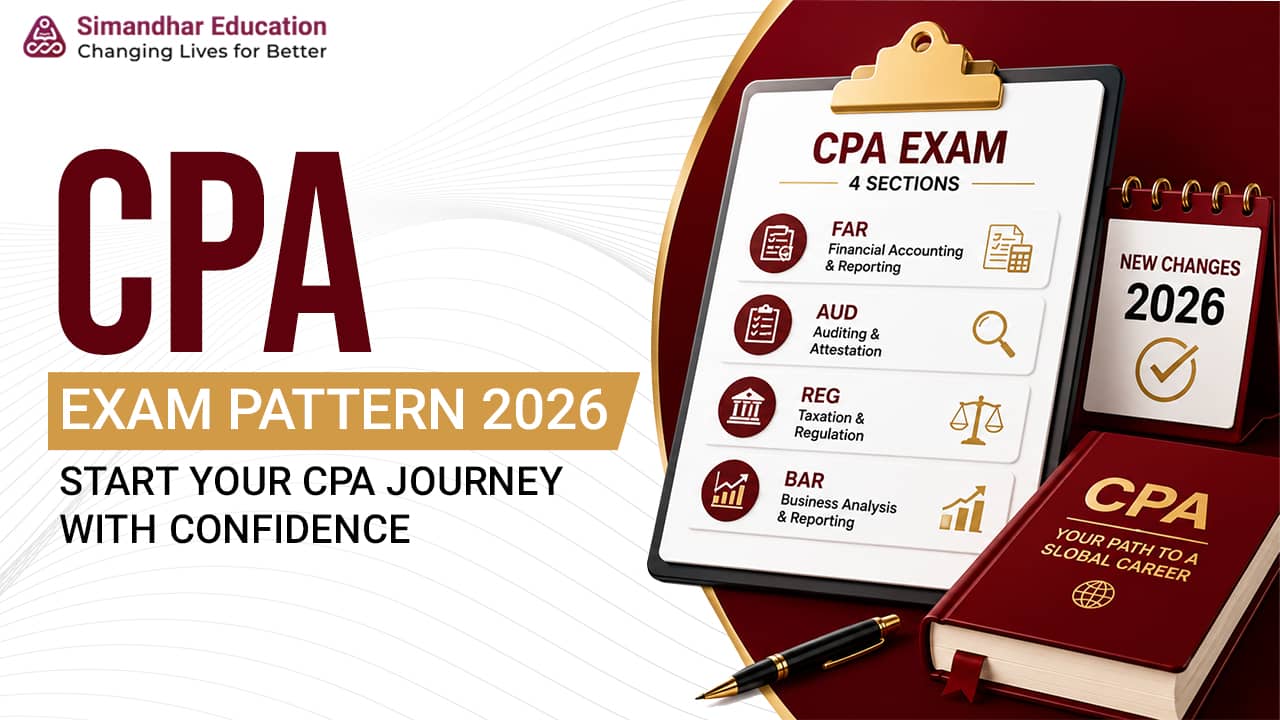
Table of Contents
The US CPA examination follows a modern structure that prepares candidates for today's accounting and finance profession. Every candidate must complete a combination of core accounting subjects and one specialized discipline to earn the CPA credential. The exam is designed to assess both technical knowledge and the ability to apply concepts in real business situations.
The CPA exam pattern follows the CPA Evolution model introduced by the AICPA. Candidates must pass four exam sections—three mandatory Core sections (Auditing and Attestation (AUD), Financial Accounting and Reporting (FAR), and Regulation (REG)) and one Discipline section chosen from Business Analysis and Reporting (BAR), Information Systems and Controls (ISC), or Tax Compliance and Planning (TCP). Each exam is four hours long and includes Multiple-Choice Questions (MCQs) and Task-Based Simulations (TBS). Candidates must score 75 or above on each section to pass.
Why Was the CPA Exam Pattern Changed?
The accounting profession has evolved significantly with advancements in technology, automation, artificial intelligence, and data analytics. Modern CPAs are expected to possess not only technical accounting expertise but also skills in business analysis, technology, and strategic decision-making.
To meet these changing industry requirements, the AICPA introduced the CPA Evolution model. The updated structure ensures that every CPA develops a strong foundation in accounting while allowing candidates to specialize in an area that aligns with their career goals.
This revised CPA exam structure better reflects the responsibilities of today's accounting and finance professionals.
Understanding the CPA Evolution Model
The CPA Evolution model follows a Core + Discipline approach.
Every candidate studies the same Core accounting subjects and then selects one specialized Discipline.
Core Sections (Mandatory)
Every CPA candidate must pass:
- Auditing and Attestation (AUD)
- Financial Accounting and Reporting (FAR)
- Regulation (REG)
These subjects build the essential technical knowledge expected from every licensed CPA.
Discipline Sections (Choose One)
Candidates select one of the following:
- Business Analysis and Reporting (BAR)
- Information Systems and Controls (ISC)
- Tax Compliance and Planning (TCP)
The Discipline section allows candidates to gain deeper knowledge in their preferred career area without affecting the CPA license they ultimately earn.
CPA Exam Sections Explained
1. Auditing and Attestation (AUD)
AUD focuses on auditing principles and professional responsibilities.
Major topics include:
- Ethics and professional responsibilities
- Risk assessment
- Internal controls
- Audit procedures
- Audit evidence
- Audit reporting
Candidates learn how auditors evaluate financial statements and maintain professional standards.
2. Financial Accounting and Reporting (FAR)
FAR is considered one of the most comprehensive sections of the CPA exam.
Topics include:
- Financial statements
- US GAAP
- Government accounting
- Not-for-profit accounting
- Financial reporting
- Transactions and reporting standards
Strong conceptual understanding is essential for success in FAR.
3. Regulation (REG)
REG focuses on taxation, ethics, and business law.
Topics include:
- Federal taxation
- Individual taxation
- Business taxation
- Ethics
- Professional responsibilities
- Business law
This section is particularly useful for candidates interested in taxation and advisory services.
4. Discipline Sections
After completing the Core sections, candidates choose one specialization.
Business Analysis and Reporting (BAR)
BAR is suitable for candidates interested in:
- Financial analysis
- Advanced reporting
- Business performance
- Data interpretation
- Strategic finance
Information Systems and Controls (ISC)
ISC focuses on technology and information systems.
Major topics include:
- IT governance
- Cybersecurity
- System controls
- Data management
- Information security
This Discipline is ideal for candidates interested in accounting technology and digital transformation.
Tax Compliance and Planning (TCP)
TCP is designed for candidates pursuing careers in taxation.
Topics include:
- Individual taxation
- Entity taxation
- Tax planning
- Tax research
- Compliance strategies
Candidates planning careers in tax consulting often choose this specialization.
What Is the CPA Exam Format?
The updated CPA exam sections are designed to evaluate both conceptual understanding and practical application.
Each exam includes:
Multiple-Choice Questions (MCQs)
MCQs assess:
- Accounting concepts
- Professional standards
- Business knowledge
- Analytical thinking
Task-Based Simulations (TBS)
Task-Based Simulations evaluate your ability to apply accounting knowledge in practical business situations.
These simulations may require candidates to:
- Analyse financial information
- Prepare accounting entries
- Review documents
- Complete spreadsheets
- Solve business scenarios
The emphasis on application makes the CPA Examination more practical than theory based.
CPA Exam Duration
Each CPA exam section has a duration of four hours.
Candidates should manage their time carefully between:
- Reading questions
- Solving MCQs
- Completing Task-Based Simulations
- Reviewing answers
Developing strong time-management skills through regular mock exams can significantly improve performance on exam day.
How Is the CPA Exam Scored?
One of the most common questions among candidates is how the CPA exam is evaluated.
Each section of the CPA exam is scored on a scale of 0 to 99, and candidates must achieve a minimum score of 75 to pass. A score of 75 does not mean you answered 75% of the questions correctly. Instead, it represents the level of knowledge and skills required to demonstrate competency.
The exam uses a combination of question types to assess both conceptual understanding and practical application.
Question Types Included
- Multiple-Choice Questions (MCQs)
- Task-Based Simulations (TBS)
The weightage of these questions varies slightly across different exam sections, but both are important for achieving a passing score.
Can You Take the CPA Exam in Any Order?
Yes.
One of the biggest advantages of the CPA Evolution model is its flexibility.
Candidates can choose the order in which they attempt the exam sections based on their strengths and career goals.
Many students begin with FAR because it provides a strong accounting foundation, while others start with REG or AUD depending on their background.
A common preparation sequence is:
- FAR
- AUD
- REG
- BAR / ISC / TCP
However, there is no mandatory order.
Which Discipline Should You Choose?
Choosing the right Discipline depends on your career aspirations.
| Discipline | Best For | Career Path |
|---|---|---|
| BAR | Candidates interested in financial reporting and business analysis | Financial Analyst, FP&A, Corporate Finance |
| ISC | Candidates interested in technology and information systems | IT Audit, Risk Advisory, Information Systems |
| TCP | Candidates interested in taxation | Tax Consultant, Tax Advisor, Public Accounting |
Remember, your CPA license remains the same regardless of the Discipline you choose.
CPA Exam Preparation Tips
Understanding the CPA exam pattern is only the first step. Success depends on following a structured preparation strategy.
Create a Study Schedule
Plan weekly study goals and allocate sufficient time for each exam section.
Focus on Concept Clarity
Instead of memorizing answers, understand the concepts behind accounting standards, auditing procedures, and taxation rules.
Practice MCQs Daily
Regular Multiple-Choice Question practice helps improve:
- Accuracy
- Speed
- Confidence
- Time management
Spend Time on Task-Based Simulations
Task-Based Simulations test your ability to apply concepts in practical business situations.
Include TBS practice from the beginning of your preparation.
Attempt Full-Length Mock Exams
Mock examinations help you:
- Experience the actual exam format
- Improve time management
- Identify weak topics
- Build exam confidence
Revise Consistently
Weekly revision improves retention and reduces last-minute stress before the examination.
Common Mistakes CPA Candidates Should Avoid
Many candidates delay their success because of avoidable mistakes.
Some common ones include:
- Ignoring the latest CPA Evolution changes
- Studying from outdated materials
- Skipping Task-Based Simulations
- Practising very few MCQs
- Not following a study plan
- Avoiding mock exams
- Depending only on theory
Avoiding these mistakes can significantly improve your chances of passing all four sections.
Why Choose Simandhar Education for CPA Preparation?
Choosing the right learning partner is just as important as understanding the exam pattern.
Simandhar Education offers a structured learning experience designed to help students prepare confidently for the US CPA examination.
Learn with Becker's Industry-Leading CPA Resources
Students preparing through Simandhar Education receive access to Becker's comprehensive learning platform, which includes:
- Comprehensive CPA study material
- Printed and digital textbooks
- Concept lecture videos
- SkillBuilder videos
- 8,100+ Multiple Choice Questions (MCQs)
- 530+ Task-Based Simulations (TBS)
- 300+ Written Communication and practice exercises
- Simulated exams
- Digital flashcards
- Personalized Study Planner
- Adapt2U adaptive learning technology
- AI-powered AI Sripal academic assistance
- Academic support from experienced instructors
These resources are designed to simplify complex concepts, improve exam readiness, and help students prepare efficiently for every CPA exam section.
Why Thousands of Students Choose Simandhar Education
Students benefit from:
- 50,000+ learners trained
- 500+ hiring partners
- Dedicated placement assistance
- Expert CPA faculty
- Live online classes
- Recorded lectures
- Structured study plans
- Regular revision sessions
- Mock examinations
- Career guidance
- Student success support
As India's Official Becker Partner, Simandhar Education combines globally recognized learning resources with personalized mentorship to help students prepare confidently for the CPA examination.
Visit: US CPA Course | Global Accounting Jobs | Earn up to ₹50 LPA
Frequently Asked Questions
1. How many sections are there in the CPA exam?
The CPA exam consists of four sections—three mandatory Core sections (AUD, FAR, and REG) and one Discipline section (BAR, ISC, or TCP).
2. What is the duration of each CPA exam?
Each CPA exam section is four hours long.
3. What is the passing score?
Candidates must score 75 or above in each section to pass.
4. Can I choose any Discipline?
Yes. Candidates can choose BAR, ISC, or TCP based on their career interests.
5. Is the CPA Evolution model applicable to all candidates?
Yes. The CPA Evolution Model is the current exam structure for all CPA candidates.
6. Are Task-Based Simulations important?
Yes. TBS questions assess your ability to apply accounting concepts in practical business scenarios and are an important part of every exam section.
Conclusion
Understanding the CPA exam pattern is the first step toward building a successful career as a Certified Public Accountant. The CPA Evolution Model combines a strong accounting foundation with specialized knowledge, ensuring candidates develop the practical skills required by today's finance industry.
By understanding the CPA Exam Structure, choosing the right Discipline, practising consistently, and preparing with quality study resources, you can confidently work toward passing all four sections and earning the prestigious US CPA credential.
Watch testimonial videos: Alumni Video Stories | Global Careers | Simandhar Education

Renuka is an MBA (Finance) graduate and content writer specializing in professional courses and career-focused content. She creates clear, easy-to-understand, and SEO-friendly blogs that simplify complex topics and help students and professionals make informed career decisions.