
EA Exam Preparation: Toppers’ Study Plans & Tips
Discover EA exam preparation strategies, toppers’ study plans, daily timetables, revision tips, mock tests, and practical advice to prepare for the Enrolled Agent exam.
Table of Contents
- 1. How to Study for the Enrolled Agent Exam: Toppers Share Their Study Plans, Experiences, and Tips
- 2. Understand What the EA Exam Really Tests
- 3. Understand What the EA Exam Really Tests
- 4. Which Part Should You Start With?
- 5. My Five-Step Study Strategy
- 5.1. Step 1: Attend the lecture, take notes, then close your eyes and recall
- 5.2. Step 2: Read the textbook for the finer details
- 5.3. Step 3: Practice MCQs and study the explanations
- 5.4. Step 4: Revise cumulatively
- 5.5. Step 5: Take full-length mock tests and act on the score
- 6. My Daily Routine: Protect Your Mornings
- 7. Consistency Beats Cramming
- 8. How Many Hours Should You Study for the EA Exam?
- 8.1. Sample 30-Day Plan (per part, for candidates with strong prior knowledge)
- 8.2. Sample 60-Day Plan (per part)
- 8.3. Sample 90-Day Plan (per part, ideal for beginners)
- 9. Final Thoughts
How to Study for the Enrolled Agent Exam: Toppers Share Their Study Plans, Experiences, and Tips
Every year, thousands of candidates begin their EA exam preparation with the same questions. How many hours should I study? Which part should I take first? Is it enough to read the textbook once? I cleared all three parts of the IRS Enrolled Agent (EA) exam in my first attempt, with no prior tax experience.
Understand What the EA Exam Really Tests
In this article, I share the exact strategy that worked for me, along with practical tips you can adapt to build your own Enrolled Agent exam study plan.
Understand What the EA Exam Really Tests
The EA exam, officially the Special Enrollment Examination (SEE), has three parts, and each part has its own personality. But all three test the same three skills:
- Memory: Can you recall the rules, limits, forms, and deadlines?
- Application: Can you apply a rule to a fact pattern you have never seen?
- Analysis: Can you compare options and pick the correct treatment?
This is the most important point in any EA exam preparation strategy: you cannot pass by rote-learning forms and rules. The multiple-choice questions are built around situations. If you only memorize, a slightly reworded question will catch you out. If you understand the logic behind the rule, you can solve questions you have never practiced.

Which Part Should You Start With?
I had no prior tax experience, so I began with Part 3: Representation, Practices and Procedures. I would suggest this to many beginners, for two reasons.
- The syllabus is smaller. Finishing one part early gives you confidence and momentum.
- It builds a different mindset. Part 3 covers the rights and responsibilities of tax preparers and taxpayers, representation before the IRS, and the penalties for violating the rules of Circular 230. It is largely theoretical, but the questions still test how you apply the rules to real situations.
After Part 3, I moved on to Part 1 and Part 2. Freshers can comfortably start with either Part 1 or Part 3.
Part 1 (Individuals) lays the foundation for everything else. You need to be clear on the flow from gross income to adjustments, adjusted gross income (AGI), standard or itemized deductions, qualified business income (QBI) deduction, credits, and finally taxable income. If you can explain this flow in your own words, you are ready for the rest.
Part 2 (Businesses) builds on that foundation with business taxation. Because Part 1 gives you the basics, Part 2 feels like an extension rather than a brand-new subject.
My Five-Step Study Strategy
I used the same process for all three parts. It is simple, but it works because it repeats and reinforces learning in layers.
Step 1: Attend the lecture, take notes, then close your eyes and recall
I attended each lecture and made short notes. When the lecture ended, I closed my eyes and tried to recall what I had just learned, without looking at anything. This feels uncomfortable at first, because you realize how much you did not retain. That is exactly the point. Active recall tells your brain that this information matters, and it stays with you far longer than passive listening.
Step 2: Read the textbook for the finer details
Lectures give you a big picture. The textbook gives you the nuances: the exceptions, thresholds and conditions that exam questions love to test. I read the relevant chapter after the lecture, when the concepts were already familiar, so the reading was faster and far more meaningful.
Step 3: Practice MCQs and study the explanations
Once I was comfortable with a chapter, I tested myself with practice questions. Here is the habit that made the biggest difference: I read the explanation for every question, whether I got it right or wrong. If I got it wrong, I understood why my reasoning failed. If I got it right, I checked that I had reached the answer for the right reason and not by luck. Reviewing explanations carefully is how you avoid repeating the same mistake during revision.
Step 4: Revise cumulatively
I did not revise only the chapter I had just finished. If I had completed three chapters, I would refresh all three. When I finished fourth, I went back over all four. This takes more time, but it is one of the most effective EA exam revision strategies I know. Tax topics are connected, and revisiting earlier chapters helps you understand new concepts better while keeping the old ones fresh.
Step 5: Take full-length mock tests and act on the score
After completing every chapter in a part, I attempted mock tests covering the whole syllabus. I used the score as a guide:
- 70% or above: Identify the specific topics where you lost marks and strengthen those gaps.
- Below 50%: Go back and refresh all the chapters again for about a week before attempting another mock test.
Mock tests are not just for measuring readiness. They train you to handle the pressure and pace of the actual exam, and they show you where your understanding is weak.
My Daily Routine: Protect Your Mornings
My day starts with one hour of refreshing what I studied the day before. I do not check my phone or scroll social media first thing in the morning, no matter what.
The reason is simple. Scrolling gives you quick, easy dopamine, and once your brain gets used to that, it resists doing harder things like studying tax law. Right after waking up, your brain is well rested and ready to absorb information, so that is the best time to revise. By the time I picked up my phone, I had already done the most valuable work of the day.
You do not have to copy my exact schedule. But the principle holds for everyone: give your best mental energy to your hardest study task, and keep distractions away from the start of your day.
Consistency Beats Cramming
If there is one lesson I would highlight above all others, it is this: consistency matters more than any single day of heavy study. A few focused hours every day, with regular repetition, will take you much further than a weekend of ten-hour marathons followed by a week of nothing.
Repetition is what moves information from short-term to long-term memory. Every time you revise a topic, practice a question on it, or recall it from scratch, you strengthen it. The goal is to reach a point where you feel confident that you can solve any new question the exam throws at you, not just the ones you have already seen.
How Many Hours Should You Study for the EA Exam?
There is no single answer, because it depends on your background, your available time and how quickly you absorb new material. Instead of chasing a number, focus on a daily routine you can maintain for weeks without burning out. Many candidates plan around one part at a time, which keeps the syllabus manageable and gives you a clear target to work toward.
Below is a sample framework you can adapt. It follows the same five steps described above.
Sample 30-Day Plan (per part, for candidates with strong prior knowledge)
| Days | Study plan |
|---|---|
| Days 1-18 | Lectures, notes and textbook reading, followed by chapter-wise MCQs |
| Days 19-25 | Cumulative revision and topic-wise practice tests |
| Days 26-30 | Full-length mock tests and gap-filling |
Sample 60-Day Plan (per part)
| Days | Study plan |
|---|---|
| Days 1-35 | Lectures, notes, textbooks, and chapter-wise MCQs, with cumulative revision at the end of each week. |
| Days 36-50 | Complete syllabus revision and mixed practice questions |
| Days 51-60 | Mock tests, gap analysis, and final revision |
Sample 90-Day Plan (per part, ideal for beginners)
| Days | Study plan |
|---|---|
| Days 1-50 | Learn each chapter thoroughly using the five steps, with regular cumulative revision |
| Days 51-75 | Practice questions across the full syllabus, focusing on topics where you make mistakes. |
| Days 76-90 | Mock tests, a week of targeted revision if scores are low, and a calm final review |
Use these as starting points, not strict rules. If a mock test shows weak areas, give yourself more time. It is always better to adjust the plan than to sit the exam before you are ready.
Final Thoughts
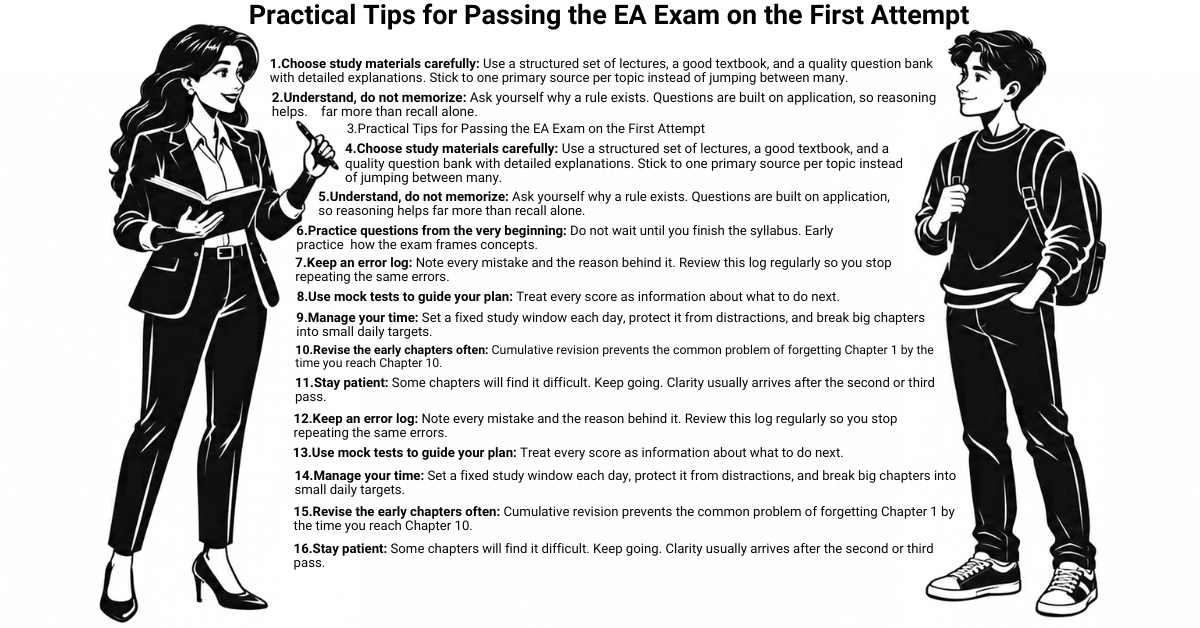
Passing all three parts of the EA exam in the first attempt did not come from a secret trick. It came from a clear process: learn actively, read for nuance, practice with explanations, revise cumulatively, test with mocks, and repeat consistently. If you follow a process like this and give it enough time, you can build the confidence to solve any question the exam presents.
The EA credential opens doors in tax practice, tax consulting, and tax technology. The preparation takes effort, but it is very achievable with the right approach. Start with the part that suits you, build your routine, and trust the process.
Best of luck with your preparation!
Planning to take EA? Explore our EA course