
What Recruiters Search for on LinkedIn: EA Edition
Learn what recruiters search for on LinkedIn when hiring Enrolled Agents. Get EA keywords, headline tips and profile fixes for US tax jobs in India.
Table of Contents
- 1. Why your EA LinkedIn Profile Needs its Own Strategy
- 2. How Recruiters Search LinkedIn
- 3. Enrolled Agent Recruiter Keywords that Matter
- 3.1. Credential and role keywords
- 3.2. Technical keywords
- 3.3. Tools and process keywords
- 4. Where to Put those Keywords
- 4.1. Headline
- 4.2. About Section
- 4.3. Experience
- 4.4. Skills
- 4.5. Licenses and certifications
- 5. LinkedIn Profile for EA Freshers and Tax Freshers
- 6. US Taxation Jobs in India: Who's Hiring and What They Read
- 7. Five Habits that Get you Noticed by Recruiters
- 8. Final thought
- 9. Frequently Asked Questions
- 9.1. What do recruiters search for on LinkedIn when hiring EA candidates?
- 9.2. What keywords should an Enrolled Agent use on LinkedIn?
- 9.3. How should an EA optimize their LinkedIn profile?
- 9.4. What are the best LinkedIn keywords for US tax professionals?
- 9.5. Can I call myself an Enrolled Agent after passing one SEE part?
- 9.6. How often should I update my profile for Enrolled Agent career opportunities ?
- 9.7. Is LinkedIn profile optimization for finance professionals different from other fields?
You cleared a tough IRS exam, or you're halfway through one. Then a recruiter searches LinkedIn for someone like you, and your profile never shows up. It happens a lot. Recruiters search by keyword, and most EA profiles don't use the words they type.
This guide covers how to build an EA LinkedIn profile that gets found, whether you're a fresher or already working in US tax.
Why your EA LinkedIn Profile Needs its Own Strategy
The Enrolled Agent credential is rare. IRS data as of 1 September 2026 shows 71,966 enrolled agents against 886,338 individuals holding a current PTIN. That works out to roughly one EA for every twelve tax preparers.
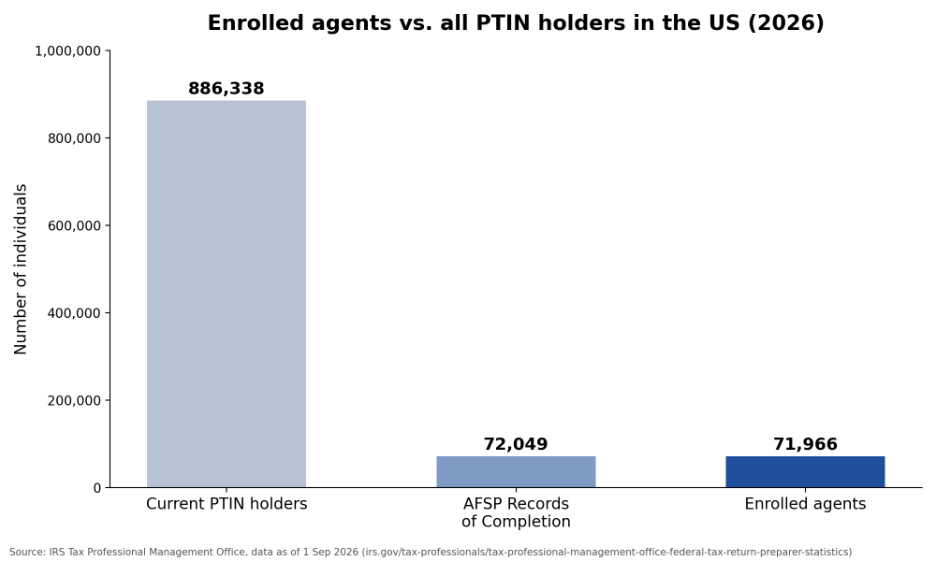
Data: Current PTIN holders 886,338 | AFSP Records of Completion 72,049 | Enrolled agents 71,966
Rare works in your favor only if recruiters can find you. The credential carries real weight, since enrolled agents have unlimited practice rights, like attorneys and CPAs. But the recruiter has to see the word "Enrolled Agent" first.
How Recruiters Search LinkedIn
Recruiters don't scroll through profiles. They type a job title, a skill and sometimes a city into a search box, then filter the results. If your profile doesn't contain those words, you don't appear, however good you are.
LinkedIn's own help page confirms that your skills list helps match you with the right opportunities, and you can add up to 100 skills. Source: linkedin
So, the real question is which words to use. These are the recruiter search keywords on LinkedIn that matter for EA roles.
Enrolled Agent Recruiter Keywords that Matter
Not sure which words to use? Start with this list, then open a few job posts for the roles you want and see which of these terms they repeat. Use those, and only the ones that are true for you.
Credential and role keywords
- Enrolled Agent, EA (IRS)
- US Tax Associate, US Tax Analyst, Tax Preparer, Tax Reviewer
- IRS representation, IRS Circular 230
- SEE (Special Enrollment Examination)
Technical keywords
- Form 1040, Form 1120, Form 1065, Form 1041
- Individual taxation, business taxation, partnership taxation
- Tax research, tax compliance, tax planning
- Representation, practices and procedures
Tools and process keywords
- Tax software you've used (for example, Lacerte, ProConnect, UltraTax, Drake, CCH Axcess)
- PTIN, e-filing, tax notices, audit support
- US taxation, cross-border tax
Only list what you've genuinely used. Recruiters catch padding quickly in the first call.
Where to Put those Keywords
Headline
Your headline appears in every search result, so it carries the most weight. Don't leave the default "Student at XYZ College."
An enrolled EA could write:
US Tax Associate | Enrolled Agent (IRS) | Form 1040, 1120, 1065 | Tax Research and Compliance
A candidate still preparing could write:
US Taxation Aspirant | EA Candidate (SEE Part 1 Cleared) | Commerce Graduate
Please be careful with the second one. Passing an exam part does not make you an EA. You become one only after you apply for enrollment, pay the fee and clear the IRS suitability check. Writing " EA candidate " is honest and still searchable.
About Section
Write it like a person talking, in first person, in four to six lines. Say what you do, what you've studied, which forms you handle and what kind of role you want. Work your keywords in as you go and skip the comma-separated dump at the bottom.
Experience
Even internships and college projects count. Write "Prepared 30 mock Form 1040 returns during EA coaching" instead of "Worked on tax returns." Numbers make it real.
Skills
Add your core skills and pin the ones closest to the job you want. Lead with hard skills such as US Tax Compliance, Form 1040 and Tax Research, and keep general ones like teamwork lower down. Ask classmates, mentors, and managers to endorse the skills you really have.
Licenses and certifications
Add " Enrolled Agent " here once you're enrolled. If you're studying, add your SEE part results or a coaching completion, and don't call it the credential itself.
LinkedIn Profile for EA Freshers and Tax Freshers
If you have no work experience yet, don't panic. A LinkedIn profile for EA freshers can still rank well, because recruiters hiring entry-level US tax staff look for exam progress and clear intent.
- State your target role in the headline, for example "US Tax Associate".
- Mention which SEE parts you've cleared and when you plan to finish.
- List academic projects, mock returns and any tax season internship.
- Turn on the "Open to work" setting for recruiters only.
- Follow and interact with the Big 4 India tax teams, GCCs and US tax firms hiring in your city.
A LinkedIn profile for tax freshers works the same way. Show direction and effort even when the experience section is short.
US Taxation Jobs in India: Who's Hiring and What They Read
US taxation jobs in India usually sit at Big 4 delivery centers, global capability centers, US-focused outsourcing firms and mid-size accounting firms. Deloitte, PwC, EY and KPMG are among the most visible employers, with listings for US tax roles in cities like Bengaluru, Mumbai and Delhi NCR.
Before you edit your profile, open five current job posts from these employers. Copy the repeated phrases such as "US individual tax," "review," "1120" or "IRS notices," then use the ones that honestly describe you. That takes twenty minutes and beats any keyword list, including this one.
Five Habits that Get you Noticed by Recruiters
How to get noticed by recruiters on LinkedIn isn't only about keywords. These habits help, too.
- Use a clear, professional photo and custom profile URL.
- Update your profile whenever something changes, such as a new exam part.
- Post or comment occasionally on US tax updates. It shows you're active.
- Send short, specific connection notes to recruiters instead of the default text.
- Keep your LinkedIn and resume consistent. Different dates or titles raise flags.
Final thought
Your credential is rare, but it only helps if the right people can find it. Spend an hour on your headline, skills and About section this week, and check the difference in profile views after a few weeks.
Want structured preparation for the IRS SEE? Explore Simandhar Education's EA course.
Frequently Asked Questions
1. What do recruiters search for on LinkedIn when hiring EA candidates?
They search for job titles like US Tax Associate or Tax Analyst, the credential name (Enrolled Agent or EA), form types such as 1040, 1120 and 1065, and tools like Lacerte or UltraTax. Location and experience filters come next. Profiles that carry these terms in the headline, skills and experience sections appear first.
2. What keywords should an Enrolled Agent use on LinkedIn?
Use "Enrolled Agent," "US taxation," "IRS representation," the forms you've handled, tax research, and the software you know. Add them naturally in your headline, About section, experience entries and skills list.
3. How should an EA optimize their LinkedIn profile?
Start with the headline, then rewrite your About section in plain language, add measurable achievements under each role, fill in your skills and pin the strongest ones, and list your licenses. This is the core of Enrolled Agent LinkedIn optimization, and it can be done in one afternoon.
4. What are the best LinkedIn keywords for US tax professionals?
Job-relevant terms perform best: US tax, individual and business tax returns, IRS notices, tax research, compliance, review, and the specific forms and software you use. Copy the language from real job descriptions.
5. Can I call myself an Enrolled Agent after passing one SEE part?
No. You become an EA only after passing all three parts, applying for enrollment and clearing the IRS suitability check. Until then, describe yourself as an EA candidate and mention the parts you've cleared.
6. How often should I update my profile for Enrolled Agent career opportunities ?
Review it every two to three months, and update it right away after any exam results, job change or certification. Recent activity keeps you visible and shows recruiters you're serious about.
7. Is LinkedIn profile optimization for finance professionals different from other fields?
Slightly. Finance recruiters lean on credentials, forms, standards and software names, so precision matters more than creative wording. Be specific and honest.
Planning to take EA? Explore our EA course