
Finance Skills Beyond Exams
Learn how Simandhar Education helps finance students build practical skills, communication confidence, interview readiness, AI awareness, and career clarity beyond exams and certifications.
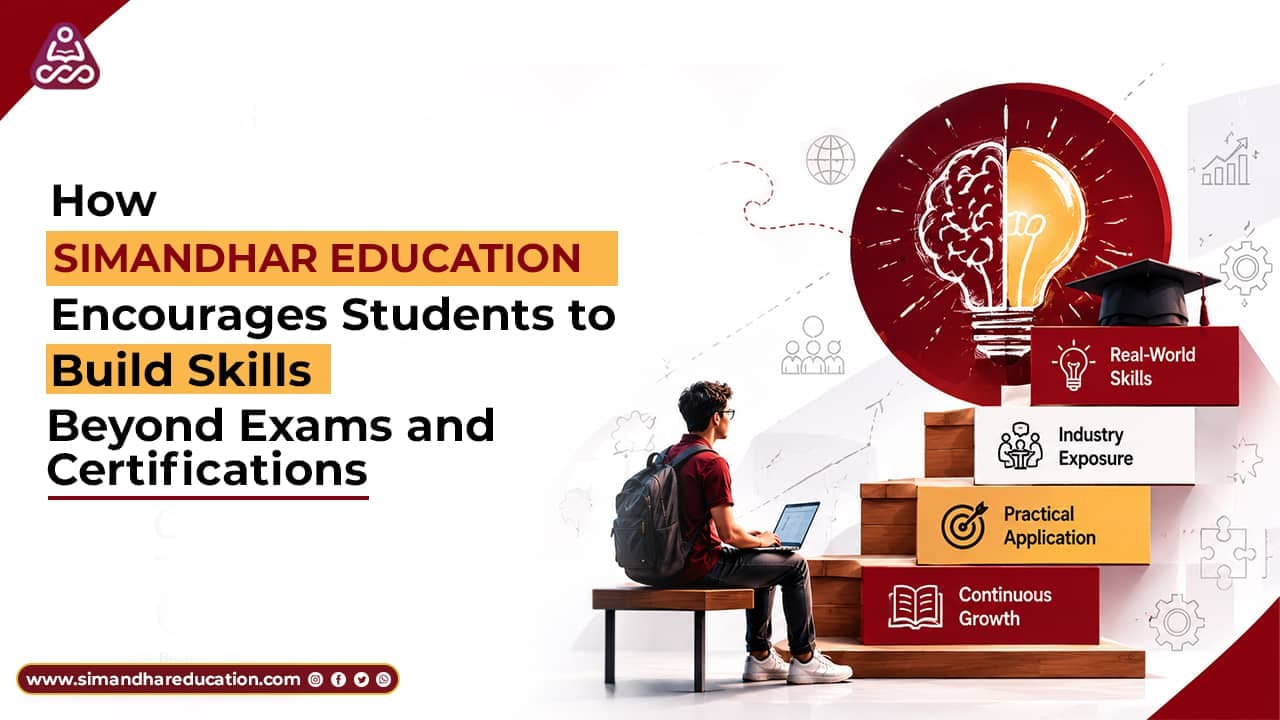
Table of Contents
- 1. How Simandhar Education Encourages Students to Build Skills Beyond Exams and Certifications?
- 2. Why Are Exams No Longer Enough for Finance Students?
- 3. What Does Simandhar Education Focus on Beyond Certifications?
- 4. Why Do Students Need Practical Skills Early?
- 5. How Does Simandhar Help Students Think Beyond Marks?
- 6. What Kind of Skills Make a Finance Student More Employable?
- 7. How Can Simandhar Education Support This Career Shift?
- 8. FAQs
- 8.1. What does skill building beyond exams mean?
- 8.2. Why are certifications alone not enough for finance jobs in 2026?
- 8.3. What courses does Simandhar Education offer for finance students?
- 8.4. How does Simandhar Education help students become job-ready?
- 8.5. Can students build skills while pursuing B.Com?
How Simandhar Education Encourages Students to Build Skills Beyond Exams and Certifications?
There is a quiet fear many finance students carry, but do not always say out loud.
What if the certificate is not enough?
A student may clear exams, collect credentials, update LinkedIn, and still feel unsure in interviews. Not because the qualification has no value, but because the workplace asks for something slightly different. It asks whether the student can explain concepts clearly. Whether the student can understand a business problem. Whether the student can use tools, think logically, speak with confidence, and behave like someone ready for responsibility.
This is where career preparation becomes bigger than exam preparation.
In 2026, finance students are not only competing with classmates. They are competing in a market where global accounting roles, AI-led workflows, remote teams, Big 4 expectations, and practical finance skills are becoming part of the same conversation. A certification may open the door, but the student still has to walk into the room with confidence.
That is why Simandhar Education's role becomes important. It does not position learning as only clearing a paper. It tries to prepare students for the kind of finance career they are actually entering.
Why Are Exams No Longer Enough for Finance Students?
Exams are important. No serious student can ignore that. Certifications like US CPA, US CMA, ACCA, EA, and CIA require discipline, consistency, and conceptual clarity. They teach students to respect a global standard.
But a job is not an exam hall.
In an exam, the candidate answers what is asked. In a workplace, the candidate has to understand what is not being said. A manager may not ask for a textbook definition. They may ask why a number moved, why a tax position matters, why a variance looks unusual, or why an internal control failed.
That shift is uncomfortable for many students. They are used to studying chapters. The workplace asks them to connect chapters to decisions.
This is why skills beyond exams matter. Communication, Excel comfort, data interpretation, interview confidence, AI awareness, workplace etiquette, and business thinking are no longer “extra” skills. They are part of employability.
What Does Simandhar Education Focus on Beyond Certifications?
Simandhar Education offers global finance programs such as US CPA, US CMA, ACCA, EA, and CIA, but its larger focus is also on making students career-ready. That matters because many students do not need only syllabus support. They need someone to help them understand what the syllabus will mean in a real role.
Along with certification training, Simandhar’s ecosystem includes practical and career-focused programs such as Practical US Taxation, AI for Finance, Data Analytics in Finance, Soft Skills Training, and Pathway to Big 4. These offerings help students build the missing bridge between “I have studied this” and “I can use this.”
For example, a student studying taxation may understand rules, but practical tax training can make the subject feel closer to actual work. A student preparing for finance roles may understand reporting, but data analytics can help them read patterns and work with tools. A student may be technically strong, but soft skills and interview preparation can help them present that strength properly.
This is the difference between being qualified on paper and being prepared in person.
Why Do Students Need Practical Skills Early?
Many students wait until graduation is over to think about skills. They first finish B.Com, then start worrying about certifications, then start thinking about interviews, then realize the market has already moved ahead.
The smarter approach is different.
A student who starts early has more time to experiment, make mistakes, ask basic questions, and slowly build confidence. They do not have to become perfect in one month before an interview. They can grow into the role gradually.
This is especially useful for commerce students who are pursuing certifications while still in college. If they learn accounting concepts, global finance basics, AI awareness, communication, and interview skills during B.Com itself, they enter the job market with a different kind of confidence. They are not waiting for life to begin after graduation. They are preparing while others are still postponing.
That early preparation can change how a student sits in an interview. It can change how they answer a question. It can change how seriously an employer sees them.
How Does Simandhar Help Students Think Beyond Marks?
A lot of students are trained to think in terms of marks. They ask, “How many papers?” “How many months?” “What is the passing score?” These questions are valid, but they are not the full picture.
The better question is: what kind of professional is this student becoming?
Simandhar’s approach helps students look at certifications as career tools, not just academic milestones. A US CMA student may start thinking about budgeting, planning, and decision-making. An ACCA student may start seeing accounting as a global profession. A CPA student may understand how U.S. accounting standards connect to multinational roles. An EA student may see U.S. taxation as a remote career path. A CIA student may realize internal audit is not just checking work, but understanding risk and governance.
When students see the career behind the course, their preparation becomes more serious. They stop studying only to pass. They start studying to belong in the profession.
What Kind of Skills Make a Finance Student More Employable?
The most employable finance students are usually not the ones who know only one thing very well. They are the ones who combine knowledge with workplace readiness.
They can speak about their subject without sounding memorized. They can use Excel, Power BI, Tableau, or basic analytics tools without fear. They understand that AI is not something to avoid, but something to learn. They can write a professional email. They can answer interview questions without freezing. They can explain why they chose a certification and where they want to go with it.
These things may sound small, but they are often what separate two candidates with the same degree.
A certificate may show that the student studied. Skills show that the student is ready.
How Can Simandhar Education Support This Career Shift?
Simandhar Education supports students by bringing exam preparation, practical learning, mentoring, AI-enabled learning, placement assistance, interview preparation, and career guidance closer together. For many students, this structure matters because they do not always know what the market expects.
A student may know they want a finance career, but may not know whether to choose audit, tax, FP&A, management accounting, internal audit, or global accounting. Guidance helps reduce that confusion. It gives the student a direction before they spend time and money on the wrong path.
The real value is not only in preparing for a certification. It is in helping students become more employable, more aware, and more confident about the professional world they are trying to enter.
Students who want to build exam knowledge along with practical finance, interview, AI, and career-ready skills can explore Simandhar Education's global certification and upskilling programs.
FAQs
1. What does skill building beyond exams mean?
Skill building beyond exams means developing practical abilities such as communication, interview readiness, data handling, workplace confidence, AI awareness, and real-world finance application along with certification preparation.
2. Why are certifications alone not enough for finance jobs in 2026?
Certifications help students prove subject knowledge, but employers also look for practical thinking, confidence, tool knowledge, communication skills, and the ability to apply concepts in business situations.
3. What courses does Simandhar Education offer for finance students?
Simandhar Education offers programs such as US CPA, US CMA, ACCA, EA, CIA, Practical US Taxation, AI for Finance, Data Analytics in Finance, Soft Skills Training, and Pathway to Big 4.
4. How does Simandhar Education help students become job-ready?
Simandhar helps students through structured certification training, practical learning programs, AI-powered learning support, placement assistance, interview preparation, soft skills development, and career guidance.
5. Can students build skills while pursuing B.Com?
Yes. Students can start building certification knowledge, practical finance skills, communication skills, AI awareness, and interview readiness while pursuing B.Com, so they are better prepared for jobs after graduation.