
NASBA Leadership at Simandhar Education
Learn how former NASBA leadership and global finance experts joining Simandhar Education’s Advisory Board reflects the future of finance education, ethics, AI, global careers, and student readiness.
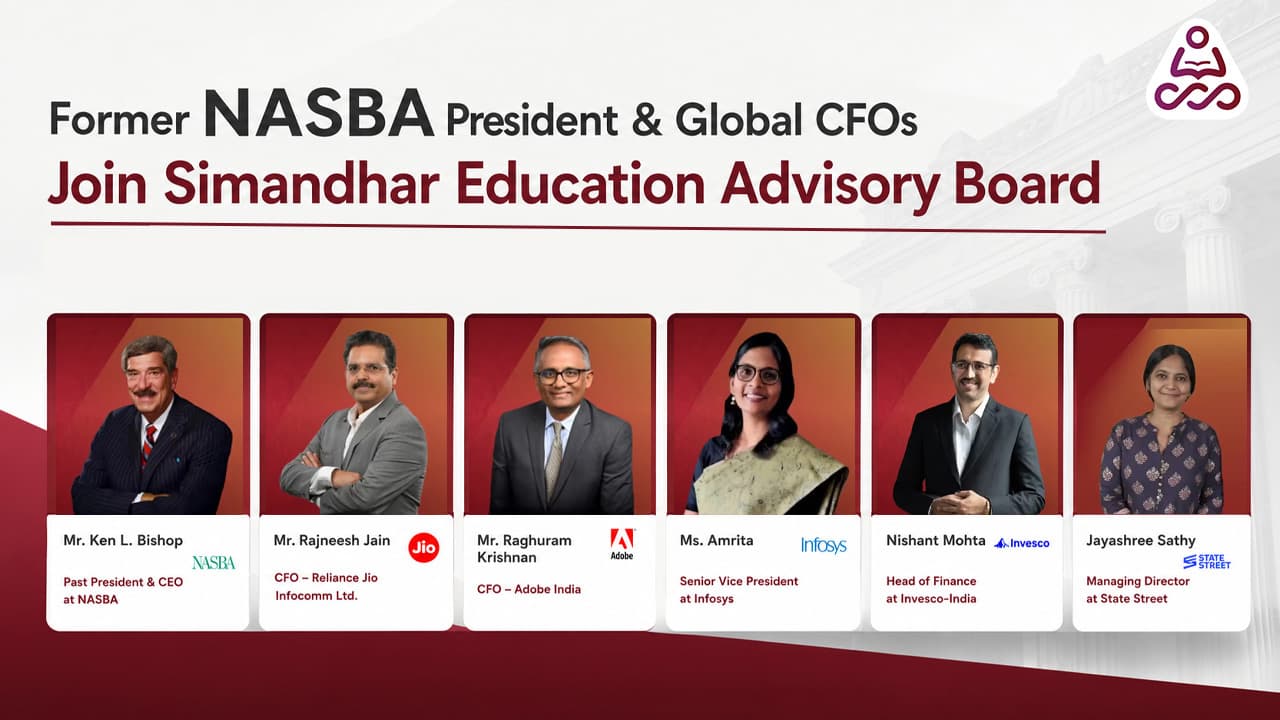
Table of Contents
- 1. How Does Former NASBA Leadership and Global Finance Experts Joining Simandhar Education’s Advisory Board Reflect the Future of Finance Education?
- 2. Why Does This Advisory Board Update Matter for Students?
- 3. What Does Former NASBA Leadership Bring to Simandhar Education?
- 4. Why Do Global CFOs Matter in Finance Education?
- 5. How Does This Reflect the Future of Finance Education?
- 6. Why Is Ethics Becoming More Important in the AI Era?
- 7. How Can This Help Simandhar Students Think Bigger?
- 8. What Should Students Take Away From This?
- 9. FAQs
- 9.1. Who is Ken L. Bishop?
- 9.2. Why is former NASBA leadership joining Simandhar Education’s Advisory Board important?
- 9.3. Which finance leaders are connected to Simandhar Education’s Advisory Board update?
- 9.4. How does this help Simandhar students?
- 9.5. What does this say about the future of finance education?
How Does Former NASBA Leadership and Global Finance Experts Joining Simandhar Education’s Advisory Board Reflect the Future of Finance Education?
Sometimes, one announcement says more than just the announcement itself.
When leaders like Ken L. Bishop, former President and CEO of NASBA, along with finance leaders such as Rajneesh Jain (Reliance Jio), Raghuram Krishnan (Adobe India), Amrita (Infosys), Nishant Mohta (Invesco) and Jayashree Sathy (State Street), become associated with Simandhar Education's Advisory Board, it is not just another update for students to scroll past.
It says something about where finance education is going.
Because the future of finance will not belong only to students who clear exams. It will belong to students who understand ethics, global standards, technology, business decisions, and the responsibility that comes with handling numbers.
That is why this matters.
For a student preparing for US CPA, US CMA, ACCA, EA, CIA, or any global finance pathway, this kind of advisory strength shows that Simandhar is not looking at education as only classroom teaching. It is trying to bring the profession closer to the student.
Why Does This Advisory Board Update Matter for Students?
Students often think education begins and ends with classes, notes, and exams.
But the real world does not work that way.
A student may clear a paper and still feel nervous in an interview. A student may know accounting standards but not understand how global finance teams work. A student may be good at solving questions but still not know what ethics, judgment, and professional responsibility look like in real situations.
That is why an advisory board matters.
When people who have led large finance, accounting, regulatory, and corporate systems guide an education company, students get more than academic direction. They get a clearer sense of what the profession expects.
For Simandhar Education, this is important because its students are not preparing for small goals. Many of them are aiming for Big 4 firms, MNCs, global accounting roles, US tax careers, internal audit roles, FP&A teams, and international finance opportunities.
What Does Former NASBA Leadership Bring to Simandhar Education?
Ken L. Bishop’s connection is important because NASBA is deeply linked with the US CPA ecosystem.
For students, NASBA may sound like a name they hear during eligibility, evaluation, or CPA exam discussions. But at a deeper level, NASBA represents regulation, public trust, licensing, ethics, and the seriousness of the accounting profession.
That is the part students should notice.
A CPA is not just someone who passes exams. A CPA is expected to carry responsibility. There is trust involved. There is public interest involved. There is a standard of conduct involved.
So when former NASBA leadership becomes part of Simandhar’s advisory direction, it brings that global accounting seriousness closer to Indian students.
It quietly tells students: this profession is bigger than marks.
Why Do Global CFOs Matter in Finance Education?
Finance students often study topics like budgeting, reporting, costing, audit, tax, and analytics. But CFOs see how all these topics work inside real companies.
They understand how finance supports decisions. They know what companies expect from freshers. They see how AI is changing teams. They know why communication matters. They also know that finance professionals today cannot survive only by doing routine work.
That is why leaders such as Rajneesh Jain and Raghuram Krishnan matter in this conversation.
They bring the industry side into education.
For students, this is valuable because there is often a gap between what is taught and what is expected at work. Good finance education should reduce that gap. It should help students understand not only the syllabus, but also the workplace waiting after the syllabus.
How Does This Reflect the Future of Finance Education?
The future of finance education is moving away from only “exam coaching.”
That does not mean exams are not important. They are very important. But exams alone cannot prepare a student for global finance roles.
Students now need global certifications, practical exposure, AI awareness, analytics skills, soft skills, interview readiness, and a better understanding of ethics and business judgment.
This is where Simandhar Education larger ecosystem fits in. Along with courses like US CPA, US CMA, ACCA, EA, and CIA, Simandhar also offers career-focused support such as Pathway to Big 4, Data Analytics in Finance, AI for Finance, Practical US Taxation, and Soft Skills Training.
So the advisory board update is not separate from the student journey. It supports the same idea: finance education has to become more complete.
Why Is Ethics Becoming More Important in the AI Era?
AI can help with speed. It can help with data. It can help automate routine work.
But AI cannot replace responsibility.
Finance professionals will still need to ask the harder questions. Is the information reliable? Is the judgment fair? Is the reporting ethical? Is the risk being understood properly? Is the professional doing what is right, not just what is fast?
That is why ethics is becoming even more important, not less.
Former NASBA leadership brings the public-trust side of accounting. Corporate finance leaders bring the business-responsibility side. Together, they show students that the future finance professional cannot only be technically sharp. They also have to be trustworthy.
How Can This Help Simandhar Students Think Bigger?
Many students start their journey with a very simple thought: they want a good job.
That is completely natural.
But over time, the goal has to become bigger than just getting placed. Students need to understand what kind of professional they are becoming. Are they building global skills? Are they learning how finance works in real companies? Are they becoming comfortable with technology? Are they developing judgment? Are they preparing for leadership, not just employment?
This kind of advisory support can help Simandhar stay connected to those bigger questions.
It can help students see that a finance career is not only about passing one exam and moving on. It is about building a professional identity.
What Should Students Take Away From This?
Students should take this as a signal.
Finance education is changing. The old way of studying only for exams and thinking about careers later is no longer enough. The students who will stand out are the ones who build early, prepare seriously, and understand that global finance needs more than technical knowledge.
It needs ethics. It needs confidence. It needs communication. It needs AI awareness. It needs business thinking. It needs guidance from people who have actually seen the profession from the inside.
That is why Simandhar Education Advisory Board update matters.
It shows that the future of finance education will be more global, more practical, more ethical, and more connected to the real world.
Students who want to build global accounting and finance careers can explore Simandhar Education’s certification programs, practical upskilling courses, and career-readiness support.
FAQs
1. Who is Ken L. Bishop?
Ken L. Bishop is the former President and CEO of NASBA, an organization connected to the US CPA licensure and state board ecosystem.
2. Why is former NASBA leadership joining Simandhar Education’s Advisory Board important?
It is important because it brings global accounting, CPA regulation, ethics, public trust, and professional standards closer to finance education in India.
3. Which finance leaders are connected to Simandhar Education’s Advisory Board update?
Public updates mention leaders such as Ken L. Bishop, Rajneesh Jain, President and CFO of Reliance Jio Infocomm, and Raghuram Krishnan, CFO of Adobe India.
4. How does this help Simandhar students?
It helps students by connecting education with real industry expectations, global accounting standards, ethical thinking, AI awareness, and career readiness.
5. What does this say about the future of finance education?
It shows that finance education is moving beyond exam coaching toward global readiness, practical skills, ethics, technology awareness, and stronger industry connection.