
The Long-Term Career Value of CPA, CMA, ACCA, and EA
Explore the long-term career value of CPA, CMA, ACCA, and EA certifications and how these globally recognized credentials support leadership roles, international opportunities, higher earning potential, and long-term finance career growth.
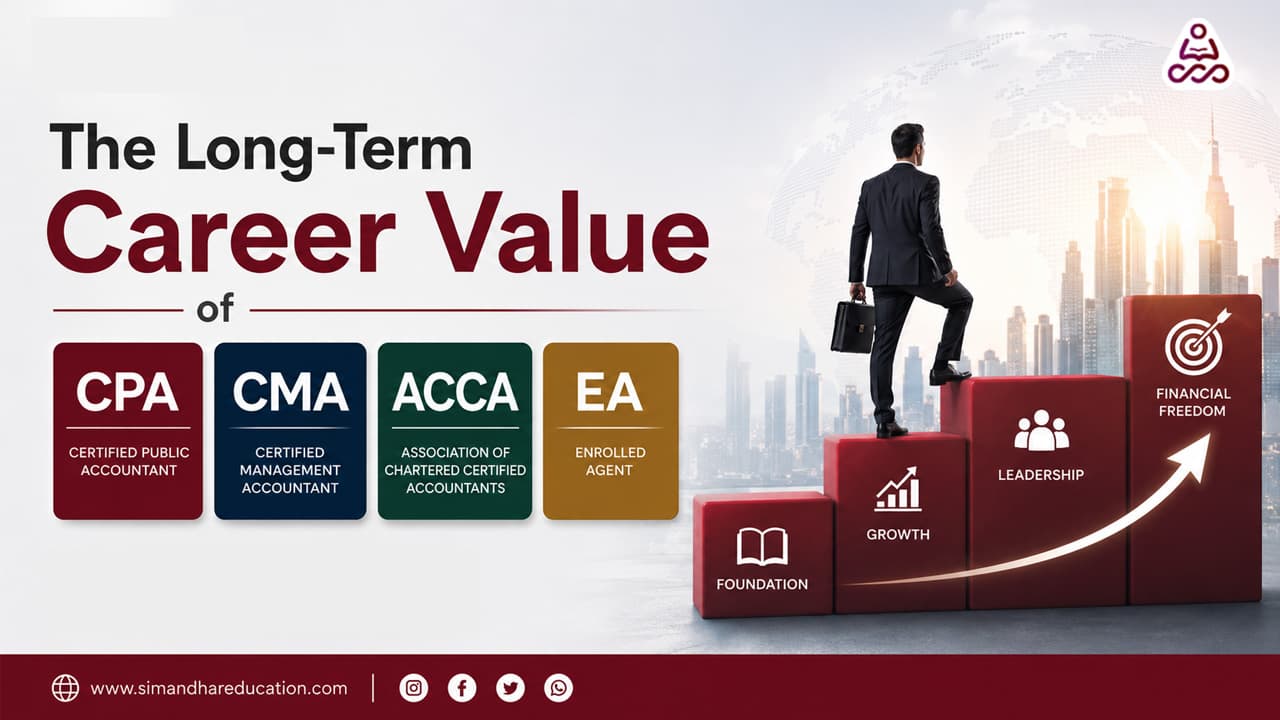
Table of Contents
- 1. The Long-Term Career Value of CPA, CMA, ACCA, and EA
- 2. CPA: A Credential That Only Gets More Valuable With Time
- 3. CMA: The Strategic Finance Credential That Grows With Your Ambitions
- 4. ACCA: The Global Passport That Never Expires
- 5. EA: The Underrated Credential With Serious Long-Term Value
- 6. The Compounding Effect of Credentialing Early
- 7. Credentials Create Networks That Last Decades
- 8. Getting the Foundation Right
- 9. Conclusion
- 10. FAQs:
- 10.1. Which certification among CPA, CMA, ACCA, and EA has the best long-term career value?
- 10.2. Does the value of these certifications decrease as you gain more work experience?
- 10.3. Is the Enrolled Agent credential worth pursuing compared to the CPA or CMA?
- 10.4. How do these certifications contribute to building a professional network over time?
- 10.5. At what stage of a career is it too late to pursue one of these certifications?
The Long-Term Career Value of CPA, CMA, ACCA, and EA
When discussing professional accounting certifications, most people's concerns tend to revolve around short-term gains. What kind of a salary raise am I going to receive once I clear my exam? How soon will I be able to get a better job position? Such questions are quite valid, but unfortunately, they ignore long-term prospects. After all, the true value of such credentials is not what they do for you right now, but what they will be doing for you in ten, twenty or even more years from now.
Professional life in accounting and finance is a long one. In the best case scenario, a person can expect to dedicate as much as four decades of their life to a career. At that, the choices a person makes during the first and middle decades compound significantly over time and make it hard or impossible to turn back. Investing in an internationally recognized certification is an example of such a decision, and learning about its long-term effects helps one distinguish a professional career planner from a reactive opportunist.
CPA: A Credential That Only Gets More Valuable With Time
The title of Certified Public Accountant is considered to be one of the most prestigious accounting certificates in the US, but its relevance only grows as one progresses along their professional trajectory. Indeed, while initially this certificate will serve you well in gaining access to a better firm, receiving a pay raise, and securing additional opportunities, as one moves on to more senior positions, it serves as a proof of one's professionalism and expertise.
Indeed, partners at the Big Four, CFOs of publicly traded firms, and heads of internal audit departments of large firms almost always possess a CPA certificate. Thus, this certification is not just a great start to one's career; it is an integral part of the latter.
One should also note that a CPA certificate comes with certain privileges regarding one's practice. Indeed, such a certified accountant can sign off on an audited document, represent a client in front of the IRS, and provide an attestation of their accounting services. This is far from a list of minor things, and such opportunities will never disappear over the course of one's career.
Finally, for Indian professionals working in US multinationals or in GCC, a CPA certificate remains relevant in ensuring that one is recognized as competent in finance and accounting functions related to working with US stakeholders.
CMA: The Strategic Finance Credential That Grows With Your Ambitions
While the Certified Management Accountant credential does not carry the same status as a CPA, it still serves as an integral part of a career progression. This particular certificate emphasizes a forward-looking view toward finance functions, which means that one will be developing a mindset suitable for taking senior positions in the area. At first, the certificate will prove that one is capable of performing in-depth analysis and understands management accounting concepts. However, with one's career advancement, it will speak of one's capabilities as a strategic thinker and visionary.
According to surveys performed by the IMA, CMA certificate holders earn salaries higher than their colleagues who lack the certificate. Moreover, such an income gap is bound to increase, meaning that having a CMA certificate helps one's salary grow with seniority.
ACCA: The Global Passport That Never Expires
Among all of the discussed qualifications, the ACCA is unique in the sheer breadth of its recognition across different geographic locations. Indeed, it is recognized in over 180 countries, making it a credential that will remain relevant for a professional moving to a different country, even after several decades of practice.
If you are considering becoming a portfolio professional working across different countries, the ACCA will help you to gain recognition in all of them. Even if you choose to stay within the same country, this qualification will still prove to be relevant in case of relocation or a change in a professional direction.
Moreover, ACCA certificate contains a number of papers that become increasingly relevant for one's practice when they take senior positions, for example, those concerning advanced financial management or advanced audit. Finally, for many, it may be surprising to see that the knowledge gained from ACCA papers becomes relevant again after several years of practice, as some of the issues addressed become increasingly pertinent.
EA: The Underrated Credential With Serious Long-Term Value
Unlike a CPA certificate that focuses on generalist accounting and auditing skills, the Enrolled Agent qualification focuses specifically on tax matters. Awarded by the IRS, this is one of the highest credentials issued by this agency, and provides an EA with unlimited representation before the organization in any matter related to taxes.
Thus, from the point of view of professional development in taxation, this certificate will serve you very well during many decades. Indeed, compared to other specialized professions such as lawyers and CPAs, the Enrolled Agent is a specialist in tax law and thus offers a lot of opportunities over the course of many years. Finally, for Indian professionals offering tax advisory services to US customers, this certification is an indispensable instrument for carrying out such activities.
The Compounding Effect of Credentialing Early
There is one important characteristic of professional certificates that should be taken into consideration. Once you obtain one, you will be getting benefits associated with it for as long as you continue practicing in the field. In other words, the certificate obtained at age twenty-five will bring you thirty-five years of benefits, while one acquired at age thirty-five will bring you twenty-five years.
Credentials Create Networks That Last Decades
There is perhaps no greater advantage to professional certifications that people often overlook in their rush towards earning them than access to the communities around them. CPAs will find themselves connected with members of local societies while CMAs will enjoy the support of an IMA chapter. The ACCA and the NAEA will offer a chance to connect with their respective professional communities through their membership networks.
However, the point is not merely to find someone to connect with when the time comes to move jobs. The communities that emerge from professional certifications can provide a lifetime of career opportunities, some of which might not exist otherwise. You may meet the very person you need to recommend you for a CFO position years after meeting him at a CMA event in your mid-thirties. You could discover the business partner you never knew you needed because you had the opportunity to meet them through the ACCA community.
Getting the Foundation Right
The true value of any certification program depends largely on the quality of preparation you received before passing the examinations. In essence, there is little use in obtaining a CPA qualification if you had to take the test multiple times and failed to absorb all the necessary information. Instead, such qualifications are usually only valuable to those who prepared extensively before taking the exam.
That is precisely why Simandhar Education offers comprehensive coaching for CPA, CMA, ACCA, and EA applicants. This coaching service helps Indian professionals build solid foundations for their qualifications, which makes the entire process worthwhile in terms of career growth.
Conclusion
CPA, CMA, ACCA, and EA are all long-term investments into your future career path in finance, and the professionals who understand this tend to approach them differently than others. While these individuals know that obtaining their qualification takes time and effort, they are also aware of the benefits they will receive in return for years to come.
After all, the time between earning a qualification and finding a job can stretch into decades, which should be plenty of time to consider all aspects of your career growth. If anything, that should serve as motivation rather than stress.
FAQs:
1. Which certification among CPA, CMA, ACCA, and EA has the best long-term career value?
Each certification has strong long-term value but in different directions. The CPA is the strongest for public accounting, audit, and US-facing finance roles. The CMA grows in value as professionals move into strategic finance and leadership positions like CFO. The ACCA offers the broadest geographic flexibility across 180 countries. The EA is the most specialized, carrying serious long-term weight for tax professionals working with US clients. The best one depends entirely on the kind of career you are building.
2. Does the value of these certifications decrease as you gain more work experience?
Not at all. If anything, these certifications tend to become more valuable as careers progress. In early career stages they help you get better roles and higher starting salaries. In mid and senior career stages they become markers of credibility, open doors to leadership positions, and provide access to professional communities and networks that actively shape career trajectories. The CPA and ACCA in particular remain highly relevant even at the most senior levels of the profession.
3. Is the Enrolled Agent credential worth pursuing compared to the CPA or CMA?
The EA and CPA serve different purposes and are not always direct competitors. The EA is specifically focused on taxation and grants unlimited representation rights before the IRS, making it the strongest credential for tax specialists. The CPA covers a broader range of accounting functions. For professionals who want to build a long-term career in tax advisory, particularly in US taxation, the EA is absolutely worth pursuing and in some cases more directly valuable than the CPA for that specific path.
4. How do these certifications contribute to building a professional network over time?
Each certification comes with access to a professional community that extends well beyond the exam itself. CPA societies, IMA chapters for CMA holders, ACCA member networks, and NAEA communities for EAs connect professionals with peers, mentors, and collaborators across industries and geographies. Over a long career these networks generate referrals, mentorship opportunities, business partnerships, and job leads that are genuinely difficult to access any other way. The network effect of a professional certification is one of its most underrated long-term benefits.
5. At what stage of a career is it too late to pursue one of these certifications?
Honestly, it is rarely too late. While starting early maximizes the number of years you benefit from the credential, professionals who certify in their late thirties or forties still see meaningful career impact in terms of roles, compensation, and opportunities. The more relevant question is not whether it is too late but whether the remaining years of your career justify the investment, and for most finance professionals the answer is yes. A certification earned at forty can still shape the next twenty to twenty-five years of a career in significant ways.