
US CPA REG Exam Explained: Format, Difficulty & Prep
Wondering how hard the US CPA REG exam is? Learn the format, 72 MCQs, 8 simulations, difficulty, and how to prepare, even without US tax knowledge.

Table of Contents
- 1. US CPA REG Exam Explained: How Hard Is It and What Should You Expect?
- 1.1. Worried About REG? Let's Start with What to Expect
- 2. What Is the US CPA REG Exam?
- 3. What Does the REG Exam Format Look Like?
- 4. How Hard Is CPA REG, and Why?
- 5. What Do REG Questions Actually Look Like?
- 5.1. Illustrative MCQ
- 5.2. Illustrative Simulation (Simplified)
- 6. Can You Prepare Without a US Tax Background?
- 7. How Can You Feel More Prepared on Exam Day?
- 8. Ready to Take the Next Step?
- 9. Frequently Asked Questions
US CPA REG Exam Explained: How Hard Is It and What Should You Expect?
Worried About REG? Let's Start with What to Expect
Every year, thousands of Indian commerce students decide to pursue the US CPA. Many of them feel confident about auditing and accounting, but go quiet when someone mentions REG. It is the section on US taxation, a subject most of us have never studied in a classroom. Questions start piling up: What will the exam look like? Will I understand the rules? Can I really pass it? Let's follow one such student to see how those doubts get answered.
Ananya Rao, is in the final year of her B.Com, She has decided to pursue the US CPA, but the US CPA REG exam keeps her awake at night. She has never filed a US tax return, and she has no idea what the questions will look like. So, she books a session with Vikram Iyer, a CPA mentor who has guided many first-time candidates.
(Ananya and Vikram are fictional characters, created to make the explanation easier to follow.)
“Vikram sir, honestly, I’m scared of REG,” she says. “I only know Indian tax. Will I even understand the questions?”
Vikram smiles. “That’s the most common worry I hear. Let’s replace the fear with facts. Then you can decide if it’s manageable.”
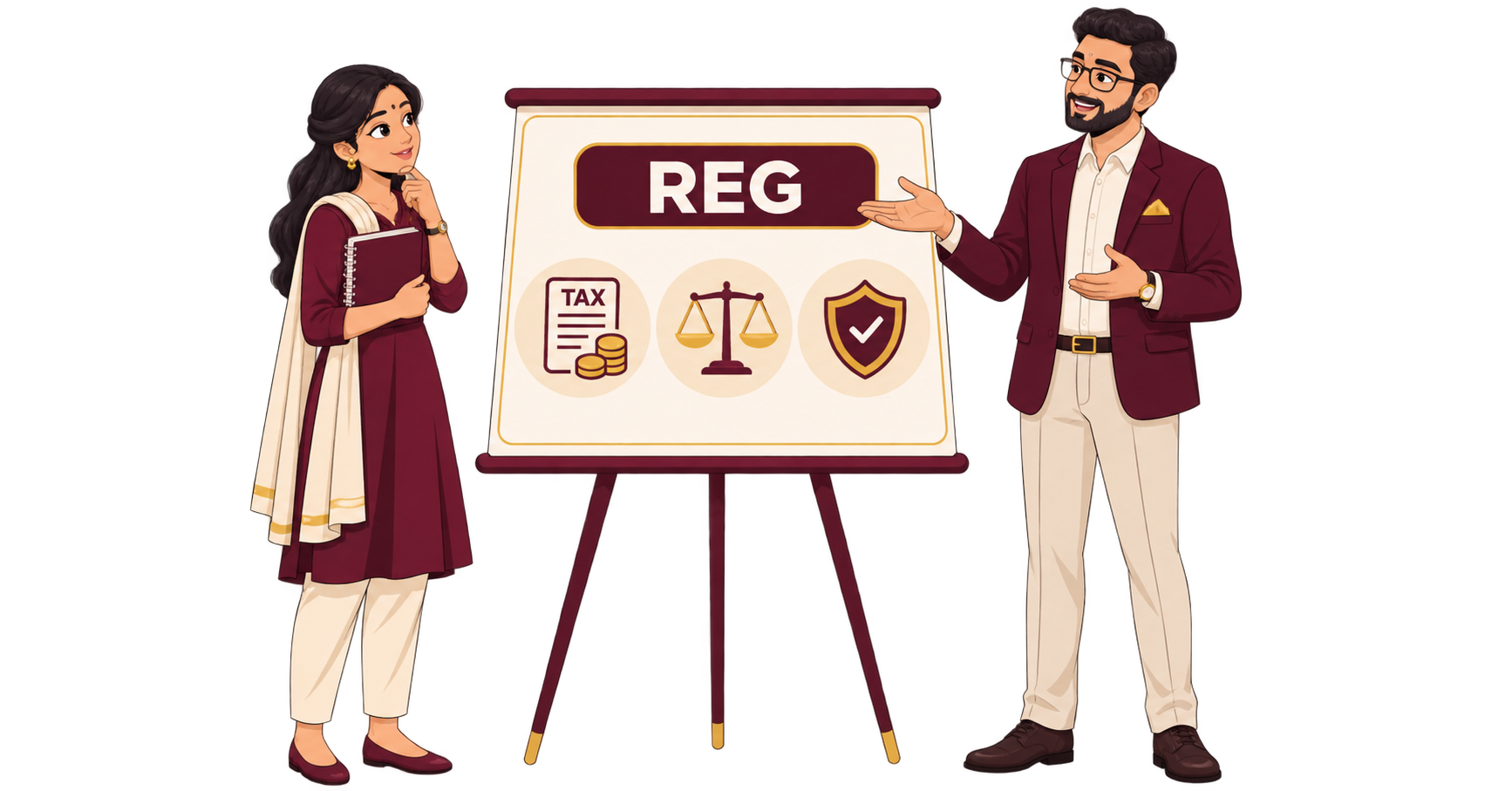
What Is the US CPA REG Exam?
“REG stands for Regulation,” says Vikram. “Despite the name, most of it is US federal taxation, plus business law and ethics. It is one of the three Core sections every candidate must pass, along with AUD and FAR.”
The AICPA (the American Institute of CPAs, which sets the exam) divides the CPA REG syllabus into five areas. The ranges below come from the January 2026 blueprint:
- Area I: Ethics, professional responsibilities and federal tax procedures (10–20%)
- Area II: Business law (15–25%)
- Area III: Federal taxation of property transactions (5–15%)
- Area IV: Federal taxation of individuals (22–32%)
- Area V: Federal taxation of entities, including tax preparation (23–33%)
What Does the REG Exam Format Look Like?
“Now the structure,” says Vikram. “Many students feel calmer once they see it laid out.”
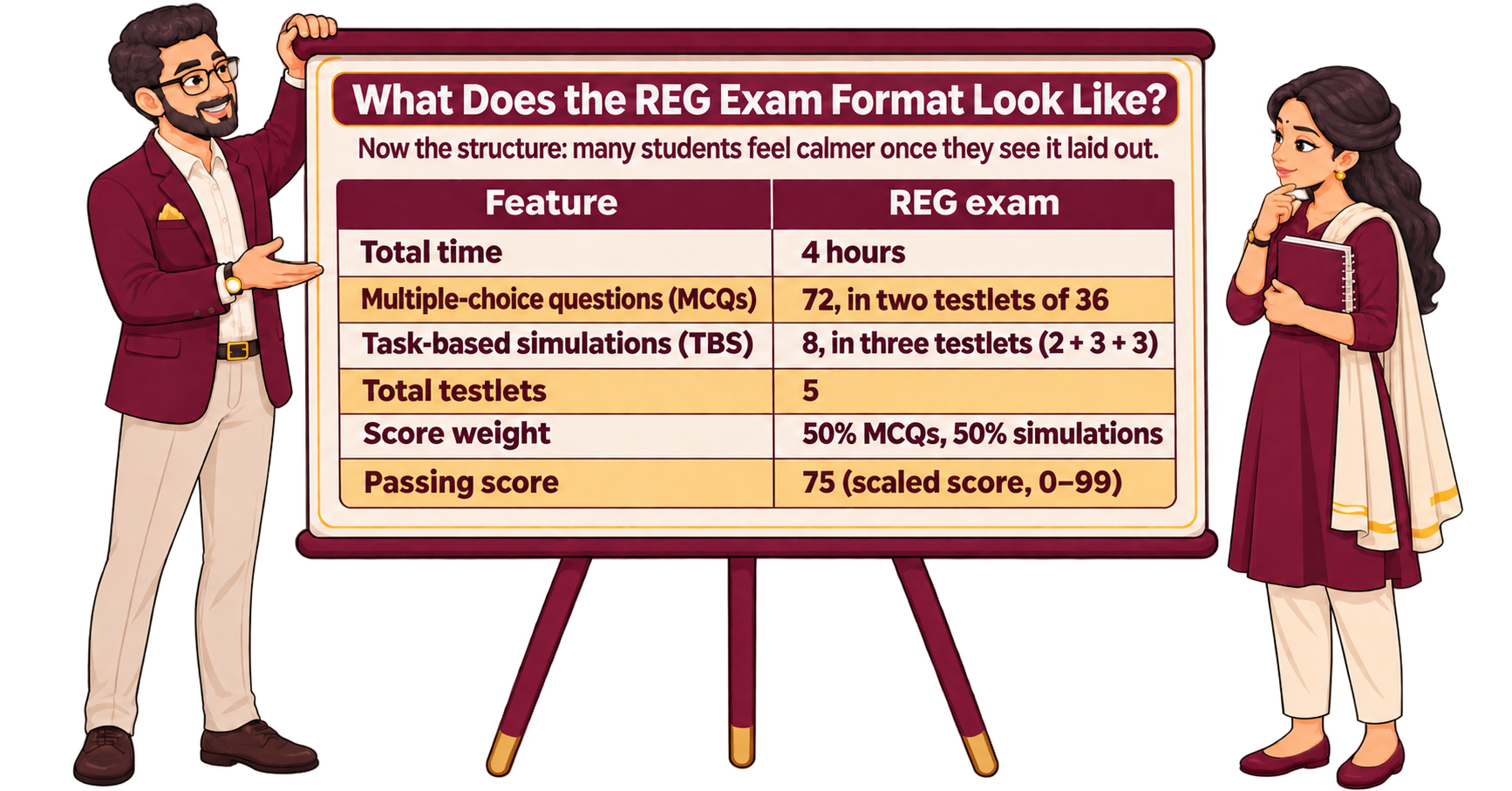
“A testlet is just a block of questions,” he explains. “Testlets 1 and 2 are all MCQs. Testlets 3, 4 and 5 are all simulations. There is a standard 15-minute break around the midpoint, and it doesn’t use up your four hours.”
Ananya frowns. “So, simulations are half the marks?”
“Yes. That’s why you can’t prepare only with MCQs.”
One more thing: some questions are unscored "pretest" questions the AICPA uses for future exams. You can't tell which ones, so treat every question as if it counts.
How Hard Is CPA REG, and Why?
“Be honest with me,” says Ananya. "How hard is the US CPA REG exam?"
“Honestly? Challenging, but not impossible,” says Vikram. “Recent AICPA pass-rate data places REG among the more passable Core sections, at roughly two-thirds of candidates. But a pass rate doesn’t tell you how it feels to you. Difficulty depends on your background and preparation. Here is what makes REG feel hard:
1. Unfamiliar Rules US tax terms, such as filing status or adjusted gross income, are new if you've only studied Indian law.
2. Exceptions Many tax rules come with "except when…" conditions, and the exam loves testing them.
3. Application, Not Memory Questions give you a situation and ask you to apply the rules.
4. Time Pressure Four hours sound long until you are on simulation number six.
5. Changing Laws Recent tax legislation is added to the exam in stages, so always study from current material.
“The good news,” he adds, “is that every one of these can be trained. None of them need a US tax background. They need practice.”
What Do REG Questions Actually Look Like?
“Let me show you two examples,” says Vikram. “Both are original and simplified, only to give you a feel.”
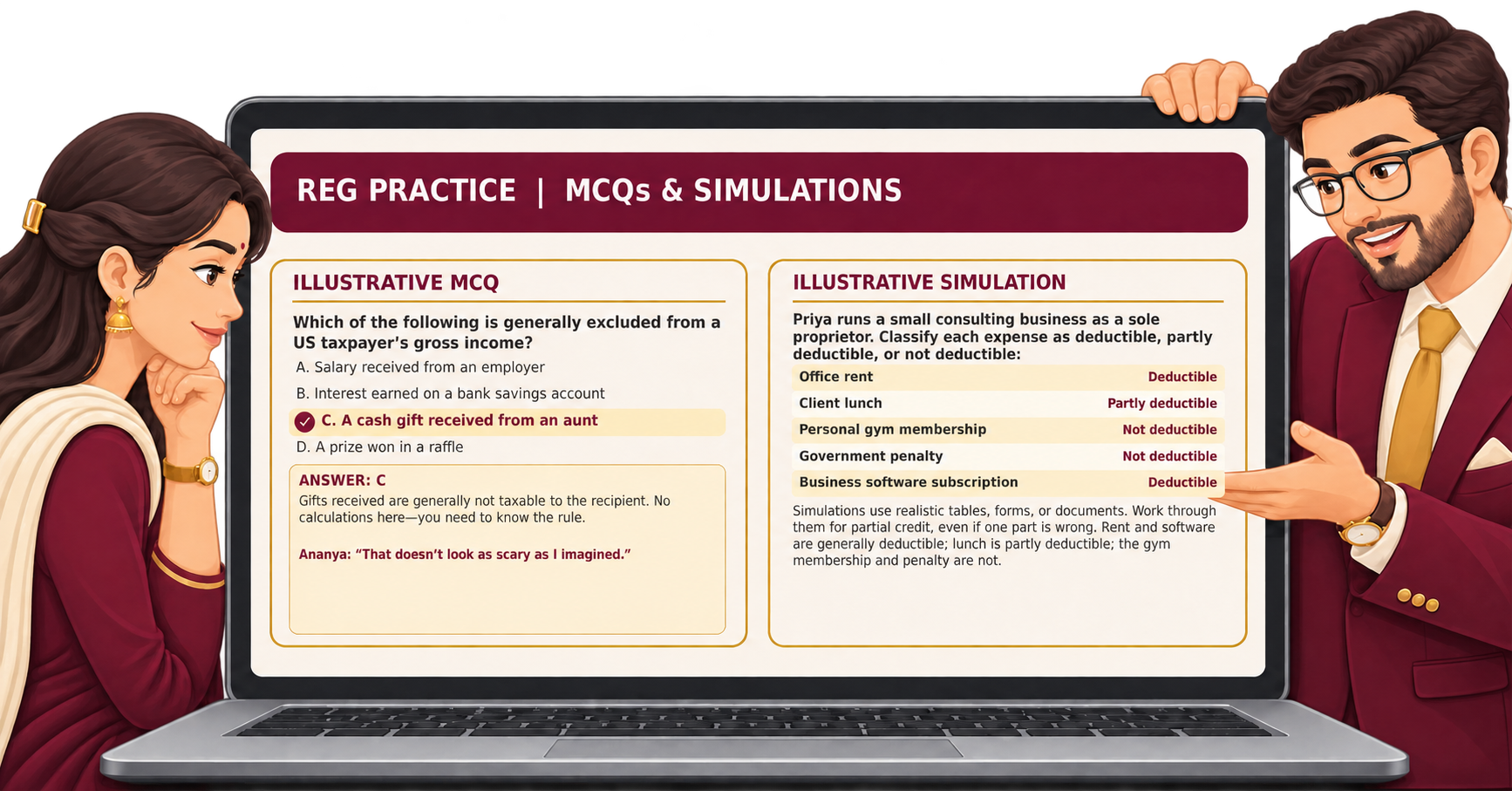
Illustrative MCQ
Which of the following is generally excluded from a US taxpayer's gross income?
- Salary received from an employer
- Interest earned on a bank savings account
- A cash gift received from an aunt
- A prize won in a raffle
“The answer is C. Gifts received are generally not taxable to the person receiving them. Notice that you don’t need any calculations here. You need to know the rule.”
Illustrative Simulation (Simplified)
Priya runs a small consulting business as a sole proprietor. For each expense, mark it as Deductible, partly deductible, or not deductible: office rent, a client lunch, her personal gym membership, a government penalty, and a business software subscription.
“Simulations give you a realistic scenario like this, usually with a table, a form or a set of documents. You work through it and often earn partial credit even if one part is wrong. Here, rent and software are generally deductible, the client lunch is only partly deductible, and the gym membership and penalty are not.”
Ananya laughs. “That doesn’t look as scary as I imagined.”
Can You Prepare Without a US Tax Background?
“Absolutely,” says Vikram. “Most Indian candidates start exactly where you are. Here is the progression I suggest for CPA REG preparation:
1. Build Foundations: Learn core ideas first: who is a taxpayer, what counts as income, and what deductions mean. Don't rush into questions yet.
2. Practice Topic by Topic: After each topic, attempt MCQs on only that topic. Focus on why the wrong options are wrong.
3. Move to Simulations Early: Don't wait until the end. Begin with simple simulations and slowly increase the difficulty.
4. Add Timed Practice: Roughly 75–90 seconds per MCQ and about 15–25 minutes per simulation is a common planning guide. Practice mixed sets under the clock.
5. Take Full-Length Mocks: A few four-hour mocks near the end build both stamina and confidence.
“How many hours should I plan?” asks Ananya.
“The AICPA doesn’t prescribe a fixed number. Many review providers suggest somewhere around 100 hours or more for REG, depending on your starting point. Treat that as a planning estimate, not a rule.”
How Can You Feel More Prepared on Exam Day?
“In the last few weeks,” says Vikram, “keep it simple:
- Revise actively: Rework problems instead of re-reading notes.
- Review every mistake: Keep a mistake log with the rule, why you missed it, and the fix. This is where your score grows.
- Practice timed sets: Learn to move on from a question that is eating your time.
- Get used to the interface: The AICPA offers a free exam tutorial and sample tests. Using them means the screen, calculator and tools feel familiar on the day.
- Protect your time for simulations: They carry half your score, so don’t spend too long on MCQs.
Ready to Take the Next Step?
REG feels big mainly because it is unfamiliar. Once you know the format, the weightage and a clear study path, it becomes a series of small, practical steps.
If you'd like guided support on your US CPA journey, you're welcome to explore Simandhar Education's US CPA preparation support and speak to a counsellor.
Frequently Asked Questions
1 How many questions are on the CPA REG exam?
There are 72 multiple-choice questions and 8 task-based simulations, spread across five testlets in four hours.
2 Is the CPA REG exam difficult for Indian students?
It can feel unfamiliar at first, because the US tax law is new. But with structured practice, many Indian students clear it. Difficulty depends on your preparation, not your nationality.
3 Do I need a US tax background to start?
No. The syllabus is built so a beginner can learn from the basics and gradually reach exam level.
4 How should I approach task-based simulations?
Read the scenario fully, note what is being asked, then work step by step. Start with the parts you're sure of, and don't leave answers blank, since partial credit is possible on many simulations.
5 How do I manage time in the exam?
Aim to finish the MCQ testlets with comfortable time left, since the three simulation testlets need more thought. Check the clock at the end of each testlet.
6 Which is more important, MCQs or simulations?
Both. Each carries 50% of your score, so practice from the start.
Planning to take CPA? Explore our CPA course