
What Are the Topics Covered in EA Part 1, Part 2, and Part 3 in 2026?
Thu Jun 25 2026
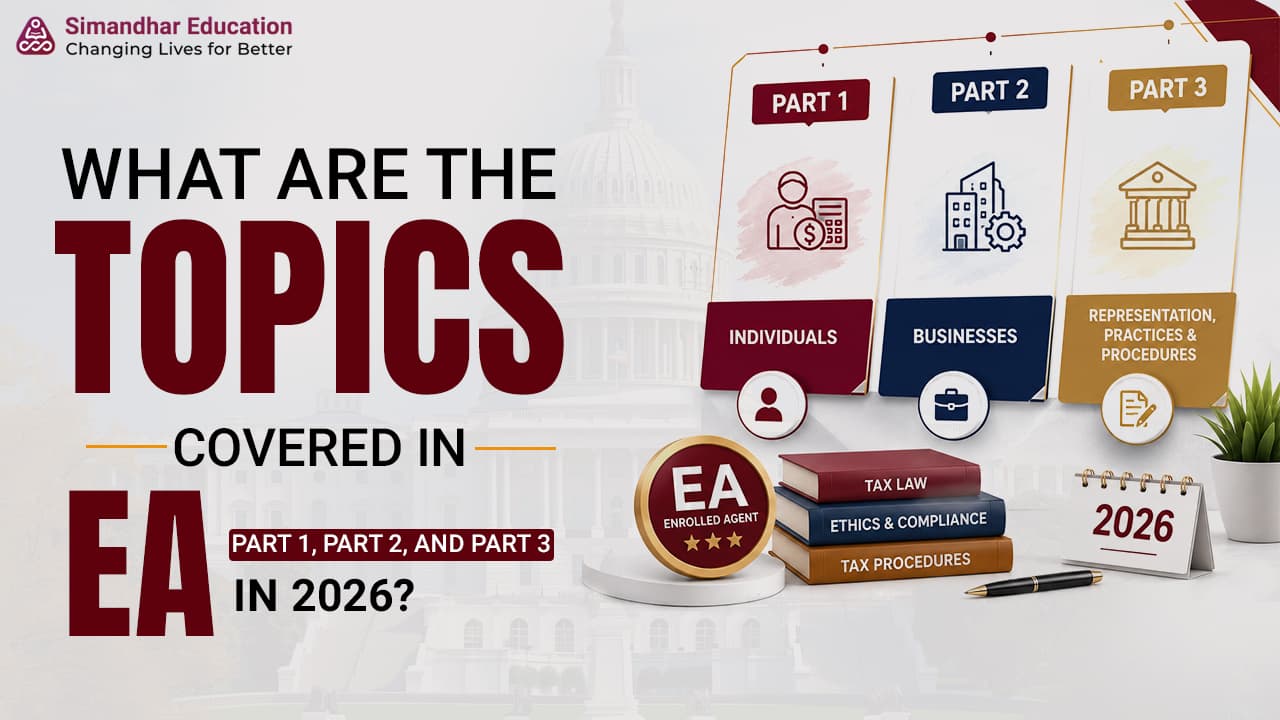
Table of Contents
The EA syllabus 2026 consists of three exam parts: Part 1 (Individuals), Part 2 (Businesses), and Part 3 (Representation, Practices, and Procedures). Together, the EA Part 1 2 3 syllabus covers individual taxation, business taxation, IRS regulations, taxpayer representation, ethics, audits, collections, and compliance procedures. The SEE exam topics 2026 are designed to test a candidate's knowledge of US tax laws and their ability to represent taxpayers before the Internal Revenue Service (IRS).
The Enrolled Agent (EA) credential is one of the most respected tax qualifications for professionals who want to build a career in US taxation. Recognized by the IRS, the EA designation provides unlimited representation rights before the IRS and creates opportunities in taxation, compliance, advisory, and consulting roles globally.
Understanding the complete EA syllabus 2026before starting your preparation can help you create a structured study plan, identify important topics, and improve your chances of passing all three parts of the Special Enrollment Examination (SEE).
What Is the EA Syllabus 2026?
The EA syllabus 2026 consists of three exam parts:
| EA Exam Part | Focus Area |
|---|---|
| Part 1 | Individuals |
| Part 2 | Businesses |
| Part 3 | Representation, Practices, and Procedures |
Each part focuses on a specific area of US taxation and contains multiple-choice questions designed to assess a candidate's practical understanding of tax laws and IRS regulations.
How Is the EA Exam Structured in 2026?
The Special Enrollment Examination (SEE) is conducted to evaluate a candidate's competency in US taxation.
EA Exam Structure
- Three separate exam parts
- 100 multiple-choice questions per part
- 3.5 hours duration per exam
- Computer-based testing format
- Administered through Prometric testing centres
- Scaled scoring system
- The candidates can pick the parts in any order
One of the biggest advantages of the EA qualification is its flexibility. Candidates can prepare for and clear one part at a time based on their schedule and learning pace.
What Topics Are Covered in EA Part 1: Individuals?
Part 1 focuses on the taxation of individual taxpayers and forms the foundation of the EA exam.
Major Topics Covered
Preliminary Work and Taxpayer Information
- Filing requirements
- Taxpayer identification
- Due diligence requirements
- Recordkeeping requirements
Income and Assets
- Salary and wages
- Interest income
- Dividend income
- Rental income
- Retirement income
- Capital gains and losses
Adjustments and Deductions
- Standard deductions
- Itemized deductions
- Business-related deductions
- Adjustments to income
Tax Credits
- Child Tax Credit
- Education Credits
- Earned Income Tax Credit
- Foreign Tax Credit
Tax Computation
- Income tax calculation
- Self-employment tax
- Alternative Minimum Tax
Specialized Returns
- Estate and trust taxation basics
- Gift tax fundamentals
Why Part 1 Is Important
Part 1 is highly relevant for professionals involved in tax preparation and compliance services for individual taxpayers. It provides the knowledge needed to understand tax return preparation, deductions, credits, and filing requirements.
Which Subjects Are Addressed in EA Part 2: Businesses?
Part 2 focuses on the taxation of businesses and various legal entities operating in the United States.
Major Topics Covered
Business Entities
- Sole Proprietorships
- Partnerships
- Corporations
- S Corporations
- Limited Liability Companies (LLCs)
Business Financial Information
- Accounting methods
- Financial records
- Inventory valuation
- Cost recovery methods
Business Deductions
- Operating expenses
- Employee benefits
- Interest expenses
- Depreciation deductions
Corporate Taxation
- Corporate income taxation
- Corporate distributions
- Reorganizations
- Liquidations
Partnership Taxation
- Partnership formation
- Allocation of income and losses
- Partnership distributions
Specialized Business Topics
- Tax-exempt organizations
- Retirement plans
- Trusts and estates
Why Part 2 Is Important
Part 2 prepares candidates to work with business tax returns and corporate taxation matters. Professionals working in US taxation outsourcing firms often deal with these topics regularly.
What Topics Are Covered in EA Part 3: Representation, Practices, and Procedures?
Part 3 focuses on taxpayer representation and IRS procedures.
Major Topics Covered
Practice Before the IRS
- Circular 230 regulations
- Professional conduct
- Practitioner responsibilities
Representation Rights
- Power of Attorney
- Taxpayer representation procedures
- IRS communication protocols
IRS Procedures
- Audits
- Appeals
- Collections
- Penalty procedures
Taxpayer Rights
- Taxpayer Bill of Rights
- Confidentiality requirements
- Due process protections
Ethics and Compliance
- Professional ethics
- Standards of conduct
- Regulatory compliance
Why Part 3 Is Important
This section is unique because it teaches candidates how to represent taxpayers before the IRS. It also covers ethical responsibilities and procedural rules that tax professionals must follow.
Which EA Exam Part Is the Most Difficult?
The answer depends on a candidate's educational background and work experience.
- Candidates with accounting and taxation experience often find Part 1 easier.
- Professionals with corporate tax exposure may find Part 2 more comfortable.
- Candidates unfamiliar with IRS procedures may find Part 3 challenging.
Part 2 is seen by many people as the most complete because it covers a wide range of business types and tax rules.
The best approach is to study each section systematically and focus on understanding concepts rather than memorizing rules.
What Are the Most Important SEE Exam Topics 2026?
While every topic is important, candidates should pay special attention to:
Part 1
- Individual taxation
- Tax credits
- Capital gains and losses
- Retirement income
- Filing requirements
Part 2
- Partnerships
- Corporations
- Depreciation
- Business deductions
- Accounting methods
Part 3
- Circular 230
- Audits and appeals
- Representation rights
- Ethics
- IRS collections procedures
Mastering these SEE exam topics 2026 can significantly improve exam performance.
How Long Does It Take to Complete the EA Syllabus?
Most candidates complete the EA program within 6 to 8 months.
A typical preparation timeline includes:
| EA Part | Recommended Study Time |
|---|---|
| Part 1 | 2–3 Months |
| Part 2 | 2–3 Months |
| Part 3 | 1–2 Months |
The exact duration depends on a candidate's prior knowledge, study schedule, and work commitments.
Who Is Eligible for the EA Exam?
One of the biggest advantages of becoming an Enrolled Agent is that there are no strict educational requirements.
Basic Eligibility
- Minimum age of 18 years
- Valid identification documents
- Interest in taxation and accounting
Students, graduates, accountants, tax professionals, and working professionals from different educational backgrounds can pursue EA.
Why Pursue EA in 2026?
The demand for US taxation professionals continues to grow globally. Companies serving US clients require skilled tax professionals who understand IRS regulations and compliance requirements.
Benefits of Becoming an Enrolled Agent
- IRS-recognized credential
- Global career opportunities
- Authority to represent taxpayers before the IRS
- Growing demand in taxation firms
- Opportunities in Big 4 and multinational organizations
- Short completion timeline
- Strong career growth potential
For professionals interested in taxation, EA remains one of the most specialized and valuable credentials available today.
Why Choose Simandhar Education for EA?
Choosing the right learning partner can make a significant difference in your EA journey.
Simandhar Education has helped thousands of students build successful careers in accounting, finance, and taxation.
Why Students Choose Simandhar
- 30,000+ students trained
- 5,000+ placements
- 250+ corporate tie-ups
- Strong industry network
- Placement assistance
- Dedicated mentorship
- AI-powered Digital AI Sripal support
- Comprehensive study resources
- Structured preparation approach
In addition to academic support, students benefit from career guidance, interview preparation, and exposure to industry best practices.
Frequently Asked Questions
1. What is included in the EA syllabus 2026?
The EA syllabus 2026 includes three parts covering Individuals, Businesses, and Representation, Practices, and Procedures.
2. How many parts are there in the EA exam?
The EA exam consists of three separate parts.
3. What are the major SEE exam topics 2026?
Major SEE exam topics 2026 include individual taxation, business taxation, partnerships, corporations, IRS procedures, ethics, audits, and taxpayer representation.
4. What is covered in EA Part 1?
EA Part 1 covers individual taxation, income, deductions, tax credits, and tax computations.
5. What is covered in EA Part 2?
EA Part 2 covers business taxation, partnerships, corporations, accounting methods, and business deductions.
6. What is covered in EA Part 3?
EA Part 3 covers IRS procedures, taxpayer representation, ethics, audits, appeals, and collections.
Final Thoughts
Understanding the EA syllabus 2026 is the first step toward becoming an Enrolled Agent. Since the exam is divided into three focused sections, candidates can prepare strategically and develop expertise in individual taxation, business taxation, and taxpayer representation.
A strong understanding of the EA Part 1 2 3 syllabus and key SEE exam topics 2026 can help candidates approach the exam with confidence and build a successful career in the growing field of US taxation.
Watch testimonial videos: Alumni Video Stories | Global Careers | Simandhar Education

Renuka is an MBA (Finance) graduate and content writer specializing in professional courses and career-focused content. She creates clear, easy-to-understand, and SEO-friendly blogs that simplify complex topics and help students and professionals make informed career decisions.