
EA Career Path: From Tax Associate to Tax Manager (Skills & Salary Roadmap)
Cleared your EA? See how a US tax career grows from Associate to Manager and beyond, with the skills to build and the India and USA salary range at each stage.

Table of Contents
- 1.1. Stage 1: The US Tax Associate (0–2 years)
- 1.2. A Quick Detour: How Technology and AI Are Changing US Tax Work
- 1.3. Stage 2: The Senior Tax Associate (3–5 years)
- 1.4. Stage 3: The Tax Manager (6–9 years)
- 1.5. Stage 4: Senior Leadership or Your Own Practice (10+ years)
- 1.6. Putting the Journey Together: Salary Progression at a Glance
- 1.7. Where the EA Can Take You Beyond the Main Ladder
- 1.8. The Five Underrated Skills That Decide How Far You Go
- 1.9. One Practical Update Before You Plan Your Exam
- 1.10. Sum Up: Your Roadmap in One Minute
- 1.11. Frequently Asked Questions
Most people clear the EA exam and ask the same question: “I have the credentials. Now what?”
The realistic answer is that your EA gets you through the door. What moves you up after that is a different set of things: the skills you build, the complexity of work you handle, and how much your seniors trust you with. Years on the job help, but they are not the whole story.
So instead of giving you a list of job titles and salaries, this article walks you through a career mentoring session.
Meet Rohan, who has just passed his EA, and Meera, who has been working in this industry for more than 15 years. Explore their conversation to get the complete picture of EA career progression, step by step.
A quick note before we begin: all salary figures are approximate ranges based on published 2026 industry data. Your actual offer depends on your employer, city, specialization, and performance.

Stage 1: The US Tax Associate (0–2 years)

“I have cleared my EA and joined as a US Tax Associate. What should I focus on if I want to grow in this field?”
“Right now, your job is to become reliable. Prepare individual returns, learn about the common forms, get comfortable with the tax software, and keep your error rate low. Nobody gets promoted quickly in tax by being fast and sloppy. Accuracy comes first, speed follows.”

“But I already have the EA. Doesn’t that put me ahead?”
“It puts you ahead of people without a credential, and in India it often brings a salary premium. But a credential tells your manager what you can do. Your work tells them what you actually do. Think of the EA as your entry ticket, not your promotion.”
“Let me lay out your next step in one table. Read it left to right, it tells the whole story.”
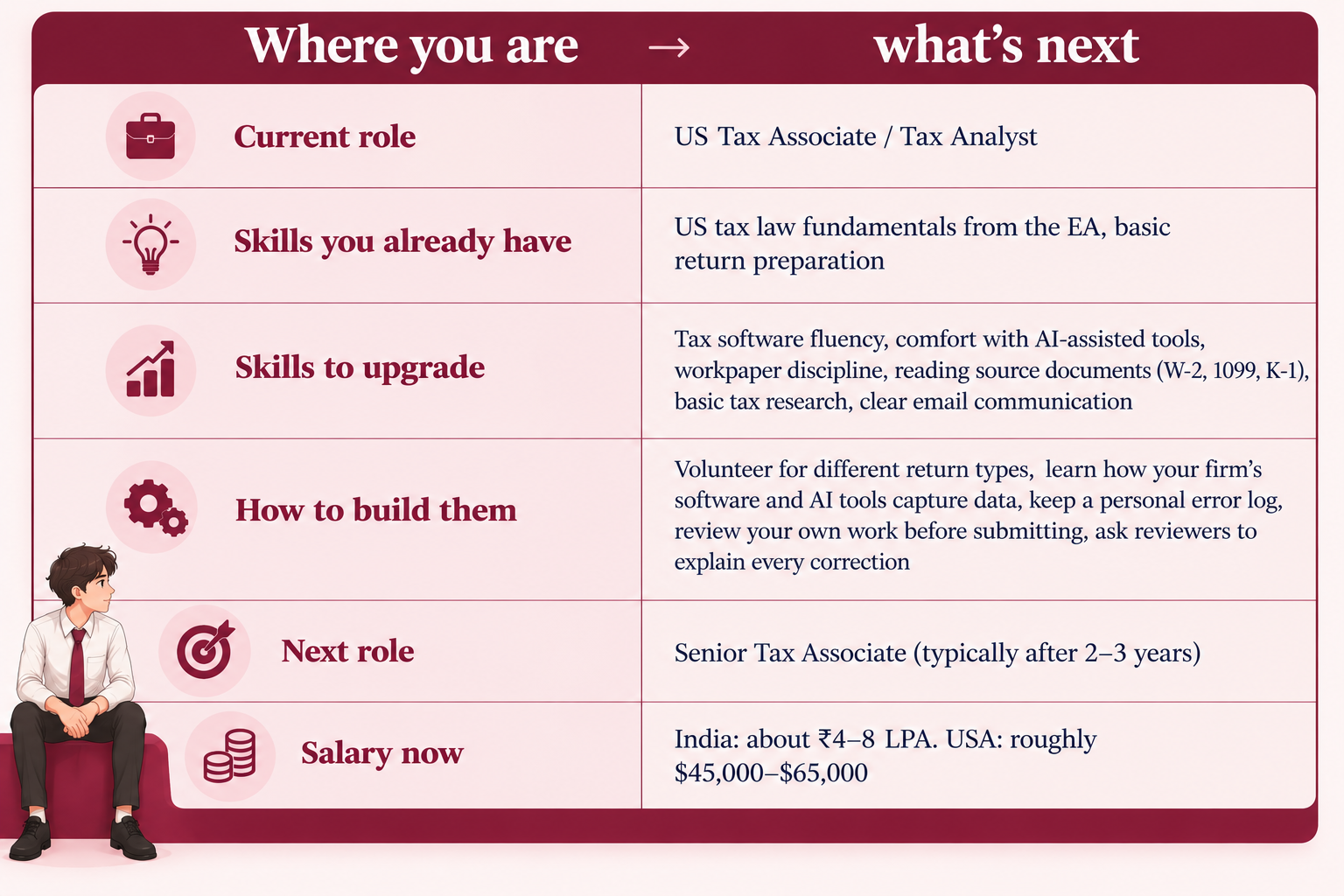
“Notice the pattern: every skill in that third row is about trust. A reviewer who stops finding the same mistakes in your files starts giving you harder files. That is how promotions begin.”
A Quick Detour: How Technology and AI Are Changing US Tax Work
“Meera, I keep hearing that AI will take over tax preparation. Should I be worried?”
“Worried, no. Prepared, yes. Let me explain what is actually changing. A few years ago, a lot of an associate’s days went into typing numbers from source documents into software. Today, tools can read documents such as W-2s, 1099s and K-1s, pull the figures into the return, and flag items that look unusual. AI assistants can also summarize a long IRS notice or draft a first-pass research note on a tax question.”
“So the job gets faster?”
“Yes, and that is good news for you. The repetitive data entry shrinks, so you reach the interesting work sooner: reviewing, questioning numbers, researching tricky issues and advising clients. Firms are also able to handle more returns in the busy season with the same team.”
“Then what is left for humans?”
“Quite a lot. AI can be wrong, and it can sound very confident while being wrong. It may misread a document, apply last year’s rule or miss a fact that only the client knows. As the preparer, you remain responsible for the accuracy of what is filed, so someone must check the output, apply professional judgement, and decide what is correct. Client data is also sensitive, so you must know what you may and may not put into any tool. In short, AI does the first draft; a trained professional owns the final answer.”
“That is why the Associate who learns to use these tools and checks them carefully moves ahead. The one who blindly trusts them, or refuses to use them, falls behind.”
Stage 2: The Senior Tax Associate (3–5 years)
“Say two or three years pass and I’m confident with individual returns. What changes then?”
“Your work stops being only about forms. You will start handling business returns such as partnerships and S-corporations, and you will begin reviewing the work of juniors. You will also be expected to research a tax question and explain your conclusion, not just apply a rule you already know.”
“That sounds like a big jump from preparing returns.”
“It is, and this is where many people stall. They have five years of experience, but it is one year of experience repeated five times. To avoid that, you have to deliberately pick up harder work.”
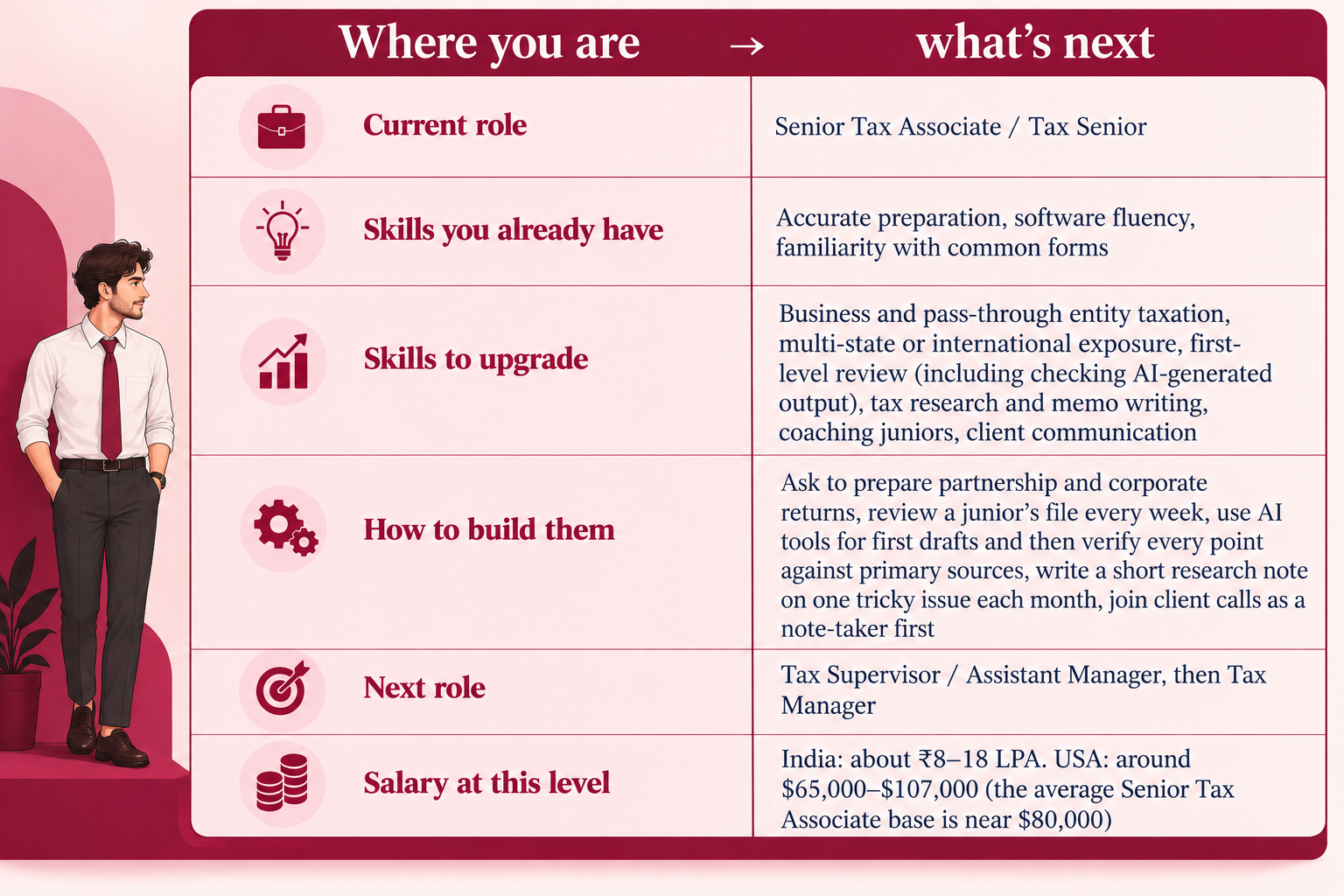
“Look at the EA salary row. In India, this is the stage where pay can nearly double compared with your first job, but only for people who build the review and research skills. Two Senior Associates with the same years of experience can sit at opposite ends of that range.”
Stage 3: The Tax Manager (6–9 years)
“And after that? What does it take to become a Tax Manager?”
“A manager is paid to carry responsibility. You review final returns before they go to the client, you manage deadlines across a team, you handle difficult client questions, and you answer to the partner or director when something goes wrong. The technical bar stays high, but the people bar rise just as fast.”
“So technical skill is no longer enough?”
“It is no longer a skill. Plenty of technically brilliant seniors never become managers because they can’t delegate, can’t explain delays calmly, or can’t develop their team. Managers are judged on how well the whole team performs.”
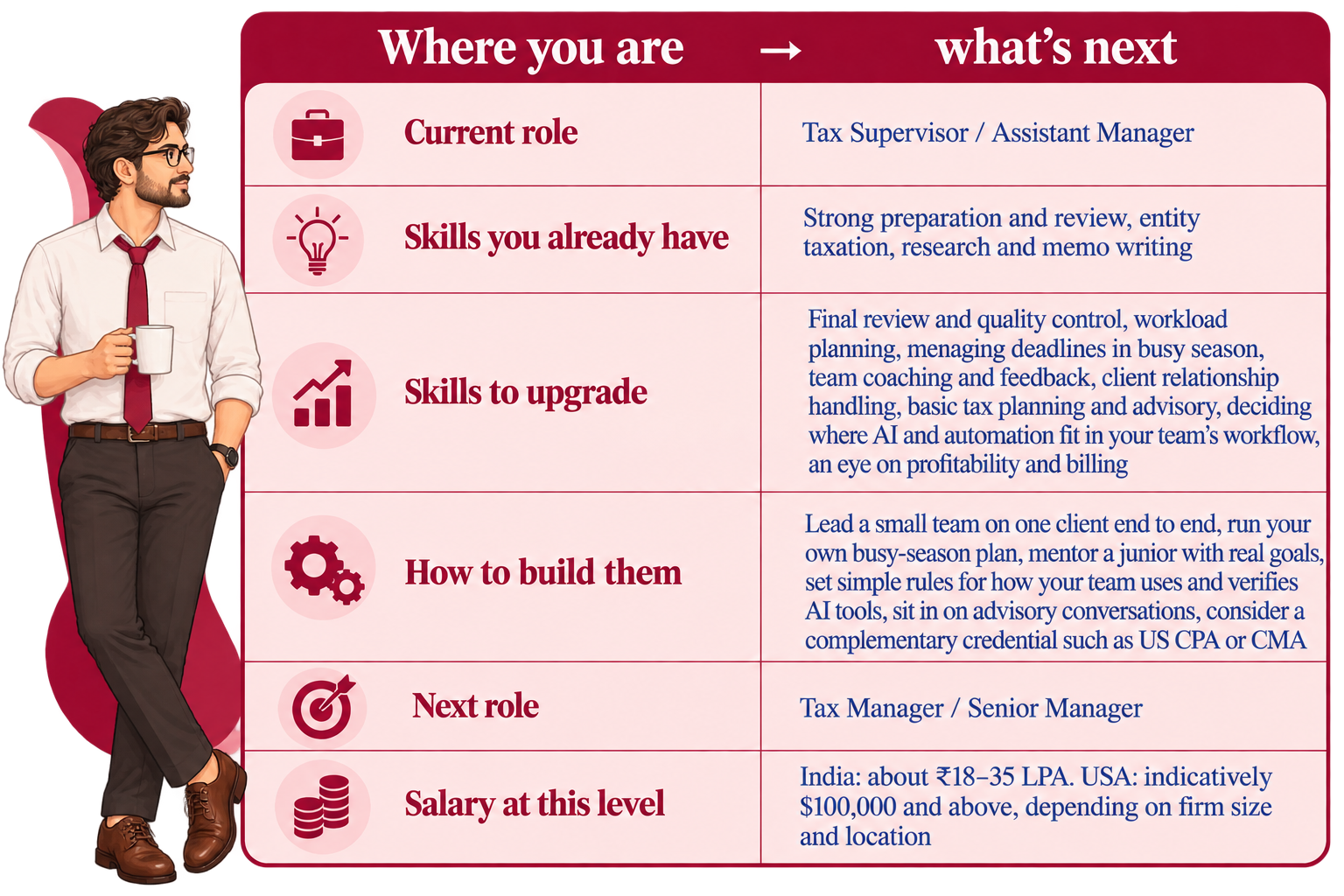
“The India range looks wide because it is. A Big 4 US tax team, a US multinational’s in-house team and a small outsourcing firm pay very differently. Choose your employer type deliberately at this stage, because it shapes the next five years.”
Stage 4: Senior Leadership or Your Own Practice (10+ years)
“Two broad directions. The first is leadership inside an organization: Senior Manager, Associate Director, Director, or Head of US Tax. The second is independent practice, where you use your EA’s right to represent clients before the IRS and build your own client base or a boutique firm.”
“Which one is better?”
“Neither, they suit different people. Leadership rewards people who enjoy building teams and managing relationships inside a larger system. Independent practice rewards people who enjoy client relationships, risk and running a business. In both cases, your reputation does the selling.”
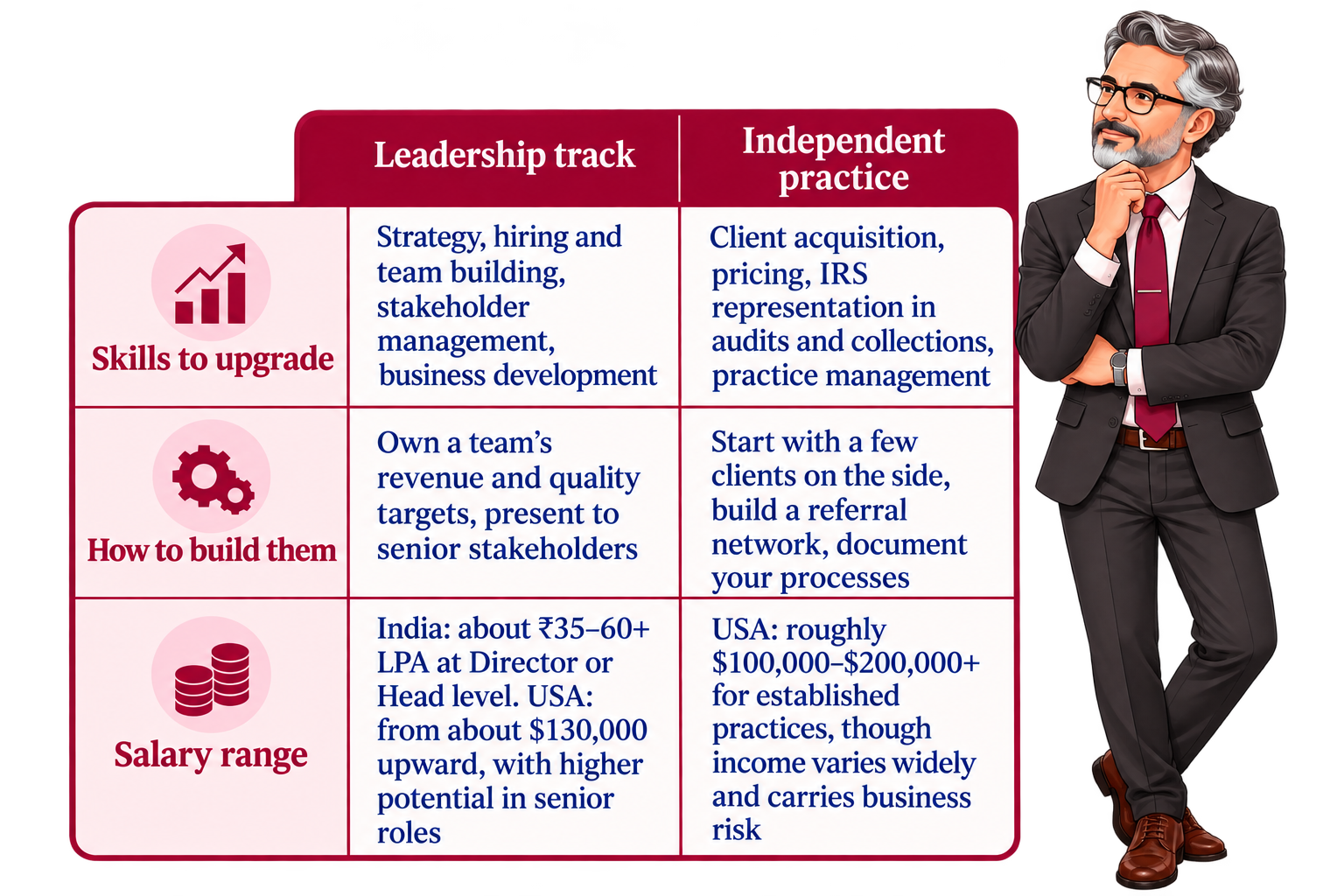
"Please treat those numbers as a guide, not a promise. Independent income especially can swing a lot from year to year."
Putting the Journey Together: Salary Progression at a Glance
“Can you show me the whole journey in one place?”
“Here it is. Read it as a ladder. Each rung is only reachable once you have built the skills from the stage before it.”
| Stage | Typical experience | India (approx.) | USA (approx.) |
|---|---|---|---|
| US Tax Associate | 0–2 years | ₹4–8 LPA | $45,000–$65,000 |
| Senior Tax Associate | 3–5 years | ₹8–18 LPA | $65,000–$107,000 |
| Tax Manager / Senior Manager | 6–9 years | ₹18–35 LPA | $100,000+ |
| Director / Head of US Tax | 10+ years | ₹35–60+ LPA | $130,000+ |
"Two things to notice. First, the biggest percentage jumps happen when you move up a level, not when you simply add another year. Second, adding a complementary credential such as a US CPA can improve earnings further; some industry sources suggest a premium in the range of 25–40 percent for professionals holding both."
Important note: Salary figures in this article are approximate and compiled from published 2026 industry sources. Please verify the current IRS and PSI exam details on the official IRS website before planning your exam.
Where the EA Can Take You Beyond the Main Ladder
“Are there other directions apart from the manager’s route?”
"Yes. Experienced EAs often specialize, because specialists are harder to replace. Common directions include international tax, state and local tax, corporate in-house tax roles, tax advisory and IRS representation work such as audit and collections support. Each of these demands a deeper skill in one area rather than a wider skill across many, so pick one you genuinely enjoy."
The Five Underrated Skills That Decide How Far You Go
“Meera, if I had to pick only a few things beyond tax knowledge, what would they be?”
"Five skills, and they are the most underrated part of an EA's career. Two people can have the same credential and the same technical knowledge, yet end up at very different levels, and these five are usually the reasons.
First, good communication skills. You must explain a tax position clearly to a client who knows nothing about tax and write emails and notes your reviewer can follow in one read.
Second, analytical skills. Spotting that a number looks off, connecting information across forms and finding the real reason behind a variance is what separates a preparer from an advisor.
Third, adoption of AI. Learn the tools your firm uses, get faster with them, and always verify their output. The professionals who combine speed with careful checking will be the ones given larger responsibilities.
Fourth, judgmental capability. Tax rules are not always black and white, and you will meet grey areas where you must weigh the facts, the law and the risk before deciding. No software can take that responsibility for you.
Fifth, good representation skills. As an EA, you can represent taxpayers before the IRS. That means staying calm in audits and notices, presenting facts clearly and negotiating with confidence. Few people build this skill early, which is exactly why it stands out."
“So technical knowledge gets me hired, and these five skills help me get promoted?”
"Well put. Technical knowledge is the basis. These five decide how far you can climb on top of it."
One Practical Update Before You Plan Your Exam
"Anything should I check before I plan my own exam dates?"
"Yes. In 2026, the IRS moved the EA exam from Prometric to PSI Services , and the scoring scale changed too, with 500 now passing score on a 200–800 scale. International candidates, including those in India, test through remote proctoring. Scheduling for international candidates has also seen delays, so always check the IRS and PSI pages for current dates before you commit."
Sum Up: Your Roadmap in One Minute
Career growth after the EA is not a waiting game. At every stage, the pattern is the same: master your current role, upgrade the specific skills the next role demands, take on harder work to prove them, and then step up.
- Associates:Build accuracy, software and AI-tool skills, and discipline.
- Senior Associate:Learn entity taxation, review and research, and verify AI output.
- Manager:Add team leadership, quality control, and client handling.
- Leader or practice owner:Build strategy, business development and reputation.
Along the way, keep developing the five skills that sit on top of your tax knowledge: communication, analytical thinking, AI adoption, judgement and representation. AI will keep making tax work faster, but it works best in the hands of a professional who can check it, question it and take responsibility for the final answer.
Ask yourself Meera's three questions every year: Where am I now? What skill do I need to upgrade? What role and pay could follow? If you can answer them clearly, you are already ahead of most people with the same credentials.
Frequently Asked Questions
1. What is the career path after clearing the EA exam?
Most people start as a US Tax Associate or Analyst, move to Senior Tax Associate, then to Supervisor and Tax Manager, and later to Director or Head of US Tax. Others specialize in international tax, work in corporate tax departments, or start an independent practice.
2. How long does it take to move from Tax Associate to Tax Manager?
It commonly takes six to nine years, but it depends on your employer, the complexity of work you handle, and how quickly you build review and leadership skills. Time alone does not guarantee a promotion.
3. What skills do I need to become a Senior Tax Associate?
Strong return preparation, tax software fluency, comfort with AI-assisted tools, basic research, workpaper discipline and the ability to review a junior's work. Exposure to business returns such as partnerships and S-corporations helps a great deal. Beyond technical skills, communication, analytical thinking, judgement, and the ability to represent clients also count.
4. What is the EA salary in India at different career stages?
Approximate ranges are ₹4–8 LPA for freshers, ₹8–18 LPA at senior associate level, ₹18–35 LPA for managers and ₹35–60+ LPA for directors. Actual pay varies depending on employer type and city.
5. How much does an Enrolled Agent earn in the USA?
Entry-level roles are often in the $45,000–$65,000 range, while Senior Tax Associates average around $80,000, and managers and senior specialists can earn more. Established independent practices can earn above $100,000, with wide variation.
6. Can I move up as an EA without a CPA or CA?
Yes. The EA is a strong credential on its own for US tax roles. A complementary qualification such as a US CPA or CMA can widen your options, especially senior management or broader finance leadership roles.
7. Can an EA work with US clients from India?
Yes. Many EAs in India work with Big 4 firms, US-facing outsourcing firms and the India teams of US companies, and some serve US clients remotely. The right requirements depend on the employer and the type of work.
8. Is the EA worth it if I want a long-term career in US taxation?
For people who want to specialize in US tax, it is a focused and relatively short route into the field. Its value grows when you pair it with continuous skill upgrades, because the credential opens the door, but your skills decide how far you go.
Planning to take EA? Explore our EA course