
Courses After MBA & M.Com: Explore Finance Courses | Simandhar
Explore professional courses after MBA and M.Com, including US CPA, US CMA, US CIA, US EA and ACCA. Find the right finance qualification with Simandhar Education.
Table of Contents
- 1. Why Consider Professional Courses After MBA and M.Com?
- 2. 5 Professional Finance Courses After MBA Finance and M.Com
- 2.1. US CPA (Certified Public Accountant)
- 2.2. US CMA (Certified Management Accountant)
- 2.3. CIA (Certified Internal Auditor)
- 2.4. EA (Enrolled Agent)
- 2.5. ACCA (Association of Chartered Certified Accountants)
- 3. CPA vs CMA vs ACCA: Which Course Should You Choose?
- 3.1. Which should MBA Finance graduates consider?
- 3.2. Which should M.Com graduates consider?
- 4. How Simandhar Education Helps You Prepare for International Finance Qualifications
- 4.1. Global Examination Preparation Resources
- 4.2. 100% Live Learning
- 4.3. AI-Powered Learning Support
- 4.4. Structured Mentorship and Student Support
- 4.5. Career and Placement Assistance
- 5. Conclusion
- 6. Frequently Asked Questions (FAQs)
An MBA or M.Com gives you an academic foundation in finance, accounting and business management. But what comes next if you want to develop specialized expertise, explore international career opportunities or prepare for more focused roles in the finance industry?
For many postgraduate students, the next step is a professional qualification that builds on their existing education.
If you have completed an MBA Finance, you may want to specialize in financial planning, management accounting, auditing, or corporate finance. Similarly, an M.Com graduate may want to strengthen their knowledge of international accounting, taxation, or financial reporting.
This is where professional finance courses can make a difference.
Qualifications such as US CPA, US CMA, CIA, EA, and ACCA offer different areas of specialization and career pathways. Simandhar Education provides preparation for these international qualifications, helping graduates and working professionals plan their next step in accounting and finance.
Let's explore the available options and understand which course could align with your career goals.

Why Consider Professional Courses After MBA and M.Com?
Your postgraduate degree provides theoretical and academic knowledge. A professional qualification can help you develop specialized competencies relevant to specific finance functions.
Consider the following advantages:
- Specialized knowledge: Develop expertise in financial reporting, management accounting, auditing, taxation or risk management.
- International exposure: Understand accounting and financial practices followed in global markets.
- Career specialization: Prepare for specific responsibilities in accounting, corporate finance, auditing, and taxation.
- Professional development: Strengthen your profile with a qualification relevant to your intended career path.
- Practical application: Develop knowledge that can be applied to financial analysis, reporting, compliance, and business decision-making.
However, the right qualification depends on your academic background, eligibility, and the type of professional role you want to pursue.
5 Professional Finance Courses After MBA Finance and M.Com
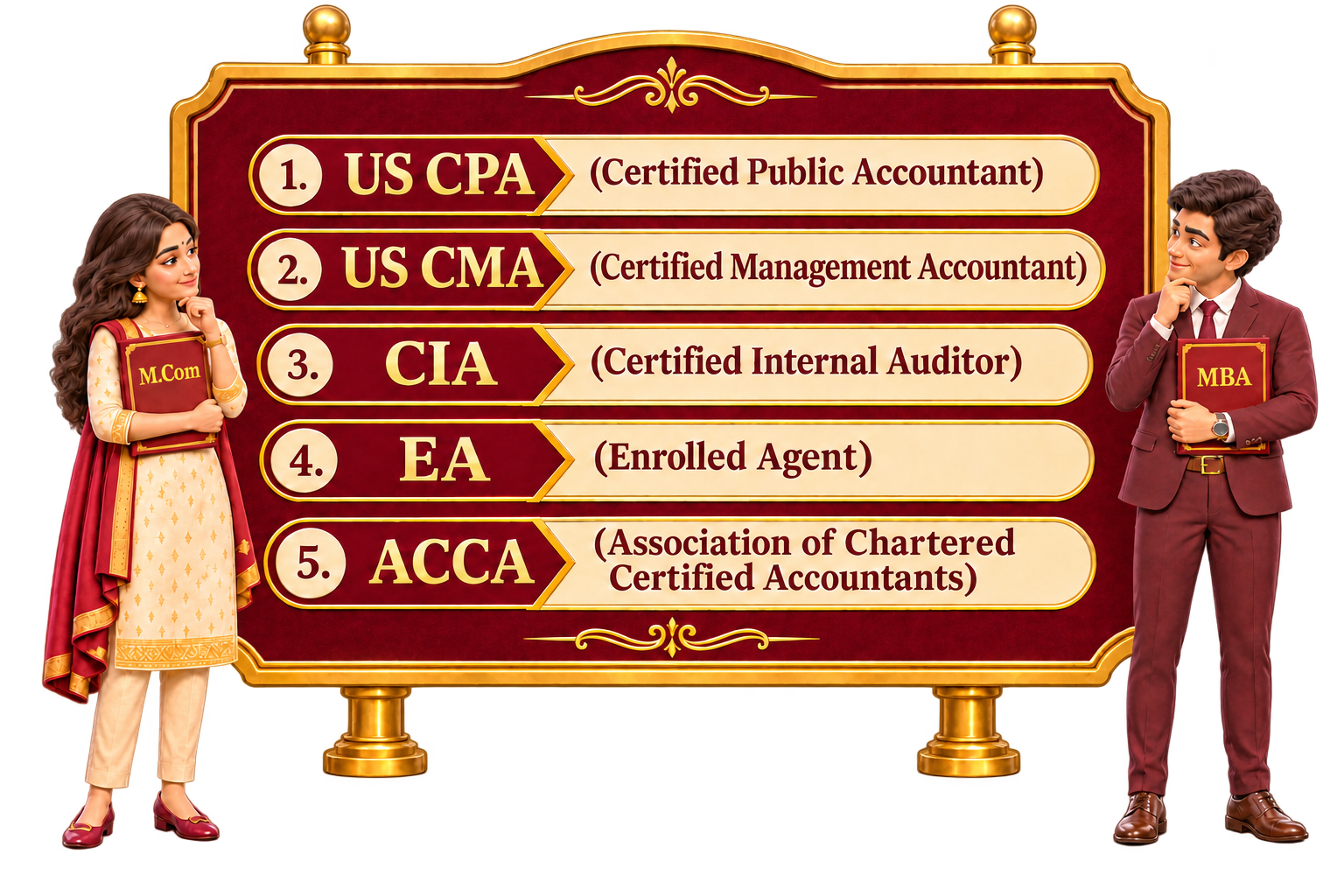
If you are exploring job-oriented courses after MBA Finance or accounting courses after M.Com, here are five international qualifications worth considering.
1. US CPA (Certified Public Accountant)
Specialization: Accounting, Auditing, Taxation and Financial Reporting
The US CPA is a professional accounting qualification for individuals interested in financial reporting, auditing, taxation, and regulatory compliance.
For MBA Finance and M.Com graduates, it can be a relevant pathway if they want to develop expertise in international accounting and financial reporting.
The US CPA examination consists of four sections:
- FAR – Financial Accounting and Reporting
- AUD – Auditing and Attestation
- REG – Regulation
- Discipline – Choose one among BAR, ISC or TCP.
Career opportunities:
- Financial Reporting Analyst
- Audit Associate
- Tax Consultant
- Financial Controller
- Risk and Compliance Professional
Why consider it? If your career interest lies in accounting, audit, taxation, or financial reporting, US CPA can complement your postgraduate education with specialized professional knowledge.
Candidates must meet the applicable US State Board for educational and credit requirements. Eligibility should be evaluated individually.
2. US CMA (Certified Management Accountant)
Specialization: Management Accounting, Financial Planning and Strategic Finance
If you are interested in corporate finance, financial planning, budgeting, and business performance, US CMA is worth exploring.
The qualification focuses on how organizations use financial information to manage costs, evaluate performance, and make strategic business decisions.
The US CMA examination has two parts:
- Part 1: Financial Planning, Performance and Analytics – Budgeting, forecasting, cost management, performance management, internal controls and technology.
- Part 2: Strategic Financial Management – Financial statement analysis, corporate finance, decision analysis, risk management and investment decisions.
Career opportunities:
- FP&A Analyst
- Management Accountant
- Cost Accountant
- Finance Business Partner
- Financial Analyst
- Finance Manager
Why consider it? MBA Finance graduates can build on their knowledge of financial management and business strategy, while M.Com graduates can develop specialized expertise in management accounting and corporate finance.
3. CIA (Certified Internal Auditor)
Specialization: Internal Auditing, Risk Management and Governance
For postgraduate students interested in internal auditing, organizational controls, and risk assessment, CIA offers a focused professional pathway.
Awarded by The Institute of Internal Auditors (IIA), the Certified Internal Auditor qualification develops knowledge of internal audit principles, audit engagements, governance and business operations.
The CIA examination consists of three parts:
- Part 1: Internal Audit Fundamentals
- Part 2: Internal Audit Engagement
- Part 3: Internal Audit Function
Career opportunities:
- Internal Auditor
- Internal Audit Manager
- Risk and Compliance Analyst
- Risk Advisory Professional
- Internal Controls Specialist
Why consider it? If you want to build a career in internal auditing, risk management, or corporate governance, CIA can help you develop the specialized knowledge required in these functions.
4. EA (Enrolled Agent)
Specialization: US Taxation and IRS Representation
If taxation is your area of interest, EA is another qualification to consider after an MBA or M.Com.
An Enrolled Agent is a federally authorized tax practitioner who can represent taxpayers before the Internal Revenue Service (IRS).
The Special Enrollment Examination (SEE) consists of three parts:
- Part 1: Individuals
- Part 2: Businesses
- Part 3: Representation, Practices and Procedures
Career opportunities:
- US Tax Associate
- Tax Analyst
- US Tax Consultant
- Tax Preparation Specialist
- Tax Compliance Professional
Why consider it? EA is suitable for graduates and working professionals who want to specialize in US taxation, tax preparation and compliance.
5. ACCA (Association of Chartered Certified Accountants)
Specialization: International Accounting, Auditing and Finance
ACCA is a professional accountancy qualification that covers financial accounting, management accounting, taxation, auditing, financial management and business strategy.
For M.Com graduates, it can provide an opportunity to develop further expertise in professional accounting. MBA Finance graduates can also explore it if they want to strengthen their technical accounting knowledge.
The ACCA qualification has three examination levels:
- Applied Knowledge: Business, management accounting and financial accounting fundamentals.
- Applied Skills: Financial reporting, taxation, audit and financial management.
- Strategic Professional: Advanced technical knowledge, professional judgement, and strategic business leadership.
The qualification includes up to 13 examinations, with exemptions depending on previous academic qualifications and ACCA's assessment.
Career opportunities:
- Financial Accountant
- Management Accountant
- Financial Reporting Analyst
- Audit Professional
- Finance Business Partner
- Finance Manager
Why consider it? ACCA is worth exploring if you want to build a career in international accounting, financial management, and auditing.
CPA vs CMA vs ACCA: Which Course Should You Choose?
One of the most common questions among postgraduate students is how to choose between US CPA, US CMA, and ACCA.
Although all three are professional finance qualifications, their areas of specialization differ.
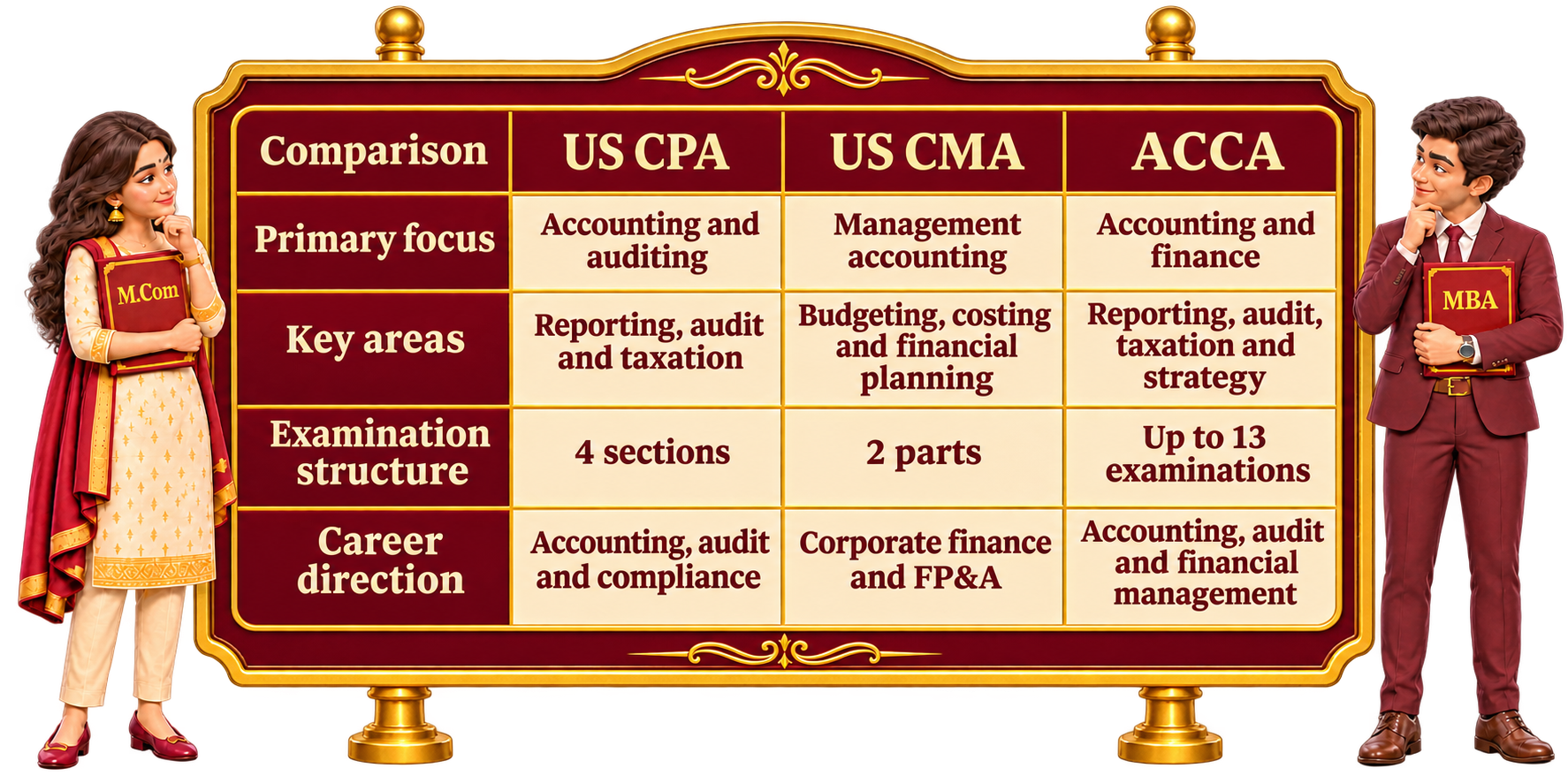
Which should MBA Finance graduates consider?
- US CPA for accounting, auditing, and financial reporting.
- US CMA for corporate finance, budgeting, and financial planning.
- ACCA for broader accounting and financial management expertise.
Which should M.Com graduates consider?
- US CPA for international accounting and auditing.
- US CMA for management accounting and strategic finance.
- ACCA for professional accounting and financial reporting.
You can also explore CIA if internal auditing interests you, or EA if you want to specialize in US taxation.
Remember that your postgraduate degree, academic credits, experience, and career objectives should all influence your decision.
How Simandhar Education Helps You Prepare for International Finance Qualifications
Choosing a qualification is an important decision. However, preparing for an international professional examination also requires the right learning resources, academic guidance, and consistent support.
Simandhar Education offers preparation for US CPA, US CMA, CIA, EA and ACCA, with course-specific learning resources and support.
Here is what students can explore:
1. Global Examination Preparation Resources
Simandhar is the exclusive Becker partner in India for US CPA and US CMA exam preparation. Students can access Becker's examination preparation resources through the applicable programmes. CIA preparation includes Gleim study materials, while ACCA students receive access to BPP study materials to support their examination preparation.
2. 100% Live Learning
Learn through instructor-led live classes, interact with faculty, and clarify doubts during your preparation. Recorded lectures are also available for revision.
3. AI-Powered Learning Support
Simandhar's learning ecosystem includes Becker Newt AI and AI Sripal, along with the CAAP (Certified AI Accounting Professional) programme, which introduces practical AI applications for accounting and finance professionals.
4. Structured Mentorship and Student Support
Access academic guidance, 1:1 mentorship and student community support through applicable course programmes.
5. Career and Placement Assistance
Prepare for professional opportunities through interview preparation, resume development, industry readiness, and career guidance. Placement assistance is available through eligible programmes and is subject to the applicable terms.
Simandhar's objective is to help students prepare international qualifications while developing the professional and technology-related skills relevant to today's finance industry.
Conclusion
Your MBA or M.Com does not have to be the final milestone in your professional education. It can be the starting point for developing specialized expertise in accounting, finance, taxation, or auditing.
Whether you choose US CPA, US CMA, CIA, EA or ACCA, focus on the qualification that complements your academic background and supports your long-term career objectives.
With structured preparation, global examination resources, live learning and career support, Simandhar Education can help you plan your next step towards a professional finance career.
Not sure which qualification suits your MBA or M.Com background?
Connect with a Simandhar Education counsellor to understand your options, check your eligibility and explore the right course for your career goals.
Frequently Asked Questions (FAQs)
1. What are the best courses after MBA and M.Com?
MBA and M.Com graduates can explore US CPA, US CMA, CIA, EA, and ACCA. Each qualification focuses on a different area, including accounting, management finance, auditing, taxation and financial reporting. The right choice depends on your career interests and eligibility.
2. What should I do after completing an MBA Finance?
You can consider professional qualifications such as US CMA, US CPA, or ACCA to develop specialized knowledge in finance and accounting. US CMA is relevant to management accounting and corporate finance, while US CPA focuses on accounting, auditing and financial reporting.
3. Can I pursue US CPA after MBA Finance?
Yes, MBA Finance graduates can pursue US CPA if they meet the educational and credit requirements of the applicable US State Board of Accountancy. Eligibility depends on the subjects and credits completed, so an individual evaluation is recommended.
4. Which accounting courses are available after M.Com?
M.Com graduates can explore US CPA, US CMA and ACCA for accounting and financial management specialization. CIA is another option for internal auditing, while EA is suitable for those interested in US taxation.
5. What is the difference between US CPA and US CMA after MBA?
US CPA focuses on accounting, auditing, taxation, and financial reporting. US CMA focuses on budgeting, financial planning, cost management and strategic decision-making. Your intended career specialization should determine which qualification you choose.
6. What are the career opportunities after MBA Finance with an international certification?
Depending on the qualification, experience and skills you develop, you can explore roles such as Financial Analyst, FP&A Analyst, Management Accountant, Audit Associate, Tax Consultant, Financial Reporting Analyst and Risk and Compliance Professional.
7. How do I choose between US CPA, US CMA and ACCA?
Choose US CPA for accounting, auditing and financial reporting, US CMA for management accounting and corporate finance, and ACCA for broader accounting, auditing and financial management. Also evaluate your academic eligibility and long-term career interests before enrolling.
8. Does Simandhar Education provide placement assistance after professional finance courses?
Yes, Simandhar Education offers placement assistance and career support through applicable programmes. This can include interview preparation, resume development, industry readiness, and career guidance. The specific support depends on the course and enrollment package.