
CPA Journey After B.Com & MBA Finance
A detailed, expert-level CPA journey of Krati Mehta, how she transitioned from B.Com and MBA Finance to CPA while working, overcame audit challenges, and succeeded with the right strategy.
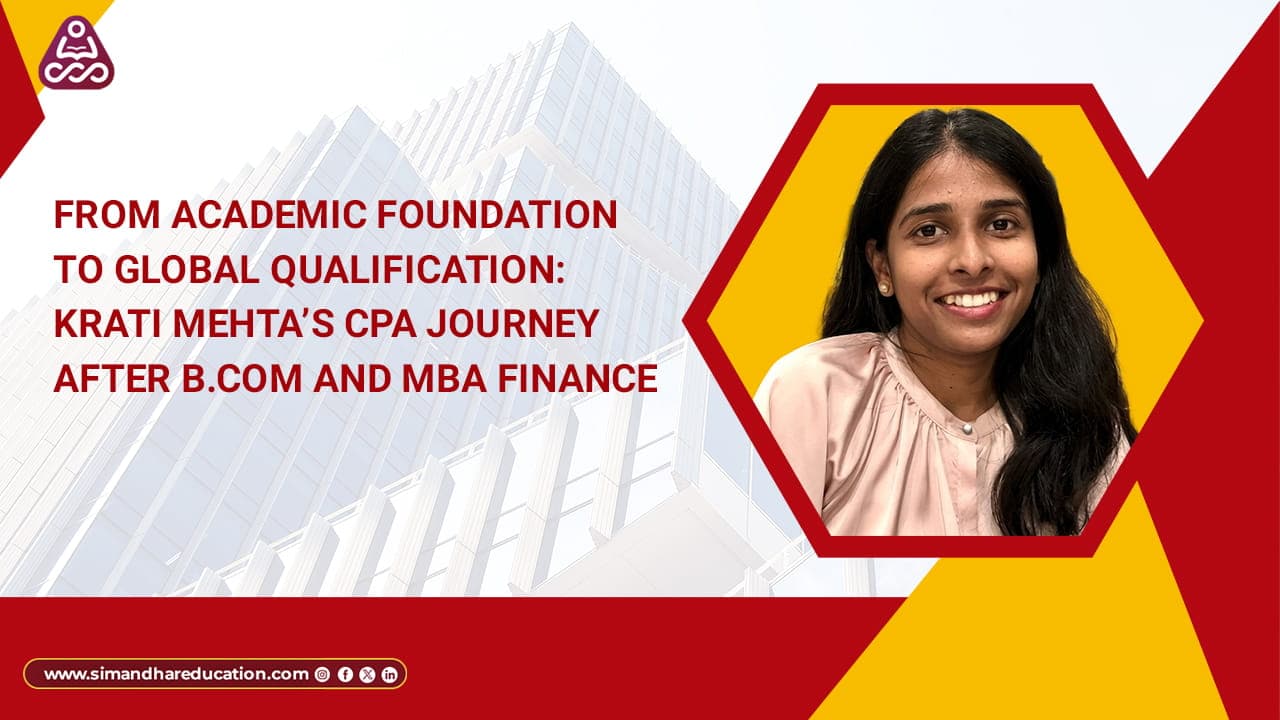
Table of Contents
- 1. From Academic Foundation to Global Qualification: Krati Mehta’s CPA journey After B.Com and MBA Finance
- 2. Introduction
- 3. Can you pursue CPA after B.Com and MBA Finance while working?
- 4. Academic Foundation and Early Career Context
- 5. The Decision Inflection Point: Why CPA?
- 6. Evaluating CPA Through a Strategic Lens
- 7. The Role of Peer Signaling in Career Decisions
- 8. Institutional Support and Learning Ecosystem
- 9. The Reality of Preparing for CPA While Working
- 10. The Audit Challenge: A Case of Conceptual Depth vs Familiarity
- 11. Strategic Adaptation: What Changed the Outcome
- 12. Time Allocation and Cognitive Discipline
- 13. Timeline and Completion Trajectory
- 14. Key Learnings from the Journey
- 15. Prescriptive Advice for Future Candidates
- 16. Why Structured Coaching Alters Outcomes
- 17. Why Simandhar Education Becomes a Strategic Lever
- 18. Conclusion
- 19. FREQUENTLY ASKED QUESTIONS
- 19.1. Can I pursue CPA after MBA Finance?
- 19.2. Is it feasible to complete CPA while working full-time?
- 19.3. Why is the audit section considered difficult in CPA?
- 19.4. How many hours should I study daily for CPA?
- 19.5. Does coaching significantly impact CPA success?
Table of Contents
From Academic Foundation to Global Qualification: Krati Mehta’s CPA journey After B.Com and MBA Finance
Introduction
Professional success in accounting and finance is rarely the result of a single decision. Rather, it is the cumulative outcome of strategic choices, adaptive learning, and sustained discipline.
Krati Mehta’s journey, from completing B.Com and MBA in Finance to earning the CPA qualification, illustrates how individuals recalibrate their career trajectories in response to evolving professional aspirations. Her experience offers not only a narrative of persistence, but a framework for decision-making and execution for aspirants navigating similar paths.
Can you pursue CPA after B.Com and MBA Finance while working?
Yes. CPA is a highly viable pathway for candidates with a B.Com and MBA in Finance. With disciplined time management, structured preparation, and appropriate guidance, it can be successfully completed alongside full-time employment.
Academic Foundation and Early Career Context
Krati’s academic progression, B.Com followed by an MBA in Finance, provided her with a robust conceptual grounding in accounting, financial management, and business strategy.
However, rather than immediately pursuing a professional qualification, she chose to enter the workforce. This decision proved critical, as it enabled her to contextualize academic knowledge within real-world financial operations, thereby sharpening her understanding of industry expectations.
The Decision Inflection Point: Why CPA?
The decision to pursue CPA emerged not from external pressure, but from deliberate exploration. While evaluating professional qualifications such as CFA and CPA, Krati undertook a comparative assessment based on:
● Subject alignment with prior education
● Relevance to her career goals
● Applicability within corporate environments
She identified CPA as a qualification that offered both conceptual continuity and global applicability, making it a strategically coherent choice.
Evaluating CPA Through a Strategic Lens
CPA’s curriculum, governed by the American Institute of Certified Public Accountants, emphasizes application-oriented knowledge across audit, financial reporting, and regulation.
For a candidate with prior exposure to finance and accounting, this creates a cumulative learning advantage, reducing redundancy and accelerating comprehension.
The Role of Peer Signaling in Career Decisions
An important catalyst in Krati’s journey was the influence of a peer who had recently completed CPA.
This individual not only validated the feasibility of the qualification but also recommended Simandhar Education as a preparation partner.
Such peer signaling plays a critical role in reducing informational asymmetry, particularly in decisions involving high-investment professional pathways.
Institutional Support and Learning Ecosystem
Krati’s experience with Simandhar Education can be characterized by structured support and responsive mentorship.
She highlights:
● Continuous faculty engagement
● Administrative responsiveness
● Strategic guidance during setbacks
In professional certifications, where ambiguity often impedes progress, such an ecosystem provides directional clarity and psychological reinforcement.
The Reality of Preparing for CPA While Working
Preparing for CPA alongside employment introduces a dual constraint, time limitation and cognitive fatigue.
Krati addressed this through disciplined scheduling:
● Weekdays: 2–3 hours of focused study
● Weekends: 6–7 hours of extended engagement
This approach reflects an understanding that success in CPA is not contingent on sporadic intensity, but on consistent, incremental progression.
The Audit Challenge: A Case of Conceptual Depth vs Familiarity
Among all sections, audit emerged as the most challenging. This difficulty was not incidental, it stemmed from a lack of practical exposure to audit processes.
Audit demands more than theoretical understanding. It requires:
● Procedural comprehension
● Contextual judgment
● Application in unfamiliar scenarios
This distinction often creates barriers for candidates without prior audit experience.
Strategic Adaptation: What Changed the Outcome
Krati’s eventual success was not the result of increased effort alone, but of strategic recalibration.
Key adaptations included:
● Repeated and layered reading of core material
● Intensive simulation practice
● Peer interaction to understand problem-solving approaches
● Moving beyond familiarity with question banks to conceptual mastery
This transition from passive repetition to active cognition marked a turning point in her preparation.
Time Allocation and Cognitive Discipline
A critical insight from her journey is that effective preparation is not defined by hours alone, but by how those hours are utilized.
High-impact study involves:
● Deep engagement with concepts
● Deliberate practice of complex areas
● Regular revision cycles
In this context, discipline becomes less about duration and more about consistency and intentionality.
Timeline and Completion Trajectory
● Initiation of CPA journey: May 2023
● Evaluation phase: Approximately 6 months
● First examination: December 2023
● Completion: December 2025
Her journey, spanning approximately two years, underscores the importance of persistence over immediacy.
Key Learnings from the Journey
Krati’s experience yields several generalizable insights:
● Premature exam attempts without preparation can negatively impact performance
● conceptual clarity supersedes superficial coverage
● Simulation practice is indispensable, particularly for audit
● Peer learning accelerates comprehension
● Structured guidance significantly enhances efficiency
Prescriptive Advice for Future Candidates
Her recommendation is methodical and grounded:
Prioritize understanding over speed. Engage deeply with the material, leverage peer insights, and seek guidance when necessary.
This reflects a broader principle:
Professional qualifications reward depth of understanding, not superficial progression.
Why Structured Coaching Alters Outcomes
In certifications like CPA, success is not solely dependent on individual effort. It is also shaped by:
● Access to curated resources
● Clarity of exam expectations
● Feedback mechanisms
structured coaching reduces inefficiencies and enhances directional accuracy, thereby improving overall outcomes.
Why Simandhar Education Becomes a Strategic Lever
Simandhar Education functions not merely as a coaching provider, but as a career enabler.
Its ecosystem integrates:
● Becker-aligned CPA preparation
● Faculty with domain expertise
● Peer-driven learning environment
● Placement-oriented support, including for freshers
For candidates balancing work and study, such integration significantly improves the probability of successful completion.
Conclusion
Krati Mehta’s journey illustrates that CPA is not an outcome of linear progression, but of iterative refinement and sustained commitment.
Her experience reinforces three core principles:
● Strategic alignment of qualification with career goals
● Adaptive learning in response to challenges
● Consistent execution over extended periods
For individuals with a B.Com and MBA background, CPA represents not just an additional credential, but a gateway to globally relevant professional opportunities.
FREQUENTLY ASKED QUESTIONS
1. Can I pursue CPA after MBA Finance?
Yes, CPA is highly suitable after MBA Finance, particularly for candidates targeting global corporate roles.
2. Is it feasible to complete CPA while working full-time?
Yes, with structured time management and consistent study routines, CPA can be completed alongside employment.
3. Why is the audit section considered difficult in CPA?
Audit requires application-based understanding and practical insight, making it challenging for candidates without prior exposure.
4. How many hours should I study daily for CPA?
An effective approach involves 2–3 hours on weekdays and extended study on weekends, with emphasis on conceptual clarity and practice.
5. Does coaching significantly impact CPA success?
Yes, structured coaching provides clarity, mentorship, and strategic direction, all of which enhance success probability.
Planning to take CPA? Explore our CPA course