
Why Do Students Fail the US CPA Exam on Their First Attempt? 10 Common Mistakes and How to Pass
Why students fail the US CPA exam on the first attempt: 10 common mistakes, a study timetable, a 30-day plan and tips to pass the CPA exam first time.
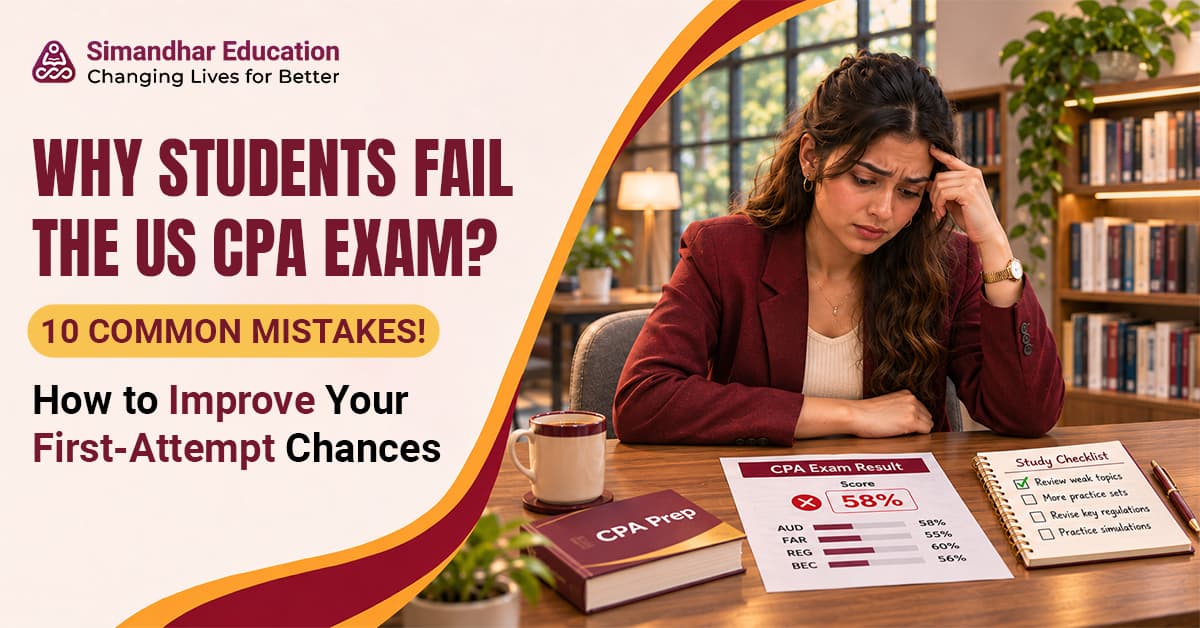
Table of Contents
- 1. Why Is Passing the US CPA Exam on the First Attempt Challenging?
- 2. 10 Common Mistakes Students Make While Preparing for the US CPA Exam
- 3. Common Mistake vs Correct Approach
- 4. How to Create an Effective US CPA Exam Study Timetable
- 4.1. Sample Study Timetable (Working Professional, About 2.5 Hours on Weekdays)
- 5. MCQs vs TBS: Why Should Students Focus on Both?
- 6. How to Identify Your Weak Areas Before the Exam
- 7. The Final 30-Day CPA Exam Preparation Strategy
- 8. How to Manage Exam Stress and Maintain Consistency
- 9. What Should You Do If You Fail a CPA Exam Section?
- 10. How Can the Right CPA Coaching and Mentorship Help?
- 11. Self-Assessment Checklist: Are You Really Ready for Your US CPA Exam?
- 12. Your First Attempt Doesn't Have to Become a Learning Experience for Your Next Attempt
- 13. Frequently Asked Questions
Why Is Passing the US CPA Exam on the First Attempt Challenging?
You have attended the lectures, read the chapters and put in the hours, yet the score report says below 75. If that sounds familiar, you are in good company. Pass rates for individual CPA sections usually sit well below 60%, so a first-attempt setback is far more common than students expect.
The good news is that most failures are not about intelligence. They come from preparation mistakes that can be fixed. The CPA exam rewards application, not memorization, and it punishes patchy planning. Under the current CPA Evolution model, you clear three Core sections (AUD, FAR and REG) plus one Discipline (BAR, ISC or TCP), and every section needs a score of 75 or higher.
In this guide, we cover why students fail the US CPA exam, the 10 most common mistakes, a realistic study timetable, a 30-day final strategy and what to do if a section does not go your way. Whether you are a commerce graduate in India or a working professional studying after office hours, this is your first-attempt playbook.
10 Common Mistakes Students Make While Preparing for the US CPA Exam
- Starting without a plan. Riya buys her course, watches lectures "whenever she is free" and has no exam date. Six months later, she has covered half of FAR. Fix: book your exam slot first and work backwards.
- Underestimating the syllabus. Many students assume the CPA is "just accounting". In reality, a section can span dozens of topics, from lease accounting to audit sampling. Plan roughly 350 to 400 study hours across the four sections.
- Watching lectures but skipping practice. Arjun finishes every video and feels confident, then freezes on real questions. Passive learning feels productive, but only practice shows what you can apply.
- Ignoring Task-Based Simulations (TBS). TBS carry about half the weight in the Core sections. Students who only drill MCQs lose marks on research, journal entries and reconciliations.
- Memorizing instead of understanding. Cramming the consolidation steps without knowing why they work collapses when the question is reworded. Learn the logic, then the rule.
- Not reviewing mistakes. Doing 100 questions and checking only the score wastes the most valuable part: the explanations. Every wrong answer is a free lesson.
- Poor time management on exam day. Spending eight minutes on one stubborn MCQ leaves the last TBS rushed. Set a per-question pace and move on.
- Studying inconsistently. Four hours on Sunday and nothing on weekdays leads to constant relearning. Steady daily study beats occasional marathons.
- Taking mock exams too late, or never. A full-length mock shows your stamina, pacing and weak areas. Students who first see the exam interface on test day lose precious minutes.
- Studying alone without feedback. Without a mentor, you cannot tell whether a gap is conceptual or just careless. Doubts pile up, and so does the stress.
Common Mistake vs Correct Approach
| Common Mistake | Correct Approach |
|---|---|
| Studying without an exam date | Book the slot and plan backwards |
| Only watching lectures | 40% learning, 60% practice |
| Skipping TBS | Practice TBS from the first week |
| Memorizing rules | Understand the logic, then revise |
| Ignoring wrong answers | Keep an error log and revisit it weekly |
| Irregular study hours | Fixed daily slot, even if short |
| Late mock exams | First mock at the halfway point |
How to Create an Effective US CPA Exam Study Timetable
A good timetable is realistic, not heroic. Most candidates need around 80 to 100 hours per section, so the real question is how many weeks those hours take you. Full-time students can finish a section in 6 to 8 weeks, while working professionals may need 10 to 12.
Start with your exam date, subtract two weeks for final revision, and divide the remaining time across units. Always leave one buffer day each week, because life happens.
Sample Study Timetable (Working Professional, About 2.5 Hours on Weekdays)
| Day | Study Hours | Activity |
|---|---|---|
| Monday | 2 | Lecture and notes on one topic |
| Tuesday | 2 | MCQ practice on Monday's topic |
| Wednesday | 2 | Next topic lecture and notes |
| Thursday | 2 | MCQs plus error-log review |
| Friday | 1.5 | TBS practice |
| Saturday | 4 | Mixed practice, weekly revision |
| Sunday | Off or 1 | Light review, rest |
This adds up to roughly 12 to 14 hours a week, which suits a working professional. Students with more time can scale it up, but keep the rhythm the same.
MCQs vs TBS: Why Should Students Focus on Both?
MCQs test speed and breadth. TBS test depth, application and, in some sections, research skills. In the Core sections, the two carry roughly equal weight, so ignoring either one puts a pass out of reach.
A practical split is to start with MCQs while you learn a topic, then add TBS practice once concepts settle. In the last four weeks, practice both in exam-like testlets with a timer. Review every TBS you get wrong, since these usually expose weak concepts that MCQs hide.
How to Identify Your Weak Areas Before the Exam
You cannot fix what you do not measure. Try this simple routine:
- Track accuracy by topic: Note your score for every practice set. Anything under 70% needs attention.
- Maintain an error log: Write the question, why you got it wrong (concept, calculation or carelessness) and the fix.
- Take diagnostic mocks: One mock at the halfway point and another two weeks before the exam.
- Revisit repeat offenders: If the same topic appears three times in your log, re-study it from scratch.
The Final 30-Day CPA Exam Preparation Strategy
The last month is about consolidation, not new learning. Here is a practical 30-day roadmap.
- Days 1 to 10: Complete content revision. Finish any pending units and revise using summary notes. Do daily MCQ sets of 30 to 50 questions.
- Days 11 to 20: Targeted weak-area repair. Use your error log. Re-study the three weakest topics and practice TBS on them daily.
- Days 21 to 25: Full-length mocks. Take two or three timed mocks under exam conditions, then spend twice as long reviewing them.
- Days 26 to 29: Light revision. Go through formulas, standards and your error log. Stop learning new topics.
- Day 30: Rest. Check your admission ticket and ID, travel to the test center in advance if needed, and sleep well.
How to Manage Exam Stress and Maintain Consistency
Stress is normal, but it should not run your preparation. Study in short blocks of 50 minutes with 10-minute breaks, and protect your sleep, especially in the final week. Keep one non-study activity in your routine, such as a walk or a sport, so that your mind recovers.
If you are preparing while working full-time, lower the daily target on tough days instead of skipping altogether. Even 60 focused minutes keeps the habit alive. Celebrate small wins, like finishing a unit or improving a mock score by five points.
What Should You Do If You Fail a CPA Exam Section?
First, breathe. Failing one section does not end your CPA journey, and your other passed sections remain valid within your credit window. The length of that window varies by jurisdiction, so confirm it with your state board.
Then follow a retake strategy:
- Study your score report to see which areas were weakest.
- Rebuild your error log and re-study those topics.
- Change what did not work, whether that is the timetable, the practice volume or the pacing.
- Book your retake while the content is still fresh, usually within four to six weeks.
Treat the first attempt as data, not a verdict.
How Can the Right CPA Coaching and Mentorship Help?
Good coaching gives you structure, accountability and fast answers. A mentor can spot patterns in your mistakes, adjust your timetable and keep you moving on tough days. For students in India, guidance on exam scheduling, time zones, eligibility and licensing pathways saves months of confusion.
At Simandhar Education, students prepare with Becker's globally recognized study material along with mentorship, live doubt-clearing and structured study plans. The aim is simple: help you spend your hours on the right things the first time.
Self-Assessment Checklist: Are You Really Ready for Your US CPA Exam?
Tick honestly. If you cannot tick at least eight, consider delaying your exam by a couple of weeks.
Your First Attempt Doesn't Have to Become a Learning Experience for Your Next Attempt
Most students who fail the CPA exam do not lack ability. They lacked a plan, enough practice or timely feedback. Fix those three things and your first attempt becomes your best attempt. Start with your exam date, build a realistic timetable, balance MCQs and TBS, and treat your error log as your most valuable study tool.
Ready to build a first-attempt CPA plan that fits your schedule? Speak to a Simandhar Education counsellor and get personalized guidance today.
Frequently Asked Questions
1 Why do students fail the US CPA exam on their first attempt?
Mostly due to weak planning, too little practice, ignoring TBS and poor time management, rather than a lack of ability.
2 How can I pass the US CPA exam on my first try?
Set an exam date, follow a structured timetable, practice MCQs and TBS regularly, take timed mocks and review every mistake.
3 What are the common mistakes to avoid while preparing for the CPA exam?
Studying without a plan, skipping practice, ignoring TBS, memorizing without understanding and starting mocks too late.
4 How many hours should I study daily for the US CPA exam?
Two to three hours on weekdays and longer on weekends works for most working professionals. Full-time students can manage four to six.
5 What is the best study timetable for US CPA students?
One that alternates learning and practice, includes weekly revision and fits your life. Around 80 to 100 hours per section is a common benchmark.
6 How do I prepare for the US CPA exam while working full-time?
Block a fixed daily slot, use weekends for practice and mocks, and extend your timeline to 10 to 12 weeks per section.
7 How can I improve my CPA exam MCQ and TBS performance?
Do timed practice, study explanations for wrong answers, and attempt TBS from the early weeks, not just at the end.
8 What should I do if I fail one section of the US CPA exam?
Review your score report, fix weak areas and retake within a few weeks. Your passed sections stay valid within your credit window.
9 How do I manage time during the US CPA exam?
Set a pace per question, flag tough ones and return later, and leave enough time for the TBS testlet.
10 How do I prepare for the US CPA exam from India?
Confirm eligibility with your state board, choose quality study material, plan around your exam slots and consider mentorship for guidance throughout.
Planning to take CPA? Explore our CPA course