
EA Eligibility 2026: Who Can Apply in India?
Learn EA eligibility in India for 2026, including education requirements, work experience, exam process, PTIN, career opportunities, and Simandhar EA guidance.
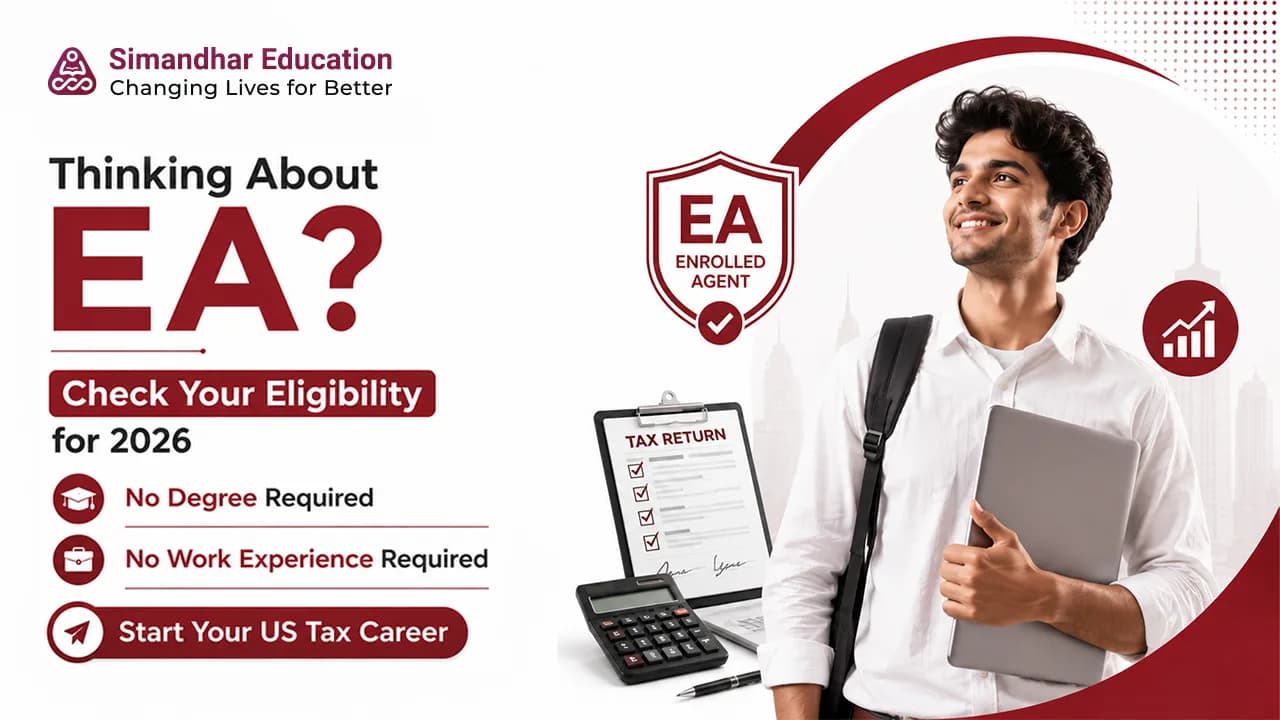
Table of Contents
- 1. What Is EA Certification?
- 2. Why EA Eligibility Matters in 2026
- 3. EA Eligibility 2026: Simple Overview
- 4. Who Is Eligible for EA Certification in India?
- 5. What Are the EA Education Requirements for Bachelor's Degree Candidates?
- 6. What Are the EA Education Requirements for Master's Degree Candidates?
- 7. What Is EA Eligibility for B.Com Students?
- 8. Is Work Experience Required Before Starting EA?
- 9. What Type of Experience Is Accepted After EA?
- 10. What Does the EA Exam Require?
- 11. What Documents Are Needed for the EA Application?
- 12. EA Eligibility 2026 for Different Student Profiles
- 13. Is EA a Good Choice for Freshers?
- 14. What EA Career Opportunities Are Available After Meeting Eligibility Requirements?
- 15. What Common Mistakes Should Students Avoid When Planning EA?
- 16. Why Choose Simandhar Education for EA?
- 17. Final Thoughts
- 18. Frequently Asked Questions (FAQs)
- 18.1. What is EA eligibility in India in 2026?
- 18.2. What are EA requirements 2026?
- 18.3. What is EA qualification India 2026?
- 18.4. Can B.Com students apply for EA?
- 18.5. Is work experience required before taking the EA exam?
- 18.6. How many parts are there in the EA exam?
- 18.7. Where can Indian candidates take the EA exam?
- 18.8. How long does it take to complete EA in India?
Indian students and professionals can apply for EA certification without a mandatory degree, age limit, or prior work experience. The IRS requires candidates to pass all three parts of the Special Enrollment Examination (SEE) and obtain a PTIN. EA Eligibility 2026 is open to candidates after completing Class 12, making it one of the most accessible global tax certifications available.
The EA eligibility 2026 pathway suits students after completing Class 12, B.Com graduates, commerce and non-commerce graduates, working professionals in taxation, and candidates seeking early entry into US tax careers. Those who want to build a career in US taxation, IRS compliance, international tax advisory, and tax outsourcing roles will find EA particularly relevant.
What Is EA Certification?
EA stands for Enrolled Agent. It is the highest tax credential awarded by the US federal government and is issued by the Internal Revenue Service.
The Enrolled Agent certification allows professionals to:
- Prepare and file US tax returns
- Represent taxpayers before the IRS
- Handle audits, appeals, collections, and compliance matters
Unlike many professional certifications, EA focuses entirely on US Taxation. It is recognized across all 50 US states and is actively sought by global accounting firms, tax outsourcing companies, and MNCs that handle US tax work.
For Indian students and professionals, EA qualification India 2026 offers a direct path into US taxation careers without requiring a specific academic background or prior work experience.
Why EA Eligibility Matters in 2026
Many students who search for EA certification are unsure whether they qualify. Some think they need a degree first. Others assume only working professionals can apply. This confusion leads to unnecessary delays.
The IRS has intentionally kept EA eligibility simple and flexible. There is no mandatory degree, no minimum age, and no prior work experience required to begin the EA exam journey.
That is why understanding EA requirements 2026 clearly is important before you start preparing.
In 2026, US tax skills are in higher demand than ever because organizations need professionals who understand:
- Individual and business tax compliance
- IRS audit and representation procedures
- Cross-border and international tax filings
- US tax outsourcing operations
- Tax advisory and planning
This makes EA certification relevant for candidates who want a focused, fast-track career in US taxation.
EA Eligibility 2026: Simple Overview
Here is a simple view of the EA eligibility 2026 requirements for Indian candidates.
| Requirement | What It Means |
|---|---|
| EDUCATION | No mandatory degree required |
| AGE LIMIT | No minimum or maximum age |
| WORK EXPERIENCE | Not required to start or complete EA |
| NATIONALITY | Open to Indian and international candidates |
| EXAM | Pass all 3 parts of the Special Enrollment Examination (SEE) |
| PTIN | A valid Preparer Tax Identification Number is required |
| PASSPORT | A valid passport is mandatory for Indian candidates |
| FINAL ENROLLMENT | Submit Form 23 to the IRS after passing all exam parts |
This means EA certification focuses primarily on your knowledge and exam performance. There are no restrictive prerequisites that limit who can pursue it.
Who Is Eligible for EA Certification in India?
Indian students and professionals from various academic and professional backgrounds can pursue EA certification.
You can consider EA if you are:
- A student after 12th standard
- A BCom student or graduate
- A graduate from any stream
- A postgraduate in commerce, finance, or business
- A working professional in taxation or accounting
- A CA student or qualified CA looking to specialize in US tax
- A CPA aspirant who wants to build US tax knowledge alongside their CPA studies
- A finance or accounting professional seeking global career options
The EA certification requirements India pathway is especially valuable for candidates who want early entry into the global tax profession without waiting to complete a full degree program.
What Are the EA Education Requirements for Bachelor's Degree Candidates?
Candidates with a bachelor's degree in any stream are eligible for EA certification.
BCom, BBA, BA, BSc, or any other undergraduate degree qualifies. The IRS does not require the degree to be in commerce, accounting, or finance.
Graduates can benefit from existing foundational knowledge in subjects such as the following:
- Accounting and financial reporting
- Business law and taxation
- Economics and mathematics
- Business communication
This background can support understanding of US tax concepts during EA preparation, even though the IRS does not make any degree a formal requirement.
What Are the EA Education Requirements for Master's Degree Candidates?
Candidates with a master's degree such as M.Com, MBA, MFA, or any equivalent postgraduate qualification are fully eligible for EA certification.
Master's degree candidates often bring a stronger conceptual foundation, which can be an advantage when covering the more complex business taxation topics in Part 2 of the SEE exam.
For Indian candidates who complete M.Com or MBA Finance after graduation, EA certification can complement their academic background and open doors to senior US tax roles faster.
What Is EA Eligibility for B.Com Students?
B.Com students can begin the EA journey even before completing their degree.
Because the IRS places no mandatory degree requirement on EA eligibility, students in the middle of their B.Com program can start preparing for and appearing in EA exams alongside college.
This is one of the biggest advantages of EA eligibility after 12th or during graduation for Indian students. Completing EA while still in college means entering the job market with a globally recognized US tax credential already in hand.
B.Com students who complete EA can target roles such as:
- US Tax Associate
- Tax Analyst
- Tax Compliance Executive
- Tax Outsourcing Associate
- IRS Documentation Specialist
Is Work Experience Required Before Starting EA?
No. Work experience is not required to register for or appear in the EA exam.
This makes EA requirements 2026 straightforward for freshers and students. You can begin the EA journey at any point without needing prior employment in a tax or accounting role.
The process involves four simple steps:
- Obtain a PTIN from the IRS
- Register with Prometric for exam scheduling
- Pass all three parts of the SEE exam
- Submit Form 23 to the IRS for final enrollment
There is no experience verification requirement before or after the EA exam. Final enrollment as an Enrolled Agent is granted upon passing all three exam parts and submitting the application.
What Type of Experience Is Accepted After EA?
While experience is not required for EA Certification itself, gaining relevant exposure after qualifying helps candidates grow in US tax roles.
Experience types that are commonly relevant for EA professionals include:
- US individual tax return preparation
- US business and corporate tax filings
- Tax compliance and documentation
- IRS audit support and correspondence
- Tax advisory and planning
- International tax and cross-border filings
- Tax outsourcing and review work
This kind of experience can accelerate career growth for EA-certified professionals in Indian tax outsourcing companies, global accounting firms, and MNC tax teams.
What Does the EA Exam Require?
The EA exam is called the Special Enrollment Examination (SEE). It consists of three parts, all offered year-round through Prometric testing centers.
| EA EXAM PART | FOCUS AREA |
|---|---|
| PART 1 - INDIVIDUALS | Individual income tax, deductions, credits, and specialized returns |
| PART 2 - BUSINESSES | Business entities, financial information, and special taxpayer situations |
| PART 3 - REPRESENTATION | IRS practices, procedures, representation, and the filing process |
All three parts must be passed within a rolling three-year window. Exams are computer-based and available at Prometric centers in Hyderabad, Bangalore, and Delhi for Indian candidates.
Each exam part costs USD 259 as of the current IRS fee schedule. There is no requirement to pass the parts in a specific order, though most candidates begin with Part 1.
What Documents Are Needed for the EA Application?
Indian candidates should keep the following documents ready before starting the EA registration process:
- Valid passport (mandatory for Indian candidates)
- PTIN confirmation from the IRS
- Prometric account login credentials
- Academic certificates (not mandatory for IRS but useful for employer verification)
- Form 23 for final enrollment after clearing all three exam parts
Having these documents prepared early prevents delays in exam registration and IRS enrollment.
EA Eligibility 2026 for Different Student Profiles
| CANDIDATE PROFILE | EA SUITABILITY |
|---|---|
| STUDENT AFTER 12TH STANDARD | Highly suitable - no degree required |
| B.COM STUDENT (ONGOING) | Eligible - can pursue EA alongside studies |
| B.COM GRADUATE | Highly suitable - can start immediately |
| M.COM GRADUATE | Recommended |
| MBA FINANCE STUDENT | Suitable, especially for US tax specialization |
| CA STUDENT | Suitable for adding US tax expertise |
| WORKING PROFESSIONAL IN TAXATION | Highly suitable - directly applicable skills |
| NON-COMMERCE GRADUATE | Eligible - no stream restriction |
| FRESHER WITH NO WORK EXPERIENCE | Eligible - experience not required for EA |
This table helps candidates quickly assess whether EA Certification fits their current profile.
Is EA a Good Choice for Freshers?
Yes - EA is one of the best certification options for freshers who want to build a focused career in US taxation early.
Because there is no degree or experience requirement, freshers can complete EA before or during graduation and enter the job market with a globally recognized credential. This reduces the waiting period between completing education and starting a professional career.
A fresher pursuing EA should focus on:
- Completing exam preparation with a structured plan
- Applying for PTIN early to avoid delays
- Targeting entry-level US tax roles during or after exam completion
- Building Excel, documentation, and communication skills alongside exam preparation
- Gaining practical exposure through internships or entry-level tax associate roles
- Preparing for interviews with a focus on US tax concepts and IRS compliance knowledge
The combination of EA certification and practical exposure can make freshers competitive for roles in global accounting firms and tax outsourcing organizations.
What EA Career Opportunities Are Available After Meeting Eligibility Requirements?
After meeting EA certification requirements India and earning the Enrolled Agent designation, candidates can pursue roles such as:
- US Tax Associate
- Tax Analyst
- Tax Compliance Specialist
- IRS Representation Professional
- Tax Advisory Consultant
- International Tax Associate
- Tax Review Analyst
- Senior Tax Consultant
- Tax Outsourcing Lead
- Independent EA Practitioner
Entry-level roles typically offer ₹4 to ₹7 LPA in Indian firms handling US tax work. With two to four years of experience, professionals can expect ₹8 to ₹15 LPA. Senior-level EA professionals with strong IRS exposure and client-handling experience can earn ₹18 LPA and above.
These roles are available across US accounting firms, Big 4 delivery centers, global tax outsourcing organizations, MNCs, and consulting firms operating in India.
What Common Mistakes Should Students Avoid When Planning EA?
Avoid these mistakes while planning your EA certification journey:
- Assuming a degree is required before starting
- Thinking work experience is a prerequisite for enrollment
- Waiting until after graduation when EA can be pursued sooner
- Preparing without a part-by-part structured study plan
- Ignoring PTIN registration until after exam completion
- Not checking Prometric center availability before scheduling
- Studying theory only without practicing mock questions
- Underestimating Part 3 - Representation, Practices, and Procedures
- Delaying Form 23 submission after passing all three parts
- Choosing EA without understanding US tax career outcomes
Planning EA preparation alongside practical career readiness steps gives candidates a much stronger start.
Why Choose Simandhar Education for EA?
Simandhar Education is a leading institute in India supporting candidates who want to build careers in US taxation, IRS compliance, and international tax advisory through EA certification.
The EA program at Simandhar is structured for both students and working professionals who want to become exam-ready and career-ready efficiently.
Simandhar's EA support includes:
- Comprehensive US taxation coverage mapped to all three SEE exam parts
- Faculty with strong IRS domain and industry experience
- Structured study plans for college students and working professionals
- Continuous assessments, mock tests, and revision support
- Guidance for PTIN application and Prometric registration
- Support for IRS enrollment and Form 23 submission
- Interview preparation and placement support
- Academic mentoring for candidates balancing EA with college
The focus at Simandhar is not just exam completion. It is building long-term career clarity for professionals entering the US taxation space.
Final Thoughts
EA certification is one of the most accessible and career-focused global tax qualifications available to Indian students and professionals in 2026.
The EA eligibility 2026 pathway removes common barriers - no mandatory degree, no age limit, no prior work experience. Any motivated candidate with a valid passport and a clear interest in US taxation can begin.
Final enrollment as an Enrolled Agent is granted after passing all three SEE exam parts and completing IRS registration. From there, the career opportunities in Indian and global tax markets are substantial.
If your goal is a focused, high-value career in US taxation, EA is a practical, achievable next step.
Start Your EA Journey with Simandhar Education
Want to check your EA eligibility for 2026 and get a clear plan for exam preparation and career outcomes?
Book a free counselling session with Simandhar Education and get expert guidance on EA eligibility, exam planning, career scope, and your complete US taxation roadmap.
Frequently Asked Questions (FAQs)
1. What is EA eligibility in India in 2026?
EA eligibility 2026 for Indian candidates is intentionally flexible. There is no mandatory degree, no age limit, and no work experience requirement. The only mandatory document is a valid passport. Indian candidates can register, appear for the SEE exam, and earn the Enrolled Agent designation after passing all three parts.
2. What are EA requirements 2026?
EA requirements 2026 include obtaining a PTIN from the IRS, registering with Prometric, passing all three parts of the SEE exam within a three-year window, and submitting Form 23 for official IRS enrollment. No degree or work experience is mandated by the IRS.
3. What is EA qualification India 2026?
EA qualification India 2026 refers to the full process Indian candidates follow to earn the Enrolled Agent designation - from PTIN registration and Prometric scheduling to passing all three SEE exam parts and completing IRS enrollment.
4. Can B.Com students apply for EA?
Yes. B.Com students can begin EA preparation and appear for exams even while still completing their degree. The IRS places no degree requirement on EA exam eligibility.
5. Is work experience required before taking the EA exam?
No. Work experience is not required at any stage of the EA certification process. Freshers, students, and candidates with no prior employment in tax roles can register and appear for the SEE exam.
6. How many parts are there in the EA exam?
The EA exam has three parts: Part 1 covers individual taxation, Part 2 covers business taxation, and Part 3 covers IRS representation, practices, and procedures. All three must be passed within a three-year window.
7. Where can Indian candidates take the EA exam?
Prometric testing centers for the EA exam in India are currently available in Hyderabad, Bangalore, and Delhi.
8. How long does it take to complete EA in India?
Most candidates complete all three parts of the EA exam within 6 to 12 months, depending on preparation consistency and time availability. Working professionals and students pursuing EA alongside other commitments typically complete the program within this range.
Planning to take EA? Explore our EA course