
How to Choose the Right Finance Certification Based on Your Career Goal
Thu Jun 18 2026
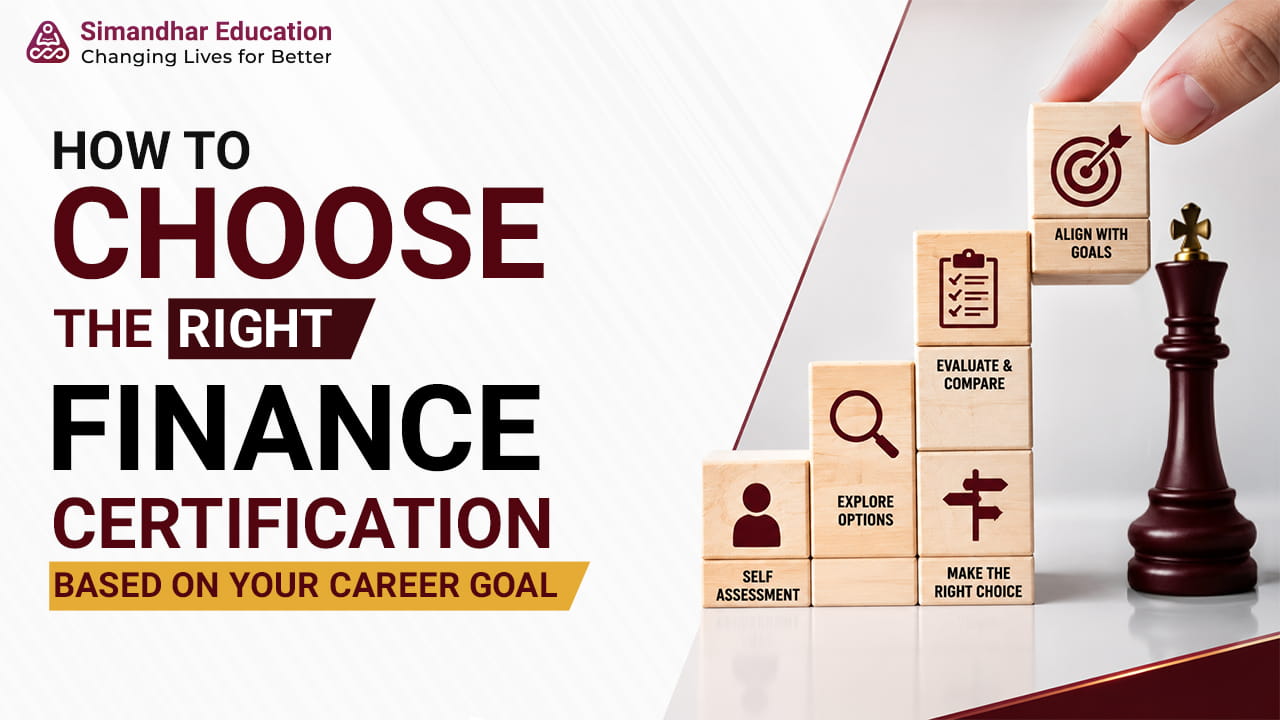
Table of Contents
Every year, thousands of commerce students and finance professionals begin researching certifications with the same question: which one is the best? But that question, as common as it is, misses the point entirely.
There is no single best finance certification. There is only the right certification for a specific career goal. CPA, CMA, ACCA, EA, CIA, and other qualifications each have a different purpose, a different skill focus, and a different kind of employer waiting on the other side.
Choosing based on peer pressure, internet rankings, or what a relative recommends is one of the most common mistakes students make. It can lead to months or years spent preparing for something that does not align with the kind of work they actually want to do.
This guide is designed to help students and working professionals approach the decision differently. The starting point is not the certification. The starting point is the career goal.
Why Choosing the Right Finance Certification Matters
Finance careers have become increasingly specialised. A professional who wants to build a career in internal audit needs a different skill set than someone targeting FP&A or international taxation. Employers in Big 4 firms, MNCs, GCCs, and consulting firms are not just looking for certified candidates. They are looking for candidates whose certification aligns with the role they are hiring for.
Choosing the right certification also affects how quickly a student can build momentum. A qualification that connects directly to their target role helps them develop relevant knowledge, speak the language of hiring managers, and demonstrate job readiness from the start.
On the other hand, choosing a certification without a career goal in mind often results in students completing rigorous exams without a clear path forward. That is a costly outcome in both time and money.
How to Identify Your Finance Career Goal
Before comparing certifications, it helps to answer a few honest questions:
- Is the goal to work in accounting and reporting, or in planning and analysis?
- Is the preference for working with global clients, or in a domestic finance environment?
- Does the interest lean toward taxation, audit, compliance, or business finance?
- Is the goal to work in public accounting, corporate finance, or consulting?
- Is there an interest in eventually working abroad or supporting international clients from India?
The answers to these questions narrow the field considerably. Most students find that once they articulate a direction, one or two certifications stand out clearly.
Quick Reference: Which Certification Fits Which Career?
Different certifications are designed for different career outcomes. Understanding the alignment between certification and career path is often the fastest way to make a confident decision.
CPA (Certified Public Accountant)
Best for: US accounting, financial reporting, audit, Big 4 firms, MNCs, GCCs, and global finance roles.
The CPA is the gold standard for professionals who want to build careers in US GAAP-based accounting and audit. It is widely recognised by Big 4 firms and multinational companies for roles that involve financial reporting, assurance, and compliance.
For Indian professionals targeting global finance roles or working in organisations that report under US accounting standards, CPA is a strong and well-regarded qualification.
CMA (Certified Management Accountant)
Best for: Management accounting, FP&A, budgeting, costing, business finance, and strategic decision-making.
The CMA is designed for professionals who want to move beyond bookkeeping and into finance roles that influence business decisions. FP&A analysts, finance business partners, and management accountants are typical career destinations.
If the goal is to work in corporate finance, planning, or analysis rather than external audit or reporting, CMA is often the more suitable choice.
ACCA (Association of Chartered Certified Accountants)
Best for: International accounting, IFRS, audit, taxation, and global finance careers across 180+ countries.
ACCA is built around International Financial Reporting Standards and is recognised across Europe, the Middle East, Asia-Pacific, and beyond.
Students who want a qualification that travels with them across geographies and sectors often find ACCA a strong fit. It covers a broad range of competencies including audit, taxation, financial management, and strategic leadership.
EA (Enrolled Agent)
Best for: US taxation, IRS representation, tax filing, tax advisory, and careers in tax outsourcing firms.
The EA is a US federal credential issued by the IRS. It specifically authorises professionals to represent taxpayers before the IRS and handle US tax matters.
For students and professionals who want to focus on US taxation rather than accounting more broadly, EA is a targeted and recognised qualification. It is particularly useful for those working in or targeting KPO, outsourcing, and GCC roles that support US-based clients.
CIA (Certified Internal Auditor)
Best for: Internal audit, risk management, governance, compliance, and control-related roles in large organisations.
CIA is the globally recognised certification for internal audit professionals. It is awarded by the Institute of Internal Auditors (IIA) and is valued by large corporates, banks, insurance firms, and public sector organisations that maintain internal audit functions.
Students who are drawn to risk, governance, and control work, rather than external reporting or taxation, often find CIA a better long-term fit.
Practical US Taxation and CAAP
Best for: Professionals seeking hands-on US tax skills or AI-ready finance competencies for future-focused roles.
Practical US Taxation is designed for students and professionals who want real-world tax preparation skills without pursuing a full certification path. It covers individual and business tax returns, tax software, and compliance workflows used by KPOs and outsourcing firms.
CAAP and AI-related finance courses are suited for professionals who want to develop skills at the intersection of finance and artificial intelligence. As organisations increasingly embed AI tools into finance workflows, candidates who understand both domains are becoming more relevant to forward-thinking employers.
Common Mistakes Students Make While Choosing a Finance Certification
Several patterns come up repeatedly when students make the wrong choice:
- Following the crowd: Choosing a certification because it is popular, not because it fits a personal career goal.
- Prioritising difficulty over relevance: Assuming a harder exam means a better outcome. Relevance to the target role matters more.
- Ignoring industry context: Not researching which certifications are actually in demand at the companies they want to work for.
- Choosing too early without exploration: Committing to a certification before understanding what the day-to-day work in that career actually looks like.
- Treating all certifications as interchangeable: Assuming CPA, CMA, ACCA, and CIA all lead to the same kind of roles. They do not.
What Employers Are Actually Looking For
Employers across Big 4 firms, MNCs, GCCs, and consulting firms are not simply screening for certifications. They are screening for alignment.
A candidate applying for an FP&A role with a CIA certification, or applying for an internal audit position with a CMA, creates a mismatch that employers notice quickly.
Beyond certification, employers want evidence of practical skills. Job-ready candidates who can demonstrate knowledge relevant to the role from day one are consistently preferred over those with theoretical preparation only.
This is why practical training, whether through structured courses or hands-on modules, has become an increasingly important part of career preparation.
How Simandhar Education Helps Students Choose the Right Path
One of the most consistent challenges students face is not a lack of information. There is plenty of information available. The challenge is making sense of it in the context of a personal career goal.
Simandhar Education works with students at exactly this stage. As an ed-tech company offering CPA, CMA, ACCA, EA, CIA, Practical US Taxation, CAAP, and other finance and accounting courses, Simandhar helps students compare certifications, understand what each qualification leads to, and identify which path makes the most sense for their background and goals.
Students benefit from guidance from faculty who have worked across international finance and accounting environments, structured learning programmes that cover both exam preparation and practical application, and career support to help connect certification with employment.
The goal is not just to help students pass exams. It is to help them build a career direction they are confident about.
Students who are unsure where to start can reach out to Simandhar to discuss their background, interests, and goals before committing to any course.
Conclusion: Start With the Goal, Not the Certification
The right finance certification based on career goal is not the one a classmate chose, or the one that sounds most impressive. It is the one that connects most directly to the kind of work, the kind of employer, and the kind of career a student is genuinely working toward.
CPA, CMA, ACCA, EA, CIA, and other qualifications each open a specific set of doors. The key is knowing which doors to aim for.
Students who are still working through that question are encouraged to take time with it, seek honest guidance, and treat the certification decision as the career decision it actually is. Getting it right from the start makes everything that follows more purposeful.
Frequently Asked Questions (FAQs)
1. Which finance certification is best for a student who wants to work in FP&A?
CMA is generally the most aligned certification for FP&A roles. It focuses on management accounting, budgeting, costing, and business decision-making, which are the core skills required in planning and analysis functions.
2. Is CPA better than ACCA?
CPA and ACCA serve different purposes. CPA is focused on US GAAP-based accounting and is most relevant for Big 4 firms and MNCs working within the US accounting framework. ACCA is built around IFRS and is recognised across more than 180 countries. The right choice depends on geography, target employer, and career direction, not on which is better in absolute terms.
3. Can a commerce graduate pursue all of these certifications?
Yes, in most cases. CPA, CMA, ACCA, EA, CIA, and Practical US Taxation are all accessible to commerce graduates, though eligibility requirements vary. Students should verify specific requirements for each certification before beginning their preparation.
4. What if a student is interested in both taxation and accounting?
Students with dual interests can consider qualifications that cover both areas, such as ACCA, which includes taxation, financial reporting, and audit. Alternatively, combining a primary certification like CPA with a Practical US Taxation course can build both accounting and tax skills in a structured way.
5. How does Simandhar Education help students decide between certifications?
Simandhar Education provides guidance sessions where students can discuss their background, career goals, and concerns before choosing a course. The aim is to help each student understand which certification is most relevant to what they want to achieve, rather than recommending a course that may not fit their direction.

Renuka is an MBA (Finance) graduate and content writer specializing in professional courses and career-focused content. She creates clear, easy-to-understand, and SEO-friendly blogs that simplify complex topics and help students and professionals make informed career decisions.