
Modi’s Diwali Gift: Two-Slab GST for a Stronger Indian Economy | Simandhar Education
Discover how Prime Minister Modi’s Diwali gift of a two-slab GST structure aims to simplify taxation, boost business confidence, and strengthen India’s economy. Read insights from Simandhar Education.
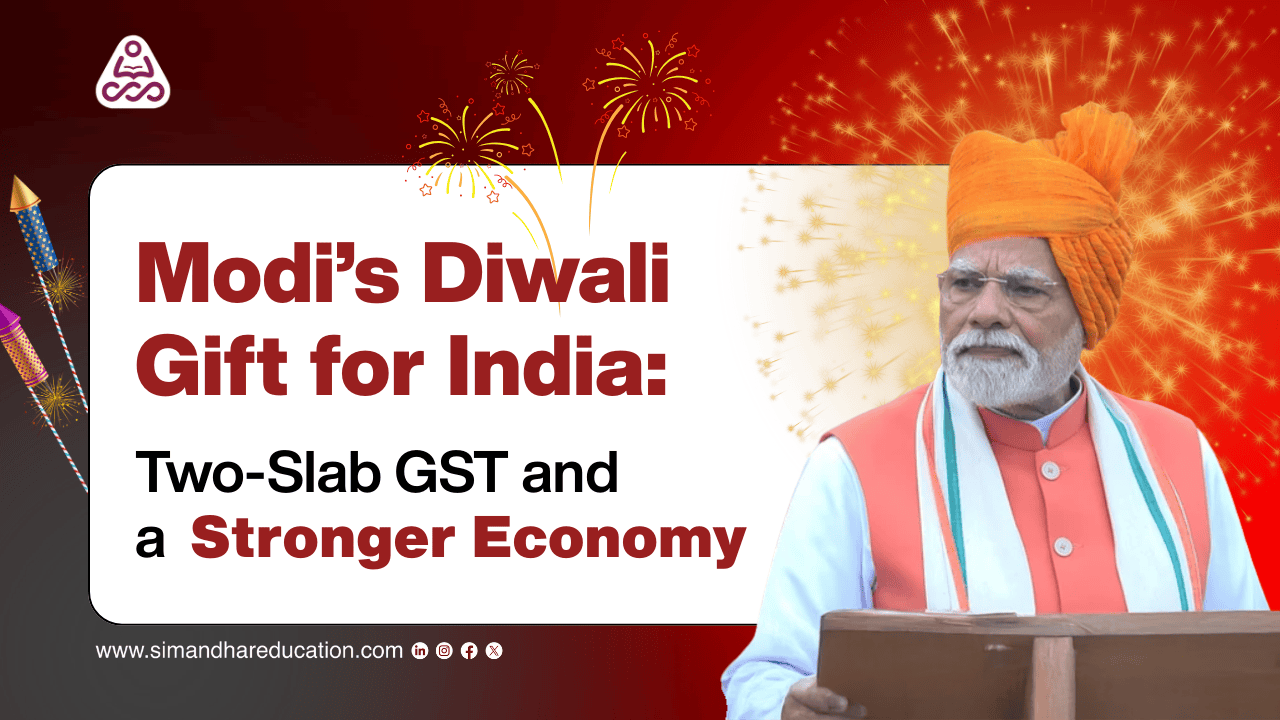
On August 15, 2025, Prime Minister Narendra Modi, in his Independence Day speech at the Red Fort, announced one of the most sweeping reforms in India’s indirect tax system since the introduction of the Goods and Services Tax (GST) in 2017. Described as a “Diwali gift to the people of India”, this reform is expected to be implemented in October 2025, just ahead of the festive season.
The reform, focused on simplification and rationalisation, aims to reduce the number of tax slabs, cut rates on everyday essentials, and introduce technology-driven compliance for businesses. For consumers, this means lower household expenses. For businesses, especially MSMEs and startups, it means reduced compliance burdens. For the economy, it promises a stimulus effect, encouraging consumption and growth.
At Simandhar Education, we see this as not just a financial development but also a learning moment for accounting, taxation, and finance professionals who must understand how policy shifts influence markets and governance.
Key Changes in the GST System
From Five Slabs to Two Slabs
Currently, GST is divided into 5%, 12%, 18%, and 28%, with a special rate for precious metals. This fragmented system often confuses businesses and creates frequent classification disputes.
The government proposes to consolidate this into:
- Merit Slab: For essential goods and services.
- Standard Slab: For general consumption.
- Special Rates: Only for limited luxury or sin goods.
This streamlined structure will simplify invoicing, reduce ambiguity, and bring India closer to global best practices in indirect taxation.
Major Rate Cut on Essentials
Perhaps the most consumer-friendly announcement is the shift of nearly 99% of goods currently taxed at 12% to the 5% category.
This covers items like:
- Packaged foods (biscuits, snacks, cereals)
- Apparel and footwear
- Hotel stays and hospitality services
- Travel-related services
For the common household, this translates into direct savings on everyday expenses.
Technological Ease of Doing Business
The Finance Ministry highlighted next-generation GST compliance tools:
- Pre-filled returns → reducing manual errors and disputes.
- Faster refunds → especially for exporters and small traders.
- AI-driven monitoring → reducing classification disputes and mismatches.
- Automated registration → speeding up business onboarding under GST.
Such reforms align with the government’s “Ease of Living” and “Ease of Doing Business” agenda.
Why This Reform is Significant
For Consumers
- Reduction of 12% to 5% rates will lower prices of essentials.
- Increased affordability during festive shopping (apparel, food, travel).
- Greater purchasing power, directly benefiting the middle class and students.
For Businesses
- Simpler compliance with fewer slabs.
- Reduced disputes due to clear categorisation.
- Cash flow relief via faster refunds.
- Benefits to MSMEs who often struggle with GST filings.
For the Economy
- Short-term ₹500 billion revenue loss (~0.15% of GDP).
- Expected 0.6–0.7% GDP boost via higher consumer spending.
- Stronger festive sales cycle, amplifying consumption-led growth.
- Builds investor confidence by showing India’s willingness to rationalise taxation.
The Government’s Larger Vision
According to the Finance Ministry, this reform stands on three pillars:
- Structural Reform
- Transition towards a simple, two-slab GST.
- Addressing inverted duty structures that affect industries like textiles and electronics.
- Rate Rationalisation
- Making taxation equitable for the common man, middle class, women, and farmers.
- Reducing tax rates on aspirational goods like clothing and travel.
- Ease of Living and Doing Business
- Leveraging technology for compliance automation.
- Enhancing cooperative federalism by building consensus with states.
This vision signals that GST reforms are no longer just about revenue collection but about citizen welfare and business efficiency.
Simandhar Education’s Perspective
For students pursuing CPA, CMA, ACCA, EA, and GST-related certifications, this reform is a real-world case study in taxation. It demonstrates how policy changes are:
- Designed with an economic stimulus motive.
- Aligned with global practices of fewer, broader tax categories.
- An example of how public finance balances revenue loss with economic gain.
At Simandhar Education, we encourage learners to go beyond textbooks. Understanding GST reforms is crucial because tomorrow’s accountants, tax experts, and financial leaders will be expected to:
- Interpret these changes for clients and businesses.
- Assess their impact on compliance and financial reporting.
- Connect India’s taxation reforms with international frameworks.
Conclusion
Prime Minister Modi’s “Diwali gift” GST reform is not just about lowering taxes - it’s a strategic push to simplify India’s tax system, encourage consumption, and ease the burden on small businesses.
For professionals and students alike, this is a reminder that taxation is not static - it evolves with economic priorities, political will, and public welfare needs.
At Simandhar Education, we remain committed to equipping our learners with the skills and insights to navigate such reforms, ensuring they are not only exam-ready but also industry-ready.
Frequently Asked Questions (FAQs)
Q1: Will GST really have
only two slabs?
Yes. The system will move towards two primary slabs, plus special rates for
luxury or demerit goods.
Q2: Which products will
see reduced GST?
Packaged food items, clothing, hospitality services, and other daily-use
consumer goods currently at 12% will shift to 5%.
Q3: Will fuel and alcohol
come under GST?
No. These remain outside GST and are governed by state taxes.
Q4: How will businesses benefit?
- Simpler invoicing.
- Reduced classification disputes.
- Faster refunds for exporters.
- Less compliance burden, especially for SMEs and startups.
Q5: When will this take
effect?
If approved by the GST Council after reviewing the Group of Ministers (GoM)
report, the new system will roll out in October 2025, ahead of Diwali.
Planning to take CPA? Explore our CPA course